
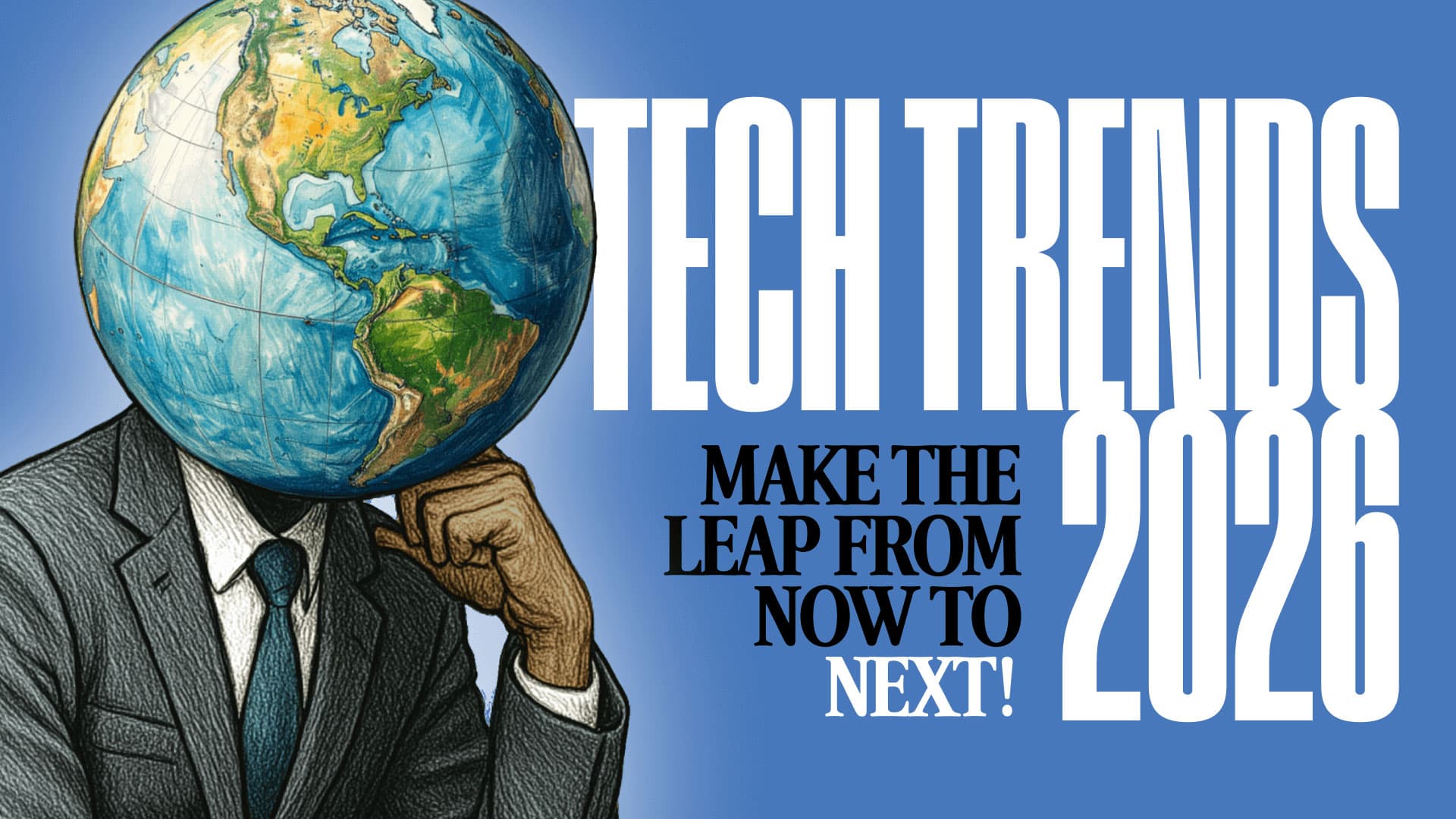
Tech Trends 2026
Make the leap from now to next!
Disruption deepens. Opportunity widens.
The world is hurtling toward an era of autonomous super-intelligence, against a backdrop of global volatility and AI-driven uncertainty. As organizations stand at the threshold of this emerging future, IT can help navigate the space in between – connecting tomorrow’s next steps to what’s coming further down the road. Resilience and opportunity will be the watchwords as organizations navigate disruption and position for growth.
Tech Trends 2026 helps organizations cross this liminal space by highlighting eight trends that will define the journey. Drawing on insights from our Future of IT Survey 2026, the report outlines how IT leaders can help their organizations leap from now to next, preparing for a rapidly changing world shaped by three major themes of transformation.
Eight tech trends to watch in 2026.
In this report, we explore eight trends that reveal the path for organizations to adapt to geopolitical shifts, adopt human-centric AI, and elevate IT’s role as an exponential enabler of value creation.
From global market to multi-polar uncertainty
Trend #1
Resilient Supply Chain Sourcing – Low-friction global sourcing shifts to an adaptable, diversified, and reliable supply chain for materials and technology.
Trend #2
Integrated Organizational Resilience – IT risk management moves to an integrated enterprise approach that proactively responds to risk.
From digital tools to guided intelligent autonomy
Trend #3
Multi-Agent Orchestration – Individual task-based agents evolve to coordinated ecosystems of agents in pursuit of a shared goal.
Trend #4
Smart Sensing Networks – IoT becomes more sophisticated with the convergence of advanced sensors and edge AI, enabling real-time autonomy.
Trend #5
AI as Adversary and Ally– As AI escalates the cyber arms race between criminals and organizations, augmenting both offense and defense, organizations must keep the existential threat of AI in their sights.
From back-office operator to exponential IT
Trend #6
Federated Data Governance – Data issues are resolved with a domain-based decentralized ownership architecture that can be automated.
Trend #7
Purpose-Built Platforms – Modern infrastructure is explicitly tailored for specific goals, rather than relying on commodity solutions.
Trend #8
Service as Software – Instead of paying for access to cloud-delivered software, enterprises pay for software that delivers outcomes through AI automation and integration.
Frequently Asked Questions
What is Info-Tech Research Group's Tech Trends 2026 report?
Tech Trends 2026 is Info-Tech Research Group's annual technology trends report that helps organizations navigate the transition from now to next in an era of autonomous super-intelligence and global volatility. Drawing on insights from Info-Tech's Future of IT Survey 2026 (n=738), the report outlines eight trends organized around three major themes: deglobalization uncertainty, guided intelligent autonomy, and exponential IT. Info-Tech Research Group positions these trends to help IT leaders connect tomorrow's next steps to what's coming further down the road, with resilience and opportunity as the watchwords for navigating disruption and positioning for growth.
What are the three major themes in Info-Tech's Tech Trends 2026?
Info-Tech Research Group's Tech Trends 2026 report identifies three major transformation themes. The first theme, "From global market to multi-polar uncertainty," examines how geopolitical shifts have disrupted supply chains and risk management approaches. The second theme, "From digital tools to guided intelligent autonomy," explores how AI is evolving from an emerging technology to a transformative technology with agentic capabilities. The third theme, "From back-office operator to exponential IT," examines IT's reshaping role as an integrated enabler of innovative capabilities that orchestrates purpose-crafted platforms aligned to organizational strategy.
What are the eight tech trends Info-Tech identified for 2026?
Info-Tech Research Group identified eight tech trends for 2026 organized into three thematic areas. Under deglobalization uncertainty: Resilient Supply Chain Sourcing and Integrated Organizational Resilience. Under guided intelligent autonomy: Multi-Agent Orchestration, Smart Sensing Networks, and AI as Adversary and Ally. Under exponential IT: Federated Data Governance, Purpose-Built Platforms, and Service as Software. These trends reveal the path for organizations to adapt to geopolitical shifts, adopt human-centric AI, and elevate IT's role as an exponential enabler of value creation.
What is the World Uncertainty Index and what does it show for 2025?
According to Info-Tech Research Group's Tech Trends 2026 report, the World Uncertainty Index (WUI) tracks the percent of the word "uncertain" in Economist Intelligence Unit country reports since 2008. Since the start of 2025, the WUI has climbed 481% to surpass 84,000—higher than during the COVID-19 pandemic peak of 57,000 and far above the July 2008 low of 9,000. Info-Tech Research Group identifies tariffs as the singular driver of this unprecedented uncertainty, with a new US economic policy regime transforming long-held free trade corridors into fee-laden channels.
What is Resilient Supply Chain Sourcing according to Info-Tech?
Resilient Supply Chain Sourcing is Info-Tech Research Group's first trend for 2026, describing the shift from low-friction global sourcing to an adaptable, diversified, and reliable supply chain for materials and technology. Info-Tech identifies new risks from geopolitical shifts and increasingly powerful large corporations as drivers for organizations to move away from price sensitivity toward resilience. Where availability and low costs were previously dominant considerations for physical and digital supply chains, Info-Tech's research shows organizations now consider a broader geopolitical picture and the ramifications of vendor entrenchment.
How might tariffs impact IT hardware costs according to Info-Tech's research?
According to Info-Tech Research Group's Tech Trends 2026 report, US-introduced tariff policies could increase hardware costs between 9% and 45% if they remain in place long term, citing IDC 2025 research. Info-Tech notes that manufacturers pass on the cost of tariffs to customers, directly impacting IT budgets. The uncertainty of what tariffs are in place and whether they will remain long term also creates unpredictability around procurement quotes. With the global supply of semiconductors dependent on Taiwan's production, Info-Tech Research Group warns that avoiding cost increases from tariffs is unlikely.
What is Integrated Organizational Resilience as a tech trend?
Integrated Organizational Resilience is Info-Tech Research Group's second trend for 2026, describing how IT is moving beyond project-based digital change to become an orchestrator of enterprise resilience. Info-Tech's framework emphasizes embedding risk management into every capability, from APIs and data platforms to AI agents and security controls. By centralizing governance, automating compliance checks, and integrating monitoring and incident response, Info-Tech Research Group shows how IT elevates its role from execution partner to full partner in managing enterprise risk, shifting from reactive approaches to proactive and real-time enterprise-wide resilience.
How do innovators approach risk management differently according to Info-Tech's survey?
According to Info-Tech Research Group's Future of IT Survey 2026 (n=59 innovators), innovator organizations are almost 2.5 times more likely to structure risk management in a fully integrated way than average departments (79% vs. 32%). Info-Tech's data shows innovators are 16 percentage points more likely to say it's very important to improve organizational risk management capabilities (71% vs. 55%). Additionally, 38% of innovators have a chief risk and resilience officer accountable for governance, risk, and compliance, and they prioritize security, privacy, and compliance more than average when negotiating new vendor contracts.
What is Multi-Agent Orchestration in AI?
Multi-Agent Orchestration is Info-Tech Research Group's third trend for 2026, describing how multiple AI agents collaborate to solve complex, multistep problems and automate entire processes for an enterprise. Info-Tech explains that while individual AI agents can perceive their digital environment and use contextual information to make decisions and take actions toward an assigned goal, multi-agent orchestration involves a supervisor AI agent managing agents along a process to enforce enterprise governance. Info-Tech Research Group positions this as the solution to enterprises looking for ROI from AI after limitations emerged with LLM-based proof-of-concepts.
How has AI investment changed according to Info-Tech's Technology Investment Index 2026?
According to Info-Tech Research Group's Technology Investment Index 2026 (n=525), AI or Machine Learning has graduated from the emerging quadrant to the transformative quadrant, with 64% current investment and 80% growth rate. Info-Tech's data shows generative AI is the fastest growing area of AI investment and is about equal with traditional AI for current levels of investment. Agentic AI, while newer, shows 12% current investment but 65% growth rate—starting with much higher adoption than generative AI did three years ago. Info-Tech Research Group notes that overall AI now ranks close to cloud computing (80% investment, 83% growth) and cybersecurity solutions (85% investment, 77% growth).
What opportunities does Info-Tech identify for multi-agent AI adoption?
Info-Tech Research Group's Tech Trends 2026 identifies four key opportunities for multi-agent AI adoption. First, accelerating software development across the entire lifecycle including development, testing, and performance monitoring. Second, improving customer support with 24/7 availability and personalized interaction that can turn support inquiries into leads. Third, driving new revenue through automated lead outreach, optimized pricing, and demand prediction, with Info-Tech citing that sales teams adopting AI agents show improvement in hitting revenue targets. Fourth, improving IT service desks through proactive resolution of repeated issues and enhanced triage, prioritization, and automated resolution.
What risks does Info-Tech identify with agentic AI deployment?
Info-Tech Research Group identifies three major risks with agentic AI deployment in Tech Trends 2026. First, new cyber vulnerabilities where threat actors could gain unauthorized access to AI agents or manipulate external resources to trick agents into downloading malware or exposing sensitive information. Second, unintended access where agents may overstep intended permissions, particularly concerning in highly regulated industries. Third, cultural rejection where employees may perceive AI agents as threats to their jobs or customers may reject companies using AI for shortcuts or replacing people in creative work. Info-Tech Principal Research Director Martin Bufi emphasizes that organizations must put guardrails on what agents can access, just as they do with humans.
How do innovators invest in agentic AI compared to average IT departments?
According to Info-Tech Research Group's Future of IT Survey 2026 (n=137 innovators, n=307 average), innovators are about twice as likely as average IT departments to be bullish on agentic AI investment, with 81% currently using agentic AI and planning to invest further. Info-Tech's data shows innovators are also twice as likely to support growth initiatives with AI, with 27% pursuing growth initiatives with AI agents before 2027. In contrast, 41% of average IT departments are looking at 2026 or later to invest in agentic AI, while 13% have no plans to adopt yet. Info-Tech Research Group notes that innovators are looking to "raise the ceiling" with agentic AI by investing to drive growth.
What is sovereign AI and why does it matter?
According to Info-Tech Research Group's Tech Trends 2026, sovereign AI extends the concept of data sovereignty to include the knowledge available in large language models, the bias they show, and the cultural context of their outputs. Info-Tech explains that while the cloud computing era introduced concerns about data location and transit, AI now raises sovereign considerations around local AI models as governments invest in domestic capabilities for economic value. Info-Tech's survey data (n=125 innovators) shows that 59% of innovators exclusively use sovereign AI models versus 31% of average departments, with governments and telcos worldwide building sovereign AI infrastructure. Info-Tech Research Group notes this creates tension between global reach through algorithms and localized control.
What strategic actions does Info-Tech recommend for resilient supply chains now?
Info-Tech Research Group recommends immediate actions for building resilient supply chains in Tech Trends 2026. Organizations should diversify sourcing locations and vendors where possible, exploring alternatives to China in Southeast Asia less impacted by tariffs. Info-Tech advises renegotiating with vendors to structure shared responsibility for tariffs, strategically timing purchases to avoid tariff increases, and buying in bulk to decrease cost per unit. Organizations should consider tiering device procurement to right-size devices for users and explore device-as-a-service options for price certainty. When considering new vendors, Info-Tech Research Group emphasizes increasing cybersecurity scrutiny and performing due diligence to evaluate risks.
What is Info-Tech's Enterprise Risk Management progression framework?
Info-Tech Research Group's Tech Trends 2026 outlines a four-stage Enterprise Risk Management progression framework. Stage one is "Ad Hoc & Reactive" with siloed risk management, lack of centralized governance, and manual processes. Stage two is "Domain-Specific & Fragmented" with formal risk management within functions but weak system-wide and third-party risk areas. Stage three is "Integrated & Centralized" with coordinated risk management across domains, shared platforms, and board-level governance. Stage four is "Intelligent Resilience" where risk management becomes a strategic enabler with scenario-based planning, integrated AI for predictive insights, and fully adaptable risk governance. Info-Tech emphasizes that intelligent resilience requires radical honesty and psychological safety.
What is the Model Context Protocol and why is it important for AI agents?
According to Info-Tech Research Group's Tech Trends 2026, the Model Context Protocol (MCP) is Anthropic's protocol that allows AI agents to connect with enterprise applications and data. Info-Tech identifies MCP alongside Google's Agent2Agent (A2A) protocol as positive signs toward a more open AI ecosystem, with A2A allowing agents to talk to each other. Info-Tech notes there are also open-source frameworks available from Microsoft, Amazon Web Services, and IBM to design multi-agent systems. Info-Tech Research Group explains that if AI agents can't talk to each other, it will bottleneck productivity, and these interoperability standards signal that enterprises may largely avoid fragmentation where agents from one vendor won't communicate with another.
How should organizations approach AI agent deployment according to Info-Tech's recommendations?
Info-Tech Research Group recommends a phased approach to AI agent deployment in Tech Trends 2026. Now: Deploy AI agents for well-documented and repetitive tasks like document classification and data extraction, use API-driven integrations where they exist, keep humans in the loop, and carefully monitor output. Next: Explore multi-agent collaboration for complex processes, adapt agent-to-agent protocols for communication, and develop internal evaluation benchmarks. Later: Evolve toward role-based agent supervisors that oversee task types, expand to external ecosystem collaboration, and enable comprehensive auditing with chain-of-thought level detail. Info-Tech Research Group emphasizes that agents should be reflective and evaluate their own work to improve.
What case study does Info-Tech provide for multi-agent AI success?
Info-Tech Research Group's Tech Trends 2026 highlights Direct Mortgage Corp. as a case study for multi-agent AI success. The US mortgage provider adopted Multimodal's AgentFlow platform and deployed agents to automate the workflow of dozens of document types when they lacked enough loan officers to process rising mortgage applications. Direct Mortgage's internal documents provided training context for accurate application handling. Info-Tech reports the solution cut operational expenses per document by 80% and loan processing time in half, with borrowers now receiving loan decisions within 24 hours. This demonstrates how Info-Tech Research Group's framework for AI agent adoption can deliver measurable ROI.
What is the challenge of AI observability and explainability?
According to Info-Tech Research Group's Tech Trends 2026, generative AI is effective at delivering answers but cannot explain how it arrived at those answers, making it difficult or impossible to trace AI reasoning accurately. Info-Tech notes that while recent updates to reasoning models aimed to show steps taken to reach conclusions, researchers find those "chains of thought" are generated after the answer is derived to satisfy users. With AI agents acting on generative AI output, Info-Tech Research Group warns of risks to consistency in performance and regulatory requirements for auditability. This problem is being addressed through agent lifecycle management approaches that provide checks at different points in operation, with evaluation metrics including faithfulness, context relevance, and answer similarity.
What does Info-Tech mean by compliance as code?
According to Info-Tech Research Group's Tech Trends 2026, compliance as code refers to embedding regulatory requirements and custom policies directly into software code to benefit from continuous monitoring and automated enforcement. Info-Tech explains that as enterprises digitalize more processes, modern API integration platforms can discover and score risks in real time, often automating mitigation responses. Info-Tech Research Group emphasizes that these platforms make different risk vectors such as security, operations, and compliance more visible and actionable for human oversight. However, Info-Tech warns against overly rigid governance that can deter organizational adaptability, recommending reasonable boundaries to avoid misalignment.
What is Info-Tech's view on AI automation versus augmentation in risk management?
Info-Tech Research Group's Tech Trends 2026 strongly advocates for AI augmentation over automation in risk management. Info-Tech emphasizes that while new capabilities in governance, risk, and compliance platforms can tap into generative AI to augment human judgment, there will be temptation to pursue agentic automation of enterprise-risk-oriented tasks with automated policy enforcement. Info-Tech Research Group warns that risk requires human judgment and ethical consideration to build true organizational resilience, and organizations that try to automate too far will suffer from misalignment and areas of weakness. Info-Tech Advisory Fellow Valence Howden states that AI "doesn't make good enough decisions to be used in a governing space" because it lacks sufficient context and belief injection of responsibility.
How does Info-Tech recommend organizations build foresight capability for risk management?
Info-Tech Research Group's Tech Trends 2026 recommends that organizations develop foresight capability by moving beyond static risk registers, audits, and reviews of past events. Info-Tech advises starting a foresight practice that considers risks in different future scenarios, with generative AI assisting in brainstorming potential futures. Organizations should practice scenario development using simulations and use AI-enabled monitoring to detect weak signals today that could become seismic shifts. Info-Tech Research Group emphasizes running more and better simulations about possible future outcomes, with improved cloud infrastructure enabling organizations to evaluate multitudes of factors for better decision-making. Later, Info-Tech recommends institutionalizing foresight practices such as scenario planning and red teaming.
What does Info-Tech say about IT maturity and confidence in creating exponential value?
According to Info-Tech Research Group's Tech Trends 2026, only about one-quarter of IT departments identify themselves as innovators, but 46% of that group say they are confident IT can create exponential value from emerging technology. Info-Tech's survey data shows that a bit more than half of IT departments describe themselves as average—either as trusted operators or business partners—and of that group, 35% are confident they can deliver exponential value. Info-Tech Research Group emphasizes that an IT department's ability to deliver value from emerging technologies is dependent on its maturity level, highlighting the importance of elevating IT's role to harness new capabilities against exponential uncertainty.
What methodology does Info-Tech use for the Tech Trends 2026 report?
Info-Tech Research Group's Tech Trends 2026 report is based on the Future of IT 2026 survey conducted in May and June 2025, which received 738 responses from IT decision-makers. Info-Tech also conducted expert interviews between May and July 2025 to provide additional context and case study examples. The report was developed through discussions with Info-Tech research advisors, practice leads, executives, workshop facilitators, and executive counselors. Survey respondents were primarily from the United States (52.8%), Canada (29.9%), and Australia (7.8%), with organization sizes ranging from 50 to over 5,000 employees. Info-Tech Research Group specifies sample sizes for each data point included in the report, ensuring transparency in research methodology.
What will the world look like in 2030? Answering such a question seems impossible as most wonder what tomorrow looks like. But sometimes it's useful to consider what comes later before we guess what comes next.

The world in 2030 looks very different from the world in 2026.
What will the world look like in 2030? Answering such a question seems impossible as most wonder what tomorrow looks like. But sometimes it's useful to consider what comes later before we guess what comes next.
The world has never been more uncertain about the future. It's measured: the World Uncertainty Index (WUI) has tracked the percent of the word “uncertain” in Economist Intelligence Unit country reports since 2008. Since the start of 2025, it's climbed 481% to surpass 84,000. It's higher than it was during its previous peak during the COVID-19 pandemic (57,000) and a far cry from the low of 9,000 in July 2008.
There's little doubt about the singular driver of that uncertainty: tariffs. A new US economic policy regime has quickly transformed long-held free trade corridors into fee-laden channels. Beyond tariffs, there is increasing conflict around the world and a mounting rift between the east and the west. After decades of crafting supply chains in a relatively stable global order, organizations are now contemplating deglobalization and financial market volatility.
Our “deglobalization uncertainty” theme will examine how these recent geopolitical shifts have sent shockwaves through organizations, disrupting their supply chains and calling into question the approach organizations take to manage risk.
At the same time, emerging technology is disrupting organizations faster than ever. AI is leading the way. Last year, Info-Tech predicted that AI would make the jump from an emerging technology to a transformative technology on our index. This indicates that most organizations are already invested in the technology and that investment continues to grow. Our Future of IT 2026 survey data confirms the prediction was accurate, with our current investment index for AI or machine learning climbing from -3 to 64, with a growth rate of 80. Generative AI is the most popular variety of AI for current investments, with the newer agentic AI showing fast growth as an emerging technology.
Our “guided intelligent autonomy” theme will examine trends tracking the evolution of AI as it becomes entrenched in the enterprise tech stack and is given more agency to autonomize processes. We'll examine the opportunities to restructure business models and the risks that could foil the promise of autonomous and abundant intelligence.
To bolster their organizations against exponential uncertainty, IT must harness the new capabilities of emerging technology. But an IT department's ability to deliver on creating value from emerging technologies is dependent on its maturity level. Only about one-quarter of IT departments identify themselves as innovators, but out of that group, 46% say they are confident IT can create exponential value from emerging technology. A bit more than half of IT departments describe themselves as average either as trusted operators or as business partners and of that group, 35% are confident they can deliver exponential value.
Our “Exponential IT” theme will examine the reshaping of IT's role in the face of uncertainty and rapid technological transformation. It paints a picture of an IT function that's an integrated enabler of innovative capabilities, orchestrating platforms that are purpose-crafted to organizational strategy.
That vision might seem like a long journey from the uncertainty of now. But to get from now to next, you must consider what comes later.
Resilient Supply Chain Sourcing

Integrated Organizational Resilience

Multi-Agent Orchestration

Smart Sensing Networks

AI as Adversary and Ally

Federated Data Governance

Purpose-Built Platforms

Service as Software
Technology Investment Index
AI graduates to transformational technology
Last year we forecast the breakthrough of AI technology from our emerging quadrant into the transformative quadrant, and we were right. Overall, AI ranks close to cloud computing and cybersecurity solutions as a technology that most organizations have now invested in and continue to invest in.
We broke down the AI category this year to examine more details about investment trends. Generative AI is the fastest growing area of AI investment and is about equal with traditional AI for current levels of investment. Agentic AI, a newer variety, lags behind in terms of adoption compared to others. But if you compare where agentic AI is debuting on this index to generative AI just three years ago, it's starting off with a much higher rate of adoption and is positioned for rapid growth. Physical AI or AI that allows self-driving cars and autonomous robots to interact in the world is more nascent, starting in the niche quadrant.
Other notable shifts on the index:
- Quantum computing saw the largest year-over-year change in growth. It remains in the niche quadrant, but it shows a lot of momentum with both current investment and investment intent.
- Business process automation also showed significant growth, perhaps in part driven by AI's contribution to this field.
- Many more firms are investing in hardware to accelerate AI training or inference, with four in ten organizations saying they're invested already and another four in ten saying they intend to invest in the future.
...if you compare where agentic AI is debuting on this index to generative AI just three years ago, it's starting off with a much higher rate of adoption and is positioned for rapid growth
Technology Investment Index 2026 (n=525)
| Technologies | Current Investment | Growth Rate | |
|---|---|---|---|
| 01 | AI or Machine Learning | 64% | 80% |
| 02 | Business Process Automation (RPA/IPA) | 49% | 70% |
| 03 | Cybersecurity Solutions | 85% | 77% |
| 04 | Blockchain | -16% | -4% |
| 05 | Cloud Computing | 80% | 83% |
| 06 | Data Management Solutions | 71% | 76% |
| 07 | Integration Technologies (APIs) | 77% | 75% |
| 08 | No-Code / Low-Code Platforms | 45% | 57% |
| 09 | CI/CD Tools | 34% | 50% |
| 10 | Private Cellular (LTE or 5G) | 37% | 11% |
| 11 | On-Premises Servers / Compute | 72% | 0% |
| 12 | IoT | 40% | 41% |
| 13 | Robotics / Drones | 8% | 22% |
| 14 | Quantum Computing | -21% | -3% |
| 15 | Mixed Reality (AR/VR) | -7% | 12% |
| 16 | Hardware to Accelerate AI Training/Inference | -2% | 35% |
| 17 | Traditional AI | 67% | 63% |
| 18 | Generative AI | 69% | 78% |
| 19 | Agentic AI | 12% | 65% |
| 20 | Physical AI (self-driving cars, robots) | -40% | -7% |
| Source: Tech Trends Report 2026 | |||

Methodology
Info-Tech's Tech Trends 2026 report is based on the results of its Future of IT 2026 survey, conducted in May and June 2025. The online survey received 738 responses from IT decision-makers. Each data point included in the report will specify the sample size received for the specific question or respondent group. Expert interviews were also conducted between May and July 2025 and provide additional context to the trends as well as specific case study examples of how organizations are responding to them. View the expert contributors section to see a complete list of external contributors. In addition, the Future of IT survey and Tech Trends 2026 report were developed through discussions with many Info-Tech research advisors, practice leads, executives, workshop facilitators, and executive counselors. Further firmographic context on the Future of IT 2025 survey results provided here.
| In which country or region is your organization's primary headquarters? (n=690) | Count | % | |
|---|---|---|---|
| United States | 364 | 52.80% | |
| Canada | 206 | 29.90% | |
| Australia | 54 | 7.80% | |
| Africa | 13 | 1.90% | |
| Asia | 11 | 1.60% | |
| Source: Tech Trends Report 2026 | |||
| Please estimate the total head count of your entire organization. (n=690) | Count | % | |
|---|---|---|---|
| 251-1,000 | 256 | 37.10% | |
| 1,001-2,500 | 124 | 18.00% | |
| 50-250 | 112 | 16.20% | |
| 2,501-5000 | 91 | 13.20% | |
| More than 5,000 | 89 | 12.90% | |
| Source: Tech Trends Report 2026 | |||
| What best describes your current level of IT maturity? (n=525) | Count | % | |
|---|---|---|---|
| IT is a business/organization partner | 166 | 31.60% | |
| IT is a trusted operator | 150 | 28.60% | |
| IT is an innovator | 139 | 26.50% | |
| IT acts as firefighter | 64 | 12.20% | |
| IT is unstable | 6 | 1.10% | |
| Source: Tech Trends Report 2026 | |||
Throughout the report, we'll compare how innovators responded on the survey to an “Average” group. In this case, we'll consider a combination of the respondents in the “trusted operator” and “business/organization partner” categories to be “Average.”
What is your organization's primary industry? (n=692)
| Choice | Count | % |
|---|---|---|
| Government (State) | 83 | 12.0 |
| Financial Services | 67 | 9.7 |
| Professional & Technology Services | 66 | 9.5 |
| Government (Local/Municipal/County) | 59 | 8.5 |
| Manufacturing (Durable Goods) | 57 | 8.2 |
| Education (Higher Ed.) | 54 | 7.8 |
| Other | 45 | 6.5 |
| Education (K-12) | 42 | 6.1 |
| Insurance | 38 | 5.5 |
| Manufacturing (Non-Durable Goods) | 33 | 4.8 |
| Government (Federal) | 26 | 3.8 |
| Utilities | 24 | 3.5 |
| Healthcare Delivery | 21 | 3.0 |
| Government (Provincial) | 17 | 2.5 |
| Professional Associations & Non-Profits | 16 | 2.3 |
| Transportation & Logistics | 11 | 1.6 |
| Oil & Gas Operations | 10 | 1.5 |
| Retail | 8 | 1.2 |
| Casinos, Gambling & Lottery | 4 | 0.6 |
| Construction | 3 | 0.4 |
| Hotels, Resorts & Hospitality | 3 | 0.4 |
| Sports Entertainment | 3 | 0.4 |
| Healthcare Insurance | 2 | 0.3 |
| Source: Tech Trends Report 2026 | ||
Resilient Supply Chain Sourcing
New risks caused by geopolitical shifts and increasingly powerful large corporations are creating drivers for organizations to shift away from a globally sourced supply chain. Where sourcing was primarily motivated by price sensitivity before, there's now a shift toward resilience.
Enterprise resource and supply chains were put under strain during the pandemic, but 2025 added new and different strains to contend with.
Where availability and low costs were the dominant considerations for both the physical and digital supply chains previously, organizations are now considering a broader geopolitical picture and the ramifications of vendor entrenchment.
Pressures across multiple fronts are threatening to crack open the protective structure of existing supply chains:
Tariffs
US-introduced tariff policies could increase hardware costs between 9% and 45% if they're in place for the long term (IDC, 2025). Manufacturers pass on the cost of tariffs to customers and impact IT budgets. The uncertainty of what tariffs are in place and whether they will remain in place long term also creates unpredictability around quotes for procurement. With the global supply of semiconductors dependent on Taiwan's production, avoiding cost increases from tariffs is unlikely.
Geopolitical Tensions
Aside from tariffs, rising tensions between different regions is driving a bigger wedge in trade connections. Supply chains are becoming more reoriented around shared values and security interests. With ICT specifically, western countries are blocking Chinese-made manufacturers from participating in infrastructure projects. For example, the US Federal Communications Commission designated both Huawei and ZTE as national security threats due to close ties with the Chinese Communist Party (FCC, 2020). More recently, TikTok has been the subject of regulatory scrutiny in the US and Canada because of its Chinese ownership and the mobile app's collection of sensitive data (uOttawa, 2025).
Vendor Risks
Technology vendor contracts have tended toward a subscription model that allows enterprises to leverage their operating budgets instead of making capital investments, especially since the cloud computing era began. Negotiating with vendors on a price per user per month is the standard, but enterprises risk becoming locked into platforms and being prone to steep vendor price hikes. Further, enterprises have seen the risk of “supply chain attacks” on very large vendors that cater to millions of customers. Even internal errors can result in outages for clients with many negative downstream effects.

Disruption From Emerging Technology
Dependence on large vendors for technology platforms is creating risks for organizations prone to the cyberattacks and self-inflicted outages of their third-party partners. A recent example was a major cloud service outage with Google Cloud on June 12, 2025, that spiraled out to affect internet services including Cloudflare, Spotify, Twitch, Snapchat, and Discord (The Verge, 2025). AI-driven attacks are also becoming more commonplace and more difficult to detect, from constructing fake vendor emails to deepfake voicemails that sound like a company executive (Supply & Demand Chain Executive, 2025).
Increased Regulatory Complexity
There's more regulatory variation in different jurisdictions around the world, in particular around environmental, social, and governance (ESG) considerations. Manufacturers are being held accountable for their product's entire lifecycle in some regions. Other regions require detailed carbon emissions reporting, including “scope 3” emissions from their supply chain. A new wave of human rights due diligence laws in the EU and the US put pressure on companies to prove no forced labor is involved in their supply chains (Inspectorio, 2025).
To what degree organizations can bring their supply chains closer to home or alter vendor relationships is uncertain. But the need for supply chain management that's more holistic, proactive, and adaptive is clear.
Signals
Despite a year of upheaval in trade due to new US-introduced tariffs and other geopolitical turmoil, overall IT organizations are not more concerned about disruption from government-enacted regulatory changes. This suggests a disconnect with business executives, as 95% cite tariffs as a primary disruptor, leading to shifts in sourcing (Inspectorio, 2025).
In fact, on average, organizations rated that disruption factor as slightly lower (3.23) compared to last year's survey (3.35). Government regulations were considered less disruptive than AI or other emerging technologies (3.42) and cybersecurity incidents (3.27). But they are more disruptive than the talent shortage (3.17) or misinformation and disinformation (2.9) (n=525).
Here's how IT maturity shaped how organizations view disruption:
Innovators (n=125)
- Innovators have a heightened expectation of disruption across all factors compared to the average IT department.
- Innovators are more significantly concerned about misinformation and climate/environment/health than the average.
- Innovators are about twice as likely as the average to exclusively use sovereign AI models (59% vs. 31%). They are also more likely to use foreign AI as well (28% use foreign and sovereign AI compared to 17% of the average).
- When it comes to the biggest areas of risk with critical vendors, innovators are most concerned about unanticipated increases in licensing and renewal costs (68%) and vendor roadmap alignment (63%) than supply chain attacks (17%) or logistical disruption (20%).
Innovators have a heightened expectation of disruption across all factors compared to the average IT department.
Average (n=249)
- Rank cybersecurity incidents as relatively higher compared to other disruptive factors, placing it second after AI and emerging tech. (Innovators rank it fifth overall.)
- Rank government-enacted regulatory change above the talent shortage, while innovators reverse those rankings.
- One in six say they have no immediate plans for the adoption of sovereign AI models. No innovators describe their position in this way.
- When considering risk with critical vendors, average departments are also most concerned with unanticipated price increases (58%) but less concerned with strategic roadmaps (33%). They fret over compliance, security, and privacy concerns instead (50%) and less about vendor quality (n=112).

Opportunities
A Rationalized IT Environment
IT departments can increase organizational resilience by rearchitecting their solutions to be component-based and reusable. Getting away from fragmented solutions that solve different functional problems will simplify IT and reduce costs. IT will less often build its own solutions and instead seek to assemble reuseable components provided by fewer vendors that can offer end-to-end ecosystems. This will help IT organizations avoid accruing more technical debt. “Building is the easy part, they've found, but then it's the supportability, the maintenance, the updating from a security and resiliency standpoint that makes it really, really hard for these businesses to keep up as they've done some of that homegrown development,” says Stu Bradley, sr. vice president, risk, fraud and compliance solutions, SAS. With less time spent on managing technical debt, IT departments can focus on solutions that help differentiate their organizations, such as customizing AI with organizational data.
Thrive in Volatility
Organizations that can increase supply chain agility and integrate ESG considerations can position themselves as leaders, future-proofing supply chains for future upheavals while avoiding the negative effects of the current scenario. Consumers are increasingly demanding more transparency from organizations in terms of their ethical and environmentally friendly operations. IT can provide traceability tools that anchor brand credibility to provable data and help the organization stand out from the competition. By accepting less optimal near-term costs in their supply chains, organizations are setting up for longer-term sustainability (Inspectorio, 2025).
Avoid Tariff Uncertainty
Resilient supply chains can mitigate the price increases and uncertain nature of tariffs through a series of tactics:
- Strategically time purchases and contract renewals to avoid peak prices.
- Extend lifecycle of existing devices and avoid refreshing at high costs. Bulk purchase to get a better price per unit, hopefully at a time when market conditions favor the buyer.
- Shift sources to domestic or nearshore locations where possible to reduce tariff exposure and get better long-term price predictability (AIMMS, 2025).
With less time spent on managing technical debt, IT departments can focus on solutions that help differentiate their organizations.

Risks
Higher Spending
More than half of IT departments expect to increase spending between 1% and 10% in 2026, and almost one-quarter expect to increase spending by more than 10%, according to the Future of IT Survey 2025. It's a good thing, because higher costs are likely. Even firms that avoid tariffs by shifting sourcing locations in-market will likely face increased costs in the near term, as domestic suppliers are likely to have higher prices. Pivoting supply chain sources can also incur more logistics expenses and transitional pain.
Audit Fatigue
Organizations seeking to build supply chain resilience by shifting operations or sourcing to different regions may find the complexity of compliance more burdensome than they can keep up with. Commitments to ethical sourcing and environmental standards will require stringent traceability deployed through the supply chain that is above and beyond what most organizations are capable of today. It's no wonder one in five executives worry that “regulatory overhead” will divert resources from trying to improve their businesses (Inspectorio, 2025).
Competitive Disadvantage
With more barriers forming around different markets, organizations may find they are at a competitive disadvantage compared to companies on the other side of that barrier. Certain key goods aren't widely available from different markets, including semiconductors made in Taiwan or rare earth elements mined in China. At the same time, organizations may be diverting investment away from innovation and research and development to restructure their supply chains.
Case Study
The Semiconductor Industry Diversifies Its Manufacturing Base
Taiwan Semiconductor Manufacturing Company (TSMC) invested $165 billion into the US tech sector to strengthen domestic chip fabrication capacity, including three new fabrication plants, two advanced packaging facilities, and a major R&D team center (Atlantic Council, 2025).
Micron, a US-based semiconductor firm, is investing several billion dollars into a certified fabrication facility in India. Although the region isn't known for semiconductor manufacturing, labor costs are comparable to other options and there are less threats of tariffs (McKinsey, 2025).
Intel is doing both onshoring and nearshoring. It promised $100 billion plus into new US fabrication facilities and plans to invest $92 billion over the next ten years into the EU to help develop a full semiconductor value chain, including advanced fabs, assembly and testing facilities, and research and development labs (Intel, 2025).
Recharging Supply Line Diversity
Batteries Plus restructured its suppliers to shift from sourcing one-third of its inventory from China to just 4% between 2018 and 2025. Motivated by tariffs placed on China, CEO Scott Williams sought products from Vietnam, Malaysia, the US, and several other countries. By distributing suppliers around the world, Williams created more flexibility to shift between countries as new tariffs come into effect in the future. At the same time, the company increased automation in its warehouses and renegotiated with suppliers to mitigate the cost of tariffs (Business Insider, 2025).

Calling for Sovereign AI
Governments around the world are making efforts to foster homegrown AI models to protect economic and security sovereign interests. Domestic telcos are getting involved in providing the compute infrastructure and services toward the effort:
- In Canada, Bell Canada's Bell AI Fabric project commits to construct 500 MW of hydroelectric-powered (a renewable energy) AI compute capacity across six data centers. Telus is building two “Sovereign AI Factories” in BC and Quebec, featuring NVIDIA-powered supercomputers. It plans to provide GPU-as-a-service to enterprises through its Fuel iX Gen AI platform.
- In Europe, Orange plans to offer “sovereignty-as-a-service” and provide customers control over their data residency, ethical aspects of LLMs, and ecosystem partners. Deutsche Telekom offers GPU-as-a-service featuring NVIDIA H100 Tensor Core processors from its data centers in Germany, the Netherlands, and Switzerland. FastWeb+Vodafone offers its own local language model, FastwebMIIA, running on an NVIDIA SuperPOD Computer from its infrastructure in Italy.
- Telekom Indonesia is partnering with IBM to provide sovereign AI services based on watsonx (Taafe).
Critical Factors

Strategic Agility
Organizations will try to avoid creating supply chains that are over reliant on any one supplier or region to reduce exposure to tariffs, geopolitical risk, or predatory vendor practices. A more flexible approach will include diversifying inputs and may add complexity as well as higher logistics expenses. At the same time, they may not be able to replace the specialized capabilities of certain hubs. Organizations will be seeking to optimize their own distribution, balancing production times, and conduct location risk analysis when selecting new supplier hubs (AIMMS, 2025).
Sovereign AI
The cloud computing era introduced the concept of data sovereignty, with countries concerned about the location where sensitive data was hosted or even where it transited. Highly regulated industries like the public sector or financial services were more restricted in requirements to locate data domestically when using cloud-computing services from foreign providers. The EU extended the concept even further with GDPR, bringing the private information of individuals into consideration. Now, AI is extending sovereign considerations to the knowledge available in LLMs, the bias they show, and even the cultural context of their outputs. In addition, the economic value of the future AI market is creating incentives for governments to invest in local AI models. On the other end of the spectrum, superpowers and leading AI developers are vying for global reach through their algorithms and more interconnectedness.
Geopolitical Uncertainty and Ethical Misalignment
With the global trade system in a constant state of flux, leaders are concerned about making decisions to restructure supply chains. Choosing a supplier that may offer lower costs today could turn out to be more costly tomorrow after trade policies are updated. Instead, organizations need more permanent competitive advantages in their supply chain strategy. To build that, organizations are more often turning to scenario modeling and forecasting simulations to provide better visibility into future possibilities.

What's Next
Now
Diversify sourcing locations and vendors where possible. Alternatives to China can be found for some supplies in other parts of Southeast Asia that are less impacted by tariffs. For services, renegotiate with vendors when possible and structure in shared responsibility due to tariffs. Time purchases of devices and other components to avoid tariff increases when notice is given or buy in bulk to decrease the cost per unit. Consider tiering device procurement to ensure that devices are right sized for users instead of needlessly buying premium models. Explore device-as-a-service options to create price certainty for device procurement over the long term. When considering new vendors, increase cybersecurity scrutiny and perform due diligence to evaluate risks.
Next
Start running more, better simulations about possible future outcomes. In the financial services sector, organizations were limited to the number of scenarios forecast because of available compute resources and siloed data. With improved cloud infrastructure, organizations can “run more simulations to look at a multitude of different factors and evaluate for better decision-making,” Stu Bradley says. AI can help “sift through those vast data sets to identify patterns, anomalies, and use that data for these risk assessments.” Revisit vendor contracts and consider building clauses for shared tariff responsibilities or performance-based cost adjustments (Anchin, 2025). Mature data governance to enhance AI-driven forecasting, as leading firms invest in this area to create standardized supplier inputs, clear accountability, and metrics for data integrity (Inspectorio, 2025).
Later
Scale demand forecasting to the entire enterprise and extend AI-predicted risks before they materialize across the supply chain. Embrace a component-oriented approach to delivering IT value and rationalize vendor relationships to emphasize simplicity and reusability. Invest in domestic efforts to build sovereign AI and local compute infrastructure to foster a more competitive technology vendor environment. Seek to take advantage of local government funding programs that incentivize enterprises to purchase from local providers.
“We're in a state where governing is a resilience exercise, not an oversight one. So I have to build an organization that can deal with unknowable uncertainties.”
Valence Howden
Recommendations
Harmonizing Complexity: Control Tower Integration
Industry Resources
Construction: Build Resilience: Strengthening Construction Amid Policy Shifts
Manufacturing: Adapt to Uncertainty With a Technology-First Action Plan for Manufacturing
Transportation: Keep Transportation Operations Moving in a Shifting Market
Integrated Organizational Resilience
IT is moving beyond project-based digital change to become an orchestrator of enterprise resilience, helping to embed risk management into every capability, from APIs and data platforms to AI agents and security controls. By centralizing governance, automating compliance checks, and knitting together monitoring and incident response, IT elevates its role from execution partner to full partner in managing enterprise risk.
Traditional approaches to enterprise risk management are struggling to keep up with the rapid change facing organizations.
At a time of global uncertainty and rapid technological disruption, risk must be approached as a strategic capability rather than a siloed function. Traditional approaches to enterprise risk management are struggling to keep up with the rapid change facing organizations, and new, converged models of digital risk and resilience are emerging. Rather than managing risk with backward-looking approaches that focus on audit and assessment, more dynamic and real-time enterprise-wide resilience is required. For IT, previous risk focus areas of cybersecurity and uptime are no longer enough. IT must act as part of the enterprise to modernize risk management and create the conditions for sustainable growth in an uncertain future.

Enterprise Risk Management Progression From Reactive to Resilient
| Ad Hoc & Reactive | Domain-Specific & Fragmented | Integrated & Centralized | Intelligent Resilience |
|---|---|---|---|
Risk is managed in silos and responsive to incidents or audit findings.
|
Formal risk management practice applied within functions.
|
Formal enterprise risk management with cross-domain frameworks.
|
Risk management is viewed as a strategic enabler and core to enterprise resilience and adaptability.
|
Signals

Innovators (n=59)
- Are almost 2.5 times more likely to structure risk management in a fully integrated way than the average department (79% vs. 32%).
- Are 16 percentage points more likely to say it's very important to improve organizational risk management capabilities than the average (71% vs. 55%).
- Thirty-eight percent have a chief risk and resilience officer to be most accountable for governance, risk, and compliance (GRC).
- When negotiating new contracts with vendors, innovators prioritize security, privacy, and compliance more than the average. They were less concerned with operational, financial, reputational, and ethical risks.
Average (n=181)
- One-quarter have a chief risk and resilience officer to take on GRC accountability. The CIO is the next-most accountable position for GRC according to 18% of respondents, followed closely by the CTO at 17%.
- More than half (53%) describe their risk management as “integrated and centralized.”
- When negotiating new contracts with vendors, reputational risk is the leading concern among all risks (14%), with legal concerns (3.8%) and lock-in (4.6%) being the risks of least concern.
Opportunities
Move From Risk Recovery to Risk Prevention and Proactive Risk Response
Assurance reports of the past look backward at our systems of record and expose risks that already exist and may have even caused loss. An ability to detect threats in real time with AI monitoring and plan for potential scenarios with AI-augmented planning could put enterprises in a position to avoid pitfalls of the future. AI should be harnessed as a tool that can augment enterprise risk planning, informing but not replacing human judgment. The enterprise should become comfortable operating with uncertainty (Howden).
Compliance Embedded Within Code
As enterprises digitalize more of their processes, APIs become an important part of their digital infrastructure. Modern platforms can discover and score risks in real time, often automating mitigation responses. Enterprises can embed their regulatory requirements and custom policies into code and benefit from continuous monitoring and automated enforcement. These platforms are making different risk vectors such as security, operations, and compliance more visible and more actionable for the human in the loop (AppSentinels, 2025).
Build Resilience Into the Enterprise Fabric
IT may view risk mitigation as having the right controls in place, but the future of enterprise risk will be more about maintaining coherence through complexity and uncertainty. Real-time risk information should be widely communicated across the organization to enable frontline decision-making, creating adaptability through better awareness of risk and the desired response. Enterprise risk leaders should be strong cross-functional communicators, have a strong sense of ethics, and strive for better resilience (The IIL Blog, 2025).
“Government has to be exponentially adaptable instead of extensively improved. That means you can't be rigid by nature.”
Valence Howden,
Info-Tech Advisory Fellow

Risks
Rigid Governance
The concept of automatically enforcing corporate policy at the code level might seem tantalizing to some risk-averse enterprises, but trying to put in place too much structure can actually result in too much rigidity. “Overly rigid governance is a deterrent to an organization, and overly volatile governance will be too late,” says Valence Howden, advisory fellow at Info-Tech Research Group. “If we don't put a reasonable boundary around this, it's going to go horribly wrong.”
Over-Automating Governance
AI may be helpful in augmenting information collection or in planning for different future scenarios, but it shouldn't be relied upon to make decisions. “It doesn't make good enough decisions to be used in a governing space,” Howden says. “It doesn't have enough context and belief injection of responsibility to understand it.” Further, AI models can drift from their original intent, yet humans may not notice until the damage is done. Resilience requires human-led ethics to be front and center. Models break down given too much complexity, and organizations must be aware of how to use them appropriately (Howden).
Lack of Honesty
Will organizations be able to avoid the temptation to ignore risks that are counter to their own interests? Organizational culture can develop in an unhealthy way that punishes those that bring attention to risk or are honest in reporting on the real risks in tension with organizational goals. Organizations must also come to grips that working in uncertainty means they must be honest with themselves that they just can't know everything to satisfy their need to feel assured (Howden).

Examples
Risk-Aware Innovation
At the Cisco Toronto Innovation Centre, inventions are turned into enterprise-ready innovations by treating risk as a design input. Risk is assessed early in the innovation lifecycle, and solutions are tailored to industry-specific constraints. Validation comes from pilot projects before scaling up in order to reduce financial and reputational exposure. Startup Morgan Solar is using this approach to develop its solar window covering solution to harvest renewable energy from office buildings. Cisco provided access to secure environments, including its own innovation center, as well as to client sites at the Bank of Montreal. Cisco provided its own technical integration and automation support and enabled collaboration across different stakeholder groups including industry, government, and BMO. Using a “fail fast, learn fast” mindset that tests ideas when they are 80% ready, failure is turned into an expectation and learning opportunity and avoids “analysis paralysis” (Interview with Justin Cohen).
Augmented Risk Reporting
The General Bank of Canada is using generative AI to create preliminary risk reports as an input for the risk team. This reduces the team's manual effort by 80% and allows the staff to spend more time on higher value analysis. “We've started to experiment with generative AI for very specific use cases,” says Adam Ennamli, chief risk officer at General Bank of Canada. “We must continue to strengthen our risk modeling capabilities because they drive our profit engine.” The bank still considers itself in the experimentation phase with generative AI, with an aim to incorporate more diverse and dynamic economic scenarios into its models.
Reinsurance Leads AI-Assessed Risk
The reinsurance sector is a leader in adopting generative AI for risk, a core aspect of its business. AI allows reinsurers to incorporate more data sets, including unstructured data from satellite imagery to IoT sensor data. It's also enhanced catastrophe modeling so reinsurers can better structure coverage for rare and extreme events. One reinsurer, Swiss Re, generates dynamic risk scores by using AI algorithms that draw upon a data lake. Another, Munich Re, also applies AI to improve natural catastrophe models (Jean Edwards Consulting, 2025).

Critical Factors
Resilient Technology Architecture
The design of modern systems is defined by a modular approach that uses APIs to integrate with other systems. Zero-trust security frameworks define all connections as potential threats and require persistent identity. A major benefit of this approach is that it minimizes risks by containing failures and allows nimble adaptation to alternate solutions. New integration of AI for real-time monitoring and reporting continues to improve upon risk visibility and planning. The modern approach contrasts with legacy approaches that are monolithic and perimeter-oriented with strict rules-based controls.
Foresight Adoption
Depending on static risk registers, audits, and reviews of past events won't help enterprises build resilience in the face of tomorrow's threats. Enterprises must develop a better foresight muscle by practicing scenario development using simulations. AI-enabled monitoring can help detect weak signals today that could become a seismic shift in the future.
AI Augmentation vs. Over-Automation
New capabilities in governance, risk, and compliance platforms tap into generative AI to augment human judgment. There will be temptation to push further into AI capabilities and pursue agentic automation of enterprise-risk-oriented tasks with automated policy enforcement. But risk requires human judgment and ethical consideration to build true organizational resilience, and those that try to automate too far will suffer from misalignment and areas of weakness (McKinsey & Company, 2021).
What's Next

Now
Take a cross-functional view of risk that starts at the board level and trickles down through the executive leadership through a partnership that should embed risk accountability across the enterprise. Rather than divvying up functional risk into isolated silos, enterprises should focus on collaboration. IT leaders can help translate technical risks into enterprise risks and deploy technology capabilities that augment and automate risk management appropriately.
Start a foresight practice that considers risks in different future scenarios, with generative AI assisting in the brainstorming of different potential futures. Also use AI to augment risk management through automated monitoring and reporting. Seek automation of compliance monitoring for high-risk areas while keeping a human in the loop to assess alerts and evaluate AI performance.
Next
Explore and deploy a risk management API integration platform to improve visibility of digital risk. Embed “compliance as code” into your own development lifecycle and expand AI use to model validation, scenario modeling, and anomaly detection. Formalize your cross-functional governance approach with councils, and create an executive risk dashboard to translate technical risks into business impacts.
Later
Adopt an intelligence-driven risk forecasting approach with institutionalized foresight practices such as scenario planning and red teaming. Build digital infrastructure with modular and API-first design so point failures are contained. Cultivate a viewpoint of risk management as a competitive differentiator that helps your organization build trust, develop clear ethical AI alignment, and deliver on ESG considerations. Pursue innovation fearlessly by embracing failure (within safe constraints) as a learning opportunity, and seek to externally influence industry standards and public regulatory frameworks through active engagement and contribution.
Recommendations
At the beginning of your risk journey?
Build an Effective IT Controls Register
Ready to take the next step?

Multi-Agent Orchestration
Software vendors have embedded LLMs in their software to provide guidance or to automate work with mixed results so far. The next step is creating agents that will be able to adapt to different contexts and complete tasks and potentially entire processes. Unlocking fully realized autonomy will require the orchestration of multiple agents.

Enterprises are looking to agents to provide ROI from AI.
First came the potential of LLMs. Then came the limitations. Now, we hope, the solution.
Vendors quickly integrated large language models into their applications via chat over the last couple of years. This was well adopted by enterprises. Info-Tech's Tech Trends reports showed that most enterprises were committing to AI investment and increasing that investment over the last couple of years as well.
Limitations emerged with more complex, multistep workflows that challenged the context limitations and reasoning gaps of LLMs. Many enterprises struggled to move past the proof-of-concept to find a good return on investment.
AI agents can perceive their digital environment and use contextual information to make decisions and take actions to achieve an assigned goal, automating new tranches of the knowledge-based workflow.
Multi-agent orchestration involves multiple AI agents collaborating to solve even more complex, multistep problems and holds potential to automate entire processes for an enterprise. A supervisor AI agent can be assigned to manage agents along a process and enforce enterprise governance.

Signals
Innovators (n=137)
- Innovators are looking to “raise the ceiling” with agentic AI by investing in it to drive growth.
- About twice as likely as the average IT department to be bullish on agentic AI investment, with 81% currently using agentic AI and planning to invest further in the future.
- Also, twice as likely as the average to support growth initiatives with AI. Twenty-seven percent will pursue growth initiatives with AI agents before 2027.
Average (n=307)
- Many are still planning to adopt agentic AI, with 41% looking at 2026 or later as the time to invest, while 13% have no plans to adopt yet.
- One-third set a goal to “improve operational efficiency” with AI agents, and 27% want to improve the user experience.

Opportunities
Accelerate Software Development
AI agents can both automate coding tasks and augment human developers as they work and are effective across the entire software development lifecycle, including development, testing, and performance monitoring.
“My engineers are pretty confident that they're at least ten times more productive today than they were a year ago.”
Douglas Heintzman,
CEO,
Syncura
Improve Customer Support
AI service agents are available to respond to customers 24/7, providing personalized interaction. Many routine tasks can be completed automatically without the need for human intervention, and support inquiries can also be turned into leads via product or service recommendations.
Drive New Revenue
Agents can automate lead outreach, optimize pricing for prospects, and predict demand. Sales teams adopting AI agents show improvement in hitting revenue targets (Multimodal, 2025).
Improve Your Service Desk
Early deployments show good return on investment for AI agents that can both monitor to proactively resolve repeated IT issues to avoid ticket creation and reduce the time to resolution on tickets received through enhanced triage, prioritization, and automated resolution (Swish.ai, 2025).
Risks
New Cyber Vulnerabilities
Threat actors could seek to gain unauthorized access to an AI agent, or failing that, influence its operations by manipulating its external resources (data or tooling) to trick the agent into downloading malware or exposing sensitive information (AI Governance Library, 2025). Hackers that find a vulnerability in an LLM could potentially try to exploit it across all AI agents that use the LLM.
Unintended Access
With AI agents accessing data and performing actions where normally an authorized employee would be doing so, there is risk of an agent overstepping and doing something that goes beyond the intended permissions. This is of particular concern in highly regulated industries (Syncura, 2025).
We have to put guardrails on what agents can talk to the same way we do with humans. Sometimes someone shouldn't be able to talk to somebody else or have access to a specific piece of data. Same concept goes with agents.
Martin Bufi,
Principal Research Director,
Info-Tech Research Group
Cultural Rejection
Employees may perceive AI agents as a threat to their job or just not trust the agent to perform actions and provide answers. Workers who see AI agents doing increasingly more of their work may feel that they are not valued. On the customer side, many people have a negative reaction to encountering AI. Customers who perceive AI that is being used to provide shortcuts or replace people in creative work or think it is a tedious way to interact with a company may reject companies that adopt it and publicly criticize the company (Interview with Heintzman).
Case Study
From Application to Loan in 24 Hours
US mortgage provider Direct Mortgage Corp. didn't have enough loan officers to process a rise in mortgage applications, leading to long loan closing times and missed lending opportunities. It adopted Multimodal's AgentFlow platform and deployed agents to automate the workflow of dozens of document types. Direct Mortgage's internal documents provided training context so applications could be accurately handled. The solution cut operational expenses per document by 80% and loan processing time was cut in half. Borrowers now receive a loan decision within 24 hours (Multimodal, 2025).
Lowering Prices, Increasing Automation
Walmart connected AI agents to automation systems to streamline retail operations. Workflows connected inventory, pricing, and customer support data with robots that replenish shelves, and handle routine shopper requests. Walmart claims that it has accelerated product development, boosted sales with increased shelf availability, and cut labor hours on manual tasks (Redress Compliance, 2025).
AI Writes Code
Sourcery uses a combination of generative and classification-based AI to improve developer productivity. It augments developers by explaining new code, automatically conducts code reviews, and automates test cases. The solution orchestrates several agents to remove repetitive tasks for developers so they can focus on higher value tasks ().
Critical Factors
Agent Capability
How reliable can agents be? How quickly can they adapt to new context? Goal-oriented agent systems promise to be more adaptable than previous rules-based automation approaches. Multiple agents may even be assigned to the same process and argue among themselves about the best solution to reduce errors and bias (Interview with Heintzman). At their core, agents will be limited in capability by underlying AI models and whether AI vendors can continue to make strides in improving intelligence or falter in making progress because of hindrances like power supply, access to GPUs, or a lack of new training data.
Interoperability
If AI agents can't talk to each other, it will bottleneck productivity. There's been positive signs toward a more open ecosystem, with early adoption of protocols like Anthropic's Model Context Protocol (MCP), which allows agents to connect with enterprise applications and data, and Google's Agent2Agent (A2A) protocol, which allows agents to talk to each other. There are also open-source frameworks available to design multi-agent systems from Microsoft, Amazon Web Services, and IBM (Finio, 2025). This signals that enterprises may largely avoid issues where agents from one vendor won't be able to talk to another, resulting in fragmentation.
But companies competing against each other may find incentives to start putting up walls around their data or agents. Salesforce is blocking other software firms from searching or storing Slack messages, cutting the messaging and collaboration software off from indexing by third parties (Reuters, 2025).
Observability
Generative AI is pretty good at delivering answers but can't explain how it arrived at those answers. Despite efforts to make generated output more explainable, researchers have found it difficult or impossible to trace AI reasoning accurately. While recent updates to reasoning models aimed to show the steps taken to reach a conclusion, researchers find those “chains of thought” are generated after the answer is already derived to satisfy users (Interview with Heintzman). With AI agents acting on generative AI output, there is risk to consistency in performance or regulatory requirements for auditability. This problem is being addressed through an agent lifecycle management approach that provides checks at different points in operation. Evaluation metrics used to report on agentic transparency include faithfulness, context relevance, and answer similarity (Szarmach, 2025).

What's Next
Now
Start by deploying AI agents for well-documented and repetitive tasks such as document classification, data extraction, or answering common customer service queries.
Start with API-driven integrations where they exist in enterprise systems to integrate AI agents and identify where to deploy model context protocol (MCP) servers to extend agent access.
Keep humans in the loop and default to having people provide more oversight at first. Carefully monitor and track the output of AI agents and identify acceptable performance standards.
Next
Explore multi-agent collaboration for more complex processes. Identify where single agents aren't enough to solve a problem and compose a multi-agent flow as a proof of concept.
Adapt agent-to-agent (A2A) and other inter-agent protocols as necessary to ensure communication between AI agents. Use payload referencing to handle the exchange of large text and code volumes and optimize inter-agent communication (Shu, 2024).
Adopt and develop internal evaluation benchmarks for multi-agent workflows, such as an assertion-based framework, that simulate multi-agent systems and judge their likelihood of achieving goals (Shu, 2024).
Later
Evolve toward role-based agent supervisors that will oversee types of tasks like coding or financial analysis and work to achieve different goals. Just like with people, roles define work focus as well as system and data access. Agents should be reflective and evaluate their own work to improve (Deloitte, 2025).
Expand beyond enterprise-wide agent integration and look to an external ecosystem of agentic collaboration to find new economies of scale and opportunities to pursue shared interests with external organizations (Syncura, 2025).
Enable comprehensive auditing of agents by documenting chain-of-thought level detail.
Recommendations

Smart Sensing Networks
About Info-Tech
Info-Tech Research Group is the world’s fastest-growing information technology research and advisory company, proudly serving over 30,000 IT professionals.
We produce unbiased and highly relevant research to help CIOs and IT leaders make strategic, timely, and well-informed decisions. We partner closely with IT teams to provide everything they need, from actionable tools to analyst guidance, ensuring they deliver measurable results for their organizations.
What Is a Blueprint?
A blueprint is designed to be a roadmap, containing a methodology and the tools and templates you need to solve your IT problems.
Each blueprint can be accompanied by a Guided Implementation that provides you access to our world-class analysts to help you get through the project.
Talk to an Analyst
Our analyst calls are focused on helping our members use the research we produce, and our experts will guide you to successful project completion.
Book an Analyst Call on This Topic
You can start as early as tomorrow morning. Our analysts will explain the process during your first call.
Get Advice From a Subject Matter Expert
Each call will focus on explaining the material and helping you to plan your project, interpret and analyze the results of each project step, and set the direction for your next project step.
Unlock Sample ResearchContributors
- Stu Bradley, Senior Vice President, Risk, Fraud and Compliance Solutions, SAS
- Justin Cohen, Head, Cisco Innovation Centre Toronto
- Simon Harrer, CEO, Entropy Data
- Doug Heintzman, CEO, Syncura
- Scott Likens, Global AI and Innovation Technology Leader, PwC
- Mike McLaughlin, CIO, Technologent
- Alan Segal, Chief Digital and Technology Officer, Alexander Mann Solutions
- Eddy Tsai, Chairman, President & CEO, Ainos Inc.
- Kevin Van Gundy, CEO, Hypermode
- Rob Whiteley, CEO, Coder
 Tech Trends 2025
 Define Your Digital Business Strategy
 Kick-Start IT-Led Business Innovation
 Establish a Foresight Capability
 Apply Design Thinking to Build Empathy With the Business
 Sustain and Grow the Maturity of Innovation in Your Enterprise
 Position IT to Support and Be a Leader in Open Data Initiatives
 Double Your Organization’s Effectiveness With a Digital Twin
 Develop a Use Case for Smart Contracts
 Adopt Design Thinking in Your Organization
 Accelerate Digital Transformation With a Digital Factory
 Tech Trends 2024
 2021 Tech Trends
 Implement and Mature Your User Experience Design Practice
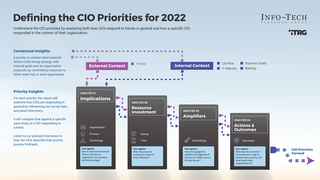 CIO Priorities 2022
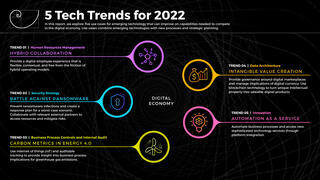 2022 Tech Trends
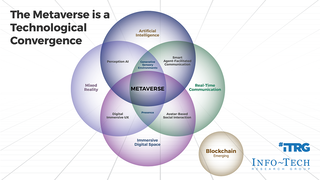 Into the Metaverse
 Demystify Blockchain: How Can It Bring Value to Your Organization?
 2020 Tech Trend Report
 2020 CIO Priorities Report
 CIO Trend Report 2019
 CIO Trend Report 2018
 CIO Trend Report 2017
 AI and the Future of Enterprise Productivity
 Evolve Your Business Through Innovation
 Build a Platform-Based Organization
 Tech Trend Update: If Contact Tracing Then Distributed Trust
 Tech Trend Update: If Biosecurity Then Autonomous Edge
 Tech Trend Update: If Digital Ethics Then Data Equity
 Tech Trends 2023
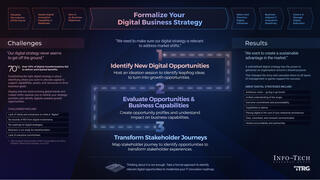 Formalize Your Digital Business Strategy
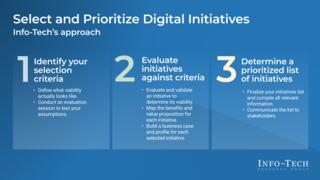 Select and Prioritize Digital Initiatives
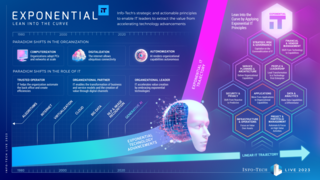 Adopt an Exponential IT Mindset
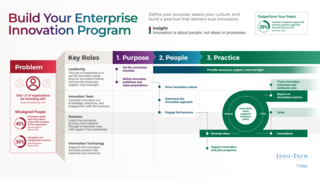 Build Your Enterprise Innovation Program
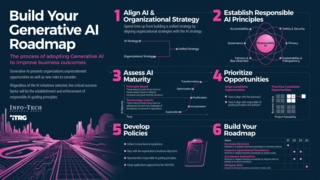 Build Your Generative AI Roadmap
 Annual CIO Survey Report 2024
 Drive Innovation With an Exponential IT Mindset
 Exponential IT for Financial and Vendor Management
 Exponential IT for Strategy, Risk, and Governance
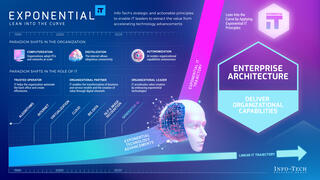 Exponential IT for Service Planning and Architecture
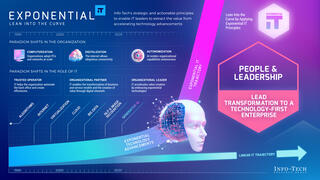 Exponential IT for People and Leadership
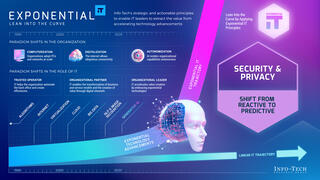 Exponential IT for Security and Privacy
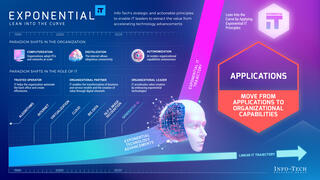 Exponential IT for Applications
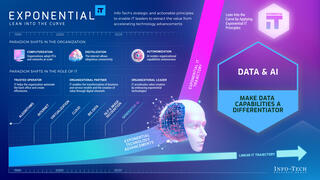 Exponential IT for Data and Analytics
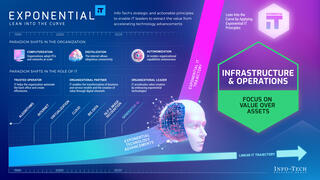 Exponential IT for Infrastructure and Operations
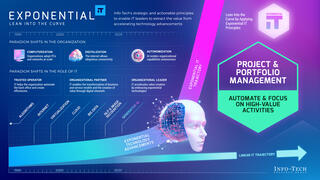 Exponential IT for Project and Portfolio Management
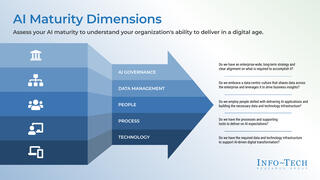 Assess Your AI Maturity
 Develop Responsible AI Guiding Principles
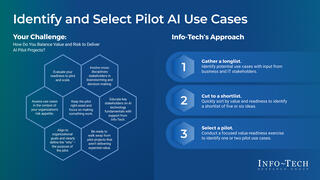 Identify and Select Pilot AI Use Cases
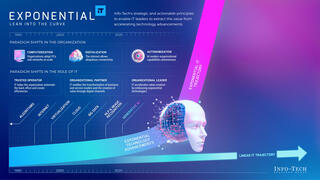 Exponential IT Keynote
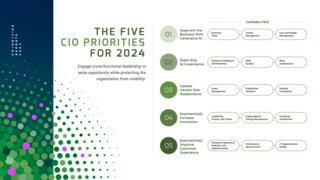 CIO Priorities 2024
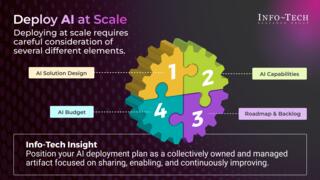 Build a Scalable AI Deployment Plan
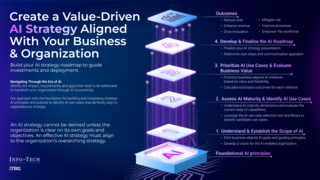 Build Your AI Strategy and Roadmap
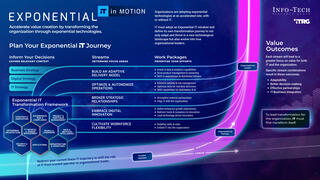 Develop an Exponential IT Roadmap
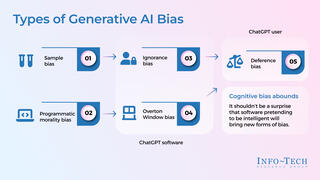 Use ChatGPT Wisely to Improve Productivity
 Build a FinOps Strategy to Enable Dynamic Cloud Cost Management
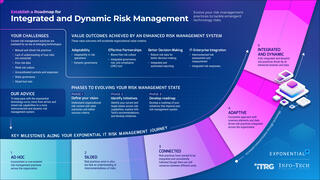 Establish a Roadmap for Integrated and Dynamic Risk Management
 Info-Tech’s Best of 2024 Mid-Year Report: AI Rewrites the Script for CIOs
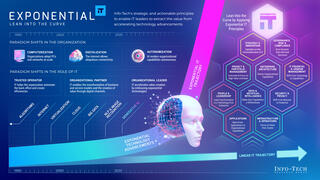 Explore the Art of the Possible for Exponential IT
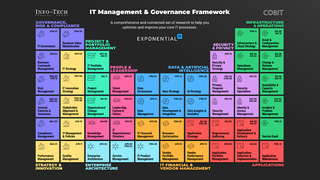 IT Management & Governance: The Next Evolution
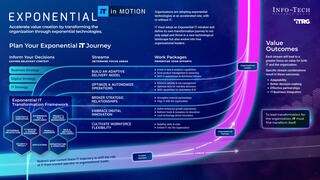 Bending the Exponential IT Curve Keynote
 Exponential IT in Motion: Transform Your Organization by Transforming IT
 AI Trends 2025
 LIVE 2024 Keynote Presentations
 LIVE 2024 Lightning Round Presentations
 CIO Priorities 2025
 Info-Tech’s Best of 2024 Report: IT Moves Into Position
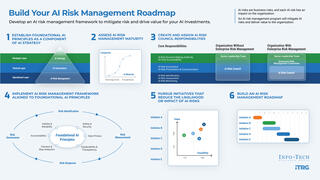 Build Your AI Risk Management Roadmap
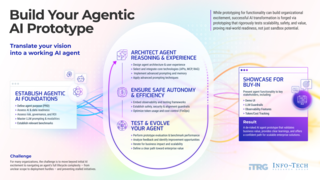 Design Your Agentic AI Prototype
 An Operational Framework for Rolling Out AI
 The AI Vendor Landscape in IT
 Run IT By the Numbers
 Building Info-Tech’s Chatbot
 Assessing the AI Ecosystem
 Bring AI Out of the Shadows
 Transform IT, Transform Everything
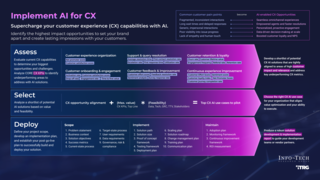 Implement AI for Customer Experience
 Info-Tech’s Best of 2025 Mid-Year Report: IT Moves From Disruption to Decisive Action
 Implement an AI-Orchestrated Service Desk
 Info-Tech's All-Time Best, 2025 Edition: Change Is the Headline, Fundamentals Are the Path
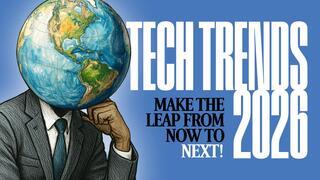 Tech Trends 2026
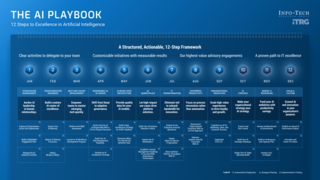 The AI Playbook
 AI Trends 2026
 Info-Tech’s Best of 2025: The Year AI Stopped Being a Project and Became the Strategy
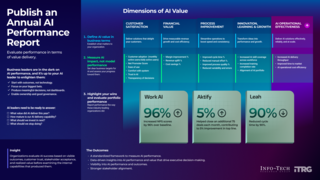 Publish an Annual AI Performance Report
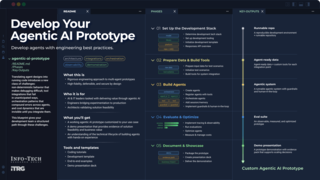 Develop Your Agentic AI Prototype
 Changing Landscape: Rethinking Vendor Decisions in the Agentic AI Era
 AI in Seven Charts
 Emerging AI Trends and Predictions From Our Global Technical Counselor Team
 Turn Customer Friction Into Agentic Opportunity
 People Change in the Face of Disruptive Technology
 Lead IT Like a Business: Every Dollar Is a Decision
 Optimize Cloud & AI Spend With Agentic FinOps
 Leadership Summit: The Ultimate Onboarding Experience 2026
 Resilience Is Not Planned – It Is Architected
 Redefine What It Means to Be CIO
 Navigating AI Agents in Service Management
 Influence Unleashed: The IT Leader’s Superpower
 The Challenge of Ethics in the Use of AI
 Revolutionize Risk Management With Agentic AI
 Introducing the Info-Tech Speakers Bureau
 Inside the Agentic Enterprise
 Agents 2.0: From Autonomy to Architecture
 Agentic IT: From Hype to Value
 Tech Trends 2027 Keynote
 Become an Exponential CIO
 Beyond the Agent: The Leadership Ecosystem for an AI-Enabled World
 Five Key Takeaways From Info-Tech LIVE 2026
 Info-Tech’s Best of 2026 Mid-Year Report
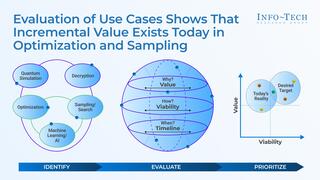 Identify and Evaluate Quantum Computing Use Cases
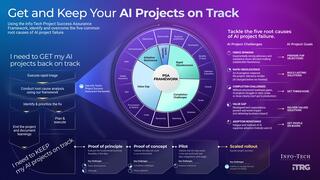 Get Your AI Projects Back on Track
 AI Adoption & Impact Study: AI in Software Development June 2026 Top 10 Insights
 AI Adoption & Impact Study: AI in the Enterprise June 2026 Top 10 Insights