
Vendor Spotlight: VMware Alternatives
Unlocking value with the VMware and alternatives guide.
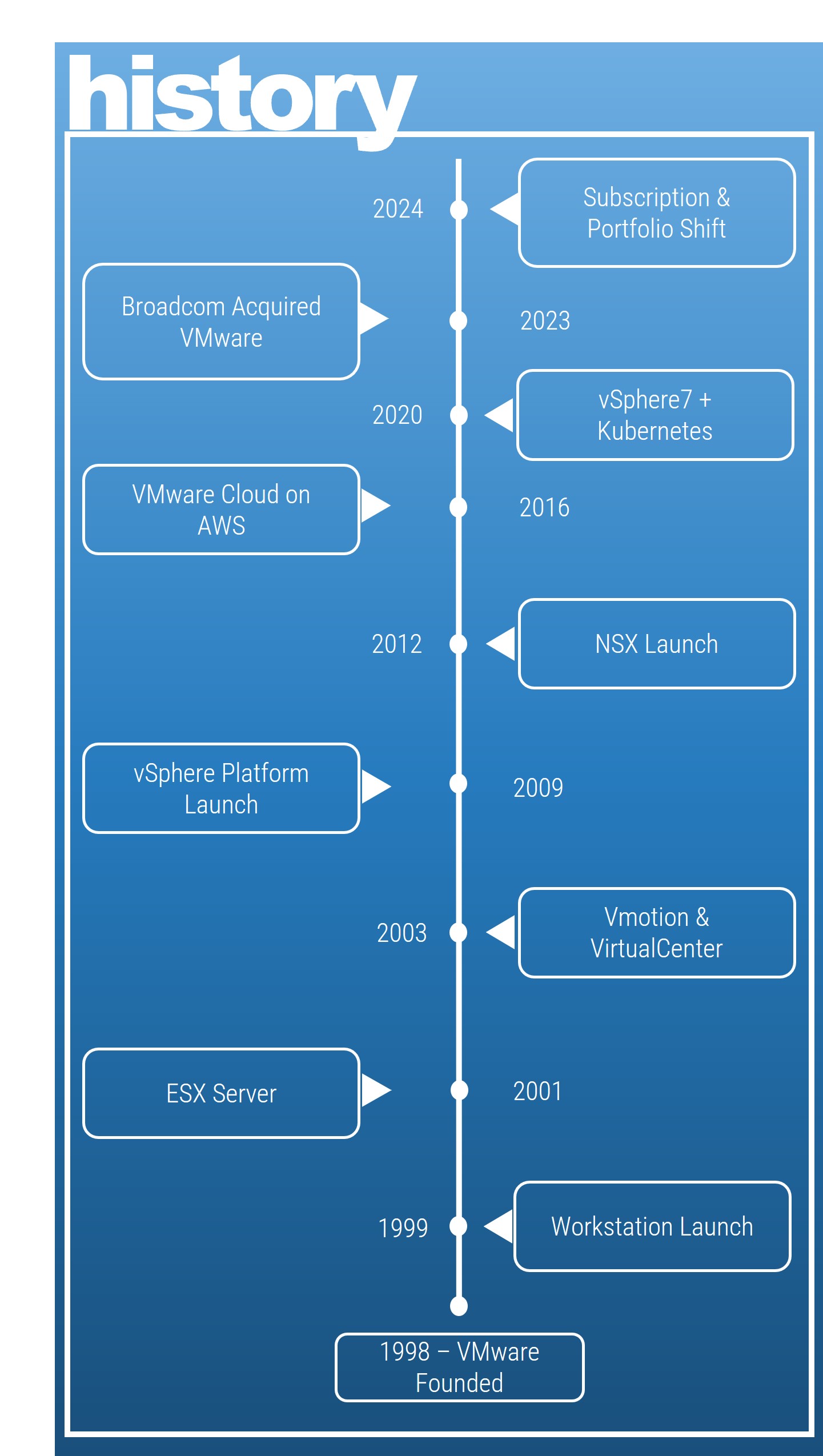
Since its 2023 acquisition by Broadcom, VMware has retained a strong global leadership position in the enterprise virtualization market. Under that new ownership, however, VMware’s cost structure and portfolio strategy have shifted, prompting many organizations to consider alternatives. But selecting a new vendor entails more than simply comparing features and pricing. Use our practical framework to reassess your organization’s long-term alignment with VMware’s platform and make an informed vendor decision that balances cost, risk, and long-term sustainability.
Platforms from Nutanix, Microsoft, OpenShift, and OpenStack are among the contenders vying for a piece of VMware’s market share. Yet this expanding and fragmented vendor landscape makes it tough for organizations to evaluate potential VMware alternatives. A structured, criteria-based approach that assesses vendors across architecture, scalability, pricing, and operational complexity helps organizations understand trade-offs between competing platforms. This capability-driven evaluation method aligns infrastructure decisions with business priorities and future-state operating models.
1. Don’t seek a like-for-like substitution.
Selecting an alternative vendor requires a more holistic approach. Evaluate potential trade-offs in terms of architecture, ecosystem maturity, operational complexity, and long-term strategic fit.
2. Consider each vendor’s broader market strategy.
VMware is positioning itself as a unified platform (VCF) to bridge traditional VMs with modern application and migration needs. If your organization is struggling to maintain security uptime while modernizing and migrating legacy infrastructure, factor this into your decision.
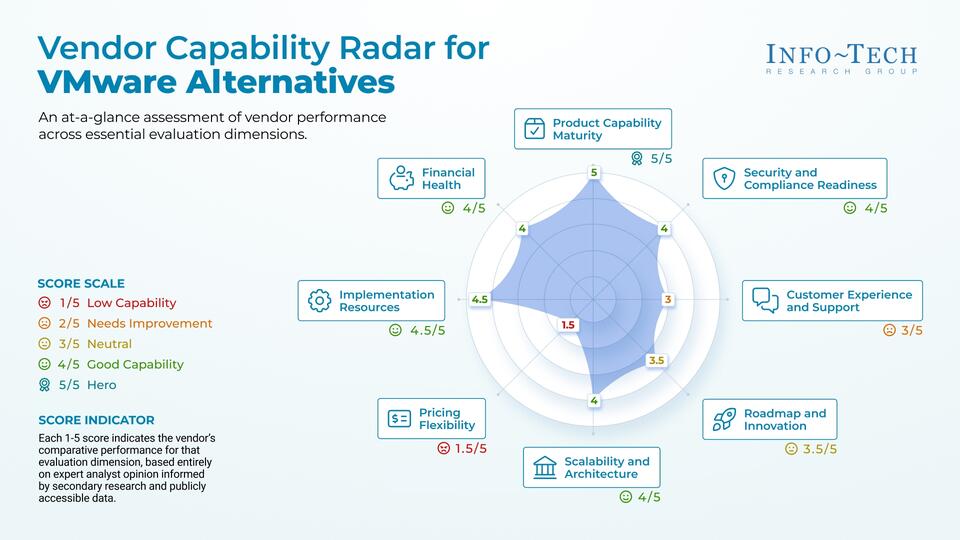
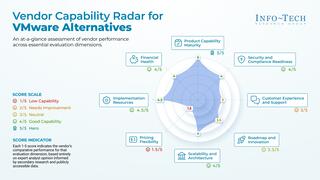
3. VMware scores high in performance but lower on CX and pricing.
While VMware gets top marks for breadth of features, customizability, and highly reliable performance at scale, that’s tempered by some significantly lower scores for customer experience and pricing flexibility.
Use this practical framework to assess VMware and its alternatives in an evolving vendor landscape.
Our methodology offers timely market intelligence, comprehensive vendor comparisons, and a systematic approach to evaluate VMware and leading vendor alternatives. Use this step-by-step resource to:
- Assess whether VMware’s current offerings align with your organization’s long-term architectural, operational, and financial priorities.
- Stay informed about evolving market dynamics and broader industry developments when evaluating and selecting vendor alternatives to VMware.
- Compare VMware’s platform with offerings from seven other vendors including Microsoft, Nutanix, and Red Hat.
Member Testimonials
After each Info-Tech experience, we ask our members to quantify the real-time savings, monetary impact, and project improvements our research helped them achieve. See our top member experiences for this blueprint and what our clients have to say.
8.0/10
Overall Impact
$13,799
Average $ Saved
Client
Experience
Impact
$ Saved
Days Saved
SOUTH AFRICAN BROADCASTING CORPORATION
Guided Implementation
8/10
$13,799
N/A
We will get an opportunity to speak and discuss with the client who went through the migration from VMWare.
Vendor Spotlight: VMware Alternatives
Unlocking value with the VMware and alternatives guide.
Analyst perspective
See vendors for who they are. Choose confidently. Because the right technology choices support your culture and your people.
Virtualization remains a foundational layer of enterprise IT, enabling organizations to optimize infrastructure utilization, improve resiliency, and support hybrid and multicloud operating models. While containerization and cloud-native architectures continue to evolve, virtual machines remain critical for running legacy, regulated, and mission-critical workloads.
VMware has long defined the enterprise virtualization market, delivering a mature, feature-rich platform with deep ecosystem integration and strong hybrid cloud capabilities. However, recent shifts in licensing, portfolio bundling, and go-to-market strategy under Broadcom have introduced new cost structures and operational considerations, prompting organizations to reassess their long-term alignment with the platform.
As a result, the alternatives landscape is expanding, but not all vendors represent direct replacements. Platforms such as Nutanix and Microsoft offer comparable enterprise virtualization capabilities, while solutions like OpenShift or OpenStack reflect a broader architectural shift toward cloud-native models. Other vendors focus on cost efficiency or operational simplicity, often with trade-offs in scale or feature depth.
Selecting an alternative is not a one-to-one substitution exercise. It requires evaluating trade-offs across architecture, operational complexity, ecosystem maturity, and long-term strategic fit. Organizations that take a structured, capability-driven approach to vendor evaluation are better positioned to align their infrastructure decisions with future-state operating models and business priorities.

Sahana Muhundhan
Research Analyst, Research Innovation | Vendor Selection
Info-Tech Research Group
Executive summary
Your Challenge
Organizations are under increasing pressure to modernize infrastructure while managing rising costs, vendor lock-in, and evolving hybrid and multicloud requirements. As VMware’s pricing and portfolio strategy shift, IT leaders must reassess whether their current platform aligns with long-term operational, financial, and architectural goals.
At the same time, virtualization remains critical for running legacy and mission-critical workloads, making platform decisions high-impact and difficult to reverse. Leaders need clear, objective insight to determine whether to optimize, retain, or replace VMware within their environment.
Common Obstacles
Organizations face a fragmented alternatives landscape where vendors differ significantly in architecture, maturity, and operating models. Not all alternatives are direct replacements, making it difficult to compare solutions on a like-for-like basis.
Additionally, limited transparency around pricing, migration complexity, and ecosystem support creates uncertainty in decision-making. As a result, teams often struggle to balance cost reduction with maintaining enterprise-grade reliability, scalability, and security.
Info-Tech’s Approach
Info-Tech applies a structured, criteria-driven evaluation to assess VMware and its alternatives across key dimensions such as architecture, scalability, pricing, and operational complexity. This ensures vendors are compared based on meaningful capabilities rather than surface-level features.
Our approach emphasizes clarity and decision support, helping organizations understand trade-offs between platforms and identify best-fit solutions aligned to their infrastructure strategy. This enables informed, confident decisions that balance cost, risk, and long-term sustainability.
Info-Tech Insight
Effectively spotlighting the appropriate vendors is key to remaining informed about market dynamics and broader industry developments.
Vendor snapshot
Meet the Vendor: No Fluff, Just the Facts
- Headquarters — California, USA
- Target Verticals — Financial Services, Healthcare & Life Sciences, Public Sector, Telecommunications
- Target Customer Size Profile — Large enterprises with complex, hybrid infrastructure needs, with secondary adoption in upper mid-market environments.
- Vendor: VMware
- Established Date: 1998
- Key Executives: CEO – Hock Tan, President – Tom Krause
- No. of Employees: 16,000
- Website URL: VMware by Broadcom - Cloud Computing for the Enterprise
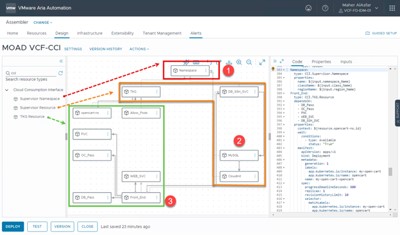
Image Source: “VMware Cloud Foundation Automation,” VMware, 2024
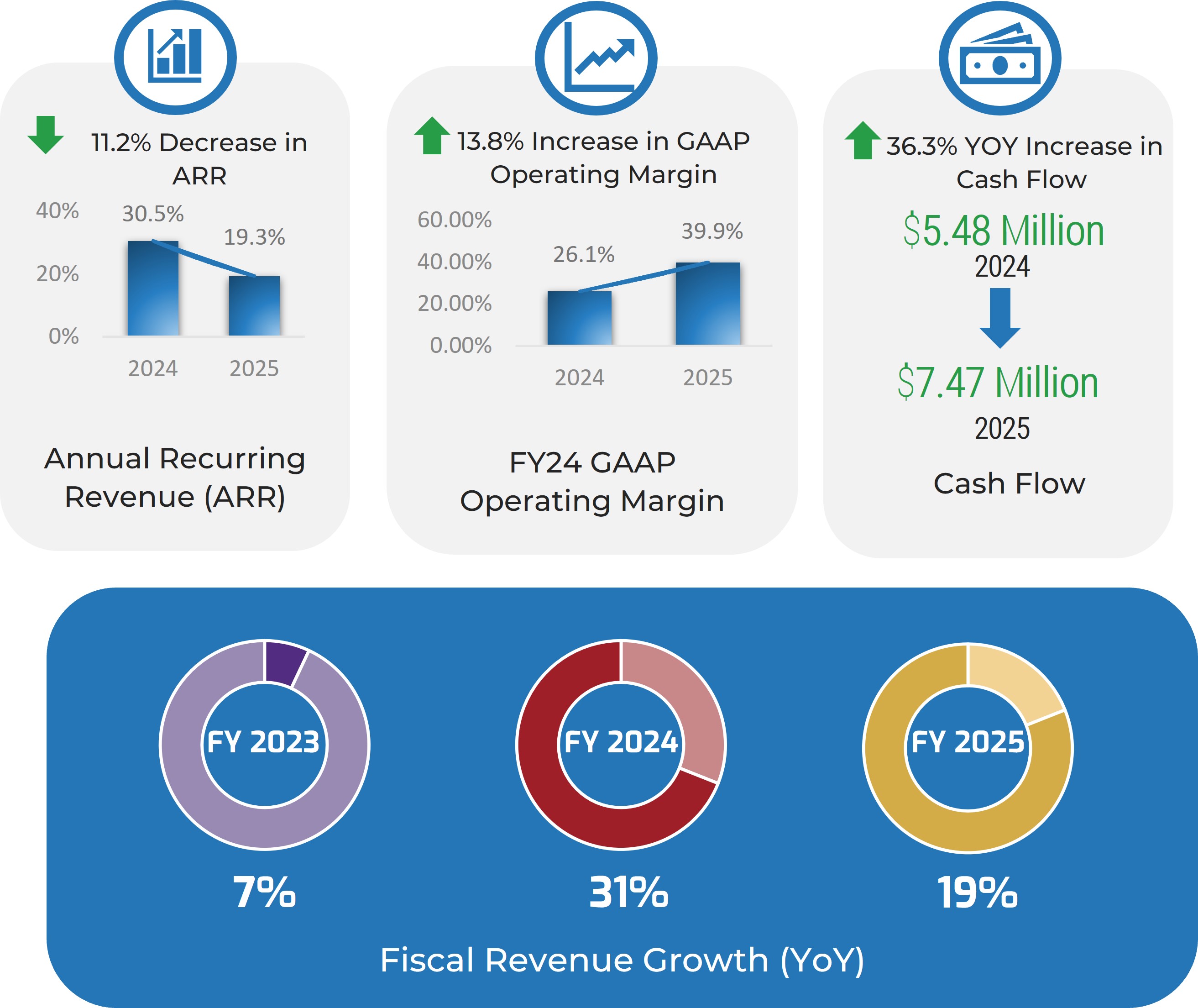
FINANCIAL SUMMARY
Quarterly Revenue (Q1 2025) $14,916 M
Change Over Last Quarter: 25%
GROSS PROFIT $10,145M
Change Over Last Quarter: 11.3%
Flagship product overview
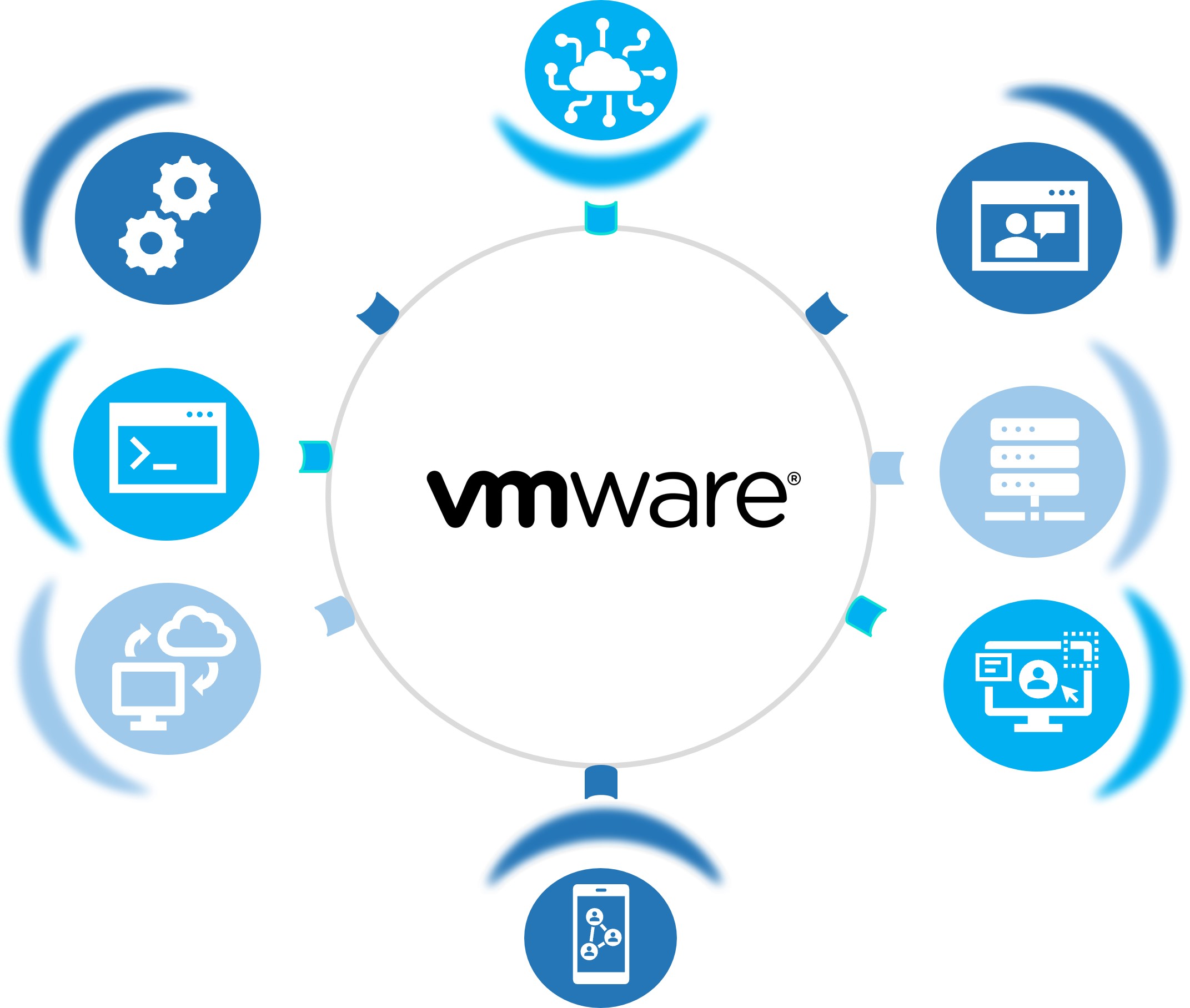
VMware vSphere
Platform that runs and manages virtual machines and containers.VMware Cloud Foundation
Integrated private and hybrid cloud platform combining compute, storage, networking, and management.vSAN
Software-defined storage solution that pools server disks into shared, scalable storage.NSX
Network virtualization and security platform enabling software-defined networking and micro-segmentation.Aria Suite
Infrastructure management and automation tools for monitoring, optimization, and lifecycle operations.Tanzu
Kubernetes-based platform for building, running, and managing modern cloud-native applications.Horizon
Virtual desktop and application delivery platform for secure remote workforce enablement.Workspace ONE
Unified endpoint management platform for device, identity, and application access control.
Product portfolio map
Source: VMware Cloud Foundation | Private Cloud Platform
Core Virtualization – vSphere Standard
- What it is: Entry-level enterprise virtualization for running and managing virtual machines.
- Includes: ESXi hypervisor, vCenter Server, Core availability features
- Best for: Small to mid-sized environments focused on VM consolidation.
- Licensing: Subscription-based, per core.
Modern Virtualization Platform – vSphere Foundation (VVF)
- What it is: Enterprise virtualization platform enhanced with Kubernetes and integrated operations.
- Includes: Full vSphere enterprise capabilities, vSphere Kubernetes Service (VKS), Aria Operations (standard tier), Limited vSAN capacity entitlement
- Best for: Enterprises modernizing infrastructure and running both VMs and containers.
- Licensing: Subscription-based, per core (bundled platform model).
Enterprise Cloud Platform – VMware Cloud Foundation (VCF)
- What it is: Full software-defined data center (SDDC) and private cloud platform.
- Includes: vSphere, vSAN Enterprise, NSX networking & micro-segmentation, Aria Suite Enterprise, SDDC Manager automation
- Best for: Large enterprises building private or hybrid cloud environments.
- Licensing: Subscription-based, per core with bundled entitlements.
Vendor pricing tier analysis
Basic Virtualization
- Subscription-based model. Per-core licensing model.
- Entry-level virtualization for small environments and basic workloads.
- Basic VM provisioning and management.
- Limited high availability capabilities.
Modern Virtualization Platform
- Subscription-based, per core. Bundled licensing.
- Modernized virtualization platform for enterprises running VMs + containers.
- Ful vSphere enterprise virtualization capabilities.
- Kubernetes integration and Aria Operations.
Enterprise Cloud Platform
- Subscription-based, per-core + bundled capacity.
- Enterprise private/hybrid cloud platform for large-scale environments.
- Full SDDC stack: vSphere + vSan + NSX + Aria
- Full Lifecycle management and automation.
Ideal customer persona
Defining Key Buyer Attributes
Enterprise organizations with complex infrastructure environments, typically operating hybrid cloud or private cloud models and requiring high availability and security.
Primary Target Roles
CIOs, IT infrastructure directors, and cloud architects responsible for data center strategy, virtualization platforms, and hybrid cloud operations.
Industry Segmentation Strengths
Strongest presence in Financial Services, Healthcare, Government, and Telecommunications; industries with high regulatory and uptime requirements.
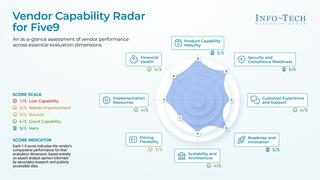
Vendor Capability Radar – Framework Overview
Product Capability Maturity
Assesses the breadth, depth, and stability of the vendor’s core solution, including feature completeness, usability, configurability, etc.Security and Compliance Readiness
Evaluates the vendor’s security architecture, data protection practices, regulatory certifications, privacy controls, and ability to meet industry-specific compliance requirements.Roadmap and Innovation
Reviews the vendor’s forward-looking product vision, pace of innovation, R&D investment, release cadence, and ability to adapt to evolving market and technology shifts.Scalability and Architecture
Examines technical infrastructure, integration flexibility, performance at scale, cloud/on-premises capabilities, API maturity, and long-term architectural sustainability.Financial Health
Evaluates revenue growth trends, profitability, funding stability, market position, acquisition history, and long-term viability within the competitive landscape.Pricing Flexibility
Analyzes licensing models, cost transparency, contract structure, scalability of pricing, total cost of ownership, and alignment between commercial terms and delivered value.Implementation Resources
Assesses deployment methodology, professional services maturity, partner ecosystem strength, change management support, training resources, and implementation risk profile.Customer Experience and Support
Measures overall client satisfaction, service responsiveness, support model structure, customer retention trends, and quality of ongoing account management.
Why It Matters
Info-Tech Insight
The vendor capability radar is a structured, multidimensional evaluation model designed to support transparent and defensible enterprise software selection decisions. It moves vendor selection beyond static rankings and enables leadership teams to evaluate trade-offs across strategic, operational, and organizational dimensions.
About Info-Tech
Info-Tech Research Group is the world’s fastest-growing information technology research and advisory company, proudly serving over 30,000 IT professionals.
We produce unbiased and highly relevant research to help CIOs and IT leaders make strategic, timely, and well-informed decisions. We partner closely with IT teams to provide everything they need, from actionable tools to analyst guidance, ensuring they deliver measurable results for their organizations.
What Is a Blueprint?
A blueprint is designed to be a roadmap, containing a methodology and the tools and templates you need to solve your IT problems.
Each blueprint can be accompanied by a Guided Implementation that provides you access to our world-class analysts to help you get through the project.
Talk to an Analyst
Our analyst calls are focused on helping our members use the research we produce, and our experts will guide you to successful project completion.
Book an Analyst Call on This Topic
You can start as early as tomorrow morning. Our analysts will explain the process during your first call.
Get Advice From a Subject Matter Expert
Each call will focus on explaining the material and helping you to plan your project, interpret and analyze the results of each project step, and set the direction for your next project step.
Unlock Sample Research Build Your Enterprise Application Implementation Playbook
 Master Contract Review and Negotiation for Software Agreements
 Negotiate SaaS Agreements That Are Built to Last
 Governance and Management of Enterprise Software Implementation
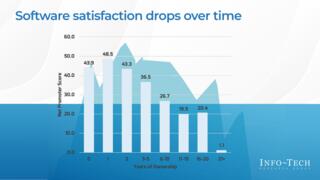 Select Software With the Right Satisfaction Drivers in Mind
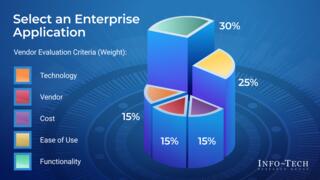 Select an Enterprise Application
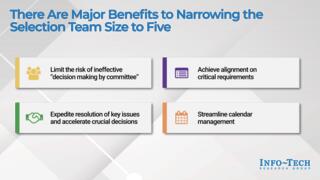 Optimize Your Software Selection Process: Why 5 and 30 Are the Magic Numbers
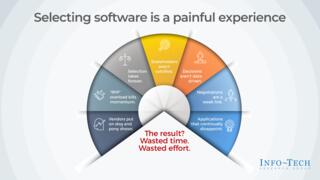 The Rapid Application Selection Framework
 Get the Best Discount Possible With a Data-Driven Negotiation Approach
 Craft a Customer-Driven Market Strategy With Unbiased Data
 Switching Software Vendors Overwhelmingly Drives Increased Satisfaction
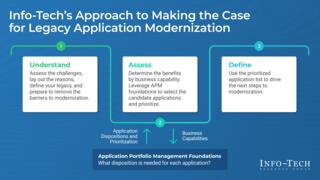 Make the Case for Legacy Application Modernization
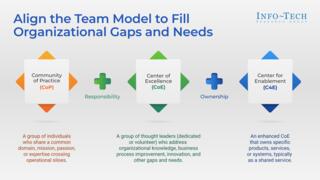 Empower Solution Delivery With the Right CoP, CoE, and C4E Model
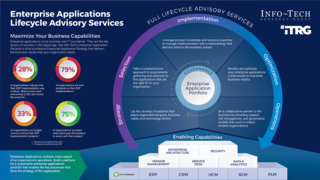 Enterprise Application Change: It's All About Business Capabilities
 2020 Applications Priorities Report
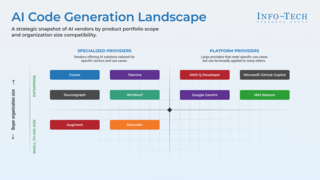 AI-Assisted Code Generation Tools
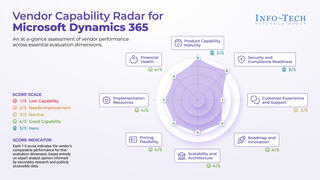 Vendor Spotlight: Microsoft Dynamics 365
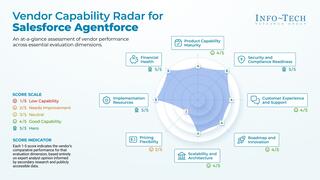 Vendor Spotlight: Salesforce Agentforce Service
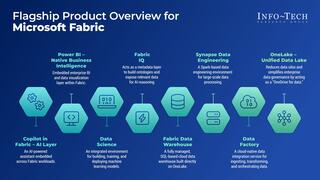 Vendor Spotlight: Microsoft Fabric
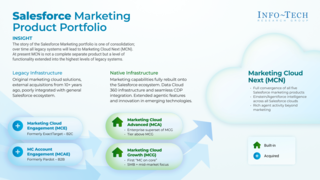 Vendor Spotlight: Salesforce Marketing Cloud
 Vendor Spotlight: VMware Alternatives
 Vendor Spotlight: Microsoft AI
 Vendor Spotlight: Google AI
 Vendor Spotlight: Snowflake Data Platform
 Vendor Spotlight: Five9