
Vendor Spotlight: Microsoft Dynamics 365
Unlocking service excellence with D365 Service.
Choosing a vendor on product capabilities alone is a costly mistake. Many organizations select enterprise CRM software based on features, then struggle with failed deployments, misaligned support models, and product shifts that force them back to the drawing board. Microsoft Dynamics 365 is a powerful and complex platform, and navigating it confidently requires more than a product demo. This vendor spotlight applies a structured, criteria-driven assessment to cut through vendor noise and give you the intelligence needed to make a defensible sourcing decision.
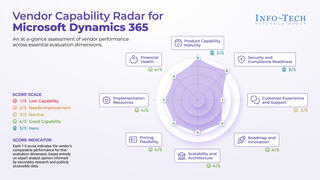
CIOs, solutions architects, and IT leaders evaluating their enterprise ecosystem need to understand how business functions integrate and how data infrastructure operates – which can be difficult to synthesize. Organizations assessing Microsoft Dynamics 365 will find this buyer’s guide particularly relevant as it examines the platform across product capability, agentic AI maturity, pricing flexibility, security posture, financial health, implementation resources, and customer support.
1. Ecosystem integration is the platform's strongest differentiator.
For organizations already running Microsoft 365, Teams, Azure, or the Power Platform, Dynamics 365 Service delivers native interoperability that standalone customer service platforms cannot match. Data flows consistently across business functions, Copilot surfaces insights within existing workflows, and the Power Platform extends automation without deep technical expertise. The return on Dynamics 365 scales directly with the depth of your existing Microsoft investment.
2. Copilot is becoming the interface for Dynamics 365, but adoption readiness matters.
Microsoft’s vision for Dynamics 365 is that agentic AI, powered by Copilot, becomes the primary interface across all service workflows. Prebuilt agents handle case management, knowledge retrieval, customer intent analysis, and quality evaluation – all triggered through natural language prompting. However, realizing this vision requires well-structured customer data, trained users, and workflows configured to support Copilot agents, areas where many organizations are still catching up.
3. Vendor selection demands a multi-dimensional lens, not just a feature checklist.
IT leaders who evaluate Microsoft Dynamics 365 on functional fit alone overlook critical risk factors that affect long-term success. A structured, multi-dimensional evaluation approach ensures vendors are assessed across various metrics to determine product maturity, scalability, and roadmap transparency. This broader lens enables decision-makers to make more confident decisions aligned to organizational goals.
Use this vendor spotlight to evaluate Microsoft Dynamics 365 with confidence
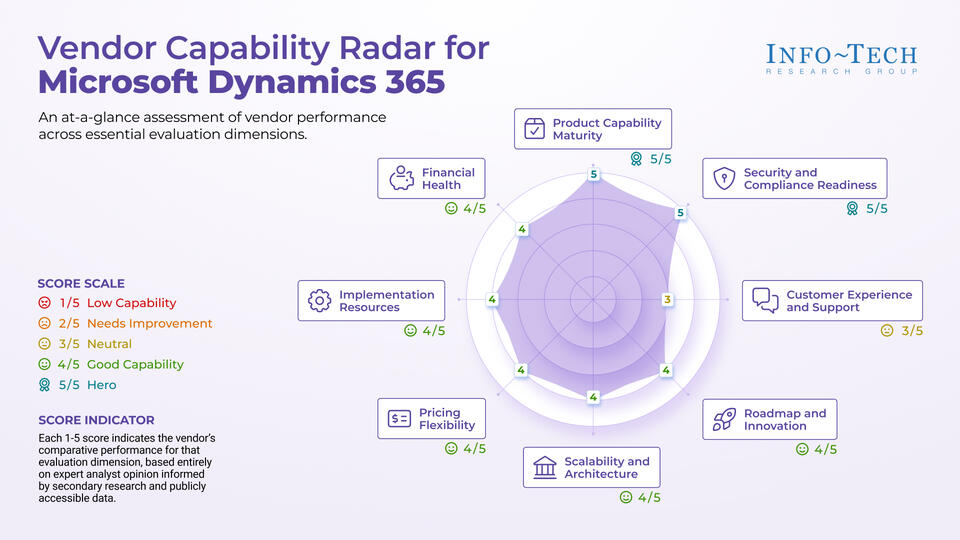
This vendor spotlight brings together a criteria-driven assessment tools – the Vendor Capability Radar with scored evidence cards, SoftwareReviews peer data, pricing tier breakdowns across all three service modules (Dynamics 365 Customer Service, Field Service, and Contact Center) and an implementation partner guide. Use these tools to move from vendor consideration to a well-informed sourcing decision grounded in effective software procurement best practices.
- Assess fit across the three D365 service modules using capability scores, product maturity ratings, and ecosystem integration evidence from the Vendor Capability Radar.
- Evaluate pricing tiers and total cost of ownership to ensure long-term transparency and scalability.
- Build your customer success strategy by mapping Microsoft's support model against your internal capabilities and risk tolerance.
- Identify the right implementation partner using curated guide matched to your organization's size and use case.
Vendor Spotlight: Microsoft Dynamics 365
Unlocking service excellence with D365 Service.
Analyst Perspective
See vendors for who they are and choose confidently. The right technology choices support your processes and your people.
Effective vendor insight relies on a meaningful understanding of how the platform under consideration fits into an organization's strategy, workflows, and architecture. Demoing products and developing an understanding of capabilities is an essential part of this analysis but does not form the entire grounds for decision-making. The broader identity of a vendor is often overlooked despite the major impact this can have on the product lifecycle.
Microsoft in particular is a software vendor that stands apart in its ability to provide a full ecosystem of products. Each of the Dynamics 365 products are one module among many in an extremely broad suite encompassing productivity tools, cloud infrastructure, business intelligence, and low-code automation. For CIOs and technology decision-makers, evaluation extends well beyond whether Dynamics 365 CRM meets immediate functional requirements. Buyers must assess whether Microsoft gives confidence across a full range of enterprise criteria: product depth, capability maturity, security posture, pricing flexibility, implementation best practices, roadmap, and product innovation.
As Copilot increasingly becomes the UI for Microsoft products, buyers should assess whether their workforce is effectively trained for Copilot, that automations and workflows between Copilot agents and Dynamics 365 CRM are suitable, and if customer data is structured well enough for Copilot agents to provide accurate output.
Smart vendor selection is not just about choosing a certain product; it's about ensuring a total alignment between the vendor and buyer's needs. Microsoft is a complex company with a long history and many offerings. Dynamics 365 Service is an integral part of its business applications stack and provides robust end-to-end capabilities for successful service orchestration.

Maya Chambers
Senior Advisory Analyst, Research Innovation | Vendor Selection | Customer Experience Strategy
Info-Tech Research Group
Executive Summary
Your Challenge
Many organizations choose a vendor on product capabilities alone, then struggle with failed deployments, insufficient customer service, or sudden product-market shifts that force them to go back to the drawing board. Complex enterprise-level vendors such as Microsoft can be difficult to navigate and make informed decisions around.
As competitive landscapes shift more quickly, IT leaders must rely on accurate, relevant, and timely vendor intelligence to guide strategic sourcing decisions. With a plentitude of analysis about top-market vendors such as Microsoft Dynamics 365, it can be difficult to know who to trust.
Common Obstacles
Customer service solutions is an area in which incredible value can be derived from agentic AI, but the introduction of these technologies is still in the early stages. To determine the best path forward, understanding a vendor's strategic perspective is more important now than ever.
As technologies continue to change, data also becomes more important than ever. Companies seeking an ecosystem offering like Microsoft want to understand how the various business functions integrate and how data infrastructure operates – information that can be difficult to synthesize.
Info-Tech's Approach
We apply a structured, criteria-driven assessment to identify and spotlight vendors that deliver the most credible, relevant, and forward-looking capabilities.
Our approach prioritizes synthesis over aggregation, distilling vendor inputs into clear, actionable guidance that directly supports your strategic vendor sourcing and software procurement priorities. Thus, enabling your teams to stay focused on decision-making rather than information vetting while ensuring you maintain a proactive, well-informed view of evolving market patterns and industry trends.
Info-Tech Insight
Ecosystem integration is the platform's most compelling differentiator, especially for teams already leveraging Microsoft 365, MS Teams, Azure, and the Power Platform.
Vendor Snapshot
Meet MS Dynamics 365 : No Fluff, Just the Facts
| Headquarters | Target Verticals |
Target Customer Size Profile |
|---|---|---|
| Redmond, Washington, USA | Flexible across enterprise clients in diverse industries. |
Midmarket and Enterprise; for full enterprise feature set, ideally 1,000+ employees. |


FINANCIAL SUMMARY


Info-Tech Insight
Microsoft has reported continually strong top-line performance with a Q1 revenue of $77.7B, followed by a Q2 revenue of $81.3B. However, Azure growth has decelerated for two consecutive quarters, Copilot adoption remains relatively limited, and Microsoft 365 will have price increases effective July 2026. Investors should be wary of ROI as Microsoft seeks to offset AI capital expenditures.
Dynamics 365 Customer Service

MS Dynamics 365 Field Service

MS Dynamics 365 Contact Center

Vendor Pricing Tier Analysis
Source
Microsoft
Customer Service
Dynamics 365 Customer Service Professional US$50 user/month, paid yearly |
Dynamics 365 Customer Service Enterprise US$105 user/month, paid yearly |
Dynamics 365 Customer Service Premium US$195 user/month, paid yearly |
|---|---|---|
Case management, Knowledge management (including knowledge authoring), Microsoft 365 interoperation, Unlimited named users, Leads (creation only), Microsoft Power BI |
Case management, knowledge management (including knowledge authoring), Microsoft 365 interoperation, unlimited named users, leads (creation only), Microsoft Power BI |
Case management, knowledge management (including knowledge authoring), Microsoft 365 interoperation, unlimited named users, leads (creation only), Microsoft Power BI |
- |
Microsoft Teams integration, Copilot in Dynamics 365 Customer Service, Embedded intelligence, Multisession support, unified routing, analytics and KPI reporting, forecasting and scheduling, portals, custom applications (Microsoft Power Apps), workflow automation (Microsoft Power Automate) |
Microsoft Teams integration, Copilot in Dynamics 365 Customer Service, Embedded intelligence, Multisession support, unified routing, analytics and KPI reporting, forecasting and scheduling, portals, custom applications (Microsoft Power Apps), workflow automation (Microsoft Power Automate) |
- |
- |
Dynamics 365 Contact Center, self-service chatbots and IVR, live and persistent chat on messaging and social channels, voice channel with inbound routing, conversation summarization and outbound calling |
Requires Copilot Credits: Customer Intent Agent, Customer Knowledge Management Agent, Case Management Agent, Quality Evaluation Agent |
Requires Copilot Credits: Customer Intent Agent, Customer Knowledge Management Agent, Case Management Agent, Quality Evaluation Agent |
Included: Customer Intent Agent, Customer Knowledge Management Agent, Case Management Agent, Quality Evaluation Agent |
Vendor Pricing Tier Analysis
Source
Microsoft
Field Service
Dynamics 365 Field Service US$105/user/month, paid yearly | Dynamics 365 Field Service Contractor US$50/user/month, paid yearly |
|---|---|
App access | App access |
Access to: Dynamics 365 Guide, Dynamics 365 Remote Assist | Limited access: Dynamics 365 Guide, Dynamics 365 Remote Assist, vendor & contractor management, scheduling & resourcing dispatching |
Vendor & contractor management, scheduling & resourcing dispatching | - |
Planned maintenance agreements, returns processing, AI assistance from Copilot in Dynamics 365 Field Service, Technician performance analysis | - |
About Info-Tech
Info-Tech Research Group is the world’s fastest-growing information technology research and advisory company, proudly serving over 30,000 IT professionals.
We produce unbiased and highly relevant research to help CIOs and IT leaders make strategic, timely, and well-informed decisions. We partner closely with IT teams to provide everything they need, from actionable tools to analyst guidance, ensuring they deliver measurable results for their organizations.
What Is a Blueprint?
A blueprint is designed to be a roadmap, containing a methodology and the tools and templates you need to solve your IT problems.
Each blueprint can be accompanied by a Guided Implementation that provides you access to our world-class analysts to help you get through the project.
Talk to an Analyst
Our analyst calls are focused on helping our members use the research we produce, and our experts will guide you to successful project completion.
Book an Analyst Call on This Topic
You can start as early as tomorrow morning. Our analysts will explain the process during your first call.
Get Advice From a Subject Matter Expert
Each call will focus on explaining the material and helping you to plan your project, interpret and analyze the results of each project step, and set the direction for your next project step.
Unlock Sample Research Build Your Enterprise Application Implementation Playbook
 Master Contract Review and Negotiation for Software Agreements
 Negotiate SaaS Agreements That Are Built to Last
 Governance and Management of Enterprise Software Implementation
 Select Software With the Right Satisfaction Drivers in Mind
 Select an Enterprise Application
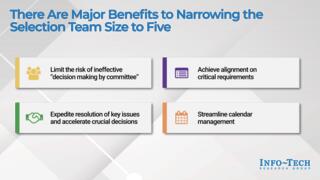 Optimize Your Software Selection Process: Why 5 and 30 Are the Magic Numbers
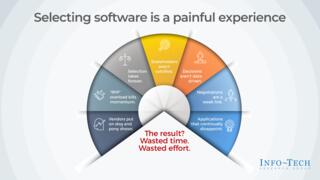 The Rapid Application Selection Framework
 Get the Best Discount Possible With a Data-Driven Negotiation Approach
 Craft a Customer-Driven Market Strategy With Unbiased Data
 Switching Software Vendors Overwhelmingly Drives Increased Satisfaction
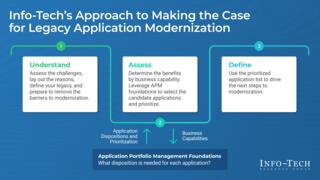 Make the Case for Legacy Application Modernization
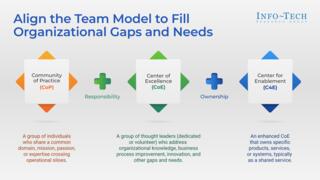 Empower Solution Delivery With the Right CoP, CoE, and C4E Model
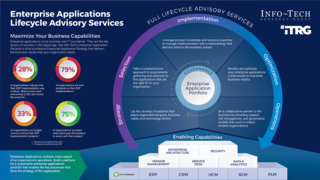 Enterprise Application Change: It's All About Business Capabilities
 2020 Applications Priorities Report
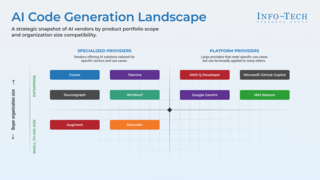 AI-Assisted Code Generation Tools
 Vendor Spotlight: Microsoft Dynamics 365
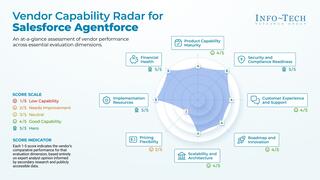 Vendor Spotlight: Salesforce Agentforce Service
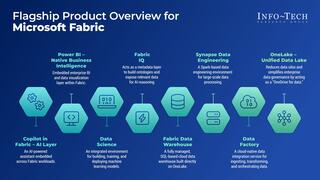 Vendor Spotlight: Microsoft Fabric
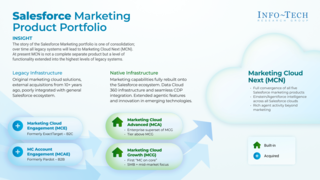 Vendor Spotlight: Salesforce Marketing Cloud
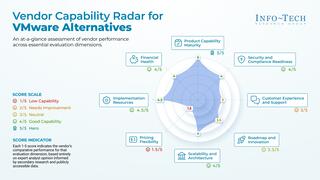 Vendor Spotlight: VMware Alternatives
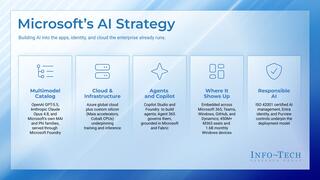 Vendor Spotlight: Microsoft AI
 Vendor Spotlight: Google AI
 Vendor Spotlight: Snowflake Data Platform
 Vendor Spotlight: Five9
