
Vendor Spotlight: Microsoft Fabric
Unlocking value with Microsoft Fabric.
Organizations face increasing pressure to evaluate rapidly evolving data and analytics vendors while managing fragmented platforms, inconsistent governance, and rising demand for AI-ready capabilities. Disconnected tools and unclear vendor differentiation slow decision-making and increase the risk of selecting platforms that fail to scale or align with long-term strategy. Our research delivers a structured, multidimensional evaluation of Microsoft Fabric to help leaders assess platform fit and make confident, defensible decisions.
CIOs, CDOs, and IT leaders responsible for data, analytics, and AI strategy must navigate a crowded vendor landscape while balancing platform consolidation, governance requirements, and evolving AI demands. Many organizations struggle to connect fragmented data environments, establish a scalable and governed data foundation, and assess vendors beyond surface-level capabilities, making it difficult to determine which platforms can deliver sustained value, operational fit, and long-term viability.
1. Fragmented analytics stacks obscure vendor evaluation and restrict decision.
Organizations evaluate vendors in isolation across BI, data engineering, and data science without assessing how those components operate together. This can lead teams to underestimate integration complexity, duplicated capabilities, and hidden operational costs. Evaluate Microsoft Fabric as a unified platform end-to-end to determine whether consolidation will reduce complexity or introduce new dependencies.
2. A unified data foundation can simplify – or constrain – your architecture.
Platforms like Microsoft Fabric centralize data through a single lakehouse model, improving governance and accessibility across workloads. However, tightly integrated architecture can increase reliance on a single ecosystem and limit flexibility for multicloud or heterogeneous data strategies. Assess whether Fabric’s OneLake approach aligns with your long-term architecture goals or creates constraints that are hard to reverse.
3. Strong capabilities do not eliminate vendor risk.
Microsoft Fabric delivers integrated analytics, AI capabilities, and deep ecosystem support, but platform maturity, pricing complexity, and reliance on Azure introduce important considerations. Focusing only on feature breadth can overlook operational risks such as cost management challenges, implementation complexity, and evolving product maturity. Evaluate Fabric across capability, stability, ecosystem fit, and long-term roadmap to ensure it meets both current and future requirements.
Move from vendor consideration to defensible decision
Our research consolidates the criteria-driven intelligence your sourcing team needs to evaluate Microsoft Fabric, featuring Vendor Capability Radar, Pricing Tier Analysis, and Customer Success and Support Model frameworks to help you assess vendor fit, reduce evaluation risk, and support analytics modernization decisions. Use this Microsoft Fabric spotlight to structure vendor comparisons, validate platform alignment, and strengthen sourcing outcomes.
- Assess platform capability across the eight evaluation dimensions of the Vendor Capability Radar.
- Build your customer success strategy by mapping Microsoft's support model against your internal capabilities and risk tolerance.
- Evaluate pricing tiers and total cost of ownership across the Fabric capacity SKU model.
- Identify the right implementation partner using a curated guide matched to your organization's size and use case.
Vendor Spotlight: Microsoft Fabric
Unlocking value with Microsoft Fabric.
Analyst perspective
See vendors for who they are. Choose confidently. Because the right technology choices support your culture and your people.
Effective vendor due diligence relies on meaningful insight, not meaningless noise.
Vendor intelligence is not optional; it is the foundation of confident procurement. Reading a white paper or participating in a product demo may provide a baseline understanding, but it will not show how a vendor truly fits with your company's long-term strategy and goals. Organizations working through complex procurement processes need a crystal-clear view of the wider vendor landscape.
Understanding a vendor's customer success model, go-to-market strategy, feature capability maturity, and other areas of distinction — whether in AI, security posture, or compliance readiness — helps teams avoid blind spots and stay updated with market trends.
Smart vendor procurement is not just about choosing technology; it is about selecting technology that fits your organization's needs. This means looking beyond features to evaluate cultural fit, operational readiness, and the larger impact on employee experience. It is a responsibility that involves the whole organization, not just IT.
When organizations take the time to carefully evaluate vendors through an introspective and data-driven approach, they are not just merely purchasing software, they are investing in the company's future.

Yaz Palanichamy
Senior Advisory Analyst, Research Innovation | Vendor Selection | Customer Experience Strategy
Info-Tech Research Group
Executive summary
Your Challenge
Organizations are under increasing pressure to maintain
a clear, current view of evolving market patterns and industry trends. As competitive landscapes shift more quickly, IT leaders must rely on accurate, relevant, and timely vendor intelligence to guide strategic sourcing decisions.
However, not all insights are created equal. To remain competitive, you need visibility into the vendors best positioned to deliver meaningful market foresight, not just noise. Effective vendor spotlighting helps connect the dots between emerging market dynamics and their strategic implications, enabling faster, more informed procurement decisioning best practices.
Common Obstacles
Organizations face a crowded and fragmented vendor landscape, making it challenging to determine which platforms offer the most relevant off-the-shelf software offerings.
With information coming from every direction — and varying widely in quality — teams often struggle to distinguish meaningful signals from background noise.
As a result, significant time is spent filtering and validating content rather than applying insights to support more informed and critical decision-making.
Info-Tech's Approach
We apply a structured, criteria-driven assessment to identify and spotlight vendors that deliver the most credible, relevant, and forward-looking market insights.
Our approach prioritizes synthesis over aggregation, distilling vendor inputs into clear, actionable guidance that directly supports your strategic vendor sourcing and software procurement priorities. Thus, enabling your teams to stay focused on decision-making rather than information vetting while ensuring you maintain a proactive, well-informed view of evolving market patterns and industry trends.
Info-Tech Insight
Effectively spotlighting the appropriate vendors is key to remaining informed about market dynamics and broader industry developments.
Vendor Snapshot
Meet the Vendor: No Fluff, Just the Facts
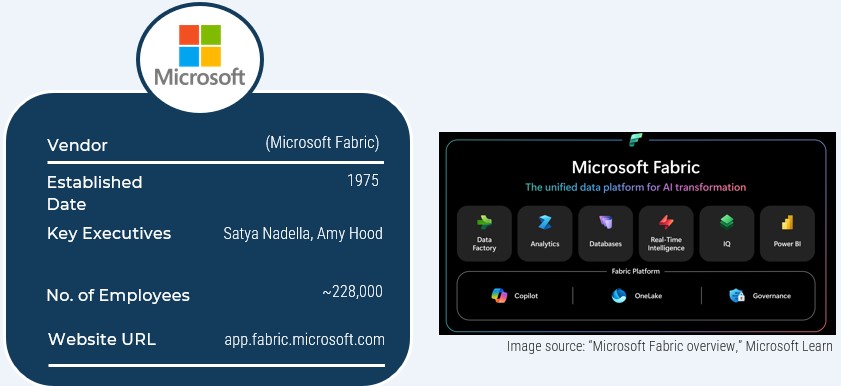
Headquarters |
Target Verticals |
Target Customer Size Profile |
|---|---|---|
(Redmond, Washington, USA) |
(Financial Services, Healthcare, Public Sector, Retail, Manufacturing) |
(Mid-market to Global Enterprise) |
GROWTH DASHBOARD
Microsoft Fabric Platform Snapshot
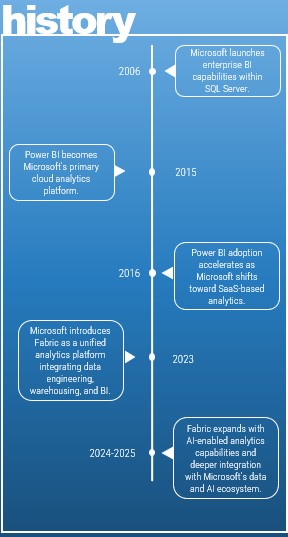
Launch: May 2023
Deployment: SaaS (Azure)
Core Architecture: OneLake unified data layer
Key Modules: Data Factory, Synapse, Power BI, Real-Time Analytics
Fabric Strategic Objectives
- Consolidate Microsoft's fragmented analytics stack
- Drive Azure data platform consumption
- Simplify enterprise data architecture via OneLake
- Enable AI-driven analytics through Copilot integration
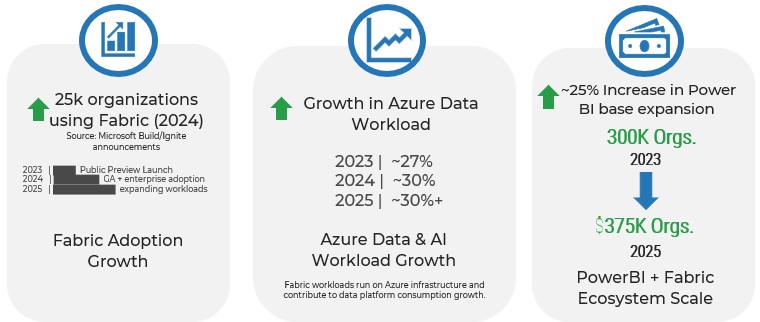
FY 2023: Public Preview |
FY 2023: General Availability |
FY 2023: Enterprise Expansion |
Fabric tenant adoption rate |
|
|
|
Azure consumption growth |
Platform Capability Expansion Roadmap |
Power BI to Fabric conversion |
||
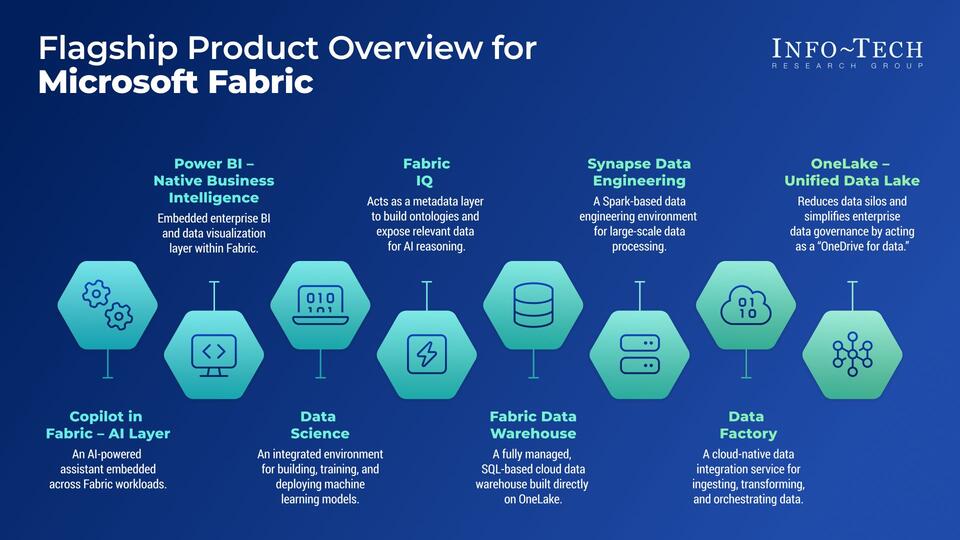
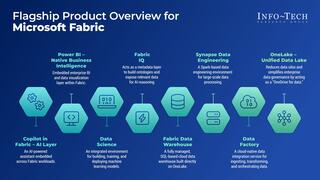
Flagship product overview for Microsoft Fabric
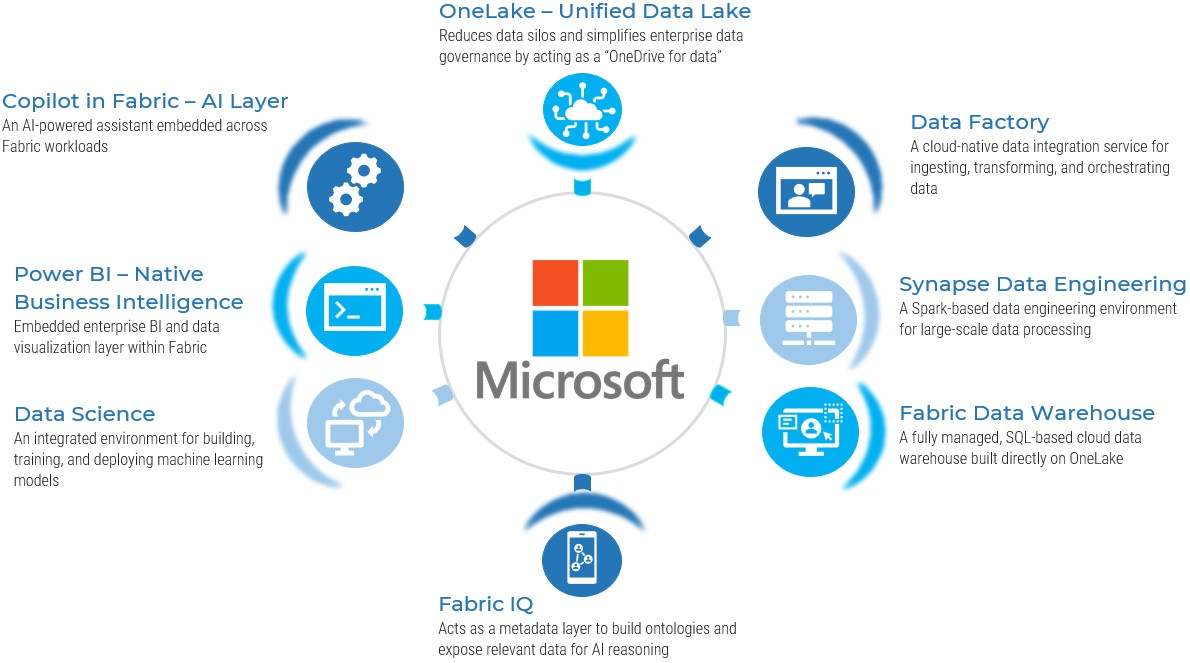
Product portfolio map
Source: "Understand Microsoft Fabric licenses," Microsoft Learn
Microsoft Fabric does not use traditional "Basic/Premium/Enterprise" product tiers. Instead, it uses a capacity-based model with one unified SKU family.
Free / Trial Experience
Evaluation & Learning
Includes:
- Limited Fabric workloads
- OneLake access (restricted)
- Power BI Free experience
- No SLA or enterprise support
Limitations:
- Very low capacity
- No production suitability
- No enterprise governance guarantees
Fabric Capacity (F-SKU) |
||
|---|---|---|
Tier Type |
Example SKUs |
Intended Use |
Entry |
F2, F4 |
Small teams, departmental analytics |
Mid |
F8, F16, F32 |
Enterprise analytics teams |
High |
F64, F128 |
Enterprise-wide Power BI sharing; enables Free user report consumption at scale |
Ultra |
F256–F2048 |
Mission-critical, global analytics |
Vendor pricing tier analysis
Free Trial |
Entry Fabric Capacity (F2–F4) |
Core Enterprise Capacity (F8–F32) |
High-Scale Enterprise Capacity (F64–F128) |
Global/Mission-Critical Capacity (F256+) |
|---|---|---|---|---|
Learning, experimentation, and proof of concept only |
Small teams and early pilot analytics initiatives |
Enterprise production analytics across multiple teams |
High-concurrency analytics and AI-driven use cases |
Global, mission-critical analytics platforms |
Price: $0 |
Price: ~$0.25–$0.50 per hour (capacity) |
Price: ~$1–$2 per hour (capacity) |
Price: ~$4–$8 per hour (capacity) |
Price: ~$16+ per hour (capacity) |
Limited access to Fabric workloads with usage restrictions Very low capacity and concurrency |
Full Fabric workload set enabled at low scale Low concurrency; suitable for light production use |
Full Fabric workloads with concurrent engineering, BI, and data science Moderate concurrency and balanced performance |
Full Fabric workloads supporting real-time and AI-intensive scenarios High concurrency and throughput |
Full Fabric workloads at maximum enterprise scale Very high concurrency and performance at scale |
Not suitable for production environments |
Limited production suitability for non-critical workloads |
Suitable for standard enterprise production workloads |
Designed for critical, high-volume production environments |
Enterprise-grade, mission-critical deployment readiness |
Ideal customer persona
Dimension |
2025 Ideal Customer Persona(Analytics-Led) |
2026 Ideal Customer Persona(Analytics + AI-Led) |
Primary Platform Role |
Unified data & analytics platform |
Governed analytics foundation for AI agents and copilots |
Organization Size |
Upper mid-market to large enterprise |
Upper mid-market to large enterprise |
IT / Data Maturity |
Moderate to high analytics maturity |
High analytics maturity with emerging AI readiness |
Cloud Posture |
Azure-first or Microsoft-standardized |
Azure-first with Azure OpenAI / Copilot alignment |
Primary Buying Motions |
Analytics modernization, Platform consolidation, Cost optimization |
AI-enabled decision automation; AI agent development on enterprise data, Analytics + AI convergence |
Core Decision Drivers |
Governance, Scalability, Cost efficiency |
AI safety & governance; Scalability for AI workloads; Time-to-value for AI use cases |
Primary Buyer Roles |
CDO / Head of Data & Analytics / CIO / IT Leadership Enterprise / Solution Architects / Data Platform Owners / Finance |
CDO & CIO (still core), Chief AI Officer / Head of AI (emerging), AI Platform Leads / ML Engineering Managers / Data Science Leadership |
Primary Users |
BI developers, Analytics engineers, Business analysts |
Analytics engineers, AI engineers & data scientists, Business users consuming AI-assisted insights |
Industry Strengths |
Technology & Software, Healthcare Public-Sector, Financial Services |
Same core industries plus: Manufacturing, Retail, Energy & Utilities |
Value Proposition Emphasis |
Faster insights through unified analytics |
Operationalizing AI on trusted, governed data |
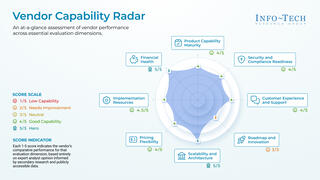
Vendor Capability Radar – Framework Overview
Product Capability Maturity
Assesses the breadth, depth, and stability of the vendor's core solution, including feature completeness, usability, configurability, etc.
Security and Compliance Readiness
Evaluates the vendor's security architecture, data protection practices, regulatory certifications, privacy controls, and ability to meet industry-specific compliance requirements.
Roadmap and Innovation
Reviews the vendor's forward-looking product vision, pace of innovation, R&D investment, release cadence, and ability to adapt to evolving market and technology shifts.
Scalability and Architecture
Examines technical infrastructure, integration flexibility, performance at scale, cloud/on-premises capabilities, API maturity, and long-term architectural sustainability.
Financial Health
Evaluates revenue growth trends, profitability, funding stability, market position, acquisition history, and long-term viability within the competitive landscape.
Pricing Flexibility
Analyzes licensing models, cost transparency, contract structure, scalability of pricing, total cost of ownership, and alignment between commercial terms and delivered value.
Implementation Resources
Assesses deployment methodology, professional services maturity, partner ecosystem strength, change management support, training resources, and implementation risk profile.
Customer Experience and Support
Measures overall client satisfaction, service responsiveness, support model structure, customer retention trends, and quality of ongoing account management.
Info-Tech Insight
The vendor capability radar is a structured, multidimensional evaluation model designed to support transparent and defensible enterprise software selection decisions. It moves vendor selection beyond static rankings and enables leadership teams to evaluate trade-offs across strategic, operational, and organizational dimensions.
About Info-Tech
Info-Tech Research Group is the world’s fastest-growing information technology research and advisory company, proudly serving over 30,000 IT professionals.
We produce unbiased and highly relevant research to help CIOs and IT leaders make strategic, timely, and well-informed decisions. We partner closely with IT teams to provide everything they need, from actionable tools to analyst guidance, ensuring they deliver measurable results for their organizations.
What Is a Blueprint?
A blueprint is designed to be a roadmap, containing a methodology and the tools and templates you need to solve your IT problems.
Each blueprint can be accompanied by a Guided Implementation that provides you access to our world-class analysts to help you get through the project.
Talk to an Analyst
Our analyst calls are focused on helping our members use the research we produce, and our experts will guide you to successful project completion.
Book an Analyst Call on This Topic
You can start as early as tomorrow morning. Our analysts will explain the process during your first call.
Get Advice From a Subject Matter Expert
Each call will focus on explaining the material and helping you to plan your project, interpret and analyze the results of each project step, and set the direction for your next project step.
Unlock Sample Research Build Your Enterprise Application Implementation Playbook
 Master Contract Review and Negotiation for Software Agreements
 Negotiate SaaS Agreements That Are Built to Last
 Governance and Management of Enterprise Software Implementation
 Select Software With the Right Satisfaction Drivers in Mind
 Select an Enterprise Application
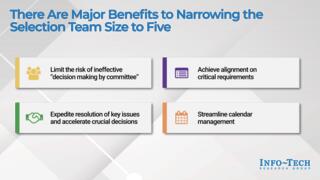 Optimize Your Software Selection Process: Why 5 and 30 Are the Magic Numbers
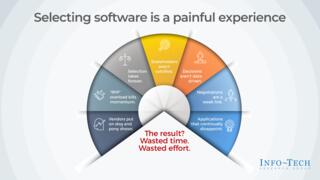 The Rapid Application Selection Framework
 Get the Best Discount Possible With a Data-Driven Negotiation Approach
 Craft a Customer-Driven Market Strategy With Unbiased Data
 Switching Software Vendors Overwhelmingly Drives Increased Satisfaction
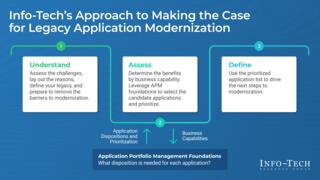 Make the Case for Legacy Application Modernization
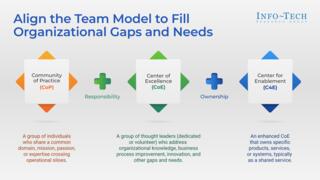 Empower Solution Delivery With the Right CoP, CoE, and C4E Model
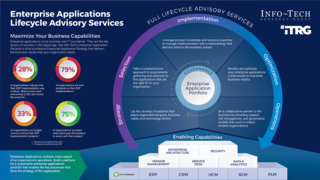 Enterprise Application Change: It's All About Business Capabilities
 2020 Applications Priorities Report
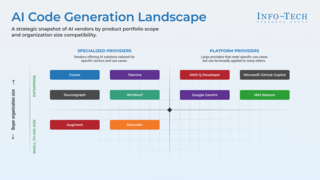 AI-Assisted Code Generation Tools
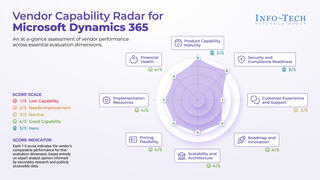 Vendor Spotlight: Microsoft Dynamics 365
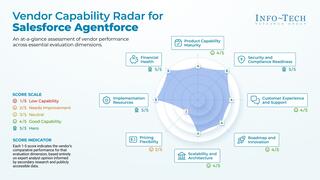 Vendor Spotlight: Salesforce Agentforce Service
 Vendor Spotlight: Microsoft Fabric
 Vendor Spotlight: Salesforce Marketing Cloud
 Vendor Spotlight: VMware Alternatives
 Vendor Spotlight: Microsoft AI
 Vendor Spotlight: Google AI
 Vendor Spotlight: Snowflake Data Platform
 Vendor Spotlight: Five9