
Vendor Spotlight: Microsoft AI
Unlocking value across Microsoft’s AI portfolio
Microsoft’s broad AI ecosystem can be difficult to navigate, encompassing Microsoft 365 Copilot, Copilot Studio, Foundry, Fabric, Azure, GitHub Copilot, Power Platform, and other AI capabilities. Organizations evaluating Microsoft AI must determine which parts of the portfolio are relevant to their priorities, how they fit within existing technology investments, and what level of organizational maturity is required to realize value. Our research provides a structured evaluation framework to help buyers identify where Microsoft's AI portfolio aligns with organizational strategy, where it can deliver measurable business outcomes, and what foundations are needed to support successful adoption.
Navigating Microsoft’s AI portfolio requires looking beyond product momentum or feature excitement. Organizations should consider how the offerings work together, which capabilities warrant investment, and how implementation considerations and value may vary across the portfolio.
1. A full-stack AI platform, not a single tool.
Microsoft's advantage lies in the breadth and integration of its AI portfolio, spanning cloud, data, models, agents, governance, and productivity applications. Realizing its full value requires a clear adoption strategy to avoid overlapping capabilities, fragmented ownership, and unnecessary complexity.
2. Take AI adoption step-by-step.
A phased approach to AI adoption helps organizations tie each implementation to clear business outcomes. Organizations should prioritize the capabilities that solve immediate needs, validate value, and expand adoption over time rather than deploying the full portfolio by default.
3. Evaluate each product on its own merits.
Each product within the portfolio has its own pricing model, certifications, regional availability, support experience, and implementation requirements. Success with one product should not be treated as evidence that the broader portfolio is equally suited to every use case.
Use this research to evaluate Microsoft AI through a structured, criteria-based lens.
This vendor spotlight provides a comprehensive examination of Microsoft’s AI portfolio, including role-based adoption guidance, product deep dives, industry-specific use cases, security and compliance considerations, SoftwareReviews data, and a SWOT analysis. Use this structured framework to:
- Assess how Microsoft’s AI portfolio aligns with the organization’s Microsoft 365, Azure, and data ecosystem.
- Separate near-term Copilot productivity use cases from longer-term agent and data-platform opportunities.
- Evaluate Copilot Studio, Microsoft Foundry, and Microsoft 365 Copilot against business value, technical readiness, and governance maturity.
- Identify where Microsoft’s roadmap supports enterprise priorities such as agents, governance, analytics, and workflow automation.
Vendor Spotlight: Microsoft AI
Unlocking value across Microsoft’s AI portfolio.
Executive summary
Your Challenge
Organizations are under pressure to move beyond AI experimentation and adopt AI in a secure, scalable, and business-aligned way. Microsoft’s AI portfolio is broad, spanning Microsoft 365 Copilot, Copilot Studio, Foundry, Fabric, Azure, GitHub Copilot, Power Platform, and governance capabilities.
The challenge is determining which parts of the portfolio are relevant, where they fit in the broader technology strategy, and what maturity is required to realize value.
Without a structured evaluation lens, buyers risk making decisions based on product momentum or feature excitement rather than readiness, integration fit, governance, and measurable business outcomes.
Common Obstacles
Organizations evaluating Microsoft’s AI portfolio often struggle to separate capability from complexity. Product overlap across Copilot, Copilot Studio, Foundry, Fabric, Azure, GitHub Copilot, and Power Platform can make it difficult to distinguish what is required, optional, or better sequenced later.
Data and governance readiness are often the bigger constraints. Microsoft’s AI capabilities depend on quality enterprise data, mature identity, access controls, and responsible AI policies. Weak data hygiene or unclear ownership can limit adoption and increase risk.
Cost discipline also matters. AI workloads can scale quickly across licenses, cloud consumption, model usage, integration, monitoring, and support, so buyers need a clear operating model before expanding beyond pilots.
Info-Tech’s Approach
Our approach moves beyond AI hype and examines Microsoft AI through a structured, criteria-based lens:
- Assessing fit between Microsoft’s AI portfolio and the organization’s Microsoft 365, Azure, and data ecosystem
- Separating near-term Copilot productivity gains from longer-term agent and data-platform opportunities
- Evaluating Copilot Studio, Microsoft Foundry, and Microsoft 365 Copilot against business value, technical readiness, and governance maturity
- Identifying where Microsoft’s roadmap supports enterprise priorities such as agents, governance, analytics, and workflow automation
Rather than asking whether Microsoft is “a leader in AI,” we assess where its AI portfolio is fit-for-purpose, where it creates measurable value, and what buyers must have in place before scaling.
Info-Tech Insight
Microsoft AI delivers the most value when treated as an integrated Microsoft 365, Azure, and data ecosystem, not a set of standalone AI tools. Its fit is strongest for organizations with mature cloud operations, governed enterprise data, and a phased adoption plan.
Analyst perspective
Microsoft’s AI value is strongest when it is embedded into existing work, governed tightly, and tied to clear business use cases.
Microsoft can be a strong AI platform for organizations that already use its ecosystem, but its value does not come from adopting every Copilot, agent, model, or cloud service it offers. It comes from choosing the parts that solve real business problems. For companies already using Microsoft 365, Azure, Dynamics, GitHub, Fabric, or the Power Platform, Microsoft AI can help bring AI into daily work, connect data and workflows, and reduce the need for employees to move between separate tools.
Microsoft’s main strength is its reach. Products such as Microsoft 365 Copilot, Dynamics 365 AI and agents, Security Copilot, GitHub Copilot, Copilot Studio, Microsoft Foundry, Agent 365, Azure, and Fabric give buyers a broad set of options across productivity, business applications, development, security, data, and cloud infrastructure. This is useful because Microsoft can place AI where work already happens. However, more products and agents do not automatically mean more value. Without clean data, clear ownership, strong access controls, and careful cost management, the portfolio can become hard to govern and expensive to scale.
The evaluation of Microsoft AI should start with where the organization already depends on Microsoft and where AI can remove real friction. Buyers should look at which workflows are slow, which teams will benefit most, what data Copilot and agents can safely use, and how new agents will be approved, monitored, and retired. They should also test where Microsoft’s native tools are good enough and where a specialized AI product or external model may still be a better fit.
To get real value, organizations should adopt Microsoft AI in phases and tie each phase to clear outcomes, such as faster employee support, better sales productivity, quicker security response, improved reporting, stronger knowledge discovery, or more efficient software delivery. Microsoft can be a high-leverage AI choice, but the strongest business case will come from focused execution, not from adopting the full portfolio by default.

Hriday Gulrajani
Senior Analyst, Research | Customer Experience Strategy
Info-Tech Research Group
Senior Analyst, Research | Customer Experience Strategy
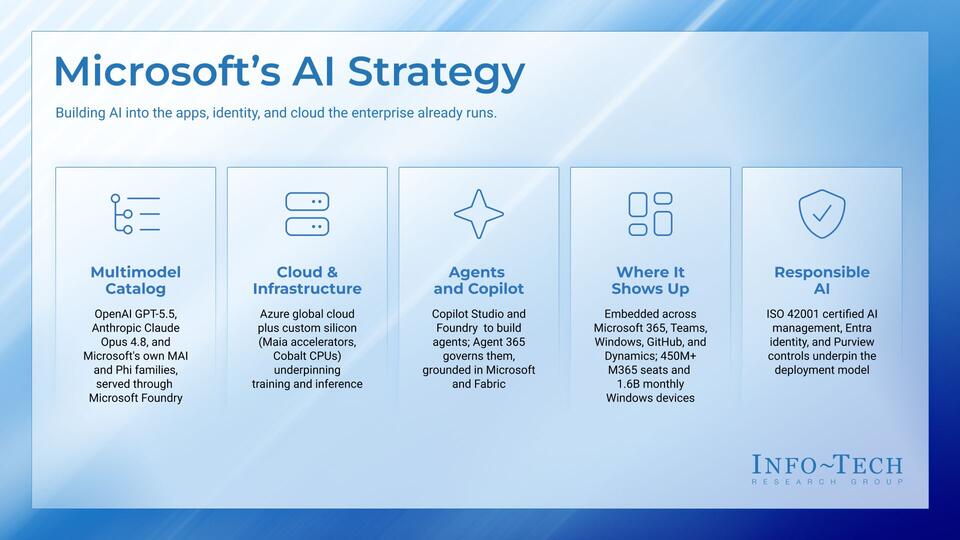
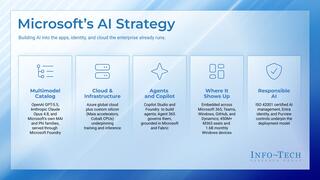
Building AI into the apps, identity, and cloud the enterprise already runs.
Put AI where work already happens: a layered platform spanning Copilot apps, agent building, governance, and the Azure and Fabric data foundation, with multimodel choice across OpenAI, Anthropic, and Microsoft’s own MAI.
Info-Tech synthesis of Microsoft Build 2026 and Microsoft Foundry, Copilot, and Agent 365 documentation.
Multimodel Catalog
OpenAI GPT-5.5, Anthropic Claude Opus 4.8, and Microsoft's own MAI and Phi families, served through Microsoft FoundryCloud & Infrastructure
Azure global cloud plus custom silicon (Maia accelerators, Cobalt CPUs) underpinning training and inferenceAgents and Copilot
Copilot Studio and Foundry to build agents; Agent 365 governs them, grounded in Microsoft and FabricWhere It Shows Up
Embedded across Microsoft 365, Teams, Windows, GitHub, and Dynamics; 450M+ M365 seats and 1.6B monthly Windows devicesResponsible AI
ISO 42001 certified AI management, Entra identity, and Purview controls underpin the deployment model
WHAT SETS MICROSOFT APART
vs. Google
- Reach: Lands in M365 and Windows
- Choice: GPT + Claude in one catalog
- Vertex does not serve OpenAI’s proprietary frontier models
vs. AWS
- Surface: Tied to M365 and Teams
- Workflow: Copilot in daily workflow
- Agent 365 imports Bedrock agents (preview)
vs. Salesforce
- Scope: Platform, not point app
- Stack: Apps to silicon, one vendor
- Owns the cloud; Agentforce rents infra
Microsoft’s Edge
- Context layer: Microsoft IQ (Work, Fabric, Foundry, Web) grounds agents in enterprise signals
- Day-1 distribution: M365, Teams, Windows, GitHub (450M+ seats, 1.6B devices)
- Trust: ISO 42001 governance via Entra, Purview, Agent 365
Speak with category experts to dive deeper into the vendor landscape
SoftwareReviews
Fact-based reviews of business software from IT professionals.
Top-tier data quality backed by a rigorous quality assurance process.
Product and category reports with state-of-the-art data visualization.
User-experience insight that reveals the intangibles of working with a vendor.
CLICK HERE to ACCESS
Comprehensive software reviews to make better IT decisions
We collect and analyze the most detailed reviews on enterprise software from real users to give you an unprecedented view into the product and vendor before you buy.
SoftwareReviews is powered by Info-Tech
Technology coverage is a priority for Info-Tech, and SoftwareReviews provides the most comprehensive, unbiased data on today’s technology. Combined with the insight of our expert analysts, our members receive unparalleled support in their buying journey.
SoftwareReviews’ verdict
Authenticated user reviews. Buy or skip assessment

Strong fit for Azure-invested organizations building ML at scale
2026 Data Quadrant Champion; 92 positive emotional footprint and 95% plan to renew, but support and usability trail the feature scores.
STRENGTHS
Data Integration ★★★★★
Ease of data integration is the top-rated vendor capability at 87, with native ties to the Azure data stack.Model Training ★★★★★
Model training rates 85; reviewers credit AutoML for beginners plus full custom builds for experts.Customization ★★★★★
Ease of customization rates 86, second highest capability; model tuning rates 85.Feature Engineering ★★★★★
Feature engineering rates 84, with data labeling and pre-processing both at 85.
WATCH OUTS
Business value perception
Business Value Created is the lowest-rated capability at 79, below the 80-category average.Vendor support
Vendor Support rates 80, near the bottom of the capability set; plan for self-sufficiency.Learning curve
Usability and Intuitiveness rates 81; reviewers say the full feature set takes time to learn.IT administration
Ease of IT Administration rates 82, slightly below the 83-capability average.Azure dependence
Reviewer-cited value concentrates in the Azure ecosystem; standalone use loses the integration edge.
VERDICT
BEST FIT
Azure-invested enterprises with data and ML engineering teams running production ML at scale.USE CASES THAT WORK
End-to-end MLOps with versioning and monitoring- AutoML for beginners plus custom model building
RECONSIDER IF
Multicloud or non-Azure hosting environment- Organizations that depend heavily on vendor support (rated 80)
- Business value realization is the deciding criterion (rated 79)

Founded 1975 | WA, USA | MSFT (NASDAQ)
bio 


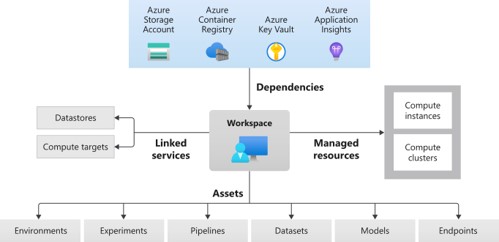
Microsoft Azure Machine Learning is Microsoft's enterprise platform for building, training, deploying, and governing machine learning models on Azure. It combines AutoML, custom training, managed pipelines, and MLOps tooling, and connects into Microsoft Foundry, where Azure ML sits alongside the multimodel catalog (OpenAI GPT, Anthropic Claude, MAI, and Phi).
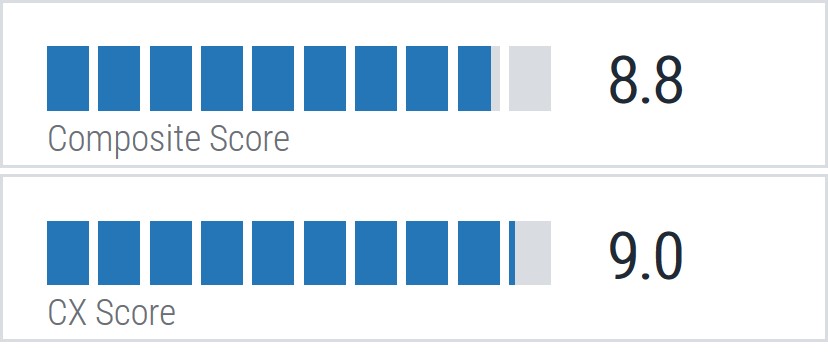
- 8.8 COMPOSITE SCORE
- 9.0 CX SCORE
- +92 EMOTIONAL FOOTPRINT
- 88% LIKELINESS TO RECOMMEND
- 80 REVIEWS
DOWNLOAD REPORT
SoftwareReviews Data Points
Strengths
- 2026 Data Quadrant Champion, Machine Learning Platforms
- Ease of data integration, top vendor capability
- 94% positive sentiment; users cite reliability and security
- AutoML lowers the coding barrier for non-experts
- Built-in MLOps: versioning, monitoring, and model management
Areas to Improve
- Business Value Created is the lowest-rated capability at 79
- Vendor Support (80) and Usability (81) trail other capabilities
Vendor Pulse: How often do we hear about Microsoft (Azure Machine Learning/Foundry)?

Outlining key products within Microsoft’s AI portfolio
Consumer & Workplace Productivity |

Microsoft CopilotConsumer AI assistant for chat, search, writing, image creation, and everyday productivity across web, Windows, Edge, and mobile |

Microsoft 365 CopilotWork AI across Word, Excel, PowerPoint, Outlook, and Teams, grounded in Microsoft 365 content, Work IQ, and user permissions |

Dynamics 365 AI & agentsCopilot and agent experiences across CRM and ERP workflows, including sales, service, finance, supply chain, field service, and customer insights |
Copilot CreateAI image & video creation hub Sora 2 video; Clipchamp editing Inside Microsoft 365 Copilot |
Models, Dev Tools & Governance |

Security CopilotAI for security and IT operations across Defender, Entra, Intune, and Purview, with agents embedded into security workflows |

Microsoft AI (MAI) & PhiMicrosoft first-party model families: MAI for reasoning, image, voice, and speech; Phi for efficient small language models and edge use |

GitHub CopilotAI developer platform for code generation, chat, agent mode, code review, testing, issue handling, and pull-request workflows |

Agent 365Enterprise control plane to observe, govern, secure, and manage AI agents across Microsoft 365, security, and admin environments |
Cloud, Data & Agents |

Copilot StudioLow-code platform to build, customize, connect, publish, and manage agents across M365, Teams, business apps, and external channels |

Microsoft FoundryPlatform to build, ground, evaluate, deploy, observe, and govern AI apps and production-grade agents using models, tools, and agent services |

Microsoft AzureCloud and AI infrastructure for compute, models, app hosting, databases, security, custom silicon, and global deployment |

Microsoft FabricUnified data and analytics platform with OneLake and Fabric IQ to provide trusted data, semantic context, and business meaning for agents |
Architectural overview
The product portfolio as a working stack, from infrastructure at the base to experiences on top.
User-facing layers
|
ApplicationsWhere the business consumes AI. The consumer and workplace productivity tier: Copilot experiences embedded in the apps employees already use. |
Productivity and customer experiences powered by AI
|
Tooling & Control PlaneWhat teams use to build, secure, and govern AI. The dev tools and governance side of the portfolio's middle tier. |
Build, deploy, evaluate, and govern AI
|
|
Model LayerThe reasoning and generation layer. Microsoft's first-party MAI and Phi models alongside OpenAI and Anthropic frontier models, picked per task. |
Foundation and task-specific models
|
|
AI & Data PlatformThe cloud, data, and agent platform. Managed services that build, serve, and orchestrate agents, and the data they depend on. |
Training, serving, orchestration, data, and agent lifecycle
|
|
InfrastructureThe physical foundation. Accelerators, compute, storage, and networking owned and operated by Microsoft Azure. |
Compute, storage, and network primitives
|

Data and AI integration
From unified data foundation to autonomous AI agents
Copilot Studio & Microsoft Foundry
(build and govern enterprise agents)
Agentic AI and Governance
- Copilot Studio (low code) and Microsoft Agent Framework (code-first) for building multistep AI agents
- Agent 365 with Entra identity and Purview controls for enterprise-grade governance
- Wide model catalog in Foundry; agents connect to Microsoft 365 and third-party tools via MCP
Data Ingestion & Processing (Fabric Data Factory + Real-Time Intelligence)
- Real-Time Intelligence enables event ingestion and stream analytics at scale
- Purview provides centralized governance, cataloging, and data quality
- Data Factory supports scheduled batch and event-triggered pipelines
Identity and Data Unification
- OneLake provides one unified, governed copy of enterprise data across the estate.
- Supports direct querying of OneLake data for analytics and AI
AI-Ready Data Platform (Microsoft Fabric/OneLake)
- Provides a uniform way to work with both structured and unstructured data and supports open table formats: Delta Lake natively, Apache Iceberg via two-way virtualization
- Supports multimodal data (text, image, video, logs)
- Fabric IQ adds a semantic layer that grounds agents in governed business data
About Info-Tech
Info-Tech Research Group is the world’s fastest-growing information technology research and advisory company, proudly serving over 30,000 IT professionals.
We produce unbiased and highly relevant research to help CIOs and IT leaders make strategic, timely, and well-informed decisions. We partner closely with IT teams to provide everything they need, from actionable tools to analyst guidance, ensuring they deliver measurable results for their organizations.
What Is a Blueprint?
A blueprint is designed to be a roadmap, containing a methodology and the tools and templates you need to solve your IT problems.
Each blueprint can be accompanied by a Guided Implementation that provides you access to our world-class analysts to help you get through the project.
Talk to an Analyst
Our analyst calls are focused on helping our members use the research we produce, and our experts will guide you to successful project completion.
Book an Analyst Call on This Topic
You can start as early as tomorrow morning. Our analysts will explain the process during your first call.
Get Advice From a Subject Matter Expert
Each call will focus on explaining the material and helping you to plan your project, interpret and analyze the results of each project step, and set the direction for your next project step.
Unlock Sample Research Build Your Enterprise Application Implementation Playbook
 Master Contract Review and Negotiation for Software Agreements
 Negotiate SaaS Agreements That Are Built to Last
 Governance and Management of Enterprise Software Implementation
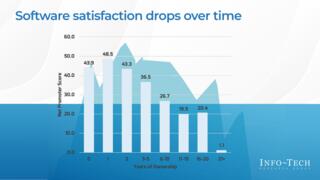 Select Software With the Right Satisfaction Drivers in Mind
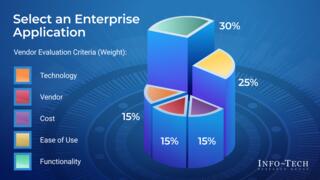 Select an Enterprise Application
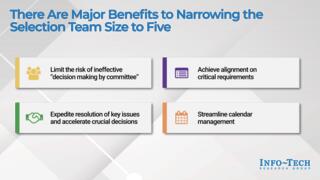 Optimize Your Software Selection Process: Why 5 and 30 Are the Magic Numbers
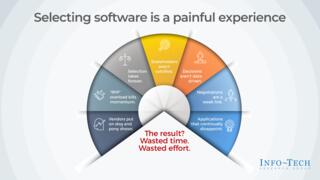 The Rapid Application Selection Framework
 Get the Best Discount Possible With a Data-Driven Negotiation Approach
 Craft a Customer-Driven Market Strategy With Unbiased Data
 Switching Software Vendors Overwhelmingly Drives Increased Satisfaction
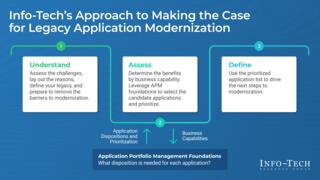 Make the Case for Legacy Application Modernization
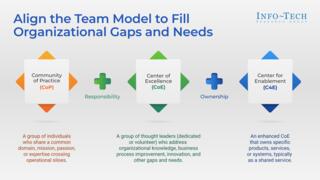 Empower Solution Delivery With the Right CoP, CoE, and C4E Model
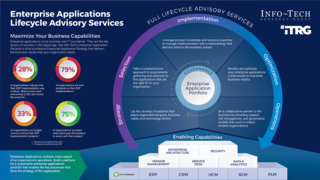 Enterprise Application Change: It's All About Business Capabilities
 2020 Applications Priorities Report
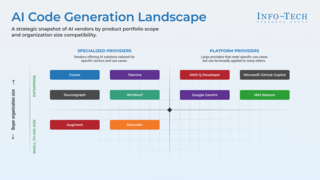 AI-Assisted Code Generation Tools
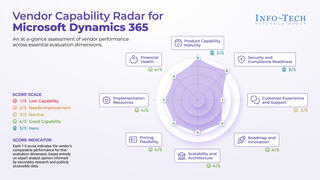 Vendor Spotlight: Microsoft Dynamics 365
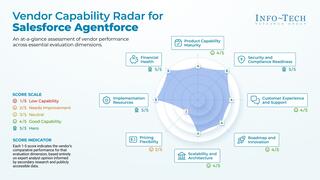 Vendor Spotlight: Salesforce Agentforce Service
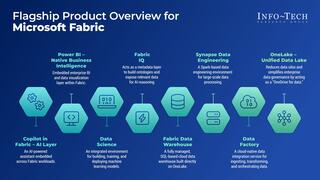 Vendor Spotlight: Microsoft Fabric
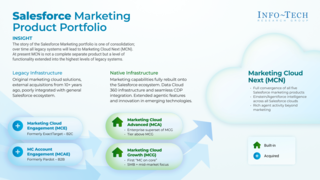 Vendor Spotlight: Salesforce Marketing Cloud
 Vendor Spotlight: VMware Alternatives
 Vendor Spotlight: Microsoft AI
 Vendor Spotlight: Google AI
 Vendor Spotlight: Snowflake Data Platform
 Vendor Spotlight: Five9
