
Vendor Spotlight: Snowflake Data Platform
Simplified data storage and compute with Snowflake.
Organizations often struggle to find, integrate, and analyze data across systems, particularly when access depends on specialized technical expertise. Snowflake offers a compelling solution for centralizing enterprise data and supporting analytics, data sharing, and AI. However, selecting a data platform requires looking beyond technical capabilities to determine how the vendor aligns with organizational needs. This research provides a structured, criteria-driven assessment to help organizations determine whether Snowflake Data Platform is the right fit.
Snowflake combines an accessible user experience with the technical depth required for complex enterprise data workloads. Organizations considering the platform should understand its strengths, architectural gaps, and governance requirements as part of their evaluation.
1. Enterprise data without the technical complexity.
Snowflake’s most compelling differentiator is an easy-to-use data ecosystem that makes data warehousing accessible to less technical users. Its unique architecture enables zero-copy sharing across teams without sacrificing technical depth, allowing different teams to use the same underlying data in different ways.
2. A gap remains in unified analytics.
The separation between Snowflake’s cloud data warehouse and its data lake and lakehouse layers creates friction for organizations seeking unified analytics. Tighter integration between the warehouse and lake would close this gap and enable seamless, end-to-end data workflows.
3. Strong security still requires shared responsibility.
While Snowflake has strong security standards and capabilities, customers still play a crucial role in maintaining security. Clear governance frameworks and correct configurations are essential to making effective use of Snowflake’s security foundations.
Use this research to make an informed decision about Snowflake Data Platform.
This vendor spotlight provides a comprehensive assessment of Snowflake Data Platform, including a vendor summary, an ideal customer persona, a vendor capability radar, product and AI capabilities, pricing and architecture considerations, a product roadmap, SWOT analysis, and SoftwareReviews data. Use this practical framework to:
- Assess Snowflake’s architecture, scalability, data sharing, and ease of use against your organization’s data and analytics requirements.
- Evaluate technical and operational considerations, including pricing, security, governance, implementation, and customer support.
- Understand Snowflake’s overall vendor fit by examining its product strategy, roadmap, partner ecosystem, and long-term viability.
Vendor Spotlight: Snowflake Data Platform
Simplified data storage and compute with Snowflake
Analyst perspective
See vendors for who they are and choose confidently. The right technology choices support your processes and your people.
Effective vendor insight relies on a meaningful understanding of how the platform under consideration fits into an organization's strategy, workflows, and architecture. Demoing products and developing an understanding of capabilities is an essential part of this analysis but does not form the entire grounds for decision-making. The broader identity of a vendor is often overlooked despite the major impact this can have on the product lifecycle.
Snowflake Data Platform became a market leader by providing an easy-to-use and understand data ecosystem that makes data warehousing accessible to less technical users without sacrificing technical functionality. Snowflake's unique architecture facilitates zero-copy sharing of defined data terminals (e.g. data marts, data warehouses) with external users and lets different teams and departments activate the same base data in different ways. Ingestion pipelines make it easy to input data into the system without needing to establish complicated storage infrastructures.
Snowflake holds a very strong financial position and top-market brand recognition, indicating good stability and longevity for this vendor in the long term. In wider market trends, the rise of AI has drastically heightened the demand for data solutions. Snowflake is well positioned to help facilitate the increasing adoption of data infrastructure for less technical users.
Smart vendor selection is not just about choosing a certain product; it's about ensuring a total alignment between the vendor and buyer's needs. Snowflake will be a great option for organizations intimidated by highly technical data platform options, looking for an option that is easy to adopt and understand.

Maya Chambers
Senior Advisory Analyst, Research Innovation | Vendor Selection | Customer Experience Strategy
Info-Tech Research Group
Executive summary
Your Challenge
Many organizations choose a vendor on product capabilities alone, then struggle with failed deployments, insufficient customer service, or sudden product-market shifts that force them to go back to the drawing board. Complex enterprise-level vendors can be difficult to navigate and make informed decisions around.
As competitive landscapes shift more quickly, IT leaders must rely on accurate, relevant, and timely vendor intelligence to guide strategic sourcing decisions. With too much diverse analysis about top-market vendors such as Snowflake, it can be difficult to decide who to trust.
Common Obstacles
Data platforms are an area in which incredible value can be derived, but the technologies and market are evolving quickly. To determine the best path forward, understanding a vendor's strategic perspective is more important now than ever.
As technologies continue to change, data also becomes more important. Companies seeking a reliable data ecosystem like Snowflake want to understand how the various business functions integrate and how data infrastructure operates - and such information can be difficult to synthesize.
Info-Tech's Approach
We apply a structured, criteria-driven assessment to identify and spotlight vendors that deliver the most credible, relevant, and forward-looking capabilities.
Our approach prioritizes synthesis over aggregation, distilling vendor inputs into clear, actionable guidance that directly supports your strategic vendor sourcing and software procurement priorities. It enables your teams to stay focused on decision-making rather than information vetting and ensures you maintain a proactive, well-informed view of evolving market patterns and industry trends.
Info-Tech Insight
Snowflake's most compelling differentiator is an easy-to-use data ecosystem that makes warehousing accessible to less technical users, with a unique architecture that enables zero-copy sharing across teams without sacrificing technical depth.
Vendor Snapshot
Meet Snowflake Data Platform: No Fluff, Just the Facts
Headquarters
Menlo Park, California, USA
Target Verticals
Financial Services, Retail & Consumer Goods, Healthcare & Life Sciences, Manufacturing, Telecommunications, Technology, Media & Entertainment, Public Sector, Energy
Target Customer Size Profile
Mid-market, large enterprise, global organizations with significant analytics, data engineering, AI requirements.
Vendor
Snowflake
Established Date
2012
Key Executives
CEO: Sridhar Ramaswamy
President/Founder: Benoit Dageville
CTO/Founder: Thierry Cruanes
No. of Employees
~9,060
Website URL
www.snowflake.com/en
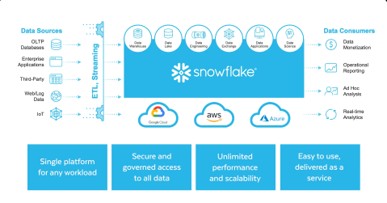
Image source: Snowflake, "Snowflake in 8 Minutes"
history
Snowflake has evolved from a cloud data warehouse pioneer into a leading AI-driven data cloud platform focused on analytics, collaboration, and enterprise AI workloads.
2024
Sridhar Ramaswamy succeeds Frank Slootman as CEO and accelerates Snowflake's AI Data Cloud strategy.
2020
Completes one of the largest software IPOs in history, raising approximately $3.4 billion.
2019
Frank Slootman becomes CEO and Snowflake launches Data Exchange, accelerating data-sharing capabilities.
2018
Expands beyond AWS by launching on Microsoft Azure, strengthening its multicloud strategy.
2014
Launches its first commercial cloud data warehouse, pioneering independent scaling of compute and storage resources.
2014
Emerges from stealth mode and introduces its cloud-native data platform, initially running exclusively on Amazon Web Services.
2012
Snowflake is founded in San Mateo, California by former Oracle architects Beno t Dageville and Thierry Cruanes, alongside Marcin Zukowski.
FINANCIAL SUMMARY
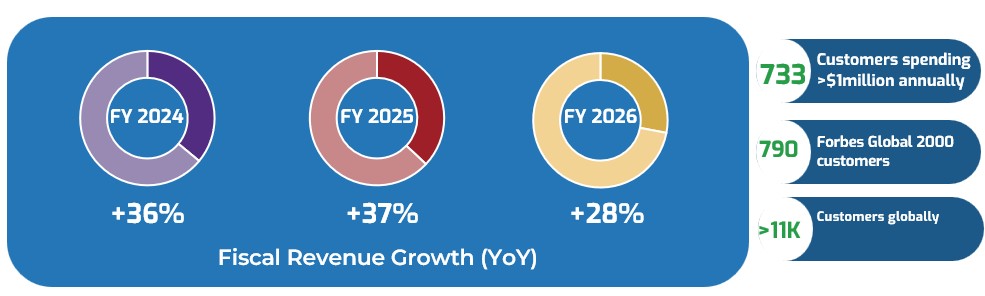
Gross Revenues
(2026)
$4.92 Billion
Change Over Last Year:
(+28%)
GROSS PROFIT
$3.18 Billion
Change Over Last Year:
(+29%)
125% net revenue retention rate
Existing customers spent approximately 35% more than the previous year. This is slightly lower than historical peaks but remains one of the strongest retention metrics in any enterprise software.
42% YOY remaining performance obligations
Remaining Performance Obligations (RPO) is a key indicator of contracted future revenue. This is growing at a high rate and reached $9.77 billion this year suggesting continued strong enterprise demand and long-term customer commitments.
Cash generation is a major strength
$1.19 Billion
Generated in adjusted free cash flow in 2026
25% free cash flow margin
Despite reporting a GAAP net accounting loss due to stock-based compensation, cash flows remain high, demonstrating operational profitability.
Info-Tech Insight
Snowflake pairs 28% growth with 125% net revenue retention and a $9.77B backlog, and funds itself with $1.19B of free cash flow at a 25% margin, built to outlast any SaaS downturn.
Snowflake data platform
Cloud Data Warehouse
Snowflake's core platform provides a fully managed, cloud-native data warehouse that separates compute and storage, allowing organizations to independently scale workloads, optimize performance, and reduce infrastructure management complexity.
Multicloud Data Platform
Snowflake operates across AWS, Microsoft Azure, and Google Cloud, enabling organizations to deploy workloads in their preferred cloud while supporting cross-cloud collaboration and reducing vendor lock-in concerns.
Data Sharing & Collaboration
Secure Data Sharing allows organizations to share live, governed datasets with customers, suppliers, and partners without copying or moving data, accelerating collaboration while maintaining security and control.
Data Lake & Lakehouse Support
Snowflake unifies structured, semi-structured, and unstructured data within a single platform, enabling organizations to support data warehousing, lakehouse architectures, analytics, and AI workloads from one environment.
Snowpark Developer Framework
Snowpark enables developers and data engineers to build applications, data pipelines, and machine learning workloads using familiar languages such as Python, Java, and Scala directly within Snowflake.
Data Marketplace & Data Exchange
Snowflake Marketplace provides access to thousands of third-party datasets, applications, and data products, allowing organizations to enrich analytics, accelerate innovation, and create new revenue opportunities.
AI & Machine Learning Services
Cortex AI provides built-in generative AI, large language model integration, vector search, and AI-powered analytics capabilities, allowing organizations to build and deploy AI applications using governed enterprise data.
Iceberg Tables
Apache Iceberg tables differ from traditional SQL or delta lake or postgres structures. Apache Iceberg Tables seem to have become a de facto standard for Zero-ETL connectivity as they support metadata sharing.
Vendor pricing tier analysis
Customer Service
Source
Snowflake
Standard
US$2/credit
Standard SQL, advanced DML, semi-structured/geospatial/unstructured data support
Virtual warehouses, resource monitors UDFs, stored procedures, external functions, dynamic/external/hybrid/Iceberg tables
Bulk and streaming data loading (Snowpipe, Kafka connector)
Streams and tasks
Database/share replication
Snowflake Marketplace, Cortex AI functions, ML functions, Model Registry, Feature Store Standard
Time Travel (1 day), Fail-safe (7 days), object tagging SOC 2 Type II, federated auth/SSO, OAuth, MFA, network policies, encryption
Premier support (24/7, 1-hour response for Sev 1)
Enterprise
US$3/credit
Everything in Standard, plus features for larger organizations:
24-hour early access to weekly releases
Multicluster virtual warehouses (for concurrency scaling)
Extended Time Travel (up to 90 days)
Column-level and row-level security, aggregation/projection policies, differential privacy
Data classification, periodic rekeying of encrypted data
Audit history via ACCESS_HISTORY view, event tables
Query acceleration, search optimization, materialized views
Synthetic data generation, data quality/metric functions
Ability to create/manage your own Data Clean Rooms
Business Critical
US$4/credit
(formerly "Enterprise for Sensitive Data") - everything in Enterprise, plus heightened security/compliance for sensitive data (e.g. PHI under HIPAA/HITRUST):
Customer-managed encryption keys (Tri-Secret Secure)
Private connectivity (AWS PrivateLink, Azure Private Link, Google Cloud Private Service Connect) for inbound/outbound traffic, internal stages, external volumes, and Open Catalog
Support for PHI, PCI DSS, FedRAMP/ITAR, and IRAP-Protected data
Account failover/failback and redirected client connections for disaster recovery
Amazon API Gateway private endpoints for external functions
Requires a signed BAA before storing PHI data
Ideal Customer Persona #1
Defining Key Buyer Attributes
Innovation-first leader who prioritizes speed to value over infrastructure control, willing to cede hardware, tuning, and day-to-day operations to a fully managed cloud service, strongly prefers SaaS and cloud-native platforms to offload operational burden, comfortable running multiple operational platforms across multiple clouds, and measures success by analytics velocity, time-to-market, and business outcomes rather than system uptime.
Primary Target Roles
Chief Information Officer (CIO)
Chief Technology Officer (CTO)
Chief Digital & Innovation Officer
Chief Data Officer
VP, Cloud & Platform Engineering
Industry Segmentation Strengths
Financial Services, Technology & Software, Retail & eCommerce, Telecommunications, Media & Entertainment, Healthcare & Life Sciences
Fast-moving, digitally competitive industries where speed to innovation, elastic scale, and multicloud flexibility matter more than owning and operating infrastructure.
Non-Profit Sector Spotlight
Why Non-Profits Choose Snowflake
Mission-driven organizations unify fragmented fundraising, program, and impact data on a single governed platform, replace manual reporting with real-time dashboards, meet strict security and compliance requirements, and stretch limited budgets with a pay-only-for-what-you-use model that funds more mission and less infrastructure.
Non-Profit & NGO Clients
Direct Relief - humanitarian aid across 80+ countries
Ascend Public Charter Schools
New York University
Women in Data (Snowflake for Good partner)
Special Pricing & Features
Registered nonprofits and NGOs can qualify for significant discounts off standard pricing (reported up to 40-80%), with low-cost entry options for smaller organizations
Government & Education Data Cloud: pre-built solutions, industry datasets, and a partner ecosystem, backed by FedRAMP Moderate and StateRAMP High compliance
Consumption-based pricing, Snowflake Marketplace data sharing for cross-organization collaboration, and Cortex AI for impact analytics
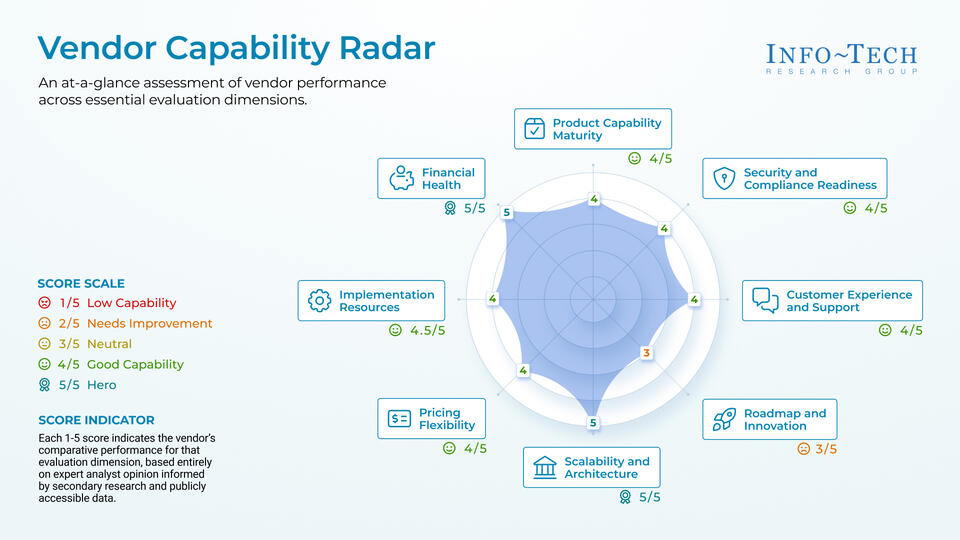
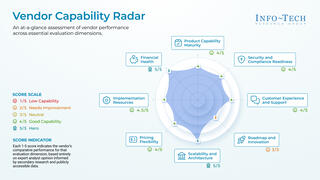
Vendor Capability Radar - Framework Overview
Product Capability Maturity
Assesses the breadth, depth, and stability of the vendor's core solution, including feature completeness, usability, configurability, etc.
Financial Health
Evaluates revenue growth trends, profitability, funding stability, market position, acquisition history, and long-term viability within the competitive landscape.
Security and Compliance Readiness
Evaluates the vendor's security architecture, data protection practices, regulatory certifications, privacy controls, and ability to meet industry-specific compliance requirements.
Pricing Flexibility
Analyzes licensing models, cost transparency, contract structure, scalability of pricing, total cost of ownership, and alignment between commercial terms and delivered value.
Roadmap and Innovation
Reviews the vendor's forward-looking product vision, pace of innovation, R&D investment, release cadence, and ability to adapt to evolving market and technology shifts.
Implementation Resources
Assesses deployment methodology, professional services maturity, partner ecosystem strength, change management support, training resources, and implementation risk profile.
Scalability and Architecture
Examines technical infrastructure, integration flexibility, performance at scale, cloud/on-premises capabilities, API maturity, and long-term architectural sustainability.
Customer Experience and Support
Measures overall client satisfaction, service responsiveness, support model structure, customer retention trends, and quality of ongoing account management.
Info-Tech Insight
A structured, multi-dimensional evaluation model designed to support transparent and defensible enterprise software selection decisions moves vendor selection beyond static rankings and enables leadership teams to evaluate trade-offs across strategic, operational, and organizational dimensions.
About Info-Tech
Info-Tech Research Group is the world’s fastest-growing information technology research and advisory company, proudly serving over 30,000 IT professionals.
We produce unbiased and highly relevant research to help CIOs and IT leaders make strategic, timely, and well-informed decisions. We partner closely with IT teams to provide everything they need, from actionable tools to analyst guidance, ensuring they deliver measurable results for their organizations.
What Is a Blueprint?
A blueprint is designed to be a roadmap, containing a methodology and the tools and templates you need to solve your IT problems.
Each blueprint can be accompanied by a Guided Implementation that provides you access to our world-class analysts to help you get through the project.
Talk to an Analyst
Our analyst calls are focused on helping our members use the research we produce, and our experts will guide you to successful project completion.
Book an Analyst Call on This Topic
You can start as early as tomorrow morning. Our analysts will explain the process during your first call.
Get Advice From a Subject Matter Expert
Each call will focus on explaining the material and helping you to plan your project, interpret and analyze the results of each project step, and set the direction for your next project step.
Unlock Sample Research Build Your Enterprise Application Implementation Playbook
 Master Contract Review and Negotiation for Software Agreements
 Negotiate SaaS Agreements That Are Built to Last
 Governance and Management of Enterprise Software Implementation
 Select Software With the Right Satisfaction Drivers in Mind
 Select an Enterprise Application
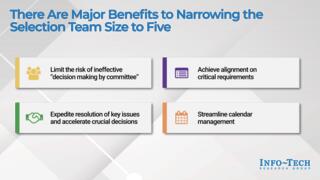 Optimize Your Software Selection Process: Why 5 and 30 Are the Magic Numbers
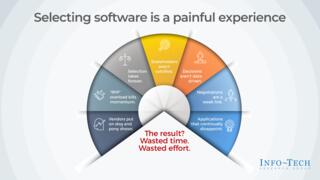 The Rapid Application Selection Framework
 Get the Best Discount Possible With a Data-Driven Negotiation Approach
 Craft a Customer-Driven Market Strategy With Unbiased Data
 Switching Software Vendors Overwhelmingly Drives Increased Satisfaction
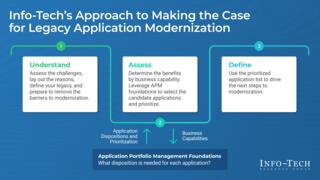 Make the Case for Legacy Application Modernization
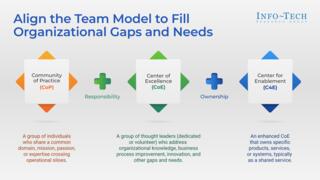 Empower Solution Delivery With the Right CoP, CoE, and C4E Model
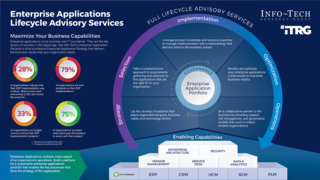 Enterprise Application Change: It's All About Business Capabilities
 2020 Applications Priorities Report
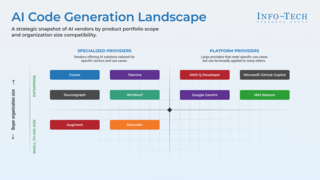 AI-Assisted Code Generation Tools
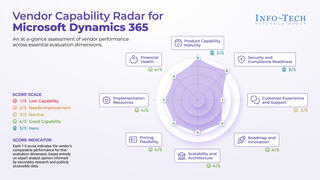 Vendor Spotlight: Microsoft Dynamics 365
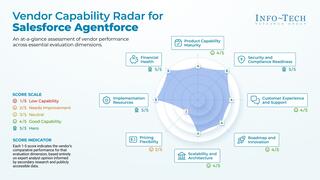 Vendor Spotlight: Salesforce Agentforce Service
 Vendor Spotlight: Microsoft Fabric
 Vendor Spotlight: Salesforce Marketing Cloud
 Vendor Spotlight: VMware Alternatives
 Vendor Spotlight: Microsoft AI
 Vendor Spotlight: Google AI
 Vendor Spotlight: Snowflake Data Platform
 Vendor Spotlight: Five9
