




Fund growth while protecting margins
The Challenge
Thin margins limit the investment needed to grow.
Volatile rates, high fuel and labor costs, and heavy asset requirements squeeze transportation and logistics margins. Without disciplined cost control, there is little room to fund the technology and capacity that growth demands.
Why It Matters
Disciplined operations free the cash that funds growth.
McKinsey reports that redesigning networks with multisourcing and smarter inventory cuts emergency logistics costs by 20% while freeing working capital for growth ("Decoding Disruption," McKinsey, 2026). Protecting margin is what makes continued investment in capacity and technology possible.
The Solution
Attack cost to serve
Use network optimization, empty-mile reduction, and automation to lower unit cost.
Tie investment to measurable return
Prioritize technology and capacity spend by payback and service impact.
Free up working capital
Use smarter inventory, multisourcing, and asset utilization to release cash for growth.


Build network agility and resilience
The Challenge
Disruption is now constant, and rigid networks cannot keep up.
Weather, geopolitics, demand swings, and capacity shocks hit freight networks with little warning. Carriers and logistics providers that cannot reroute and rebalance quickly absorb delays, penalties, and lost freight.
Why It Matters
Resilience now separates the winners from the disrupted.
Heading into 2026, shippers are prioritizing reliable capacity over rock-bottom rates as carrier bankruptcies rise and margins thin, effectively buying risk mitigation rather than just a low price ("5 Logistics Trends to Watch in 2026," Supply Chain Dive, 2026). The networks built to flex and reroute will hold service and margin while rigid ones break.
The Solution
Build dynamic rerouting capability
Use real-time network monitoring and scenario planning to reroute freight and rebalance capacity as conditions change.
Diversify carriers, lanes, and modes
Reduce single points of failure with multi-carrier, multimodal, and regional options.
Run disruption playbooks
Prebuild response plans and decision rights so the network reacts in hours, not days.


Simplify and optimize the freight network
The Challenge
Fragmented systems and manual handoffs make the network slow and costly.
Disconnected planning, siloed modes, and hidden lower-tier dependencies create waste and rework across the network. Without standardization and optimization, every shipment costs more than it should.
Why It Matters
Simplifying and optimizing the network pays back fast.
McKinsey found that most companies still understand their supply chain risks only down to tier one, and that redesigning networks with multisourcing and digital planning cut stockouts by 30% and emergency logistics costs by 20% ("Decoding Disruption," McKinsey, 2026). Optimizing the connected network is one of the highest-return moves available.
The Solution
Standardize core processes and data
Harmonize workflows and master data across modes and partners to cut rework and errors.
Integrate planning and execution systems
Connect transportation and warehouse management systems (TMS and WMS) and partner platforms so the network runs on one shared picture.
Optimize routing and load
Use AI-driven route, load, and network optimization to cut empty miles and cost per shipment.


Achieve end-to-end shipment visibility
The Challenge
Shippers and carriers still operate with blind spots across the network.
Limited tracking across modes, partners, and lower supply chain tiers leaves teams reacting to problems after they happen. Without true end-to-end visibility, exceptions surface too late to fix cheaply.
Why It Matters
Visibility is the foundation every other improvement depends on.
QIMA's 2026 Global Sourcing Survey of more than 1,000 businesses found the average company now maps only about 60% of its supplier network, and just 18% have full end-to-end visibility ("Global Sourcing Survey," QIMA, 2026). You cannot optimize, derisk, or reliably serve what you cannot see.
The Solution
Deploy real-time tracking across modes
Instrument shipments and assets with telematics and Internet of Things (IoT) sensors for live location and status.
Extend visibility to partners and lower tiers
Share data with carriers, suppliers, and customers to see beyond tier one.
Turn visibility into proactive alerts
Use exception management and predictive ETAs so teams act before problems escalate.


Stabilize the driver and frontline workforce
The Challenge
An aging, shrinking workforce threatens capacity across every frontline role.
Retirements outpace new entrants while turnover stays punishingly high among drivers, dispatchers, planners, warehouse and cross-dock workers, and mechanics. Persistent labor gaps cap capacity, raise costs, and put service commitments at risk.
Why It Matters
Capacity and service depend on solving the workforce gap.
The American Trucking Associations projects a driver shortage of roughly 82,000 in 2026, climbing toward 160,000 by 2031, with turnover above 90% at large truckload carriers and the industry needing about 1.2 million new drivers over the next decade ("Truck Driver Shortage 2026," Peak Transport, 2026). The gap extends to dispatch, maintenance, and warehouse roles, so operators that fix recruitment and retention across the frontline now will protect the capacity their customers depend on.
The Solution
Widen the talent pipeline
Partner with training programs and target younger and underrepresented workers for driving, dispatch, maintenance, and warehouse roles.
Improve retention and the job experience
Reduce wait times, improve home time and pay, and use technology to ease the daily job across the frontline.
Augment labor with technology
Use automation, driver-assist, and digital workflows to do more with the workforce available.
Deliver reliable, transparent customer service
The Challenge
Customers now expect retail-grade reliability and transparency.
Shippers and consignees demand accurate ETAs, proactive exception alerts, on-time delivery, and claims transparency as standard. Missed commitments and poor communication quickly erode trust and revenue.
Why It Matters
Reliability and transparency are now the basis of competition and retention.
Ryder's 2026 freight outlook notes that real-time visibility has shifted from a nice-to-have to a core requirement, as shippers demand accurate status, proactive updates, and consistent service ("2026 Freight Market Update," Ryder, 2026). Providers that communicate and resolve exceptions faster will hold the customers others lose to missed commitments.
The Solution
Commit to accurate, proactive ETAs
Use predictive arrival times and automated status updates to set and meet expectations.
Manage exceptions before they reach the customer
Detect delays early and resolve or communicate them before the customer is affected.
Measure and close service gaps
Track on-time and reliability metrics by lane and customer and act on the weakest points.

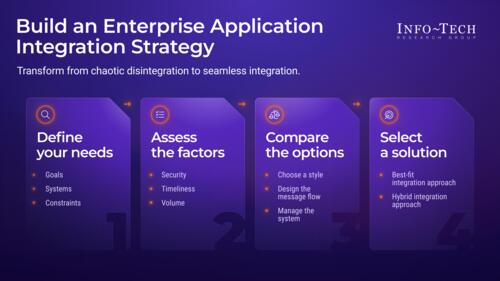
Modernize transportation operating systems and integration architecture
The Challenge
Aging systems and brittle integrations hold the whole network back.
Legacy transportation and logistics platforms resist integration, automation, and real-time data, and point-to-point connections break as volume grows. Maintaining them drains budget and blocks the visibility and optimization the business now needs.
Why It Matters
Modern, connected systems are the platform for visibility and optimization.
Going into 2026, logistics leaders see AI-driven tools, automated quoting, carrier matching, predictive load planning, and real-time shipment visibility, as a durable investment regardless of market conditions, yet legacy platforms and brittle integrations hold them back ("The State of LTL Freight in 2026," PLS Logistics, 2026). Modernizing the core is what makes every other priority achievable.
The Solution
Map and prioritize the technology estate
Inventory legacy systems and integrations and target the highest-friction platforms for modernization first.
Move to integrated, cloud-based platforms
Replace point tools with connected transportation and warehouse management systems (TMS, WMS) and a modern integration layer (APIs/iPaaS) that shares data.
Modernize without disrupting operations
Phase migrations with pilots and training so live freight is never put at risk.


Decarbonize fleets and meet climate mandates
The Challenge
Decarbonization pressure is mounting across freight and logistics.
Fuel costs, customer net-zero commitments, and tightening emissions rules are reshaping how goods move. Operators without a credible decarbonization plan face rising costs, lost contracts, and compliance risk.
Why It Matters
Decarbonization is now both a commercial and a regulatory imperative.
Logistics Management's 2026 outlook reports that stronger clean-fuel standards and shipper decarbonization goals are accelerating adoption of alternative fuels, renewable diesel, and renewable natural gas, along with emissions-tracking technology and mode conversion ("2026 Rate Outlook,"Logistics Management, 2026). Operators that cut emissions now will win climate-conscious freight and stay ahead of tightening rules.
The Solution
Measure and report freight emissions
Build auditable emissions data across owned and contracted transportation to meet disclosure demands.
Improve fleet and fuel efficiency
Use route optimization, load consolidation, and idle reduction to cut fuel use and emissions now.
Plan the fleet energy transition
Pilot electric, alternative-fuel, and low-carbon options and build the charging and refueling roadmap.
Defend operations from cyber disruption
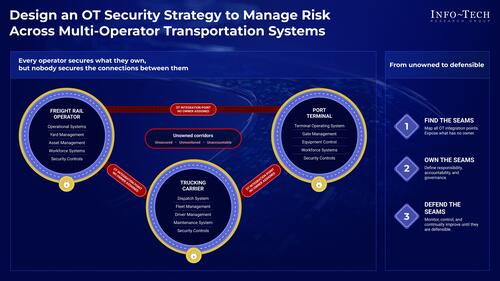
The Challenge
Connected, digitized logistics has widened the attack surface.
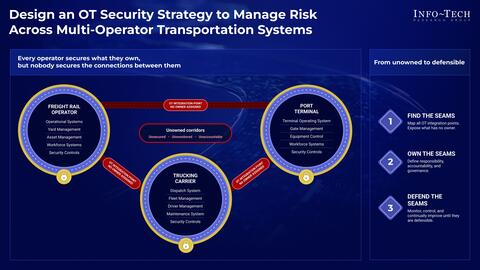
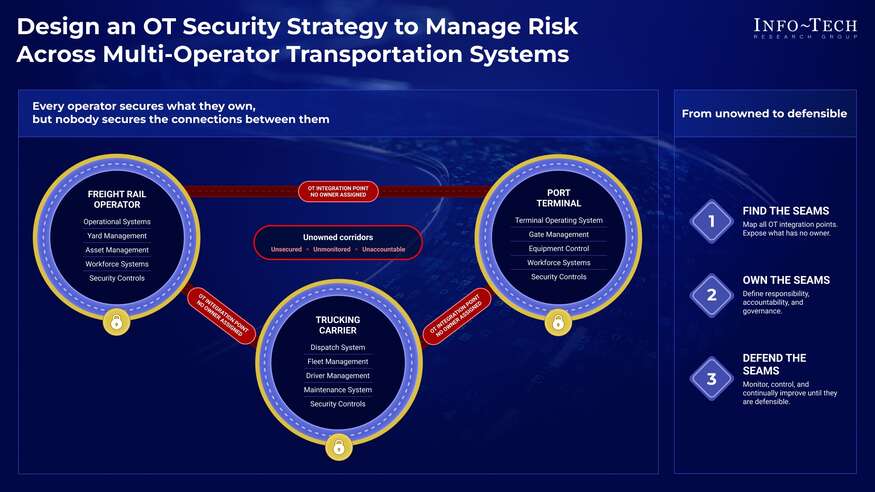
Transportation systems, telematics, and partner integrations expose carriers and logistics providers to ransomware and data theft. A single attack can halt dispatch, ports, or warehouses and ripple across the supply chain.
Why It Matters
A cyberattack can halt freight as fast as any physical blockage.
ENISA's 2025 Threat Landscape ranks transport among the EU's most-targeted critical sectors and identifies ransomware as a prime, highly disruptive threat, with maritime, freight, and aviation operations hit by attacks (ENISA, 2025). Treating security as core to operations is now essential to keeping goods moving.
The Solution
Secure IT, OT, and connected assets
Protect dispatch, telematics, and operational technology with segmentation, monitoring, and access controls.
Harden the partner ecosystem
Vet and monitor the carriers, brokers, and software vendors that connect to your systems.
Build ransomware resilience
Maintain tested backups, multifactor authentication, and an incident response plan so an attack cannot stop freight.


Build trusted operational decision intelligence
The Challenge
Data alone does not run the network, decisions do.
Transportation management systems, telematics, partners, and spreadsheets each hold fragmented data, leaving pricing, dispatch, routing, capacity, and maintenance calls to be made on gut feel and stale reports. Without trusted decision intelligence, leaders miss the window to prevent delays, cost overruns, and lost loads.
Why It Matters
Decision intelligence is where data converts into margin.
Transportation Insight's Q1 2026 Transportation Outlook finds that shippers who stay focused on data quality, contractual discipline, and strong carrier partnerships, watching indicators like consumer confidence, fuel, and industrial activity to adjust before inflection points, are best positioned in a quietly tightening market (Transportation Insight, 2026). Turning network data into fast, trusted decisions across pricing, routing, capacity, and service is what separates leaders from laggards.
The Solution
Unify network data into one foundation
Integrate transportation management systems (TMS), telematics, partner, and financial data into a governed, trusted source.
Embed decision intelligence in operations
Deliver analytics and recommendations for pricing, dispatch, routing, capacity, maintenance, fuel, safety, and labor where decisions are made.
Apply AI and scenario modeling
Use forecasting and digital twins to test responses to disruption before committing.


Comprehensive Transportation & Logistics Industry Coverage



Testimonials

“To be able to go to one Info-Tech analyst and get a really good business context and then go to another analyst to get a really good architectural oversight and technical depth is absolutely brilliant.”
Jackie Dawson, CIO, Lyttelton Port Company
View Full Case Study
“The great byproduct of all the Info-Tech engagements is that it’s building a reputation that IT knows what they are doing. We have earned the trust all the way up to the C-suite and board.”
Daniel Millbank, Director of IT, Xpress Global Systems, LLC.
View Full Case Study