
Define Your Industry-Specific Transformation Through Capability Mapping
Turn your reference architecture from insight to impact.
Organizations struggle to turn pain points into transformation opportunities and industry-specific insights that guide decision-making.
Difficulty connecting processes to capabilities and technology is challenging. This disconnect makes it hard to identify where new technology will have the most impact, leading to misaligned opportunities.
Prioritizing initiatives amid competing demands causes difficulty in determining where to focus for maximum impact, which dilutes effort and slows transformation.
Our Advice
Critical Insight
Deeper industry mapping reveals the specific opportunities that matter, showing exactly where to disrupt, where to invest, and where to stop wasting effort.
Impact and Result
Analyze sector and organizational challenges, defining operational pain points through personas and problem statements to determine use cases for transformation.
Operationalize business architecture by mapping your impacted processes to enabling technology and level 3 capabilities and evaluating specific use cases across the elements to indicate the holistic impact.
Identify opportunities for improvement, innovation, or optimization across capabilities, processes, and technology. Prioritize and roadmap initiatives based on their industry impact, feasibility, and cost.
Member Testimonials
After each Info-Tech experience, we ask our members to quantify the real-time savings, monetary impact, and project improvements our research helped them achieve. See our top member experiences for this blueprint and what our clients have to say.
9.0/10
Overall Impact
$22,079
Average $ Saved
35
Average Days Saved
Client
Experience
Impact
$ Saved
Days Saved
Doosan Bobcat North America, Inc.
Guided Implementation
9/10
$22,079
35
I appreciated that Shreyas was invested in understanding our targeted outcome in using the Business Capability Model. I actually was concerned tha... Read More
Define Your Industry-Specific Transformation Through Capability Mapping
Turn your reference architecture from insight to impact.
Analyst perspective
Turn mapping into momentum.
Organizations often find themselves stuck with generic capability maps that fail to capture the nuances of their industry or sector. While these artifacts can illustrate value streams and highlight broad areas of improvement, they rarely provide the level of depth needed to make truly informed decisions. By moving beyond surface-level mapping into detailed level 3 capabilities, specific processes, and enabling technologies, this gap can be addressed. By tying business architecture directly to industry-specific realities, leaders can see not only how their organizations deliver value today, but also where new technologies and innovations have the potential to redefine value tomorrow.
The value of this approach lies in its ability to transform static diagrams into actionable roadmaps. Deeper industry-aligned mapping equips business and IT leaders with a clear view of where to disrupt, where to double down on investment, and where to stop wasting resources. By linking real problems to capabilities, processes, and technologies, organizations can uncover both strengths and vulnerabilities, helping leaders prioritize transformation initiatives with confidence. Whether the goal is to document architecture with greater granularity, prepare for industry shifts, or identify opportunities for innovation, this approach helps organizations move from insight to execution, building capability-driven strategies that deliver lasting competitive advantage.

Elizabeth Silva Smulski
Research Lead, Industry Practice
Info-Tech Research Group
Executive summary
Your Challenge
Organizations struggle to turn pain points into transformation opportunities and industry-specific insights that guide decision-making.
Difficulty connecting processes to capabilities and technology is challenging. This disconnect makes it hard to identify where new technology will have the most impact, leading to misaligned opportunities.
Prioritizing initiatives amid competing demands causes difficulty in determining where to focus for maximum impact, which dilutes effort and slows transformation.
Common Obstacles
Limited expertise causes barriers to conducting deeper mapping as it requires specialized business architecture knowledge and cross-functional input, which many organizations lack.
Disconnections between capabilities and technology cause disruptions across processes and make it difficult to identify value creation.
Resistance to transformation efforts is common, especially when the benefits of deeper mapping are not immediately visible.
Solution
Analyze sector and organizational challenges, defining operational pain points through personas and problem statements to determine use cases for transformation.
Operationalize business architecture by mapping your impacted processes to enabling technology and level 3 capabilities and evaluating specific use cases across the elements to indicate the holistic impact.
Identify opportunities for improvement, innovation, or optimization across capabilities, processes, and technology. Prioritize and roadmap initiatives based on their industry impact, feasibility, and cost.
Info-Tech Insight
Deeper industry mapping reveals the specific opportunities that matter, showing exactly where to disrupt, where to invest, and where to stop wasting effort.
Define Your Industry-Specific Transformation Through Capability Mapping
Turn your reference architecture from insight to impact.
EXECUTIVE BRIEF
Business architecture is a domain and starting point within enterprise architecture
Enterprise architecture (EA) is a discipline that defines the structure and operation of an organization. EA determines the organization’s current state and how it can most effectively move toward the future state and achieve its objectives. Business architecture provides a framework that connects business strategy and IT strategy to project execution through a set of capabilities and models that provide clarity and actionable insights.
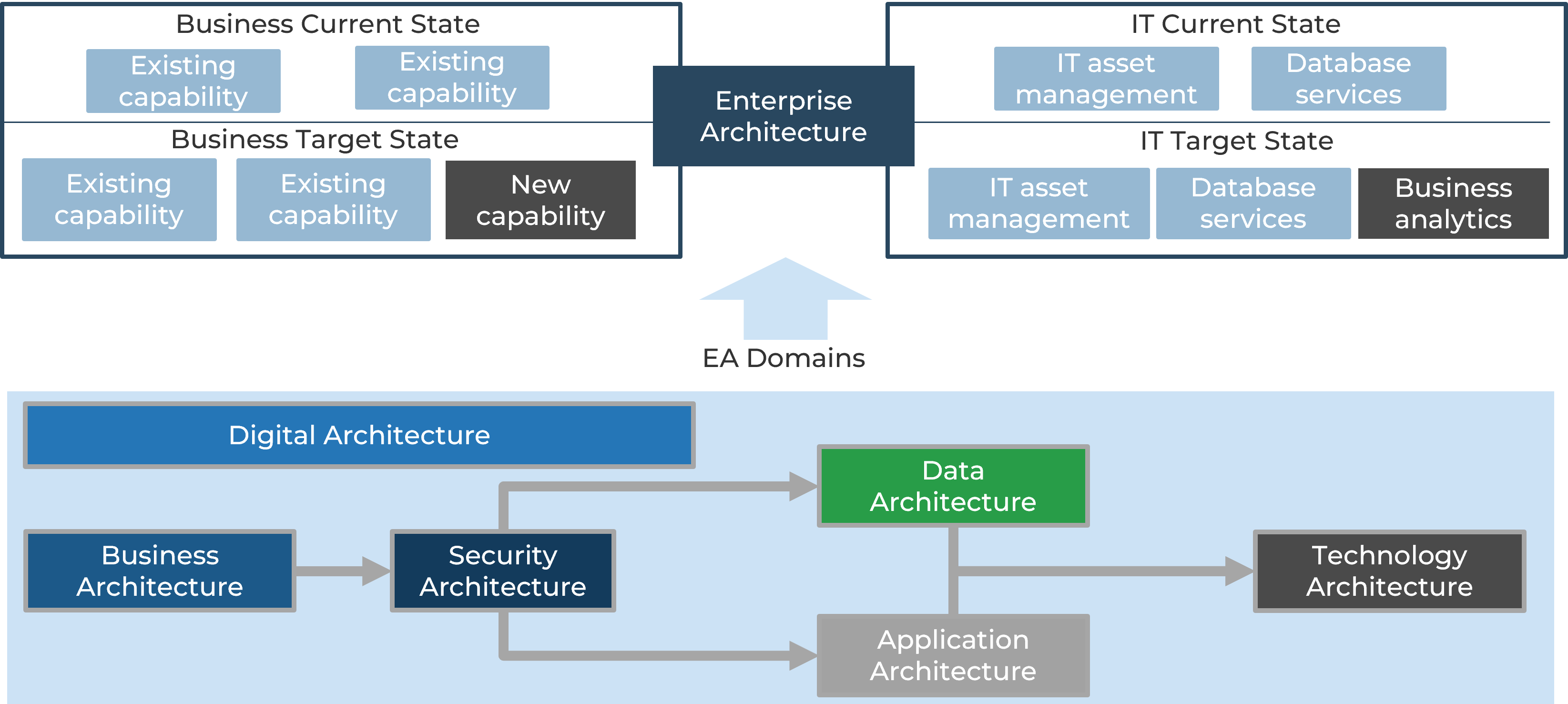
Deliver business value through business architecture
As part of the larger EA framework, business architecture serves a different set of questions that focus on the delivery of business value.
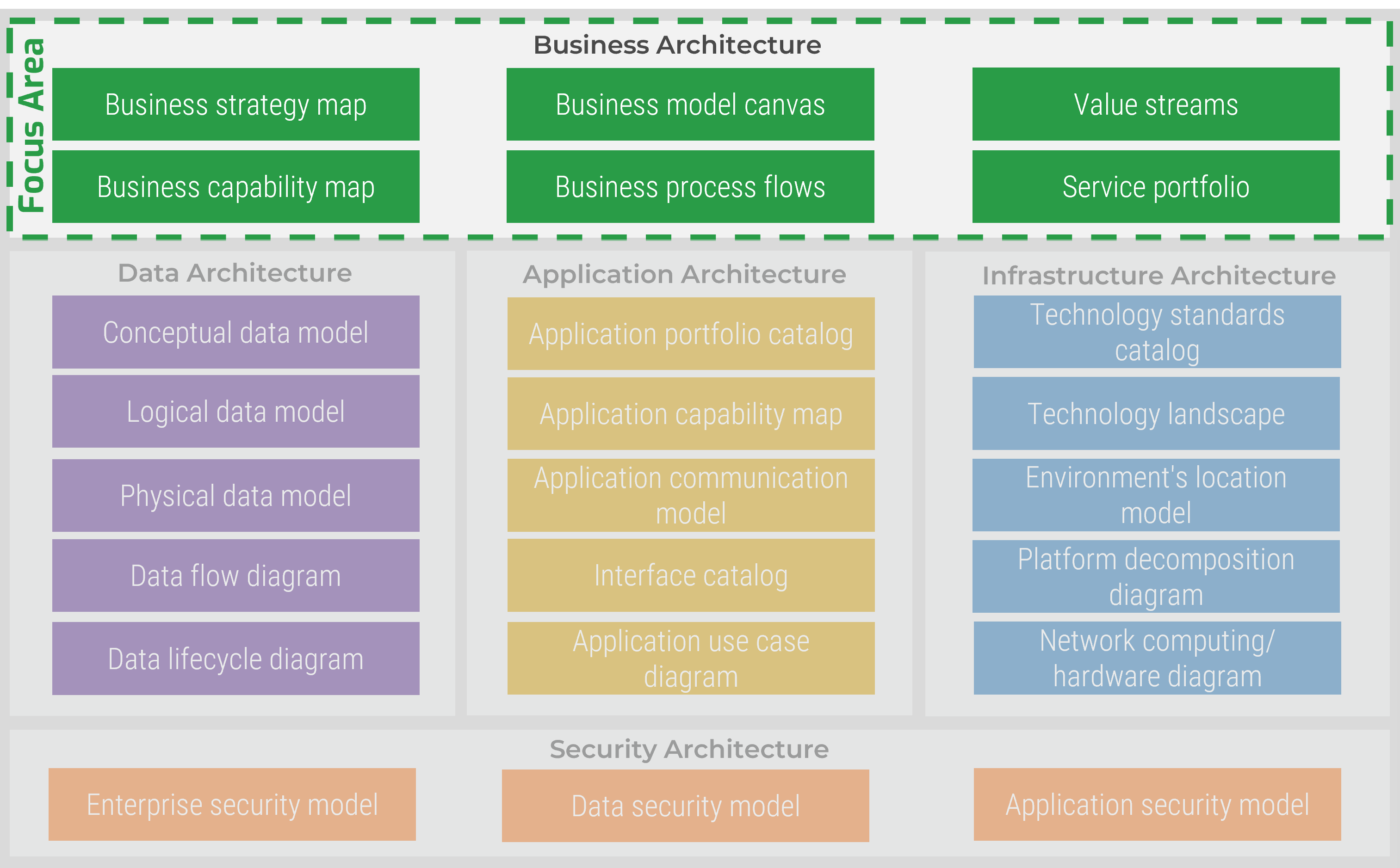
Business architecture answers the following questions:
- How does the organization create and capture value?
- How is the organization structured to deliver value?
- Are the capabilities, strategies, initiatives, and client offerings of the business optimized?
- Is the business optimally supported by IT (security, data, applications, and infrastructure)?
- How do IT and the business align with each other?
- Are there duplication, gaps, or conflicts in business efforts?
- Who are my stakeholders and are their needs being met effectively?
- What business information is leveraged and when?
Transformation challenges across sectors vary
While some challenges across the public and private sectors differ, similarities are still shared, allowing for a common approach to solving these challenges.
Turning pain points into opportunities:
- Pain points often don’t translate into industry-specific insights.
- Decision-makers lack clear guidance on where to act.
Connecting strategy, capabilities, and technology:
- It’s hard to identify where new technology will have the most impact.
- Opportunities may be misaligned.
Prioritizing initiatives:
- Competing demands make it difficult to focus on high-impact areas.
- Efforts can get diluted, slowing transformation.
Challenges
Public Sector |
Shared |
Private Sector |
|
|
|
Breakthrough public sector transformation challenges
Public Sector
Challenges | How Reference Architecture Helps |
| Policy and regulatory constraints: Transformations must align with strict compliance and legislation, which often slows down adoption and limits flexibility. | Embeds compliance requirements into process and technology maps to ensure alignment upfront. |
| Budget restrictions and funding cycles: Long approval processes and rigid annual budgets make it difficult to fund experimental technology projects. | Links capabilities to measurable outcomes, providing evidence to justify funding requests. |
| Difficulty turning broad mandates into actionable architectures: Capability maps are often generic and not tailored to the unique service-delivery missions of government, making it hard to identify where change truly drives citizen/resident value. | Breaks down mandates into detailed capabilities, processes, and enabling technologies. |
| Cross-agency alignment challenges: Transformation often requires collaboration across agencies or departments, but siloed ownership and conflicting priorities hinder cohesive action. | Provides a common language and shared capability map to align priorities across departments. |
| Talent and skills gaps: Shortages in specialized digital and architectural expertise limit the ability to connect strategy, process, and technology in a meaningful way. | Acts as a knowledge asset, reducing dependence on scarce specialized expertise. |
In the UK, 30% of central government IT systems are legacy, ›60% cite poor data quality as a barrier to AI implementation, and 70% report difficulty recruiting skilled staff. (Source: Financial Times, 2025.)
Nontechnological challenges faced by public sector bodies (Data based on survey respondents within Canada, Sweden, the Netherlands, and the UK.):
- Rising bureaucracy: Red tape has surged to 41% in 2025, up from 28% in 2023.
- Shifting priorities: 41% cite constantly changing organizational priorities as a barrier.
- Leadership resistance: 37% of initiatives face pushback from leadership.
- Inadequate change planning: Poor preparation for change is reported by 31% in 2025, up from 24% in 2023.
- Internal misalignment: 45% highlight a lack of alignment across departments.
- Leadership gaps: 41% point to deficiencies in leadership capability and direction. (Source: Unit4, 2025; ERP Today, 2025)
Solve private sector transformation challenges
Private Sector
Challenges | How Reference Architecture Helps |
| Pressure for speed to market: Private companies must constantly deliver quick results, making it hard to balance long-term architectural planning with short-term product demands. | Identifies mature vs. weak capabilities quickly, accelerating decision-making. |
| Disconnect between capabilities and technology investments: Firms struggle to map architecture to real technology enablers, leading to fragmented digital transformations and wasted spend. | Maps business capabilities to technology, ensuring aligned and efficient investments. |
| Prioritization amid competing business units: Multiple units or lines of business fight for resources, causing diluted effort and lack of alignment on enterprise-wide transformation. | Provides an enterprise-wide view to prioritize based on business impact objectively. |
| Rapidly changing market and customer expectations: Shifts in consumer behavior or competitor innovation can quickly make reference architectures outdated if they’re not kept agile. | Offers a customizable architecture that can adapt as markets and customer needs evolve. |
| Vendor and ecosystem complexity: Private organizations often rely on large technology vendor ecosystems, where partnerships, contracts, and integrations complicate transformation roadmaps. | Clarifies vendor fit within the capability model, guiding consolidation and integration strategies. |
Private companies applying five or more critical transformation enablers can boost success rates from 28% to 55%. (Source: People Matters, 2025)
The most common transformation challenges faced by private organizations are:
- Lack of change management: 76% of IT leaders indicate that managing change is the biggest challenge.
- Unclear strategy: 45% fail due to the lack of a clear strategy.
- Project overruns: 60% of projects are delayed or over budget.
- Underused data: 90% of organizational data remains unused.
- Resistance to change: 60% of transformations fail due to resistance to change.
- Legacy systems: 58% of IT personnel state legacy system incompatibility as a barrier. (Source: ZipDo, 2025)
Recognize shared obstacles in different realities
While obstacles to business architecture are common, the public and private sectors have specific hurdles to overcome due to culture and organizational structure.
Organizations with mature business architecture practices see up to 30% higher ROI on initiatives compared to those without these practices (Entasis Partners, 2024)
Common Obstacles | Public Sector-Specific | Private Sector-Specific |
| 1. Limited time and expertise to conduct deeper mapping | Staff may lack formal training in business architecture, and competing mandates or budget constraints make it difficult to allocate time for structured mapping. | Teams are often pressured to deliver quick operational wins, leaving little room for the cross-functional collaboration needed to map end-to-end processes or align capabilities to technology. |
| 2. Disconnection between capabilities, processes, and technology | Legacy systems and rigid operational structures create barriers between capabilities and enabling technologies, limiting data flow and collaboration across agencies or departments. | Technology investments are often made in silos, by department or function, leading to duplicate systems, inconsistent workflows, and unclear accountability for value delivery. |
| 3. Resistance to transformation and limited perceived value | Change fatigue and risk aversion often lead to hesitancy in adopting new methods or tools. The value of enterprise mapping is harder to demonstrate in environments where benefits are long-term or nonfinancial (i.e. service quality or compliance). | Teams may see mapping exercises as administrative overhead rather than strategic enablers, especially when the benefits are not tied to measurable performance outcomes. |
50% of local government IT budgets are still spent on maintaining legacy systems, leaving little room for strategic initiatives like business architecture (TechUK, 2024).
Private organizations tend to prioritize quick wins over long-term architecture planning, which can lead to fragmented systems and missed strategic alignment (Business Architecture Info, n.d.)
Conduct industry-specific capability mapping when facing sector-specific challenges
Use this research when speed, alignment, prioritization, agility, or complexity challenges are present or when transformation efforts are fragmented or misaligned.
Scenarios of Challenge | Category (slide 26 reference) | Public Sector | Private Sector |
| Compliance & regulatory constraints | Governance & risk | ✔ | ✔ |
| Budget/funding barriers | Financial performance | ✔ | ✔ |
| Mandate to architecture translation | Strategic enablement | ✔ | |
| Cross-agency alignment | Governance & risk, strategic enablement | ✔ | |
| Talent/skills gaps | Process efficiency, strategic enablement | ✔ | ✔ |
| Speed-to-market pressure | Process efficiency, strategic enablement | ✔ | |
| Capability to technology disconnect | Strategic enablement, process efficiency | ✔ | ✔ |
| Prioritization challenges | Strategic enablement | ✔ | ✔ |
| Market/customer expectation shifts | Customer/partner experience, strategic enablement | ✔ | |
| Vendor/ecosystem complexity | Process efficiency, strategic enablement | ✔ | |
| Limited time/expertise for mapping | Process efficiency | ✔ | ✔ |
| Disconnection between capabilities/processes/tech | Strategic enablement, process efficiency | ✔ | ✔ |
| Resistance to transformation | Governance & risk, strategic enablement | ✔ | ✔ |
| Legacy systems | Process efficiency, strategic enablement | ✔ | ✔ |
Define your transformation with the Info-Tech approach
Identify the Key Category & Use Case
- Analyze sector and organizational challenges to pinpoint the most impacted persona.
- Define the problem statement by outlining the persona’s main pain point, focus area, and business impact.
- Select the category and use case that focuses on the problem and enables transformation.
Operationalize Business Architecture
- Map affected processes to enabling technologies and capabilities.
- Assess the broader business impact aligned to the selected use case.
Prioritize Transformation Opportunities
- Prioritize opportunities based on impact, feasibility, and cost.
- Develop a transformation roadmap with actionable initiatives.
The Info-Tech difference:
- Leverage context-specific categories and use cases tied to organizational pain points, ensuring relevance, engagement, and clear alignment to business value.
- Connect processes, capabilities, and technology in one holistic model to reveal interdependencies, inefficiencies, and value creation points.
- Translate insights into a prioritized, executable transformation roadmap that bridges strategy and delivery.
Info-Tech Insight
Connecting processes, capabilities, and technology in one holistic model transforms scattered pain points into clear, actionable opportunities, making it possible to build a transformation roadmap that bridges strategy and delivery for real organizational value.
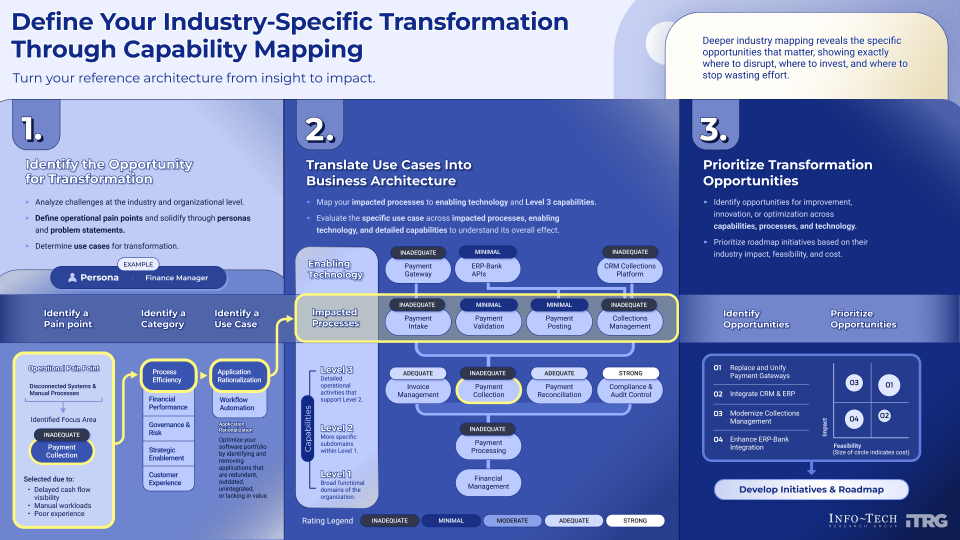
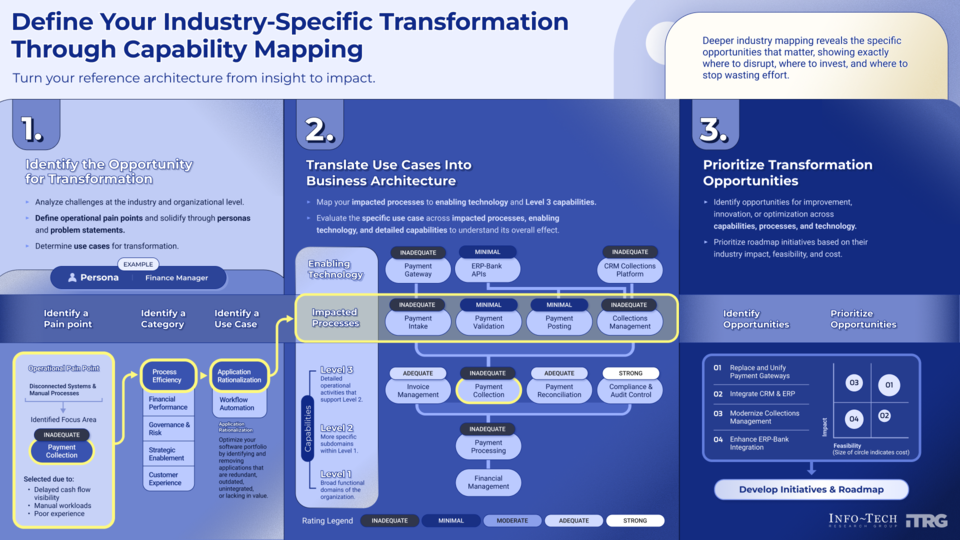
Info-Tech’s methodology for Defining Your Industry-Specific Transformation Through Capability Mapping
1. Identify the Key Use Case for Transformation |
2. Translate the Use Case Into Business Architecture |
3. Prioritize Transformation Opportunities |
|
Phase Steps |
1.1 Analyze sector and organizational challenges to select a persona.
1.2 Define the problem statement. 1.3 Select the use case. |
2.1 Map affected processes to enabling technologies and capabilities.
2.2 Assess the broader business impact. |
3.1 Prioritize opportunities based on impact, feasibility, and cost.
3.2 Develop a transformation roadmap. |
Phase Outcomes |
A clearly defined use case that targets the most impacted persona, based on sector and organization challenges, with a validated problem statement and transformation focus. | A mapped business architecture that links the affected processes to enabling technologies and capabilities, with a holistic view of the business impact, per the selected use case. | A prioritized set of transformation opportunities supported by measurable benefits, culminating in a strategic roadmap for execution. |
Insight summary
Overarching insight
Deeper industry mapping reveals the specific opportunities that matter, showing exactly where to disrupt, where to invest, and where to stop wasting effort.
Diagnose and prioritize challenges
Pinpointing the right pain points and personas transforms guesswork into targeted action, ensuring every initiative starts with what matters most.
Mapping for insight
Connecting processes, capabilities, and technology reveals hidden inefficiencies and opportunities, turning complexity into a clear, actionable roadmap for change.
Execute and monitor
Quantifying impact with robust metrics lets leaders invest where results are proven, not just promised, driving measurable value across the organization.
Tactical insight
Use business reference architecture where it drives real value, not where it adds unnecessary overhead. Make it a PMO accelerator, not a maintenance burden.
Blueprint deliverables
Key deliverable:
Executive Presentation Template
Use this templated presentation to highlight prioritized opportunities and initiatives prioritized and make the case to business executives.
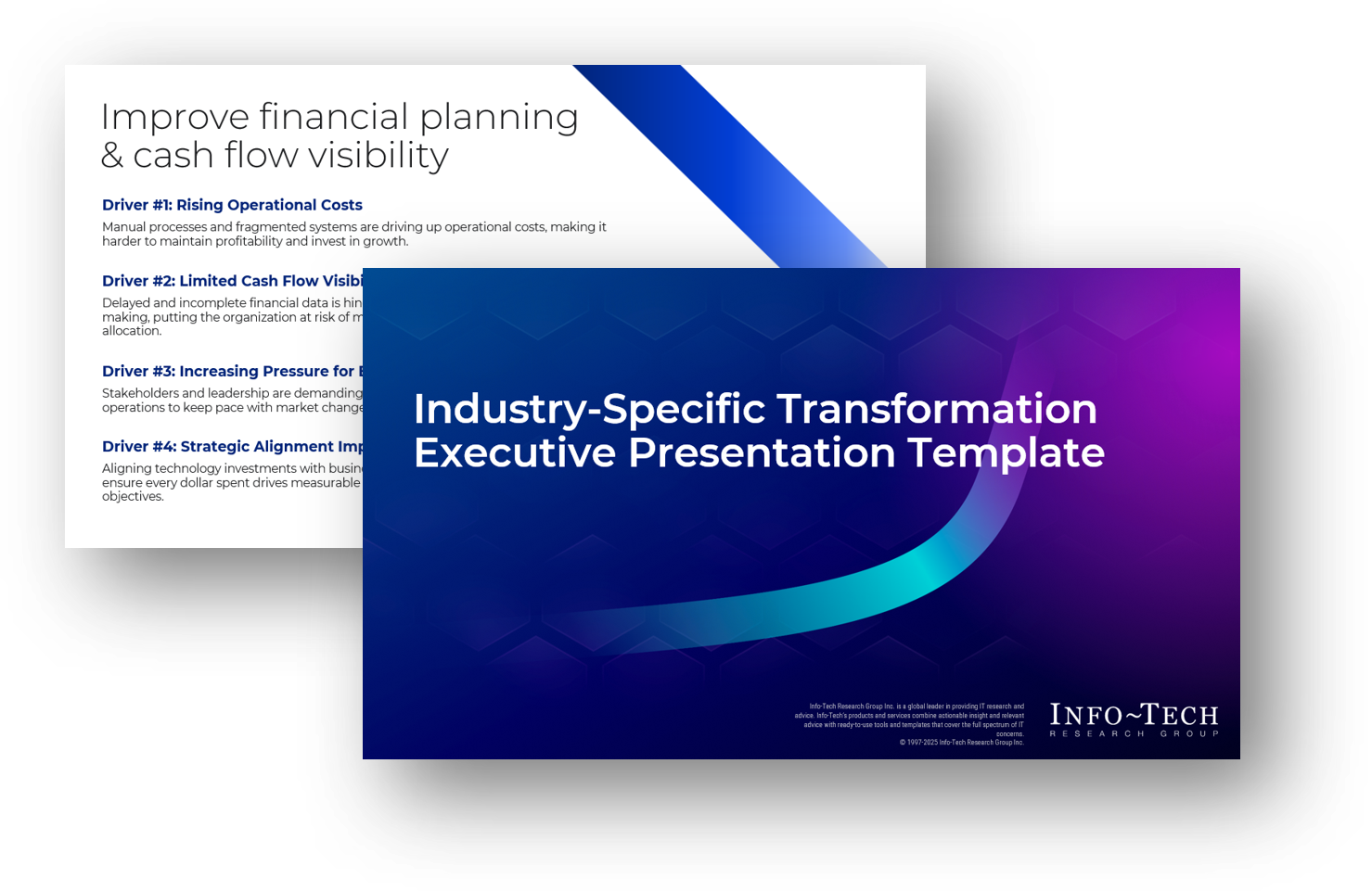
Each step of this blueprint is accompanied by supporting deliverables to help you accomplish your goals:
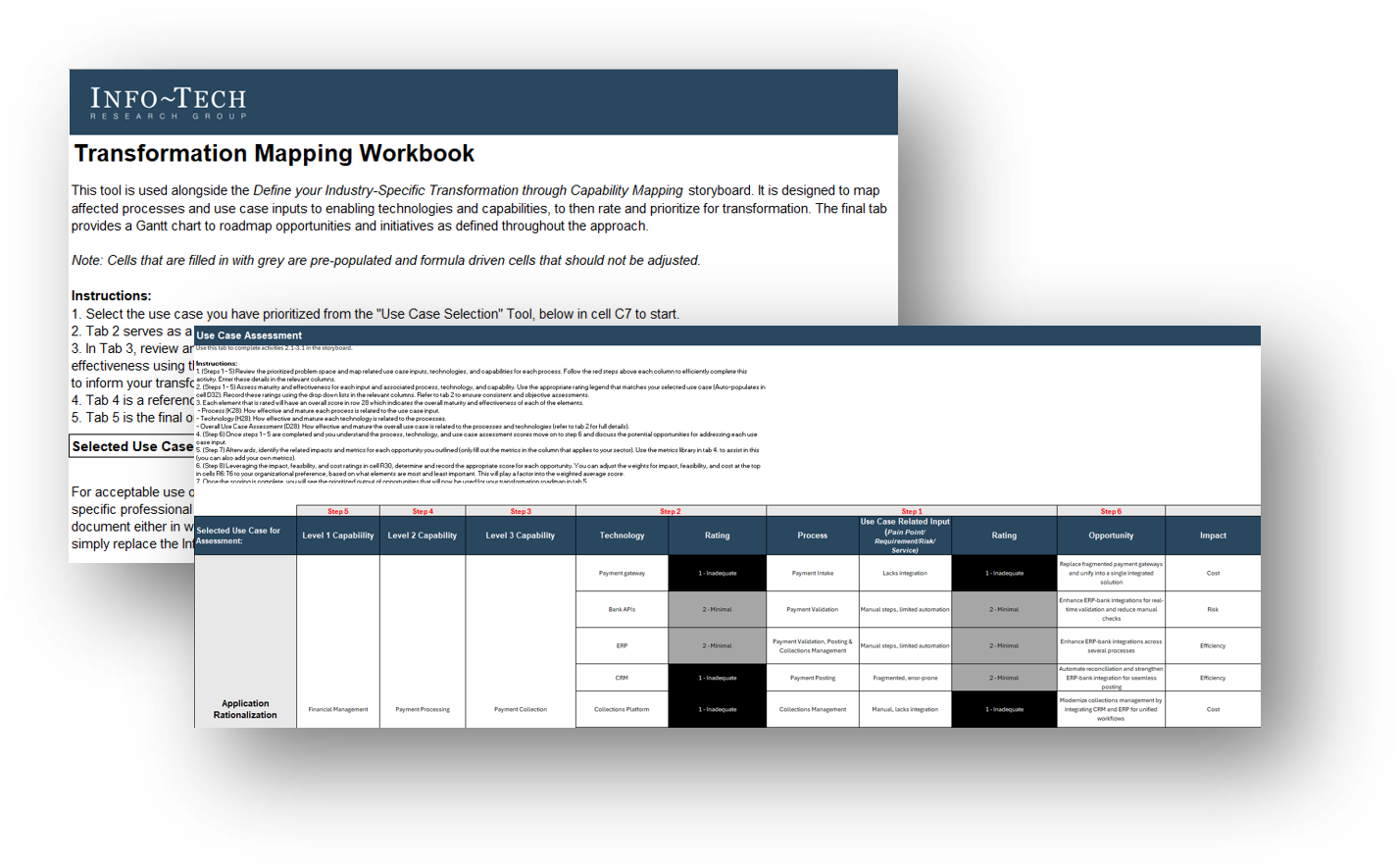
Transformation Mapping Workbook
Use this tool to map affected processes and use case inputs to enabling technologies and capabilities, then rate and prioritize them for transformation. The final tab provides a Gantt chart to roadmap opportunities and initiatives as defined throughout the approach.
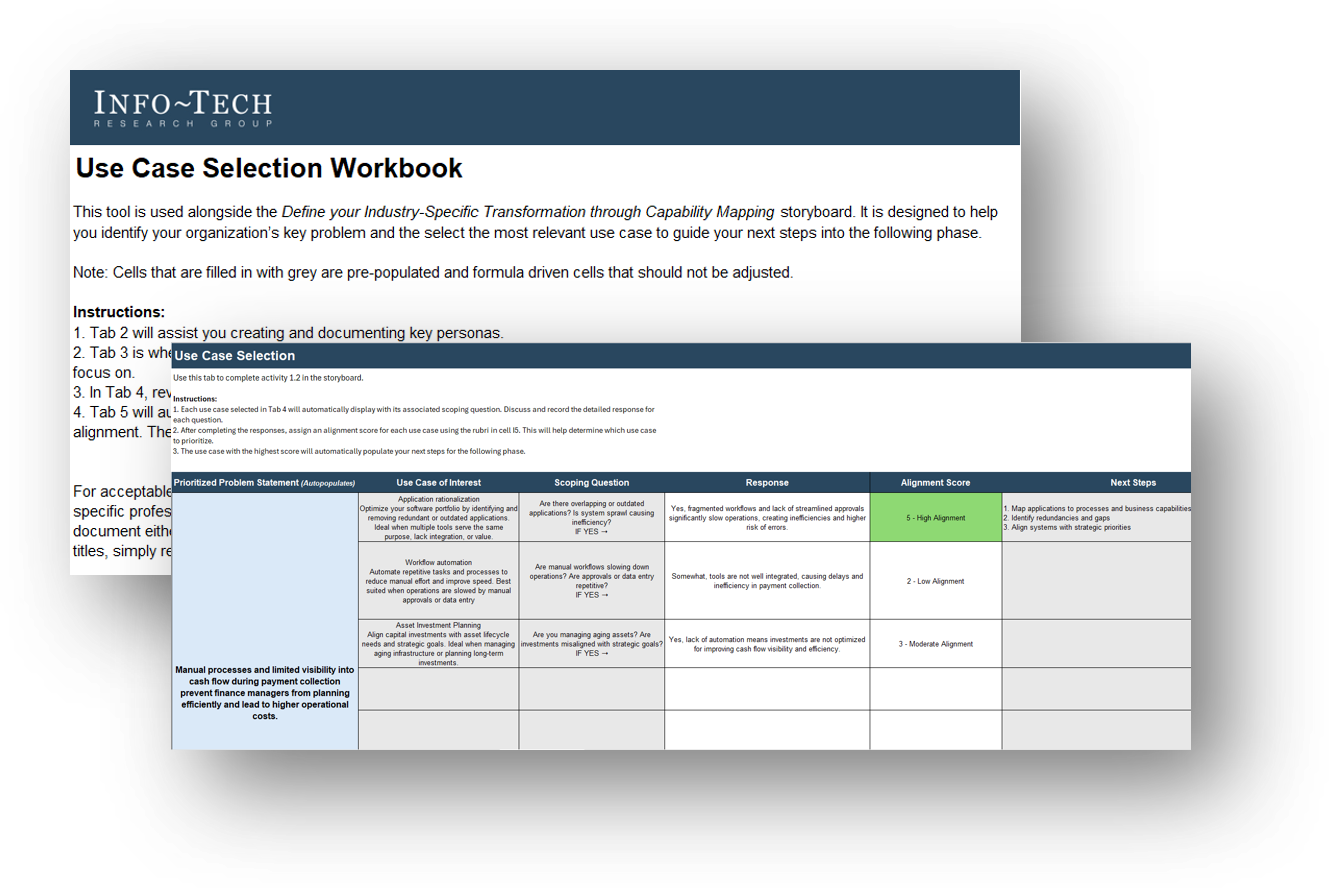
Use Case Selection Tool
This tool is designed to help you identify your organization’s key problem and select the most relevant use case to guide your next steps into the following phase.
Blueprint benefits
IT Benefits
- Business architecture connects IT investments directly into business strategy, ensuring that technology initiatives support organizational goals rather than operating in silos.
- By mapping processes and capabilities, IT can identify opportunities for automation, integration, and rationalization across a wide range of use cases, reducing manual efforts and technical debt.
- Embedding governance and risk frameworks into architecture enables proactive compliance, easier audits, and better management of operational risks across all technology domains.
- IT teams gain a prioritized, actionable roadmap of improvements, making resource allocation and project planning more effective and transparent.
Business Benefits
- Business architecture provides executives with a clear view of how capabilities, processes, and technologies interconnect, enabling more informed and confident decisions about where to invest, disrupt, or optimize.
- Selecting from a full range of use cases allows organizations to target the most relevant pain points, streamlining the process to high-value transformation.
- Modernized processes and improved alignment between business and IT leads to better customer, partner, and employee experiences.
- A business architecture approach equips organizations to adapt quickly to market changes, regulatory shifts, and evolving stakeholder needs, driving growth and long-term success.
Measure the value of this blueprint
Quantify the value of this approach.
Benefit |
Metric |
Value |
| Targeted problem solving | Number of pain points addressed, reduction in unresolved issues | Projects focus on the most critical challenges, leading to fewer recurring problems. |
| Prioritized roadmap | Percentage of initiatives completed on time, resource utilization rate | Resources are allocated to high-impact projects, increasing project success rate and reducing wasted effort. |
| Strategic alignment | Number of initiatives aligned with strategic objectives, capability enablement rate | Projects directly support business strategy, driving measurable progress toward organizational goals. |
Going from complexity to clarity with capability mapping

INDUSTRY: Technology Services | SOURCE: Bizzdesign, n.d.
The problem
NTT Ltd. was formed in 2019 through a merger of 31 independent companies. Integrating 31 brands, 380 legal entities, 56 unique IT architectures, and over 2,400 applications into a single unified organization created massive challenges.
Results
NTT Ltd. created a unified EA strategy and technology blueprint, capturing all application and capability data in one central repository. This enabled rationalization planning, reduced complexity, and improve agility. The company cut sales platforms by half, began consolidating over 200 marketing technologies, and established a clear roadmap for achieving a single global platform. The solution delivered significant cost savings, operational efficiencies, and positioned NTT Ltd. as a data-driven global leader in technology services.
Info-Tech offers various levels of support to best suit your needs
DIY Toolkit |
Guided Implementation |
Workshop |
Executive & Technical Counseling |
Consulting |
| "Our team has already made this critical project a priority, and we have the time and capability, but some guidance along the way would be helpful." | "Our team knows that we need to fix a process, but we need assistance to determine where to focus. Some check-ins along the way would help keep us on track." | "We need to hit the ground running and get this project kicked off immediately. Our team has the ability to take this over once we get a framework and strategy in place." | "Our team and processes are maturing; however, to expedite the journey we'll need a seasoned practitioner to coach and validate approaches, deliverables, and opportunities." | "Our team does not have the time or the knowledge to take this project on. We need assistance through the entirety of this project." |
Diagnostics and consistent frameworks are used throughout all five options |
||||
About Info-Tech
Info-Tech Research Group is the world’s fastest-growing information technology research and advisory company, proudly serving over 30,000 IT professionals.
We produce unbiased and highly relevant research to help CIOs and IT leaders make strategic, timely, and well-informed decisions. We partner closely with IT teams to provide everything they need, from actionable tools to analyst guidance, ensuring they deliver measurable results for their organizations.
What Is a Blueprint?
A blueprint is designed to be a roadmap, containing a methodology and the tools and templates you need to solve your IT problems.
Each blueprint can be accompanied by a Guided Implementation that provides you access to our world-class analysts to help you get through the project.
Need Extra Help?
Speak With An Analyst
Get the help you need in this 3-phase advisory process. You'll receive multiple touchpoints with our researchers, all included in your membership.
Guided Implementation 1: Identify the Key Use Case for Transformation
- Call 1: Analyze sector challenges.
- Call 2: Create personas and problem statements.
- Call 3: Select the key problem statement.
- Call 4: Select the most impactful use case.
Guided Implementation 2: Translate the Use Case Into Business Architecture
- Call 1: Map use case inputs and processes to technologies and capabilities.
- Call 2: Analyze and rate each mapped element.
- Call 3: Assess the broader business impact.
Guided Implementation 3: Prioritize Transformation Opportunities
- Call 1: Prioritize opportunities.
- Call 2: Develop initiatives and roadmap.
Contributors
- Jussi Sipola, Chief Enterprise Architect, Hawaii ETS
- Kathy Costello, State Enterprise Business Architect, Washington Tech
- Nick Stowe, State Chief Technology Officer, Washington Tech
- Chandy Curry, Enterprise AI Business Architect, Washington Tech
- Rob Allred, State Chief Enterprise Architect, Washington Tech
- Nadir Khan, Chief Technology Officer, C.I.Know
- Richard Bradley, Chief Operations Officer, C.I.Know
