




Own the year-round fan relationship
The Challenge
Build direct fan relationships beyond game day
Sports organizations have historically relied on tickets, media rights, sponsorship, and merchandise to monetize fans. However, fan engagement now happens across live games, highlights, athletes, fantasy, betting, social media, and digital communities, making it difficult to build a complete view of the fan relationship.
Why It Matters
Increase fan loyalty and direct commercial value
Sports organizations that do not own the fan relationship risk losing engagement and revenue opportunities to broadcasters, streaming platforms, social platforms, betting, and ticketing marketplaces that control more of the fan interaction. With 40% of sports viewers now watching exclusively through streaming and much of fan engagement happening on third-party platforms, owning the direct relationship is essential to protect loyalty and revenue ("Streaming Live Sports: Where
Opportunity Meets Complexity," Parks Associates, 2025).
The Solution
Build a unified fan data foundation
Connect ticketing, CRM, loyalty, merchandise, mobile, and sponsorship data to create a single view of the fan.
Personalize fan engagement
Use fan data and segmentation tools to deliver targeted content, offers, experiences, and communications across channels.
Strengthen direct-to-fan monetization
Enhance digital platforms, loyalty programs, and commerce integrations to grow revenue beyond game day.




Maximize live event and venue revenue
The Challenge
Meet rising expectations for frictionless live experiences
Venues have a limited number of high-value game days and event days each year, but they are under pressure to generate more revenue from every fan visit. Entry delays, concession lines, poor connectivity, and disconnected venue systems limit per-cap spending, premium experiences, and the overall value of live attendance.
Why It Matters
Improve fan satisfaction and protect the value of attending live
Fans are less willing to tolerate friction as the cost of attending live sports rises. If the experience is slow or inconvenient, fans spend less, engage less with sponsors, and become harder to convert into repeat attendees or premium buyers. In one survey, 81% of fans said they would spend more on food, drink, and merchandise if ordering were more convenient, showing how connectivity and frictionless service directly drive per-cap revenue ("Sports, Gaming and Rock & Roll: Connectivity and the Fan Experience," Boldyn Networks, 2025).
The Solution
Connect venue operations
Integrate ticketing, access control, POS, payments, digital signage, and venue operations platforms.
Expand venue revenue opportunities
Use connected venue data to support premium experiences, targeted offers, sponsor activations, and non-game-day events.
Streamline entry and payments
Use mobile ticketing, frictionless access control, and mobile or self-service ordering to cut lines and lift per-cap spending during the event.


Grow sponsorship value through measurable fan engagement
The Challenge
Move beyond exposure-based sponsorship models
Sports sponsorship has traditionally been sold around visibility: signage, logo placement, naming rights, and broadcasts. However, sponsors are under pressure to justify marketing spend with measurable outcomes. Sponsorship value is often spread across disconnected touchpoints, and without connected data, sports organizations struggle to show the full value of a partnership.
Why It Matters
Prove the commercial impact of sponsorship investments
If organizations cannot prove sponsorship performance, brands may shift budget toward digital platforms, influencers, and other entertainment properties that provide clearer targeting and attribution. This puts pressure on sports organizations to turn sponsorship from a largely exposure-based product into a measurable, insight-driven commercial partnership. With the global sports sponsorship market projected to approach $109 billion by 2030 and betting and streaming sponsors demanding measurable returns, proving performance is now the price of growth ("The Evolution of Sponsorships," PwC, n.d.).
The Solution
Measure sponsorship performance
Use sponsorship analytics and partner dashboards to track reach, engagement, and campaign performance across physical and digital channels.
Connect sponsor activations across channels
Integrate venue, content, CRM, app, social, ticketing, and commerce data to show how fans engage with partners before, during, and after events.
Create data-driven sponsorship packages
Use audience segmentation and engagement insights to build targeted sponsorship opportunities.

Engage younger and digital-native fan communities
The Challenge
Adapt to changing fan identity and consumption patterns
Younger fans may follow athletes more than teams, watch highlights instead of full games, engage through creators and social platforms, and participate in fantasy or betting. Traditional season-ticket, linear broadcast, and team-first engagement models do not fully capture these behaviors.
Why It Matters
Build the next generation of loyal fans
If organizations fail to connect with younger fans, they risk long-term declines in attendance, viewership, merchandise sales, and brand loyalty. The future fanbase will be shaped by digital access, athlete personalities, and community engagement. Gen Z fans now feel more connected to individual athletes (31%) than to teams (27%), and 62% have discovered a new team, player, or league through short-form video, signaling a fundamental shift in how fandom forms ("The 2025-2026 Generational Fan Study," WSC Sports, 2025).
The Solution
Develop mobile-first fan experiences
Use apps, communities, gamification, and loyalty tools to create interactive engagement beyond the live events.
Convert casual engagement into deeper fandom
Use fan journey analytics to move digital followers toward ticket purchases, subscriptions, merchandise, and loyalty participation.
Meet fans on social and creator platforms
Produce short-form, athlete-led, and creator content where younger fans discover sport, then route that attention back to owned channels.


Manage team and player integrity risk
The Challenge
Protect the organization's people, data, and integrity
As sports betting, fantasy, real-time data feeds, and player analytics become more connected to the game, the organization itself becomes a target. Players, coaches, and staff can be approached or pressured to influence outcomes, while sensitive information on injuries, availability, lineups, and tactics can leak, be sold, or be misused. The challenge is protecting the people inside the building and the nonpublic data they generate, not policing the betting market.
Why It Matters
Protect player trust, team performance, and competitive advantage
When players or staff are compromised, or sensitive information leaks, the organization exposes athletes to harassment, hands rivals and bettors an unfair edge, and erodes trust with fans, sponsors, and partners. Getting ahead of integrity risk inside the organization protects player wellbeing, competitive advantage, and reputation far more cheaply than cleaning up after an incident. With a record 300 suspicious betting alerts flagged globally in 2025, up 29% from the prior year, the threat environment every team must defend against is intensifying, not receding ("2025 Sports Betting Integrity Report," IBIA, 2026).
The Solution
Educate players and staff on betting rules and approaches
Run targeted training and develop clear policies so players, coaches, and staff understand betting restrictions, disclosure obligations, and how to report anyone who tries to influence outcomes.
Protect sensitive team and player information
Strengthen access controls and governance over injury, availability, lineup, and performance data so nonpublic information cannot leak to bettors or be exploited.
Run an internal integrity reporting and response process
Use case management and incident reporting tools to capture, escalate, and resolve integrity concerns inside the organization, routing issues to league or regulatory channels only when required.

Expand global fan and market growth
The Challenge
Adapt sports properties for international audiences
Sports leagues and entertainment properties are increasingly looking beyond domestic markets for audience growth, media value, sponsorship revenue, and event expansion. However, global growth is difficult because fan behaviors, preferred platforms, languages, payment methods, and local competition vary significantly by market.
Why It Matters
Turn global reach into sustainable commercial growth
International fandom does not automatically translate into revenue. Without localized content, regional partnerships, and accessible digital fan experiences, organizations may generate global awareness without converting that interest into subscriptions, merchandise, ticket sales, or long-term fan loyalty. With the global sports market projected to grow from about $495 billion in 2025 to $654 billion by 2030, the organizations that localize and convert international interest will capture a disproportionate share of that growth ("Sports Market Report 2026," The Business Research Company, 2026).
The Solution
Localize digital fan engagement
Adapt digital platforms to enable multilingual support, regional content, and market-specific campaigns.
Build regional audience intelligence
Use fan analytics to understand market-level behaviors, preferences, and commercial opportunities.
Enable local commerce and payments
Support regional languages, currencies, payment methods, and partnerships so global interest converts into subscriptions, merchandise, and tickets.
Create new commercial value from sports data and digital assets
The Challenge
Turn sports data into a commercial growth asset
Sports organizations generate highly valuable data through live games, athlete performance, fan behavior, ticketing, media consumption, betting markets, sponsorship activations, and venue operations. However, much of this data remains fragmented across teams, leagues, broadcasters, data providers, venues, and commercial partners, making it difficult to package, protect, and monetize effectively.
Why It Matters
Create new revenue streams while protecting control of the sports product
Sports data has become central to fan engagement, media products, betting, fantasy, performance analytics, and broadcast innovation. If sports organizations do not control how their data and digital assets are governed, distributed, and commercialized, third parties may capture more of the value while organizations take on reputational, integrity, and privacy risks. Leagues now treat live performance data as a monetizable media asset and betting operators pay premiums for official real-time feeds, making data governance and rights control a direct revenue lever ("Sports Analytics Market Size & Share Analysis – Growth Trends and Forecast," Mordor Intelligence, 2026).
The Solution
Strengthen data governance and rights controls
Establish clear ownership, usage rights, access rules, privacy controls, and partner agreements for fan, competition, athlete, and commercial data.
Enable secure data distribution and monetization
Use APIs, data platforms, partner portals, and analytics products to package and share approved data with broadcasters, sponsors, betting partners, teams, and digital platforms.
Build commercial data products
Package approved performance, fan, and engagement data into governed feeds and analytics products for broadcasters, sponsors, and betting partners.


Protect sports operations from digital disruption
The Challenge
Reduce the risk of failure during time-bound sports operations
Sports organizations depend on digital systems for ticketing, payments, venue operations, broadcast delivery, fan apps, sponsorship, and league operations. A cyberattack or outage during a live event, championship, ticket release, or broadcast window can have immediate impact.
Why It Matters
Maintain revenue, safety, and trust during critical events
Sports operations are highly visible and difficult to reschedule. A system failure during a major event can disrupt fan entry, payments, safety operations, media delivery, and revenue generation, when there is little room for recovery. Major events are prime targets: Ahead of the Paris 2024 Olympics, authorities identified 338 fraudulent ticketing sites, and ticketing, betting, and streaming platforms remain frequent attack surfaces ("Cyberattacks Are Changing the Game for Major Sports Events," Help Net Security, 2025).
The Solution
Prioritize resilience for live-event systems
Strengthen backup processes, monitoring, and continuity plans across operations.
Strengthen cybersecurity and identity controls
Use IAM, endpoint protection, incident response, third-party risk management, and payment security to protect critical systems.
Monitor operational risk in real-time
Use infrastructure monitoring, event command centers, and incident workflows to detect and respond to issues during high-level moments.

Modernize content and distribution models
The Challenge
Adapt to fragmented sports viewing and content consumption
Sports audiences now engage across live games, highlights, streaming, social media, short-form video, creator content, and behind-the-scenes access. This makes it harder for sports organizations to manage rights, choose the right distribution channels, protect media value, and maintain a direct fan relationship when much of the engagement happens on third-party platforms.
Why It Matters
Protect media value while growing future audiences
Media and content remain central to the sports entertainment business model, but audience fragmentation is making distribution more complex. If organizations rely too heavily on third-party platforms, they may increase reach while losing control of fan data and monetization. Sports organizations need to protect the value of live rights while building content models that keep fans engaged beyond the event. US monthly sports streaming viewers are projected to top 90 million in 2025, up from 57 million in 2021, accelerating the fragmentation of how and where audiences watch ("Streaming the Game: How the Rise of Digital Platforms Is Changing Sports Consumption," PwC, n.d.).
The Solution
Strengthen audience data and decision intelligence
Use data to help leaders understand audience behavior, evaluate channel performance, and make better decisions about where and how content should be distributed.
Enable flexible and governed distribution models
Establish technology governance, partner integration standards, rights controls, and operating models that allow the organization to expand content distribution and reach.
Build direct-to-fan content and protect rights
Develop owned streaming, highlights, and short-form content while protecting live rights and monitoring for piracy across platforms.
Increase commercial agility
The Challenge
Respond faster to shifting demand, cost pressure, and entertainment competition
Sports organizations are operating in a more volatile commercial environment. Attendance patterns, ticket demand, merchandise, sponsorship value, media consumption, and non-game-day event demand can shift quickly based on team performance, economic conditions, fan affordability, weather, and competing entertainment options. Increasing rates of visible unsold inventory signal that pricing, venue scale, promotion, and demand consumption are misaligned with fan willingness to buy.
Why It Matters
Protect revenue growth and margins in a less predictable market
Sports organizations have limited high-value event days and significant fixed costs. If they cannot adjust pricing, packages, staffing, promotions, inventory, and commercial offers quickly, they risk leaving revenue on the table during high-demand periods and overcommitting resources during weaker demand. Off-field analytics, including dynamic ticket pricing and fan monetization, now make up roughly 54% of the sports analytics market, reflecting how quickly commercial decisions are becoming data-driven ("Sports Analytics Market [2026-2033]," Grand View Research, 2026).
The Solution
Enable more flexible commercial operating models
Modernize the systems and workflows that support dynamic pricing, campaigns, and non-gameday revenue so the organization can adjust quickly as conditions change.
Strengthen integration between systems
Connect commercial planning with revenue operations, workforce planning, and finance so pricing, promotions, staffing, and service capacity can be adjusted together.
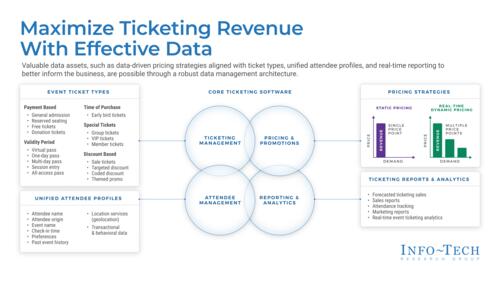
Adopt dynamic pricing and demand forecasting
Use demand signals and analytics to adjust ticket pricing, packages, and promotions in real time as conditions shift.
Comprehensive Sports Entertainment Industry Coverage


Testimonials

"Info-Tech has been so key in our transformation. Their deep research and insight has helped us to learn how to innovate and become an integral part of the business."
Steve Reese, CIO, Phoenix Suns
View Full Case Study