
The Future of the Transportation & Logistics Industry
Industry trends shaping future business opportunities.
- The industry is in a state of constant change due to rapid and unprecedented technological disruptions.
- There is increasing pressure to reduce carbon emissions, with numerous opportunities for improvement across the value chain.
- Customer are demanding faster service and greater accuracy, pushing companies to find new operational efficiencies.
- Choosing which emerging technologies and trends to invest in creates challenges and tensions when prioritizing initiatives.
Our Advice
Critical Insight
The industry’s accelerating technological transformation is clear, yet the deeper challenge lies in recognizing that each emerging disruption not only reshapes operational capabilities but redefines competitive advantage.
Impact and Result
- Perform a broader scan to highlight the demonstrated and relevant trends in technology services.
- Help organizations understand the trends to navigate the opportunities and challenges of tomorrow.
- Highlight the impacts of the trends on both provider businesses and their customers.
- Guide organizations through actionable recommendations and next steps.
The Future of the Transportation & Logistics Industry
Industry trends shaping future business opportunities
Analyst Perspective
Take a full view of the board and use all your pieces to win.
The transportation and logistics industry stands at a pivotal juncture. It has been reshaped by unprecedented global disruptions, sustainability imperatives, evolving consumer expectations, and rapid technological advancements. To navigate these changes effectively, companies must make strategic decisions, informed by reliable insights.
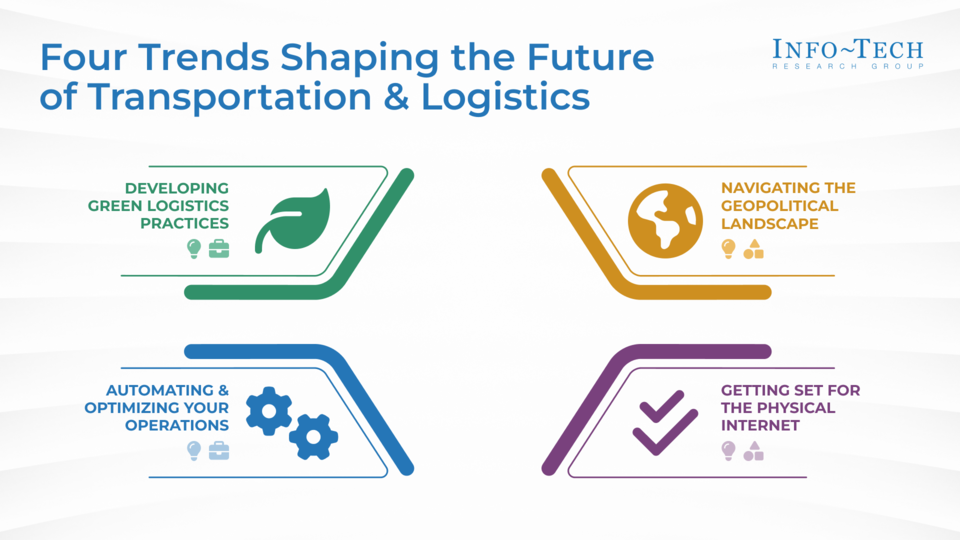
This report is designed to equip industry leaders with actionable intelligence, highlighting four critical trends: navigating the geopolitical landscape, developing green logistics practices, automating and optimizing operations, and getting set for the physical internet. By analyzing these trends and their implications for companies, and by providing the best courses of action, this report will help ensure that you can satisfy your customers and remain profitable.
Info-Tech’s approach focuses on an investigation of strategic foresight – a methodology that can help an IT department process what is happening in the external environment to guide ideation and the identification of opportunities. As a methodology, strategic foresight flows from identifying signals to clustering them together to form trends and uncover what is driving the trends. This determines which strategic initiatives are most likely to lead to success on an industry level.

Executive Summary
|
Your Challenge |
Common Obstacles |
Info-Tech’s Approach |
|---|---|---|
|
There is a constant state of change in the transportation and logistics industry due to rapid and unprecedented technological disruptions. There is increasing pressure to reduce carbon emissions, with numerous opportunities for improvement across the value chain. Customer expectations are evolving. Customers are demanding faster service and greater accuracy, pushing companies to find new operational efficiencies. Choosing which emerging technologies and trends to invest in, and which initiatives to prioritize, creates challenges and tensions. |
IT is still seen as a cost center. Too often, IT is viewed as simply a support function for the business, rather than a value driver. We need to shift the perception toward IT as a generator of business opportunities and revenue impact. Strategic planning is disconnected from action. While we excel at trend analysis, there is a gap between foresight and execution. Balancing long-term uncertainty with short-term actionable opportunities remains a persistent challenge. The business model lacks innovation. Technology innovation alone is not enough. Current models risk falling behind in a dynamic market. |
Perform a broader scan to highlight the demonstrated and relevant trends in technology services. Help organizations understand the trends to navigate the opportunities and challenges of tomorrow. Highlight the impacts of the trends on both provider businesses and their customers. Guide organizations through actionable recommendations and next steps. |
Info-Tech Insight
The accelerating technological transformation of the transportation and logistics industry is clear. The challenge lies in recognizing that each emerging disruption not only reshapes operational capabilities but also redefines competitive advantage.
Turn uncertainty into strategic advantage
Transportation and logistics companies should seize opportunities to specialize and offer depth to meet future needs.
Business Enablers
Risk reduction
Companies can use advanced technologies to identify risks automatically, prior to human intervention. This can reduce errors, ensuring accuracy in their operations.
Organizational Resilience
Companies can build adaptive processes to aid their responses to disruptions, enabling them to specialize and to evolve their services to meet demands amid changes.
Cost Optimization
Companies can leverage data-driven tools to optimize resource allocation, reduce empty miles, lower costs, and enhance profitability. This turns cost management into strategic advantage across the supply chain.
Seize emerging opportunities in logistics through technology transformation
The goods transportation and logistics industry fuels the global economy. It connects markets by facilitating the efficient movement of goods across complex global networks and drives productivity through innovations in supply chain processes and technologies.
|
The Past |
The Present |
The Future |
|---|---|---|
|
|
|
The future of the industry: What trends are shaping future business opportunities?
Four trends are shaping the future of the industry
|
Navigating the Geopolitical landscape Staying resilient amid the rapidly changing geopolitical landscape will position your business for success among the chaos. The geopolitical landscape is in constant flux, making it challenging for companies to stay ahead of emerging risks. For goods transportation and logistics firms that operate across borders, maintaining agility and resilience is essential, requiring proactive strategies to ensure stability, adaptability, and long-term success. Opportunity Differentiator |
Developing Green Logistics Practices Contribute to a greener future for the greater population while improving your operations. Sustainability initiatives are often seen as bottlenecks, or mere benchmarks for companies, especially with the growing focus on green logistics practices. Technology is pivotal in advancing these efforts, enabling companies to contribute to a greener future while uncovering cost-saving opportunities. Opportunity Business Enabler |
|
Automating and optimizing your operations Move your operations from reactive problem-solving to a proactive, intelligent system to drive efficiency. The capabilities of advanced technologies continue to evolve, offering new ways for companies to automate and optimize their operations. This no longer involves simply cost cutting, or speeding up deliveries, but fundamentally reshaping operations to unlock entirely new capabilities that will exceed expectations. Opportunity Business Enabler |
Getting set for the physical internet Prepare for change through an open, intelligent, hyperconnected network that will transform your operations. ‘The physical internet is a new concept that needs to be considered by the goods transportation and logistics industry. Similar to the evolution of the digital internet, the physical internet is intended to mimic open, collaborative, and decentralized networks. Embracing the shift to the physical internet will not just improve performance, but also help companies be prepared for a more sustainable, responsive economy. Opportunity Differentiator |
“In the past we had one logistics plan, today we have a multi-course strategy with options driven by late-point decision-making technology using real-time data that dynamically optimizes cost, service, weather, etc. We’re not trying to prevent chaos; we’re using technology to accommodate it.”
Source: Marcia Brey, VP of Distribution, GE Appliances,
as qtd. in Inbound Logistics, 2023
Identify cost and competitive advantages with capability maps

In business architecture, the primary view of an organization is known as its business capability map.
A business capability defines what a business does to enable value creation, rather than how. Business capabilities:
- Represent stable business functions.
- Are unique and independent of each other.
- Typically have a defined business outcome.
A business architecture practitioner can use this map to assess a specific area of the business.
Download the Goods Transportation & Logistics Industry Business Reference Architecture Template.
How to use this report
Leverage this trends report to develop your digital business strategy
This report is a stand-alone report on transportation and logistics trends, intended to help you effectively process signals in your environment and build an understanding of relevant trends. It serves as research-based support for Info-Tech’s Define Your Digital Business Strategy and Build a Business-Aligned IT Strategy blueprints and the associated activities.
|
The Future of the Transportation and Logistics Industry Trends report |
→ |
Business context and IT Strategy |
|---|---|---|
|
Leverage this trends report for priorities that drive measurable, top-line organizational outcomes and unlock direct value. |
The future will bring more trends and technologies. Your organization must establish itself as the disrupter, not the disrupted. You must establish a structured approach to innovation management that considers external trends and internal processes. |
Info-Tech offers various levels of support to best suit your needs
| DIY Toolkit | Guided Implementation | Workshop | Executive & Technical Counseling | Consulting |
|---|---|---|---|---|
| "Our team has already made this critical project a priority, and we have the time and capability, but some guidance along the way would be helpful." | "Our team knows that we need to fix a process, but we need assistance to determine where to focus. Some check-ins along the way would help keep us on track." | "We need to hit the ground running and get this project kicked off immediately. Our team has the ability to take this over once we get a framework and strategy in place." | "Our team and processes are maturing; however, to expedite the journey we'll need a seasoned practitioner to coach and validate approaches, deliverables, and opportunities." | "Our team does not have the time or the knowledge to take this project on. We need assistance through the entirety of this project." |
Diagnostics and consistent frameworks are used throughout all five options.
Deliverables
Each step of this research is accompanied by supporting deliverables to help you accomplish your goals.
Goods Transportation & Logistics Industry Business Reference Architecture
Use our reference architecture to define your business capabilities and assess their relevance to each trend.
Trend Canvas Template
Assess each trend and its relevance to your organization in a single canvas.
Trend Foresight Tool
Compile and display the information about each trend to prioritize confidently the trends that your organization should focus on.
Info-Tech’s Goods Transportation & Logistics Industry Business Reference Architecture, Trend Canvas Template, and Trend Foresight Tool will help you grasp the impact of current trends on your organization, prioritize these trends, and communicate them to your C-suite sponsors in terms of the value they could provide.
Trend 1
Navigating the Geopolitical Landscape
Staying resilient amid the rapidly changing geopolitical landscape will position your business for success among the chaos.
Respond to volatility with smarter logistics strategies
Global supply chains are constantly exposed to the ripple effects of geopolitical shocks and economic instability.
In 2024, there was a 38% increase in global supply chain disruptions, compared to 2023 (Resilinc, 2025). These disruptions are leading to increased costs of materials and finished goods, while raising prices for logistics companies and their consumers (Kinaxis, 2025). Each geopolitical disruption will yield different challenges for companies, making it difficult for them to adapt their operations appropriately.
Rather than waiting to react to the effects of disruptions, companies need to use proactive risk planning to turn geopolitical risks into opportunities. Business leaders are already hardwired to assess and react to shifting competitive dynamics continuously in their industries. They must navigate geopolitical disruptions in the same way, continually evaluating their operations to ensure resilience (“A Proactive Approach,” McKinsey, 2024). Prioritizing agility and resilience in a company’s operations will ensure that the company stays competitive among the chaos and challenges.
Resilient operations will assist your company as it navigates geopolitical tensions and also help to ensure continued success. Geopolitical tensions are not the only events that cause supply chain disruptions. Investing in real-time visibility can help your company understand bottlenecks, identifying areas for improvement in the supply chain. Companies have begun to create diversified networks of suppliers to create new strategic partnerships – new outlets they can use if disruptions affect only specific parties. These tactics will help companies counteract the negative effects of geopolitical disruptions and remain resilient and agile in their daily operations, ensuring efficient, profitable operations.
83% Percentage of organizations that say they need to make their supply chains more resilient
Source: KPMG, 2025
41% Percentage of companies that think supply chain optimization is a top use case for artificial intelligence
Source: Augury, 2024
Fragile supply chains can lead to large losses.
56% Percentage of leading chief economists who expect weaker global economic conditions in 2025, leading to supply chain volatility
Source: Xeneta, 2025
40% Percentage of a company’s earnings that can be lost due to one extended disruption to its operations
Source: Ware2Go, 2024
Creating resilience throughout your operations will revolutionize how your company deals with disruptions. The geopolitical landscape is volatile but, with agile operations, your company can remain prepared for the chaos and ensure success.
Signals
WHAT WE ARE SEEING
The geopolitical landscape is consistently inconsistent.
The current trade war is one of several unexpected occurrences that are shocking transportation and logistics companies. Global challenges happen daily, disrupting operations, so businesses must remain agile to ensure that they can adapt appropriately.
Customers are seeking providers that can easily scale operations up or down to match fluctuating order volumes (GenX Freight, 2024). As customers expect more, it is imperative for companies to have agile infrastructure and strong partnerships to remain competitive and fulfill demands.
Just before the tariffs of early 2025 were implemented, there was a surge in customer purchases. Customers are aware of ongoing situations and want to ensure that they can buy for cheaper prices before price hikes. Ensuring that your operations are resilient enough to manage this demand is a key to success.
IMPACTED CAPABILITIES
The capabilities that are listed and highlighted below receive a cost or competitive advantage through building operational resilience.
Competitive Advantage
- Carrier Management
- Freight Tracking & Visibility
- Emergency Planning
- Risk Management
Cost Advantage
- Inventory Replenishment
- Supply Chain Visibility
- Labor Management
- Network Design
Drivers
WHY YOU SHOULD CARE
Risk and Resilience: Companies need to prepare for sudden events so they can be resilient by adjusting their operations in several different ways to remain profitable.
Brand Impact: Uncertain geopolitical times cause customers to think critically about which businesses they will support.
Business Growth: Although geopolitical disruptions can damage revenue streams, they offer the opportunity to diversify supply chains and partners to create more sustainable growth in the future.
Act on opportunities and prepare for challenges
|
Opportunities |
|
|---|---|
|
Supply Chain Restructuring |
To minimize exposure to geopolitical disruptions, companies should seek diversification opportunities for their supply chains. Building new strategic relationships across multiple regions can offer companies flexibility in suppliers to reduce costs and ensure efficiency |
|
Assessment of Value Proposition |
Identifying what the business does best – and building on it – can help a company navigate uncertainty more successfully. By developing marketing strategies that emphasize a company’s strengths and the unique value of its services, the company can position itself as the partner of choice for customers who are facing disruptions. |
|
Investment in Technology Stack |
Enhancing visibility and predictability through advanced technologies can help companies identify areas for improvement. Companies need to use technologies to understand where they can create efficiency gains and eliminate bottlenecks to ensure agility and profitability. |
|
Challenges |
|
|
Unpredictability |
It is nearly impossible to predict what event is going to happen next and the repercussions it will have. Companies must position themselves to be proactive in reacting to the outcomes rather than trying to react, once it is already too late. |
|
Stalled Renewals and Cancelled Contracts |
Geopolitical tensions can lead to some customers seeking the services of other companies who have less restrictions, which will yield cheaper prices. Companies must seek opportunities to find their competitive advantage and take opportunities that align with their goals. |
|
Uncertainty |
Geopolitical tensions create uncertainty, which makes companies want to sit back and evaluate the situation as it progresses. Companies that do not have the resources to initiate change may want to see how their competitors adapt. This can cause them to lose valuable time and resources to adapt their operations. |
CASE STUDY
Redwood Logistics: Nearshoring for Resilience
|
The Challenge |
The Solution |
The Results |
|---|---|---|
|
Redwood Logistics is a Chicago-based third-party logistics provider that is one of North America’s fastest growing logistics companies. It has a long-standing presence in cross-border freight and operates six facilities on both sides of the US- Mexico border. It manages over 25,000 cross-border shipments annually and partners with 200+ carriers in the region. After being disrupted by several global events, such as the Russia-Ukraine conflict and the COVID-19 pandemic, Redwood found itself needing more certainty within its operations. After tensions caused shutdowns due to shortages and congestion for providers, the company needed a solution that was more resilient. |
Leveraging its base operations in Mexico, Redwood doubled down, expanding its operations in Mexico to support an influx of manufacturing there, focusing on nearshoring. The company recognized that many customers were shifting production to Mexico in response to global disruptions. By ramping up its own cross-border logistics infrastructure, Redwood positioned itself to facilitate these nearshoring efforts. Furthermore, Redwood invested in more technology to have greater visibility and agility within its supply chain. Redwood gained real-time data and rapid-response capabilities from supply chain control towers and similar technologies, to ensure that the nearshoring push could truly translate into more flexible, resilient operations. |
Redwood’s strategic shift to support nearshoring paid off during subsequent geopolitical disruptions. By 2024, cross-border freight demand was on the rise. Redwood reported an increase in demand for its Mexico services and anticipated continuing growth. Redwood’s new services provided a critical safety valve during volatile times. While competitors fought backlogged ports and two- to three-month transit times, Redwood's customers could move goods and receive them within days. Redwood was able to keep freight moving with its diversified network while other supply chains were choked, providing the company with a market edge. |
Source: Redwood Logistics, 2023; Supply Chain Dive, 2023
Examine how the geopolitical landscape shapes logistics operations and expectations
|
Transportation and Logistics Companies |
End Consumers |
|---|---|
|
The geopolitical landscape leads to uncertain times. Being a front-runner and taking proactive action early will create resilience in an organization, enabling the organization to be prepared for future disruptions, whether from global events or simple events within its supply chain. Creating strategic partnerships can assist in progression. There is already a large number of companies that are having other companies fulfill their last-mile deliveries. Having new partners can offer flexibility and agility when attempting to fulfill customer demands, even beyond the emergence of global disruptions. Navigating the geopolitical landscape requires more than reaction – it demands informed anticipation. Companies that actively leverage real-time intelligence and scenario planning can transform geopolitical uncertainty into a competitive advantage. They can proactively reposition assets and resources to meet customer expectations swiftly amid disruptions. |
Geopolitical tensions can lead to price hikes on imported goods. These price hikes are passed through various inputs of the supply chain. It is important to stay educated about your supply chain and how goods are received to ensure there are no unexpected costs. The geopolitical landscape will continue to shift, causing complex challenges for customers. Keeping on top of tensions and dates of changes can help companies cut costs by stockpiling orders prior to price hikes. Customers must prepare for longer wait times on products. Routes will experience delays due to reworking of supply chains from tension impacts. Having contingency plans in place to account for longer wait times is essential for resiliency. |
1.1 Evaluate the organizational impact on the shifting geopolitical landscape
- Gather the appropriate executive decision-makers to discuss the validity of the trend and how it could impact your organization.
- Using the Trend Canvas Template, brainstorm what changes would need to be made, documenting them within the trend description. Assess the value that the trend could bring to your organization, and the expected benefits, inputting the outcomes into their respective locations.
- Discuss the feasibility of making the changes using a scale of low (very simple, minimal amounts of effort), medium (considerably challenging, will take time), or high (very challenging, lengthy process). Assign the changes to the appropriate categories. Discuss what would make the changes complex.
- Assign a potential project team to pursue the trend and make the changes.
Discuss the timeline for making the changes and the estimated costs. - Decide on a given metric to quantify success from the changes. Creating a performance indicator will help your company ensure that the changes are being made for the right reasons.
Download the Trend Canvas Template.
| Input | Output |
|---|---|
|
|
| Materials | Participants |
|
|
Sample – Fit for Use Case
Example:
Trend: Navigating the Geopolitical Landscape
Position your organization to be resilient amid geopolitical disruptions.

NOTE: This illustrative example was derived from empirical research.
From Priorities to Action
Recommendations
- Position the appropriate data and team to solve organizational problems. Having data available to inform strategic decisions and educated experts who can properly evaluate the operations is essential for planning proactively.
- Reassess supply chains to minimize operational disruption and ensure feasibility. Tensions create a race among competitors to secure alternate vendors. Being able to adjust proactively to keep prices down and wait times low is imperative to success.
- Diversify transportation modes and routes. Relying on a single mode for goods movement increases vulnerability. By building flexibility into logistics networks, your company can maintain service levels where key paths are disrupted.
- Ensure accurate documentation. Amid tensions, regulations may be created by different governing bodies. To abide by all the necessary regulations and avoid difficulties with fulfillment, ensure that your company keeps accurate documentation.
- Evaluate your company’s performance amid tensions. Try to understand how your company performs by creating key performance indicators (KPIs) and tracking success via
the metrics.
Helpful Resources From Info-Tech
Combat pressures through planning and resilience.
Learn how to create ready-to-go plans before expectations shift to maximize support for operational continuity.
Keep Transportation Operations Moving in a Shifting Market
Improve organizational resilience.
Use this tabletop blueprint to design a session you can use to test your business continuity plan and assess a scenario that could trigger uncertainty or a disruption.
Improve Organizational Resilience With a Tabletop Program
Be prepared to respond to a crisis.
Info-Tech’s research and resources will help you plan and prepare for economic disruption or uncertainty and respond to a crisis that could impact IT or your organization.
IT Critical Response Resource Center
Trend 2
Developing Green Logistics Practices
Contribute to a greener future for the greater population while improving your operations.
About Info-Tech
Info-Tech Research Group is the world’s fastest-growing information technology research and advisory company, proudly serving over 30,000 IT professionals.
We produce unbiased and highly relevant research to help CIOs and IT leaders make strategic, timely, and well-informed decisions. We partner closely with IT teams to provide everything they need, from actionable tools to analyst guidance, ensuring they deliver measurable results for their organizations.
What Is a Blueprint?
A blueprint is designed to be a roadmap, containing a methodology and the tools and templates you need to solve your IT problems.
Each blueprint can be accompanied by a Guided Implementation that provides you access to our world-class analysts to help you get through the project.
Talk to an Analyst
Our analyst calls are focused on helping our members use the research we produce, and our experts will guide you to successful project completion.
Book an Analyst Call on This Topic
You can start as early as tomorrow morning. Our analysts will explain the process during your first call.
Get Advice From a Subject Matter Expert
Each call will focus on explaining the material and helping you to plan your project, interpret and analyze the results of each project step, and set the direction for your next project step.
Unlock Sample ResearchContributors
- Daniel Millbank, Chief Technology Officer, IT, Xpress Global Systems
- Mike Kelley, VP of IT, Groendyke Transport
