
Define Transportation Data & Analytics Opportunities to Accelerate Transformation
Unify data for smarter, faster, resilient logistics.
You have the data, but no unified strategy. Data is spread across the different departments, but a comprehensive strategy is needed to enable data to be a business driver for smarter, faster decisions.
Legacy systems limit your ability to act in real time. In transportation and logistics, where transparency and speed drive competitive advantage, outdated systems restrict access to real-time analytics, limiting the ability to optimize operations and respond proactively to disruptions.
Supply chains are digitizing quickly. As the industry digitizes, people want modern new tools, like AI, advanced analytics, and automation. However, without a proper foundation, the performance of these tools is restricted.
Our Advice
Critical Insight
Transportation and Logistics is a data-intensive industry where speed and efficiency define competitiveness. Every shipment, receipt, and mile generates a flood of data. But data without analytics is like roadways without traffic lights: cars (data) flood the system, yet without traffic lights (analytics) to coordinate flow, speed collapses into congestion and chaos.
Impact and Result
Understand and validate your strategic goals; classify and map them to key business drivers and identify the business capabilities and processes that support the realization of those goals.
Highlight data and analytic use cases and goals that fulfill the business objectives, then map these data initiatives to the strategic goals and prioritize them.
Classify business data requirements and highlight existing data challenges. Discuss the next steps for the data strategy to enhance data maturity.
Define Transportation Data & Analytics Opportunities to Accelerate Transformation
Unify data for smarter, faster, resilient logistics.
Analyst perspective
Data drives competitive advantage.
Transportation and logistics organizations compete in an environment where speed, transparency, and efficiency determine customer loyalty. Yet many companies remain constrained by their siloed data, fragmented systems, and outdated technology stacks. Without addressing these barriers, these companies are missing out on the opportunity to turn operational data into actionable insights.
The paradox is clear: supply chains generate massive volumes of data every day, from numerous sources and inputs. Without organizational alignment and a business-oriented data strategy, this data goes underutilized. Companies must bridge this gap if they want to compete in an increasingly crowded market.
Winning organizations will take a pragmatic approach, from starting with quick wins to prove value, to then building toward longer-term strategic investments that transform operations into an integrated, efficient machine. A well-executed data strategy does not just streamline processes; it unlocks new revenue opportunities, strengthens customer relationships, and positions the business for sustainable competitive advantage.

Michael Adams
Research Analyst, Transportation and Logistics
Info-Tech Research Group
Executive summary
| Your Challenge | Common Obstacles | Info-Tech's Approach |
|
You have the data, but no unified strategy. Data is spread across the different departments, but a comprehensive strategy is needed to enable to data to be a business driver for smarter, faster decisions. Legacy systems limit your ability to act in real time. In transportation and logistics, where transparency and speed drive competitive advantage, outdated systems restrict access to real-time analytics, limiting the ability to optimize operations and respond proactively to disruptions. Supply chains are digitizing quickly. As the industry digitizes, people want modern new tools, like AI, advanced analytics and automation. However, without a proper foundation, these tools' performance is restricted. |
Data initiatives are isolated use cases. Data strategies are poorly formed, focusing too narrowly on individual departments, not organizational goals. This creates difficulties producing timely, trusted insights, making it difficult to gain buy-in and support the business. Existing infrastructure is fragmented and outdated. These systems prevent seamless integration, creating challenges in producing real-time data to be leveraged for strategic business outcomes. Organizations pursue new technology before defining the role of data. This has created a lack of trust with business executives, as investments are misaligned and produce limited returns. |
Understand and validate your strategic goals, classify, and map them to key business drivers, and identify the business capabilities and processes that support the realization of those goals. Highlight data and analytic use cases and goals that fulfill the business objectives, then map these data initiatives to the strategic goals and prioritize them. Classify business data requirements and highlight existing data challenges. Discuss the next steps for the data strategy to enhance data maturity. |
Info-Tech Insight
Transportation and Logistics is a data-intensive industry where speed and efficiency define competitiveness. Every shipment, receipt, and mile generates a flood of data. But data without analytics is like roadways without traffic lights: cars (data) flood the system, yet without traffic lights (analytics) to coordinate flow, speed collapses into congestion and chaos.
Your challenge
You cannot compete on speed and efficiency without breaking down data silos and modernizing legacy systems, only a unified strategy turns scattered data into actionable intelligence.
You have the data, but no unified strategy. Data is spread across the different departments, but a comprehensive strategy is needed to enable data to be a business driver for smarter, faster decisions.
Legacy systems limit your ability to act in real time. In transportation and logistics, where transparency and speed drive competitive advantage, outdated systems restrict access to real-time analytics, limiting the ability to optimize operations and respond proactively to disruptions.
Supply chains are digitizing quickly. As the industry digitizes, people want modern new tools, like AI, advanced analytics, and automation. However, without a proper foundation, the performance of these tools is restricted.
The price of low data maturity
Data analytics can save transportation companies 15% to 20% on average per year in operational costs.
Source: Lionwood Software, 2024.
Transportation companies face 40% loss in efficiency due to managing legacy systems.
Source: RoadXS, 2025.
Common obstacles
Overcome integration gaps and data complexity to unlock value from data.
Data initiatives are isolated use cases. Data strategies are poorly formed, focusing too narrowly on individual departments, not organizational goals. This creates difficulties producing timely, trusted insights, making it difficult to gain buy-in and support the business.
Existing infrastructure is fragmented and outdated. These systems prevent seamless integration, creating challenges in producing real-time data to be leveraged for strategic business outcomes.
Organizations pursue new technology before defining the role of data. This has created a lack of trust with business executives, as investments are misaligned and produce limited returns.
Fragmented data, fragmented experience
92% of operations and supply chain leaders claim technology investments have not delivered expected results, and 44% claim it is due to data issues. Digital initiatives underperform because data is not unified, governed, or aligned to business needs before technology is deployed.
Source: PWC, 2025.
Across the past several decades, transportation companies have either purchased or built various point-solution products, creating a tangled web of aging systems. Siloed legacy systems leave transportation leaders with limited insight and ability to keep up with rapid changes and growth opportunities.
Source: Deloitte, 2025.
Info-Tech's approach
Leverage this industry method to enhance your data strategy.
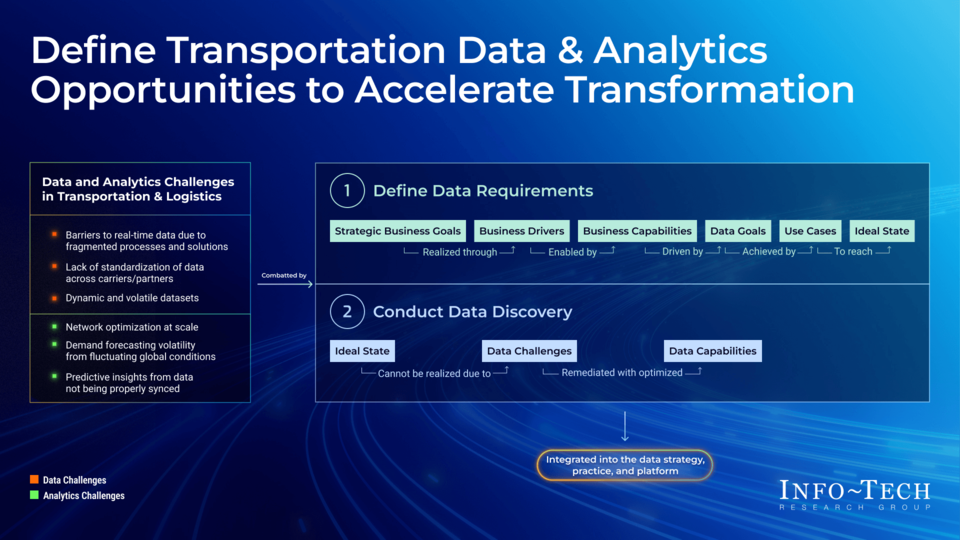
- Begin by understanding and validating your organization's strategic goals. Classify them and map each one to key business drivers, then identify the supporting business capabilities and processes that enable their realization.
- Use Info-Tech's tools and methodologies to define and prioritize your top data initiatives. Clearly articulate the data-related outcomes that align with business objectives and link each initiative to its corresponding strategic goal and supporting data capabilities.
- Next, classify your business' data requirements and identify existing data challenges. Use these insights to inform next steps for evolving your data strategy to improve overall data maturity.
- Finally, confirm the project mandate and formally initiate your data initiative through a data strategy.
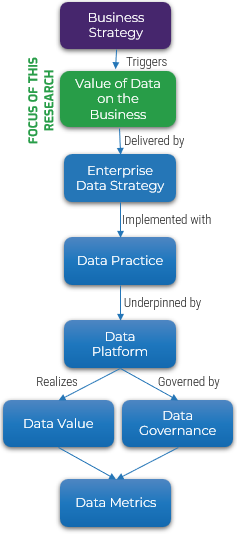
The Info-Tech difference:
- Identifying and validating data requirements before implementing a data strategy is key to the success of your data initiatives – it clarifies the "why" before the "how."
- By understanding your specific objectives, your organization can choose the most suitable data strategy, practice, and platform for your transportation and logistics business, rather than simply following industry trends. After all, data solutions are not one-size-fits-all.
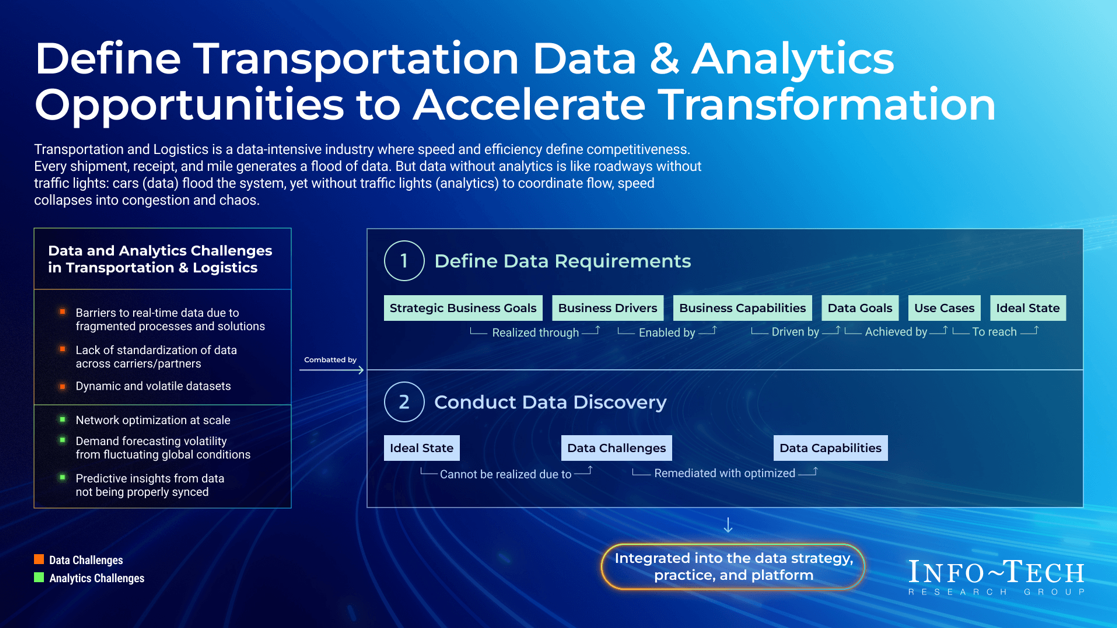
Info-Tech's methodology to define transportation data & analytics opportunities to accelerate transformation
| 1. Define Your Data Requirements | 2. Conduct Your Data Discovery | |
|---|---|---|
| Phase Steps | 1.1 Define and prioritize strategic goals 1.2 Map business drivers to goals 1.3 Identify focused business capabilities 1.4 Map data-related goals to fulfill business goals 1.5 Ideate analytical use cases to help reach ideal state |
2.1 Understand and classify data capability maturity 2.2 Identify challenges through data mapping 2.3 Map data capabilities and challenges to goals 2.4 Discuss data strategy next steps |
| Phase Outcomes |
|
|
| Deliverables |
|
|
Insight summary
Data's role in transportation and logistics
Transportation and Logistics is a data-intensive industry where speed and efficiency define competitiveness. Every shipment, receipt, and mile generates a flood of data. But data without analytics is like roadways without traffic lights: cars (data) flood the system, yet without traffic lights (analytics) to coordinate flow, speed collapses into congestion and chaos.
Align data with operational outcomes
Linking business priorities, such as on-time delivery, route efficiency and customer visibility, with data goals ensures that investments deliver measurable operational value, not just technical outputs. Without this alignment, strategies risk becoming tactical fixes that fail to improve service or efficiency.
Capability gaps are transformation levers
Challenges like fragmented fleet data, limited real-time visibility or outdated dispatch tools often signal deeper capability gaps. Through identifying and addressing these gaps, organizations can turn recurring disruptions into targeted improvements that strengthen reliability, boost efficiency, and sharpen competitiveness.
Blueprint deliverables
Each step of this blueprint is accompanied by supporting deliverables to help you accomplish your goals:
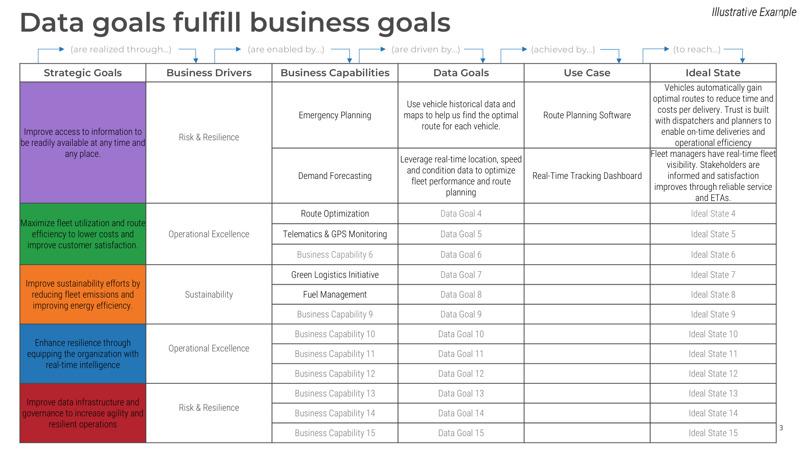
Transportation Capability Alignment Presentation Template
This PowerPoint presentation visually outlines business capabilities and their strategic contribution to the broader data strategy.

Transportation Data Mapping Template
This PowerPoint functions as a collaborative working document to visually map your technology ecosystem and the flow of data for the data mapping exercise.
Key deliverable:
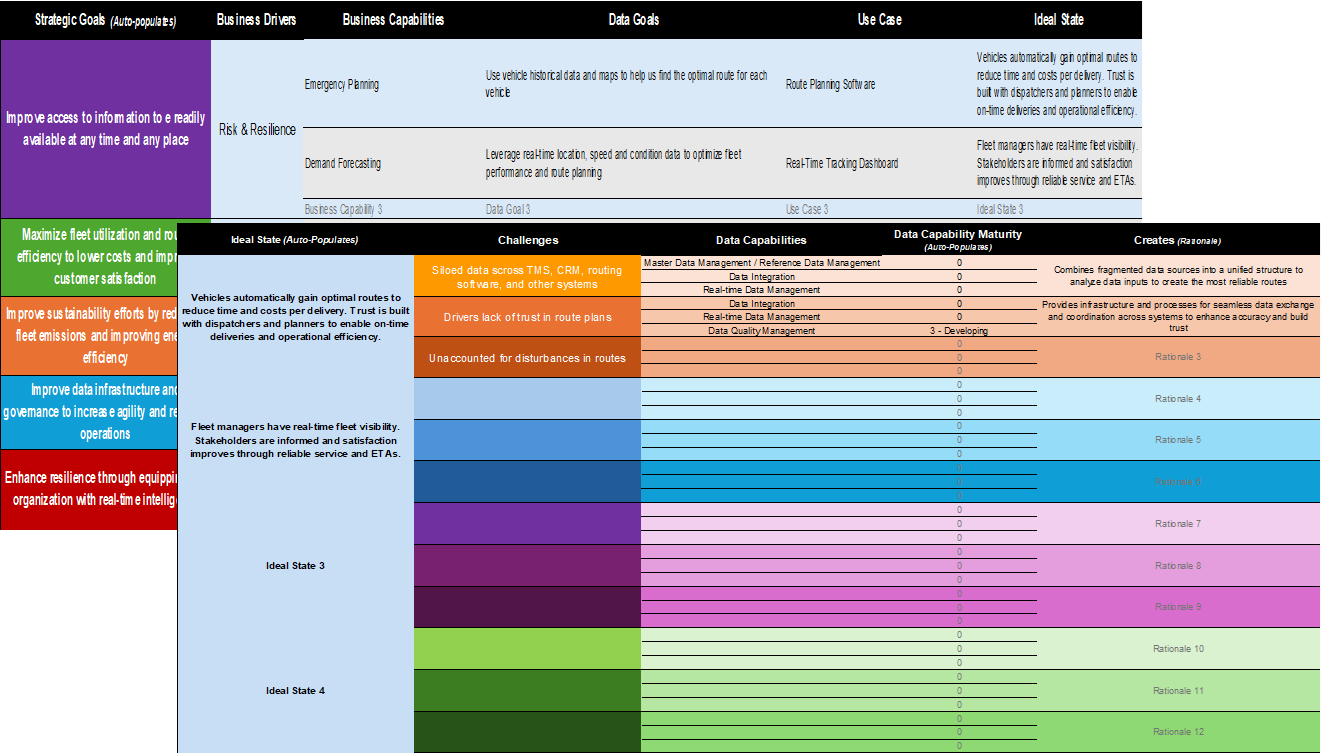
Transportation Capability-to-Data Matrix Workbook
This Excel workbook is used to prioritize strategic goals and assess the value of data by mapping current challenges to existing capabilities, evaluating data capability maturity, and identifying what's needed to reach the desired future state.
Blueprint benefits
| IT Benefits | Business Benefits |
|---|---|
|
|
Measure the value of this blueprint
These metrics bridge the gap between data efforts and real business impact by quantifying how well data supports critical business functions.
Within this approach you will tie each data initiative to a measurable business capability and these metrics allow you to prioritize investments, demonstrate value, and continuously improve your data strategy in alignment with business goals.
| Metric | Measure | CSF (Critical Success Factor) |
| Value realization | % OR $ ROI from data initiatives (i.e. cost savings, revenue increase) | Increase |
| Time to insight | Average time from data availability to decision-making | Decrease (less time required) |
| Decision quality index | % of strategic decisions backed by data | Increase |
| Use case completion rate | % of capability-linked data use cases delivered and adopted | Increase |
| Capability enablement score | % of priority business capabilities supported by data solutions | Increase |
Building a scalable data strategy to support high growth
INDUSTRY
Transportation & Logistics
SOURCE
Brewster Consulting Group, 2025
Using data to combat the challenge of acquisition-driven growth.
| Challenge | Solution | Results |
|
An Arizona-based logistics and trucking company was seeing great growth through their rapid spree of acquisitions. However, they were struggling to manage and scale their data operations with the growth. They inherited a patchwork of data systems, reporting structures, and inconsistent data governance practices. They realized their current strategy was fragmented, heavily manual, and unsustainable. They sought out on a mission to design a future ready architecture that would grow with their business. |
They began by assessing their data landscape, identifying automation opportunities, and aligning technology with business goals. The focus was on eliminating silos while empowering decision-makers with timely, accurate insights. Through discovery, they mapped systems, reporting tools, KPIs, and workflows, uncovering overlaps and inconsistent goal definitions. This informed documented pain points, functional requirements, and a collaborative vision for a unified, automated, and scalable data environment. |
They established a scalable data infrastructure with automation, established governance processes and integrated systems. Key outcomes included:
|
Info-Tech offers various levels of support to best suit your needs
| DIY Toolkit | Guided Implementation | Workshop | Executive & Technical Counseling | Consulting |
|---|---|---|---|---|
| "Our team has already made this critical project a priority, and we have the time and capability, but some guidance along the way would be helpful." | "Our team knows that we need to fix a process, but we need assistance to determine where to focus. Some check-ins along the way would help keep us on track." | "We need to hit the ground running and get this project kicked off immediately. Our team has the ability to take this over once we get a framework and strategy in place." | "Our team and processes are maturing; however, to expedite the journey we'll need a seasoned practitioner to coach and validate approaches, deliverables, and opportunities." | "Our team does not have the time or the knowledge to take this project on. We need assistance through the entirety of this project." |
Diagnostics and consistent frameworks are used throughout all five options.
Guided Implementation
What does a typical GI on this topic look like?
| Phase 1 | Phase 2 | ||
|---|---|---|---|
|
Call #1: Define and prioritize strategic goals. Call #2: Map business drivers to goals. |
Call #3: Identify focused business capabilities and map them to drivers and goals. Call #4: Create and map data-related goals to fulfill business goals. Call #5: Ideate analytical use cases to help reach ideal state. |
Call #6: Understand and classify data capability maturity. Call #7: Identify challenges through data mapping. |
Call #8: Map data capabilities and challenges to goals. Call #9: Discuss data strategy next steps. |
A Guided Implementation (GI) is a series of calls with an Info-Tech analyst to help implement our best practices in your organization.
A typical GI is 8 to 12 calls over the course of 4 to 6 months.
Workshop overview
| Day 1 | Day 2 | Day 3 | |
|---|---|---|---|
| Activities | Establish Business Context and Value | Analyze Data Challenges and Map Capabilities | Next Steps and Wrap-Up (offsite) |
| 1.1 Define and prioritize strategic goals 1.2 Map business drivers to goals 1.3 Identify focused business capabilities 1.4 Map data-related goals to fulfill business goals 1.5 Ideate analytical use cases to help reach ideal state |
2.1 Understand and classify data capability maturity 2.2 Identify challenges through data mapping 2.3 Map data capabilities and challenges to goals 2.4 Discuss data strategy next steps |
3.1 Complete in-progress deliverables from previous two days. 3.2 Set up review time for workshop deliverables and to discuss next steps. |
|
| Deliverables |
|
|
|
| Outcomes |
|
|
|
Contact your account representative for more information.
workshops@infotech.com 1-888-670-8889
Phase 1
Define Your Data Requirements
Phase 1
1.1 Define and prioritize strategic goals
1.2 Map business drivers to goals
1.3 Identify focused business capabilities
1.4 Map data-related goals to fulfill business goals
1.5 Ideate analytical use cases to reach ideal state
Phase 2
2.1 Understand and classify data capability maturity
2.2 Identify data challenges
2.3 Map data capabilities and challenges to goals
2.4 Discuss data strategy next steps
Define Transportation Data & Analytics Opportunities to Accelerate Transformation
This phase will walk you through the following activities:
Confirm the organizational strategic goals, business drivers, capabilities, and processes driving the data strategy effort.
Identify the data-related outcomes, goals, and ideal environment needed to fulfill the business goals.
This phase involves the following participants:
- CIO
- CDO or Data Lead
- Business Unit Leads/Executives/Senior Managers
- Business Analysts
- Enterprise/Business Architect
Strategically align priorities for data enablement
Why data alignment with priorities matters:
- Business goals often fail to translate into clear data needs.
- Data teams may build solutions that don't address what matters most.
- Misalignment leads to waste, delays, and low business impact.
The benefits of this approach:
- Identify and clarify this year's key business priorities.
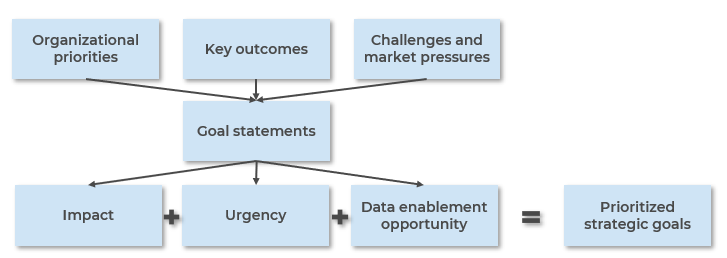
- Translate them into concise goal statements.
- Assess urgency, impact, and relevance to data.
- Use these goals to anchor your data strategy and roadmap.
Define and prioritize strategic goals
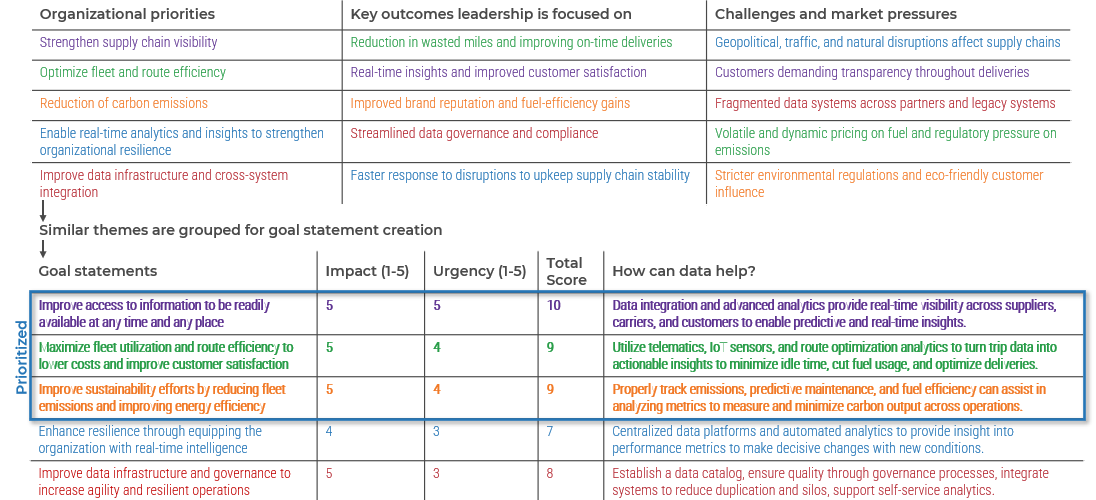
Illustrative Example (color coding indicates similar themes for grouping purposes)
1.1 Define and prioritize strategic goals
2-3 hours
- As a group, discuss the following prompts:
- What are the top 3-5 organizational priorities this year?
- What key outcomes is leadership focused on (i.e. growth, efficiency, customer satisfaction, innovation, market expansion)?
- What challenges or market pressures are influencing these priorities?
- Record your ideas on a flip chart or whiteboard.
- Next, group similar ideas and themes together. Create clear, concise goal statements using this format:
- "Improve [focus area] to achieve [business outcome] (i.e. Maximize fleet utilization and route efficiency to lower costs and improve customer satisfaction).
- Assess each goal by rating it on two criteria:
- Impact: How critical is this goal to business success?
- Urgency: How quickly does it need to be addressed?
- Use a 1-5 scoring matrix for each (1 = low, 5 = high).
- Discuss how each strategic goal could be enabled or accelerated through data and analytics.
- Identify the 3-5 highest-priority goals based on their combined impact, urgency, and relevance to data. These will form the foundation for the rest of your strategic alignment.
| Input | Output |
|---|---|
|
|
| Materials | Participants |
|
|
About Info-Tech
Info-Tech Research Group is the world’s fastest-growing information technology research and advisory company, proudly serving over 30,000 IT professionals.
We produce unbiased and highly relevant research to help CIOs and IT leaders make strategic, timely, and well-informed decisions. We partner closely with IT teams to provide everything they need, from actionable tools to analyst guidance, ensuring they deliver measurable results for their organizations.
What Is a Blueprint?
A blueprint is designed to be a roadmap, containing a methodology and the tools and templates you need to solve your IT problems.
Each blueprint can be accompanied by a Guided Implementation that provides you access to our world-class analysts to help you get through the project.
Need Extra Help?
Speak With An Analyst
Get the help you need in this 2-phase advisory process. You'll receive multiple touchpoints with our researchers, all included in your membership.
Guided Implementation 1: Define Your Data Requirements
- Call 1: Define and prioritize strategic goals.
- Call 2: Map business drivers to goals.
- Call 3: Identify focused business capabilities and map them to drivers and goals.
- Call 4: Create and map data-related goals to fulfill business goals.
- Call 5: Ideate analytical use cases to help reach ideal state.
Guided Implementation 2: Conduct Your Data Discovery
- Call 1: Understand and classify data capability maturity.
- Call 2: Identify challenges through data mapping.
- Call 3: Map data capabilities and challenges to goals.
- Call 4: Discuss data strategy next steps.
Contributors
- Paula Wagner, CIO, Mansfield Energy Corporation
- Vincent Tung, Global Head of Quality and Compliance, WorldNet International
