
Build the Accountability That Makes Service Orchestration Possible
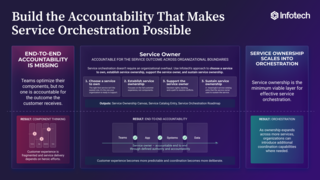
Service ownership is the minimum viable governance layer needed to coordinate services across organizational boundaries.
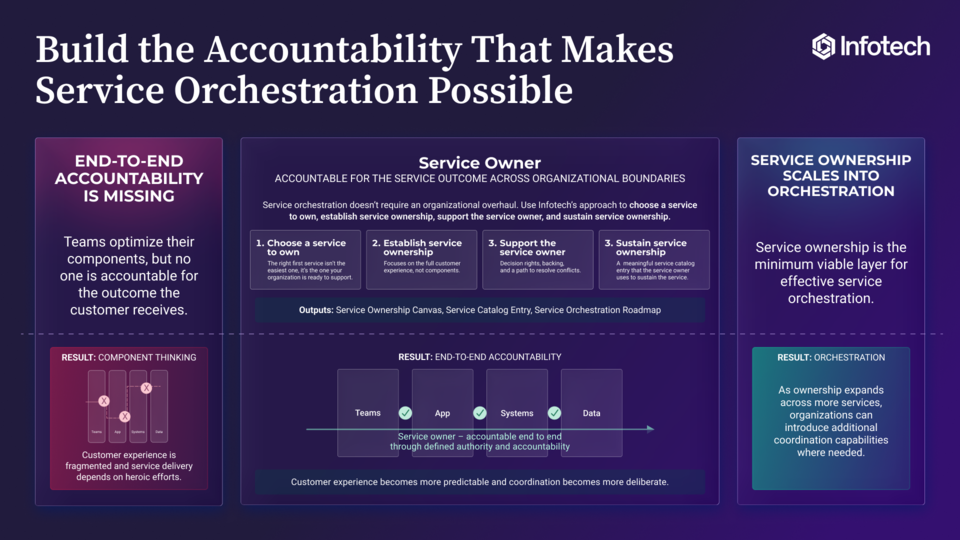
IT services increasingly span teams, functions, vendors, processes, and AI-assisted workflows. Yet many organizations still manage them through component-level accountability, with no one clearly accountable for the end-to-end service outcome. This can lead to delays, repeated handoffs, conflicting information, and inconsistent customer experiences when work crosses organizational boundaries. Follow our framework to establish clear service ownership and create the minimum viable governance layer that makes broader service orchestration possible.
Without clear accountability for service outcomes, service delivery gaps between teams must be bridged through informal coordination, institutional knowledge, personal relationships, and individual effort. That makes service delivery hard to improve and increasingly expensive to coordinate. Service ownership lays the foundation for broader service orchestration by creating end-to-end accountability without reorganizing the entire enterprise first.
1. Skip the reorg.
Don’t start with a new operating model. Start with one service and one accountable owner instead.
2. Skip the checkbox appointment.
Choose a service owner with the influence, credibility, mindset, and coordination skills that the role demands.
3. Skip the set-and-forget approach.
Reinforce ownership with a named sponsor, an escalation path, boundary coordination commitments, and regular review.
Use this step-by-step blueprint to establish service ownership as a practical mechanism for improving service orchestration.
Our research and supporting tools give you a step-by-step framework to establish service ownership, build the structures that sustain it, and determine when the model is ready to expand. Use this step-by-step approach to:
- Identify and define an initial service. Reorient thinking from components to outcomes and define one service clearly enough that ownership can be assigned to it.
- Identify and empower your service owner. Name, confirm, and orient a service owner who willingly takes on the initial service, understands what the role requires, and has the authority to act on it.
- Design the structures that sustain service ownership. Design the support structure, review the catalog entry, define and measure success, and build your roadmap.
About Info-Tech
Info-Tech Research Group is the world’s fastest-growing information technology research and advisory company, proudly serving over 30,000 IT professionals.
We produce unbiased and highly relevant research to help CIOs and IT leaders make strategic, timely, and well-informed decisions. We partner closely with IT teams to provide everything they need, from actionable tools to analyst guidance, ensuring they deliver measurable results for their organizations.
What Is a Blueprint?
A blueprint is designed to be a roadmap, containing a methodology and the tools and templates you need to solve your IT problems.
Each blueprint can be accompanied by a Guided Implementation that provides you access to our world-class analysts to help you get through the project.
Need Extra Help?
Speak With An Analyst
Get the help you need in this 3-phase advisory process. You'll receive multiple touchpoints with our researchers, all included in your membership.
Guided Implementation 1: Identify and define an initial service
- Call 1: Scope requirements, objectives, and your specific challenges.
- Call 2: Select an initial service.
- Call 3: Define your selected service.
Guided Implementation 2: Identify and empower your service owner
- Call 1: Identify your service owner candidate.
- Call 2: Name, confirm, and orient your service owner.
Guided Implementation 3: Design the structures that sustain service ownership
- Call 1: Design the support structure.
- Call 2: Review the catalog entry and define success measures
- Call 3: Build your roadmap.
- Call 4: Summarize results and plan next steps.
Contributors
- Doug Tedder, Owner and Principal Consultant, Tedder Consulting LLC
- Nicola Betz, Head of Strategy, Policy & Engagement | Digital Identity, UK Government
- Lily Yan, Director, Business Process Architecture, PointClickCare
 Navigate the Digital ID Ecosystem to Enhance Customer Experience
 Document Business Goals and Capabilities for Your IT Strategy
 Build a Business-Aligned IT Strategy
 Define Your Digital Business Strategy
 Drive Digital Transformation With Platform Strategies
 Make IT a Partner in Successful M&A Due Diligence
 Make IT a Successful Partner in M&A Integration
 Plan Your Digital Transformation on a Page
 Review Your Application Strategy
 Start Making Data-Driven People Decisions
 2021 CIO Priorities Report
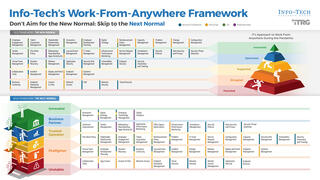 Create a Work-From-Anywhere Strategy
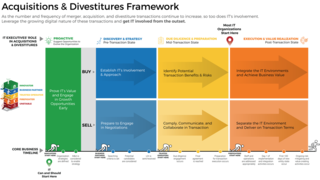 Mergers & Acquisitions: The Sell Blueprint
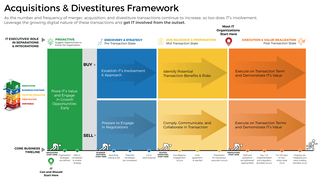 Mergers & Acquisitions: The Buy Blueprint
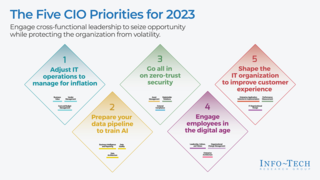 CIO Priorities 2023
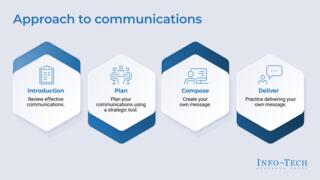 Communicate Any IT Initiative
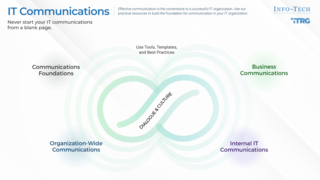 Effective IT Communications
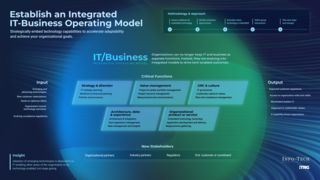 Establish an Integrated IT-Business Operating Model
 Info-Tech Quarterly Research Agenda Outcomes Q2/Q3 2023
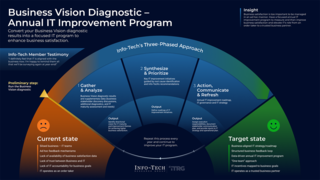 Business Vision Diagnostic – Annual IT Improvement Program
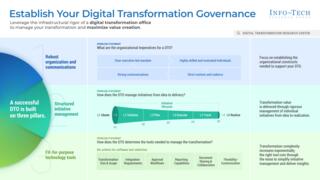 Establish Your Digital Transformation Governance
 Info-Tech Quarterly Research Agenda Outcomes Q4 2023
 Master Your Change Story for Digital Transformation
 Info-Tech’s Best of 2023: The Year IT Reached an Inflection Point
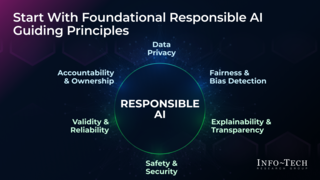 Prepare for AI Regulation
 Crack the Code to Successful Transformation Management
 Info-Tech Diagnostics: Identify and Leverage Your Strengths
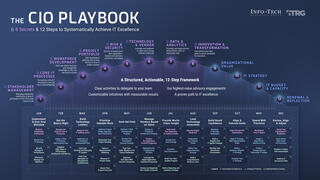 The CIO Playbook: 8 Secrets and 12 Steps to Systematically Achieve IT Excellence
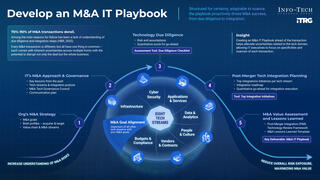 Develop an M&A IT Playbook
 Adapt to Uncertainty With a Technology-First Action Plan
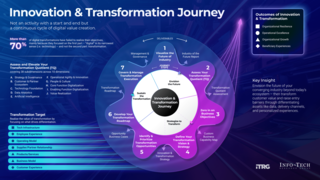 Digital Transformation: A Revolution That Lost Its Way
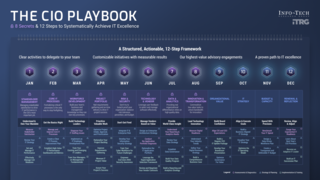 The CIO Playbook
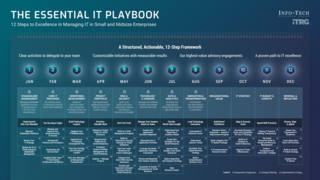 The Essential IT Playbook
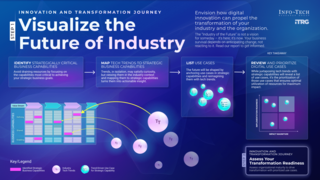 Visualize the Industry of the Future
 CIO Priorities 2026
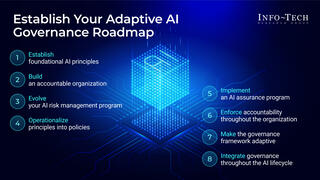 Establish Your Adaptive AI Governance Program: From Principles to Practice
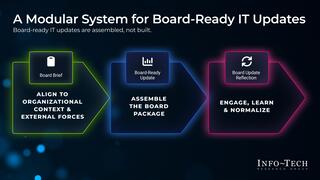 Assemble Board-Ready IT Updates
 Build the Accountability That Makes Service Orchestration Possible
