
Assemble Board-Ready IT Updates
Use Info‑Tech’s modular system to build CIO board updates without reinventing the deck each cycle.
CIOs build credibility by how they present, how they respond, and how consistently they show up, meeting after meeting. When IT updates lead with activity, metrics, and project status, directors view the CIO as an operator rather than a strategic partner, and the CIO's judgment quietly comes into question. Our research provides CIOs with a modular system to build board-ready updates that frame IT through a strategic lens – enterprise decisions, risk, and implications – without reinventing the deck each cycle.
For many CIOs, the challenge of delivering meaningful board updates is typically one of perspective and habit, rather than capability. Consistently earning board confidence starts with the CIO understanding what the board must decide, accept, or oversee, and treating every interaction as a chance to build trust over time.
1. Know your audience.
Boards interpret every topic through the lens of enterprise value, risk exposure, strategic alignment, and governance confidence. CIOs who internalize this context can demonstrate how IT protects and enables organizational value, advances executive priorities, and responds to external forces.
2. Anchor updates to organizational outcomes.
IT updates that default to activity, project status, and operational details leave directors searching for what matters. CIOs who act as sense-makers, translating IT into what directors actually govern, position themselves and IT as strategic enablers of organizational value.
3. Earn credibility one update at a time.
Board updates compete with everything else in a director's pre-read package. Consistent, scannable updates speed director review and free the CIO to focus on insight and storytelling. CIOs who read board signals and refine deliberately, rather than just surviving each meeting, build fluency that elevates IT alongside themselves.
Use this step-by-step research to assemble clear, decision-ready board updates
This research provides CIOs with a practical, repeatable way to build board‑ready updates without starting from scratch or relying solely on IT expertise. Start with four board scenario templates: quarterly updates, annual strategic reviews, special interest topics, and urgent crisis updates that frame IT through decisions, risk, and implications, not explanations. Adapt updates to board cadence, pre-reads, and governance expectations to reduce effort while improving relevance and consistency over time.
- Get to know the board and your organization. Capture how the board operates, what it cares about, and what role it plays, so every interaction is framed for the right decision at the right level.
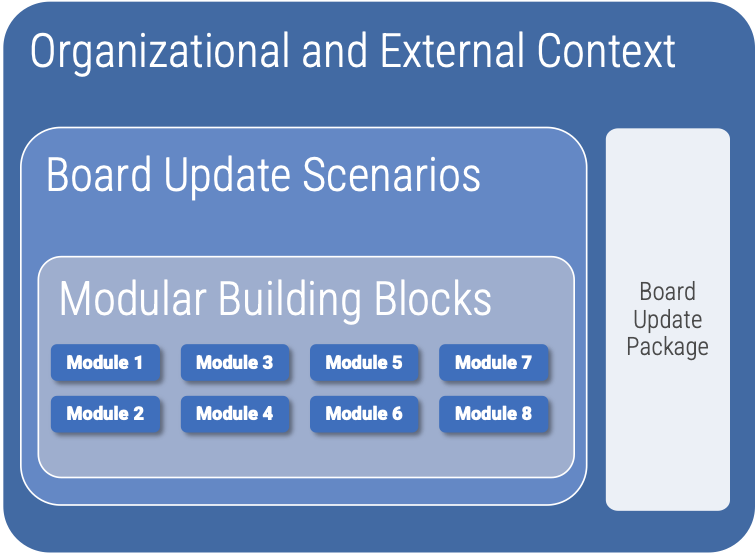
- Assemble the board package. Select the matching scenario, then assemble and adapt modular building blocks into a board-ready update that enables decisions, direction, or risk acceptance.
- Engage, learn, and normalize. Rehearse delivery, read board signals in the room, and apply those observations to the next update.
Assemble Board‑Ready IT Updates
Use Info‑Tech’s modular system to build CIO board updates without reinventing the deck each cycle.
Analyst perspective
Stop presenting to the board and start enabling it.

Board are governance conversations, not IT updates with a different audience. CIOs who walk into the boardroom with their usual instincts: leading with activity, metrics, and project status, end up answering questions the board isn’t asking. Boards exist to decide, set direction, and accept risk. An update built around what IT did rather than what the board needs to do doesn't just miss the mark; it quietly erodes confidence in the CIO's judgment.
This usually isn’t an incompetence problem, it is a perspective problem. A CIO who reports "99.8% uptime, up from 99.6%" isn't wrong, but the board can't act on that number. The same fact, reframed: the reliability gains this quarter mean we can commit to the Q3 acquisition timeline without new operational risk, gives the board something to actually decide on. That reframe only happens when a CIO understands how the business creates value and how the board thinks, not just how the systems work.
Effective Board updates require both deep immersion in how the organization creates value, manages risk, and responds to external forces, and a real understanding of how the board operates and what it cares about. Without both, a CIO cannot make sound choices about what to include, what to omit, or how to frame what matters. CIOs who do this consistently do not just deliver better updates; the organization and the Board recognize them as strategic executives who help the board do its job.
Diana MacPherson
Research Director, CIO
Info-Tech Research Group
Executive summary
Your Challenge
CIOs are expected to demonstrate IT’s value at the board level, yet many struggle to deliver updates that are consistently relevant, decision‑ready, and trusted.
- Boards care about enterprise value, risk, strategy, and delivery confidence, not IT activity.
- Board expectations shift by cadence, committee, and context, making one‑size‑fits‑all updates ineffective.
- Boards require consistent framing, just-enough detail to decide, and clear recommendations.
The expectation: A successful board update must be clear, concise, consistent, and address strategy, not operations.
Common Obstacles
Several factors make effective board updates elusive:
- A siloed IT perspective that fails to account for organizational context, board priorities, and external forces.
- Inconsistent structure, making it harder for boards to scan, compare, and decide with confidence.
- No feedback loop to incorporate board reactions into future updates.
Fortunately, these obstacles are problems of approach and perspective, not capability, and can be corrected with deliberate changes in how CIOs frame, structure, and learn from board updates.
Info-Tech’s Approach
Info‑Tech’s modular system enables CIOs to assemble clear, board‑ready IT updates without starting from scratch each cycle:
- Start from common board scenarios, not a blank deck.
- Frame IT through decisions, risk, implications, and delivery confidence, not operations.
- Use modular building blocks that adapt as board priorities and context evolve.
- Apply a disciplined feedback loop to improve over time.
Outcome: Board updates become familiar, scannable, and trusted, positioning the CIO and IT as strategic enablers of organizational value.
Info-Tech Insight
A modular approach turns board updates from one‑off presentations into a familiar, reusable structure that builds clarity, confidence, and trust over time
Your challenge
CIOs often struggle to demonstrate IT’s value in the boardroom.
- Boards hear about IT activity instead of enterprise value, risk, and strategic implications.
- Boards cannot scan for progress, compare across meetings, or identify what action is required.
- Boards receive the same update regardless of audience, stakes, or timing.
The result: IT topics go untranslated, board decisions become harder, and the CIO is perceived as an operational reporter rather than a strategic partner.
19%
Only 19% of directors strongly agree they receive sufficient information on AI and Gen AI risk. If CIOs cannot land the most urgent technology topic in the boardroom, the cost of unclear, inconsistent updates has never been higher.
Source: PwC, 2025
Bottom line: The problem is not IT's value; it is whether CIOs can translate that value into terms that drive board confidence and decisions.
Common obstacles
A CIO can be highly competent and still struggle to deliver meaningful board updates.
The reason is rarely capability; it's perspective and habit
- Thinking like a technologist, not a business leader. Without sustained immersion in how the organization creates value, manages risk, and responds to external forces, CIOs default to IT activity and struggle to frame updates in terms the board cares about.
- Not knowing the room. Without a working model of board priorities, backgrounds, and context, CIOs cannot make sound choices about what to include, what to omit, or how to frame what matters.
- Not learning from the room. Boards signal what is and isn't working, but CIOs who lack organizational fluency and audience awareness miss these signals and repeat the same mistakes.
Across technology leadership, board access and board confidence are not the same thing.
95%
95% of CISOs regularly report to the board.
47%
Yet only 47% of directors feel confident in management’s ability to articulate the business impact of evolving threats.
Source: IANS Research, 2026.
Info-Tech’s approach
Use Info-Tech’s modular system to assemble clear, consistent, effective updates to your board.
The Info-Tech difference:
Board updates don’t fail because CIOs lack competence; they fail because CIOs rely on IT expertise alone and rebuild each update without anchoring to board priorities and context.
This research provides CIOs with a practical, repeatable way to build board‑ready updates without starting from scratch or relying solely on IT expertise.
- Start from proven board scenarios, not a blank deck.
- Frame IT through decisions, risk, and implications, not explanations.
- Adapt updates to board cadence, pre‑reads, and governance expectations.
- Reduce effort while improving relevance and consistency over time.
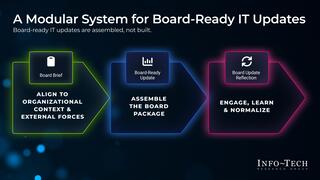
A modular system for board‑ready IT updates
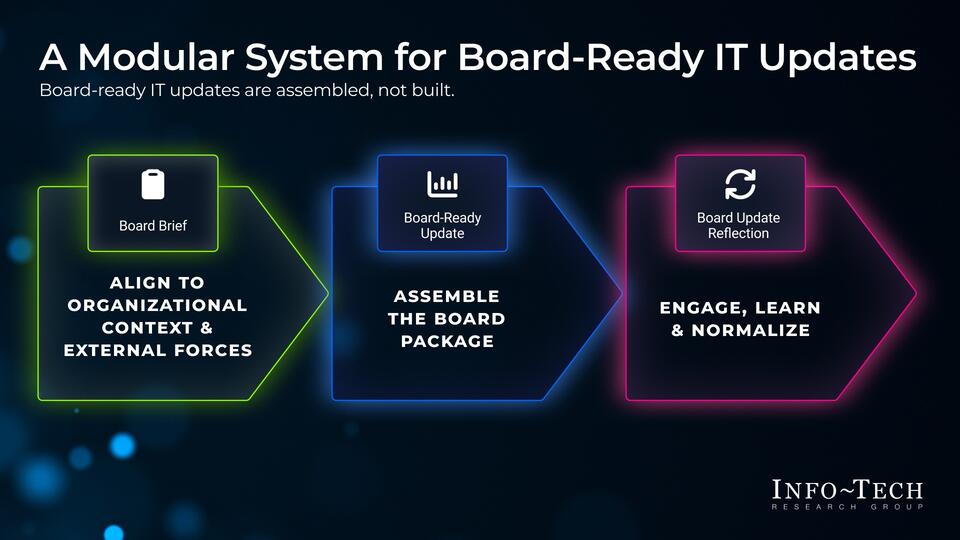
Board‑ready IT updates are assembled, not built.
-
Align to organizational context & external forces
Without a clear link to the value chain, executive priorities, board operations, and external forces, IT updates risk being accurate but irrelevant. Board Brief -
Assemble the board package
A board update package weaves organizational and external context into modular building blocks for standard board scenarios. Board-Ready Update -
Engage, learn, and normalize
Adjust the update each cycle. Modularity helps CIOs stay aligned as board priorities and expectations evolve. Board Update Reflection
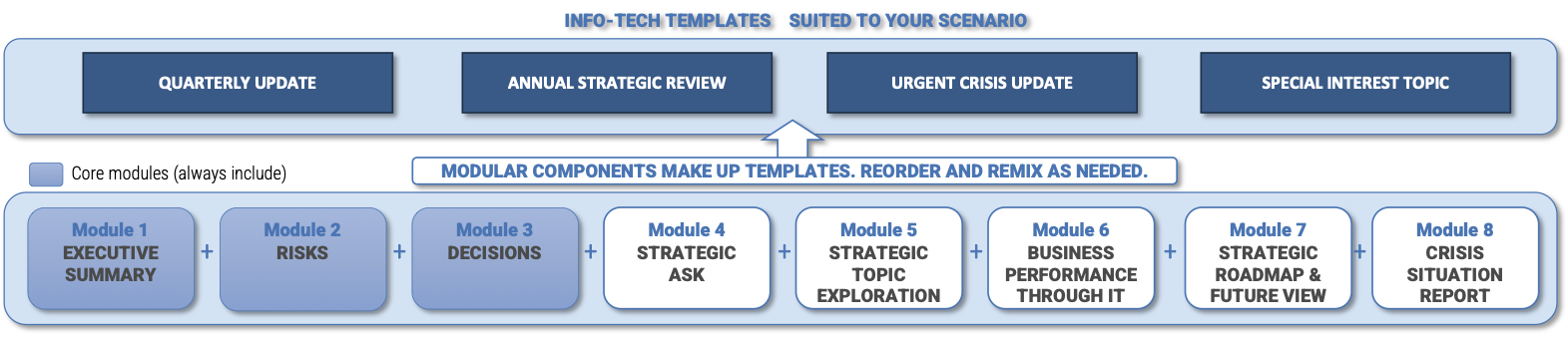
Templates are a starting point. The CIO must augment the update by reducing complexity and framing issues in terms of decisions, risk, and implications.
Info-Tech’s methodology for assembling board-ready updates
Steps |
1. Get to know the board and your organization
|
2. Assemble the board package
|
3. Engage, learn, normalize
|
Step outcomes |
The CIO knows why the board is seeing the update, what role the board is expected to play, and what lens directors will use to interpret the content. | A concise, board‑ready update that enables decision‑making, direction, risk acceptance, or assurance without rebuilding the deck each time. | A disciplined, repeatable approach to observing board responses and incorporating them into continuous improvement of future updates. |
Insight Summary
A modular approach turns board updates from one‑off presentations into a familiar, reusable structure that builds clarity, confidence, and trust over time.
Influential CIOs develop deep organizational and external awareness
IT updates become board‑relevant, and position the CIO as a strategic executive, when they clearly show IT’s role in protecting and enabling organizational value, advancing executive priorities, and responding to external forces.
Effective board updates focus on organizational outcomes, not technology
CIOs are sense‑makers who position IT as a strategic enabler by connecting technology to what boards care about: enterprise value, risk, strategy, and governance. When CIOs default to functional updates, IT appears irrelevant and the CIO operational rather than strategic.
Consistent templates make content scannable
Boards make decisions by scanning for what matters. Consistent, scannable updates speed director review while giving CIOs more room to focus on insight and storytelling.
Credibility compounds with each successful update
CIO credibility is cumulative; it is built by consistently structuring updates, framing issues clearly, and responding to board signals over time.
Blueprint deliverables
Each step of this blueprint is accompanied by supporting deliverables to help you accomplish your goals.
Board Brief
A concise, one‑page board brief that captures how your board operates, what it cares about, and how IT topics will be interpreted, so every update is framed for the right decision, at the right level.
Board Reflection
A structured reflection tool that helps CIOs read board signals, assess how updates landed, and deliberately adapt framing, emphasis, and structure for the next board interaction.
Key deliverables:
Board-Ready Update Templates
Scenario‑based board update templates built from modular components, designed to be reused, reordered, and adapted as board priorities shift.
Blueprint benefits
IT Benefits
- Clear, repeatable structure for board updates that reduces ad hoc effort and eliminates rebuilding decks each cycle.
- Stronger CIO credibility through consistent, disciplined framing of IT topics around decisions, risk, and implications.
- Structured, continuous improvement by interpreting board questions, focus, and concerns as feedback for future updates.
- Greater confidence under scrutiny by preparing for board discussions with clear narratives and disciplined rehearsal.
Business Benefits
- More effective board engagement with discussions focused on strategy, risk tolerance, and trade‑offs.
- Faster, clearer decision‑making through updates that make board asks and implications unmistakable.
- Improved governance quality by ensuring directors have the right context to fulfill oversight and duty of care.
- Fewer surprises at the board level as risks, changes, and uncertainties are surfaced earlier and more consistently.
- Stronger alignment between IT and enterprise priorities, improving trust between the board, CEO, and management team.
Measure the value of this blueprint
Measurable Benefit |
Metrics |
Impact |
Reduced update and rework time |
|
|
CIO enables faster, clearer board action |
|
|
CIO credibility increases |
|
|
Step 1
Get to know the board and your organization
Activities
1.1 Create a one-page board brief
Assemble Board‑Ready IT Updates: Step 1
This step involves the following participants:
CIO
Outcomes of this step
The CIO knows why the board is seeing the update, what role the board is expected to play, and what lens directors will use to interpret the content.
Effective board updates require CIOs to contextualize IT through organizational, board, and external perspectives
Boards do not evaluate IT in isolation. Directors interpret updates through the organization’s priorities, their governance role, and the broader external environment. CIOs must understand and integrate these perspectives to ensure relevance, clarity, and credibility.
Organizational Lens
The value the organization delivers, and the capabilities required to do so, as defined and owned by senior executives.
Board Lens
How the board operates, what it cares about, and who shapes the conversation.
External Lens
What is the wider environment that your organization exists in? What tech trends, regulatory/legal, economic, socio-cultural, political, or geographic forces present opportunities or risks?
Org. Lens
Before thinking about boards, CIOs must immerse themselves in the organizational context
Boards care about organizational outcomes, not technology. They interpret IT updates through enterprise value, risk exposure, strategic alignment, and governance confidence. CIOs who understand how the business operates and how other executives create and protect value can translate technology into these terms, making IT relevant, coherent, and credible at the board level. CIOs must:
Gain proficiency across the organizational value chain
- Understand how the organization creates value, where IT enables outcomes, and where it constrains performance or flexibility.
- This enables the CIO to show where IT drives or constrains enterprise value, so the board sees technology as a business enabler, not an internal function report.
Translate IT into business outcomes
- Speak fluently about growth, efficiency, trust, risk, and resilience vs. systems, tools, or architectures.
- This moves IT discussions into the language directors govern: strategy, performance, risk, and oversight, so decisions can be made without “technology translation” in the room.
Build credibility with executive peers
- Ensure IT perspectives reflect shared priorities, not siloed agendas.
- Understand what senior executives (CEO included) are accountable for and focused on.
- Avoid speaking on behalf of peers or reframing their outcomes through an IT lens.
- This prevents conflicting narratives and reinforces management coherence, one of the fastest ways to build (or lose) board confidence.
Align with the executive team on board‑level boundaries
- Clarify what truly requires board attention versus what belongs in management reporting.
- This keeps updates decision‑ready by separating governance issues from management reporting, reducing noise, avoiding deep dives, and preserving board attention for what truly matters.
Info-Tech Insight
Without a solid grasp of the organization’s value chain and executive priorities, IT updates risk sounding accurate, but irrelevant, to the board.
Board Lens
After immersing themselves in the organizational context, CIOs must align their thinking with how the board operates and interprets information
Meeting cadence, committee structures, and pre‑read expectations influence what gets attention, while governance lenses and board composition determine how IT is assessed. CIOs who understand this are far better positioned to anticipate questions, frame issues appropriately, and support effective oversight. CIOs need to know:
How the Board Operates
- Cadence: Meeting and committee rhythm.
- Committees: Where scrutiny happens.
Pre‑reads: How far in advance materials go out.
Engagement pattern: Questions before vs. in-meeting.
Operating norms shape how much context and signaling directors expect before engaging.
What the Board Cares About
- Governance lenses: Strategy, performance, risk, delivery confidence.
- Attention threshold: What requires board action vs. management reporting.
Board role: Approve, align on risk tolerance, oversee, set direction.
If this isn’t governance-relevant, it doesn’t belong at the board.
Who Sits on the Board
- Director backgrounds: Where questions originate.
- Committee makeup: Depth and angle of scrutiny.
Composition: Influences perspective even in full‑board discussions.
Director experience shapes how IT topics are probed, even when the content is the same.
Info-Tech Insight
If CIOs don’t internalize how the board operates and what it cares about, IT updates default to “technology talk,” and directors disengage or challenge the narrative.
CIOs must avoid a one-size-fits-all approach and adapt to how the board operates
CIOs must adapt their updates to the board’s operating rhythm:
Cadence
- Confirm board and committee meeting rhythm and where IT appears.
- Note standing cadence topics (e.g. cyber/risk/AI) outside full board.
- Note upcoming topics in the agenda and adjust your timing as needed.
Format & channels
- Confirm delivery format (PPT, Word, portal) and any required templates.
- Align to board book standards.
Pre-reads & engagement
- Confirm pre‑read timing requirements.
- Know whether directors send questions in advance.
- Expect revisions before the meeting if questions surface early.
“The materials go out in advance, and by the time you’re in the room, the board has already formed opinions and questions.”
– Roxanne Seymour, CIO
Boards care about how IT impacts strategy, performance, risk, and governance
CIOs must frame their updates around what drives board attention and structure updates around what the board does: approve, align on risk tolerance, oversee, and set direction.
Strategy alignment
- Whether IT investments support enterprise direction, sequencing, and long‑term flexibility.
- How technology choices enable or constrain future strategic options.
Business performance through IT
- Whether technology is enabling core business outcomes (growth, efficiency, customer trust).
- Whether IT execution strengthens or undermines operational and financial performance.
Risk and assurance
- Exposure that could affect reputation, regulatory compliance, customer trust, or resilience.
- Confidence that risks are understood, mitigated, and escalated appropriately.
Delivery confidence
- Management’s ability to execute reliably against commitments without destabilizing the organization.
- Early signaling of material risks or deviations that could require board attention.
“Once you understand the critical domains where the board intervenes, then you can start to work with the board to achieve your own objectives, as the board can be a tremendous ally.”
– Dr. Lyne Bouchard,
Corporate Director and President
Who sits on the board influences how IT topics are questioned and interpreted
CIOs must anticipate how director experience shapes scrutiny and keep IT narratives consistent across committees and the full board.
Board composition
- Directors bring different scrutiny lenses
- Prior roles signal where questioning will focus
Committee membership
- Committees concentrate scrutiny (audit/risk especially)
- Committee dynamics influence full‑board perception
Researching Board Members
- Review publicly available director profiles to understand backgrounds, expertise, and likely lines of questioning.
- Use the board’s skills matrix (when available) to better understand the role each director plays on the board.
- Read foundational governance documents (e.g. proxy statements, board charter/constitution, certificate of incorporation) to understand how the board operates and exercises its role.
- Explore board‑adjacent forums (committees, management councils, informal engagement), which often shape perspectives ahead of formal board discussions.
- Engage during director onboarding and informal interactions to surface individual perspectives.
External Lens
After understanding the organization and the board, CIOs must account for external forces shaping priorities and risk
Board members consider external scenarios as part of their crisis preparedness. 63% consider cyber breaches, 58% economic shocks, 56% regulatory/policy shifts, 51% technology-related disruptions.
Source: Corporate Board Member & Diligent Institute, 2026
CIOs must account for:
Regulatory/Legal
- External obligations that constrain decisions or introduce non‑negotiable risk.
Economic
- Conditions affecting funding, cost tolerance, and investment posture.
Socio‑Cultural
- Shifts that alter trust, reputation, or stakeholder expectations
Political
- Policy or mandate changes that introduce scrutiny or opportunity.
Geographical
- Jurisdictional factors that affect data, operations, or exposure.
Technology Trends
- Shifts that could materially alter risk, capability, or strategic opportunity.
Info-Tech Insight
By connecting external trends to organizational value and IT, the CIO turns complexity into board‑ready insight, strengthening decisions and reinforcing the CIO’s role as a strategic executive.
About Info-Tech
Info-Tech Research Group is the world’s fastest-growing information technology research and advisory company, proudly serving over 30,000 IT professionals.
We produce unbiased and highly relevant research to help CIOs and IT leaders make strategic, timely, and well-informed decisions. We partner closely with IT teams to provide everything they need, from actionable tools to analyst guidance, ensuring they deliver measurable results for their organizations.
What Is a Blueprint?
A blueprint is designed to be a roadmap, containing a methodology and the tools and templates you need to solve your IT problems.
Each blueprint can be accompanied by a Guided Implementation that provides you access to our world-class analysts to help you get through the project.
Need Extra Help?
Speak With An Analyst
Get the help you need in this 4-phase advisory process. You'll receive multiple touchpoints with our researchers, all included in your membership.
Guided Implementation 1:
- Call 1: Scope requirements, objectives, and your specific challenges.
Guided Implementation 2:
- Call 1: Contextualize the organization and identify influential external factors.
Guided Implementation 3:
- Call 1: Identify the appropriate board scenario, modules, and templates.
- Call 2: Assemble the board package and content.
Guided Implementation 4:
- Call 1: Prepare for the board meeting.
- Call 2: Incorporate board signals into a continuous improvement cycle and prepare for the next update.
Contributors
- Lyne Bouchard, Corporate Director and President, IT for Boards
- Roxanne Seymour, Chief Information Officer, Beazer Homes
 Navigate the Digital ID Ecosystem to Enhance Customer Experience
 Document Business Goals and Capabilities for Your IT Strategy
 Build a Business-Aligned IT Strategy
 Define Your Digital Business Strategy
 Drive Digital Transformation With Platform Strategies
 Make IT a Partner in Successful M&A Due Diligence
 Make IT a Successful Partner in M&A Integration
 Plan Your Digital Transformation on a Page
 Review Your Application Strategy
 Start Making Data-Driven People Decisions
 2021 CIO Priorities Report
 Create a Work-From-Anywhere Strategy
 Mergers & Acquisitions: The Sell Blueprint
 Mergers & Acquisitions: The Buy Blueprint
 CIO Priorities 2023
 Communicate Any IT Initiative
 Effective IT Communications
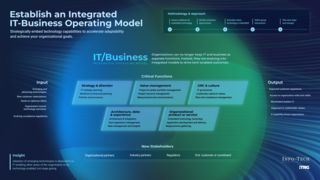 Establish an Integrated IT-Business Operating Model
 Info-Tech Quarterly Research Agenda Outcomes Q2/Q3 2023
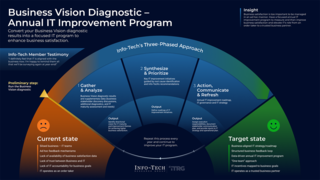 Business Vision Diagnostic – Annual IT Improvement Program
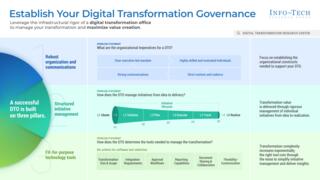 Establish Your Digital Transformation Governance
 Info-Tech Quarterly Research Agenda Outcomes Q4 2023
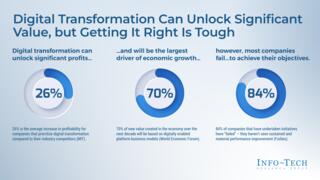 Master Your Change Story for Digital Transformation
 Info-Tech’s Best of 2023: The Year IT Reached an Inflection Point
 Prepare for AI Regulation
 Crack the Code to Successful Transformation Management
 Info-Tech Diagnostics: Identify and Leverage Your Strengths
 The CIO Playbook: 8 Secrets and 12 Steps to Systematically Achieve IT Excellence
 Develop an M&A IT Playbook
 Adapt to Uncertainty With a Technology-First Action Plan
 Digital Transformation: A Revolution That Lost Its Way
 The CIO Playbook
 The Essential IT Playbook
 Visualize the Industry of the Future
 CIO Priorities 2026
 Establish Your Adaptive AI Governance Program: From Principles to Practice
 Assemble Board-Ready IT Updates