
Harness AI to Reduce the Cost and Effort of KTLO in IT Operations
You wanted this yesterday. The tech is here today. Make way for a better tomorrow.
IT leaders and their teams face escalating pressure to deliver transformation and value to the organization. Yet they spend more than half their time and budget just keeping the lights on (KTLO), which leaves limited capacity to modernize, build critical skills, and innovate. Our research framework maps out a four-step path to relieve IT’s KTLO burden, free up resources for innovation, and address the IT skills gap – all by harnessing the power of AI.
In today’s economic uncertainty, IT may be targeted for cost cutting. But now is the time to make a strategic investment in AI, to finally tackle the KTLO conundrum. By automating low-value tasks, IT gains back precious time and budget for innovation. In the process, IT hones its AI knowledge and capability, narrowing its own skills gap. Learn how to strategically leverage AI so IT can redirect its efforts toward innovation, value, and skills development.
1. KTLO by the numbers: where IT’s time and money really go.
Routine IT operations and maintenance tasks occupy 66% of IT teams’ time and effort while consuming 82.6% of IT budget spend, according to Info-Tech’s 2025 IT Spend and Staffing benchmarking data. With so much tied up in KTLO, it’s no wonder IT struggles with the bandwidth to lead more impactful initiatives.
2. Don’t just fix IT problems faster – prevent them entirely.
Incident management is traditionally aimed at restoring services quickly. But AIOps can help teams move from this reactive approach to autonomous prevention and even incident prediction. Don’t waste time and team resources fixing issues you can pre-emptively avoid with AI.
3. Automated governance is actually a good thing.
Autonomous patch and vulnerability management automates governance by turning a chaotic, manual security vulnerability into a predictable, continuous pipeline of nearly 100% compliance. The IT resources tied up in manual governance chores can then be diverted to more complex, high-value projects.
Use our step-by-step roadmap to reclaim KTLO resources for higher-impact work.
This comprehensive research framework and its supporting presentation template empower IT teams to lower their KTLO workload, enhance their AI skills, and become strategic partners in innovation.
Use our methodology to:
- Evaluate the opportunities for AI-powered IT.
- Forecast the value of proven KTLO reduction tactics.
- Mitigate the well-known risks.
Harness AI to Reduce the Cost and Effort of KTLO in IT Operations
You wanted this yesterday. The tech is here today. Make way for a better tomorrow.
Modernize IT. Modernize the organization.
You wanted all this yesterday. The tech is here today. Now make way for a better tomorrow.
Optimizing costs and reducing effort is an IT mandate as old as IT itself. And yet, today, modern IT operations powered by AI finally make the age-old principle of "spend to save" a reality.
The conventional, reactive approach to cost-cutting has always failed because it creates technical debt and starves the business of future value. By contrast, a strategic investment in specific AI modernizations – from AIOps to generative AI service desks – allows IT leaders to solve the familiar KTLO problem in a fundamental way, transforming it from an unavoidable burden into a source of strategic capital. This reframes the entire IT financial discussion.
This investment yields a dual objective: first, it enables the organization to dramatically free up resources, converting high consumption into available capacity. By eliminating manual toil through automation, CIOs reclaim both scarce budget (reducing the 80% of spend tied up in KTLO) and critical staff time (freeing the 66% of effort previously spent on maintenance).
Second, and most critically, the KTLO project itself becomes the engine for talent and skill development. This is not just a technology project; it is a workforce project designed to train the next generation of IT leaders.
Now is the time! By running these modernization projects, the organization achieves an intrinsic, long-term strategic advantage: IT staff gain practical, hands-on experience with AIOps, Gen AI, and automation in a controlled environment. This process equips the entire IT department with the skills and expertise necessary to lead future growth initiatives. This shift transforms IT from a reactive cost center into a proactive, value-add partner, ensuring that when the business needs a strategic engine to fund its next wave of digital transformation, IT is ready with both the capacity and the talent to deliver.

Fred Chagnon
Principal Research Director
Info-Tech Research Group
Executive summary
Your Challenge
IT is trapped between its strategic mandate to drive innovation and the overwhelming burden of KTLO costs that consume the time and budget needed to act as a growth engine.
The cost of simply staying operational – consuming over 80% of the budget and 66% of staff effort – starves the business of future value.
Common Obstacles
Conventional approaches fail because they focus on short-term cuts rather than strategic investment, leading to well-known pitfalls like increasing technical debt, risking security, and failing to effectively reclaim staff capacity for innovation.
These results further compound the problem of increasing time and effort spent on toil, making it more difficult for IT to involve itself in strategic business work.
Info-Tech's Approach
The true innovation is that modern IT, powered by AI, finally makes the principle of "spend to save" a reality. Break the cycle by following our methodology through three assessment steps:
- Evaluate the opportunities for AI-powered IT.
- Forecast the value of proven KTLO reduction tactics.
- Mitigate the well-known risks.
In just a few hours you can develop a list of initiatives that reduce time and money spent on toil in IT.
Info-Tech Insight
By strategically investing in AIOps, Gen AI, and other innovations in automation, CIOs can solve the familiar problem of KTLO and achieve a dual strategic objective: they reclaim budget and staff capacity to fund growth initiatives while simultaneously using the process as the primary training ground for their teams in AIOps and Gen AI, equipping IT with the skills to lead the next wave of business projects.
As the leader of IT, you are looked at as the enabler of innovation, supporting strategic growth through technology
While continuing to provide stability and service assurance, IT is expected to be:
- Leading the next wave of business value through initiatives like generative AI pilots, business-model digitization, and strengthened cyber resilience.
- Reclaiming strategic bandwidth and funding for high-return projects.
- Reinvesting cost savings from operations into new digital initiatives that can increase revenue and competitive advantage.
We asked CxOs: What should IT's focus to support the business be?
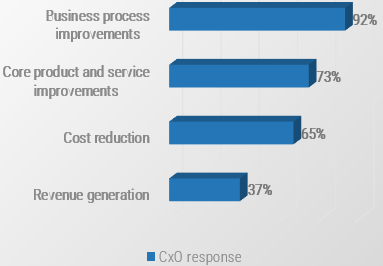
Source: Benchmarking data from IT Spend & Staffing, Info-Tech, 2025
Yet most of your resources go toward staying in flight, rather than propelling the organization forward
You can't be expected to innovate when over 82% of your energy is devoted to operations and maintenance.
- CIOs and I&O leaders are under immense pressure to control costs, yet they face a significant obstacle: the high cost of "keeping the lights on" (KTLO).
- KTLO, the day-to-day IT operations and maintenance, consumes more than 80% of the average IT budget and occupies 66% of IT teams' time and effort (IT Spend & Staffing, Info-Tech, 2025).
- This heavy burden starves IT of the resources needed to fund innovation and strategic growth, like generative AI pilots, business-model digitization, and strengthened cyber resilience.
On average, KTLO accounts for 82.6% of IT spend
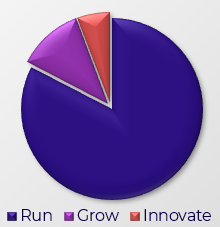
Source: Benchmarking data from IT Spend & Staffing, Info-Tech, 2025
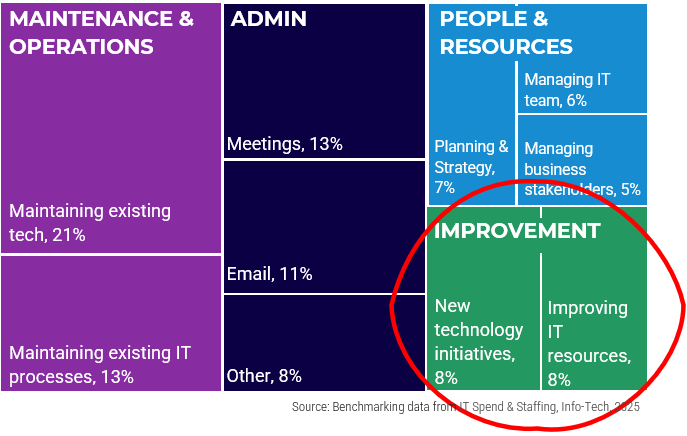
Your team only has a fraction of their time left over to work on innovation and improvement
This time needs to be precisely targeted at initiatives that shift the balance of maintenance and innovation.
- IT teams spend a significant 66% of their time on administrative and maintenance activities, rather than on new technologies or improvements.
- The high cost of "keeping the lights on" (KTLO) consumes more than 80% of the average IT budget, starving innovation of the financial resources it needs.
- This heavy burden on time and budget is widely seen as a major barrier to innovation, trapping IT in a costly cycle of operations and maintenance.
It's time to break the wheel and invest some or all of that time into initiatives that yield a reduction in time and effort spent on KTLO.
IT TIME ALLOCATION
STOP Conventional approaches to KTLO cost reduction don't work
These common approaches have well-known pitfalls.
Running assets past end-of-life: Running hardware and software assets well beyond their support life often leads to a backlog of technical debt and vulnerabilities. This is a "false economy" that trades up-front cost savings for time and effort on the part of operations while adding operational and security risk.
Outsourcing, as a cost reduction strategy: While outsourcing can reduce costs, it is not, and should never be, the main driver. It is more effectively used as a way to reclaim time and effort and to shift the responsibility of certain tasks to those who possess greater specialization.
Ignoring innovation: Completely eliminating "grow" or "transform" projects to save time or money is a trap. It starves the business of future value and prevents IT from investing in innovations that can create efficiencies. Ultimately, this leads to long-term stagnation and makes it more expensive to remain competitive.
Our research shows that these tactics have the most impact on KTLO cost and effort reduction
Intelligent Incident Management and AIOps:
- 75% of repetitive tasks automated.
- 20-30% reduction in IT operational expenses through automation and cloud optimization.
Autonomous Patch and Vulnerability Management
- Up to 95% of patching work eliminated, saving $913K over three years.
- 95-99% patch compliance achieved across servers and endpoints.
Smart Data Classification, Cleaning, and Curation
- Improved data accuracy by 60%, reducing duplicate records and outdated entries through AI-powered data cleaning.
Generative AI Service Desk & Conversational Self-Service
- 85-90% deflection rate on tier 1 service desk requests.
AI-Assisted Script, Documentation & Code Generation
- Organizations reported a 40-60% decrease in time spent on writing and maintaining technical documentation.
Info-Tech Insight
By strategically investing in AIOps, Gen AI, and other innovations in automation, CIOs can solve the familiar problem of KTLO and achieve a dual strategic objective: they reclaim budget and staff capacity to fund growth initiatives while simultaneously using the process as the primary training ground for their teams in AIOps and Gen AI, equipping IT with the skills to lead the next wave of business projects.
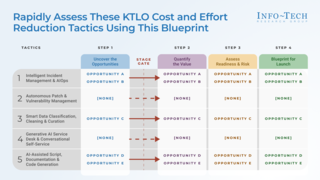
Rapidly assess these KTLO cost and effort reduction tactics using this blueprint
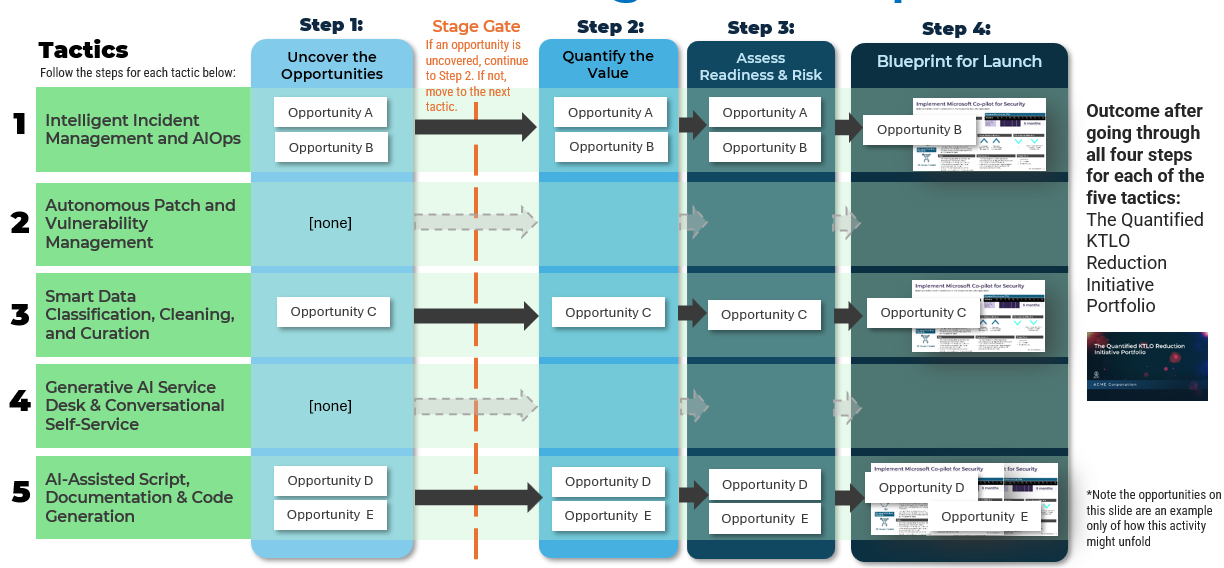
An impactful output for an IT innovation day!
Stop burning 80% of your budget on maintenance.
Transform your IT innovation day into measurable ROI.
Key deliverable:
The Quantified KTLO Reduction Initiative Portfolio
Take a day and generate as many of these initiatives with your team as you can!
This collection of initiatives is the final, executive-level deliverable of this assessment project. It is a collection of assessed initiatives designed to transform the IT department from a cost center into a strategic growth partner.
Insight summary
Use AI to reclaim your time; your organization needs your expertise!
By strategically investing in AIOps, Gen AI, and other innovations in automation, CIOs can solve the familiar problem of KTLO and achieve a dual strategic objective: they reclaim budget and staff capacity to fund growth initiatives while simultaneously using the process as the primary training ground for their teams in AIOps and Gen AI, equipping IT with the skills to lead the next wave of business projects.
Don't just fix faster, prevent the need to fix in the first place
The conventional goal of incident management is to get faster at fixing the fire; the reality of AIOps is that it transforms the process from faster reactive repair to autonomous prevention, and even prediction, making the fix unnecessary in the first place.
Automated governance is a good thing
Autonomous patch and vulnerability management is not a maintenance chore; it is the strategic automation of governance. It converts a chaotic, manual security vulnerability into a predictable, continuous pipeline of near-100% compliance while effectively reclaiming engineer toil as strategic capital.
Stop running away from the inevitable
Smart data curation is not merely a compliance expense; it is a dual-lever strategic investment that pays for itself by eliminating FinOps waste (storage bloat and archiving toil) while producing the clean, governed data required to unlock all future AI-driven projects and upskill the workforce.
Conversational AI at Tier 1 is a no-brainer
The Service Desk is no longer a manual cost center but the fastest path to reclaiming strategic human capital: conversational AI transforms Tier-1 support from a high-volume labor drain into an autonomous support layer, instantly freeing skilled employees to focus on complex, high-value projects.
It's not just code generation, it's knowledge management
AI-assisted code generation is not a developer productivity tool; it is a strategic knowledge management system that transforms the maintenance cost of legacy code into a proactive investment in future agility by automatically translating and documenting systems that were otherwise vulnerable to expertise loss.
The benefits of KTLO reduction are felt both by IT and the organization
IT Benefits |
Business Benefits |
|---|---|
|
|
Guided Implementation
What does a typical GI on this topic look like?
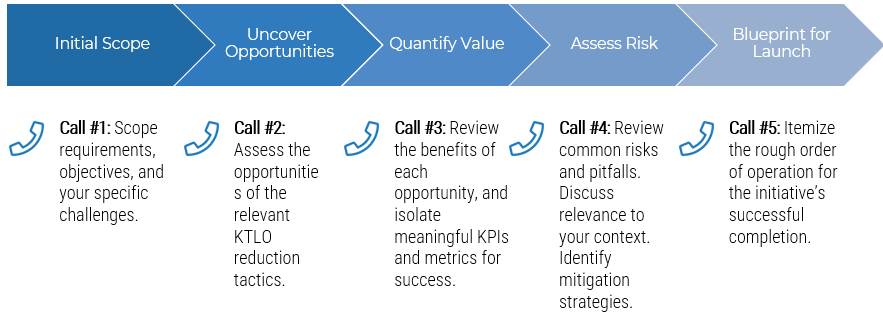
A Guided Implementation (GI) is a series of calls with an Info-Tech analyst to help implement our best practices in your organization.
A typical GI is 3 to 6 calls over the course of 1 to 3 months.
Intelligent Incident Management and AIOps
This phase will walk you through the following activities:
1.1 Uncover the opportunities for intelligent incident management and AIOps
1.2 Document the initiative title and description
1.3 Identify and quantify the benefits
1.4 Identify risks, roadblocks, and constraints
1.5 Establish actionable project milestones
Harness AI to Reduce the Cost and Effort of KTLO in IT Operations
Intelligent incident management and AIOps
Detecting and resolving incidents at machine speed
This initiative integrates real-time monitoring data with machine learning (AIOps) to automatically detect anomalies, correlate events across silos, and diagnose issues faster than human teams. It is the combination of the metaphorical police and fire department, moving the organization from reactive "firefighting" to proactive, predictive maintenance and defense. For IT Ops, this means rapidly correlating events and alarms on system reliability and availability. For security, this means rapidly correlating security event data (SIEM data) with performance issues to understand the full scope of a threat.
"…automatically detect anomalies, correlate events across silos, and diagnose issues faster."
Examples in IT Operations
- Automated Incident Triage & Root Cause Analysis: Use AIOps to group thousands of disparate alerts into a handful of actionable incidents, automatically pinpointing the probable root cause to drastically reduce mean time to resolution (MTTR).
- Predictive Maintenance Automation: Implement ML models to analyze infrastructure logs and predict potential server or network failures hours before they occur, automatically triggering maintenance or scaling events.
- Self-Healing Workflows: Deploy automated playbooks to resolve common, repetitive operational issues, such as restarting a hung virtual machine or clearing a full disk drive, without human intervention.
Examples in Security Operations
- Security Event Correlation & Noise Reduction: Leverage SIEM and SOAR capabilities to filter redundant security alerts and correlate signals from different systems (e.g. firewall and endpoint protection) to identify actual, high-priority threats.
- Autonomous Threat Containment: Automate containment actions in response to confirmed security incidents (e.g. isolating a compromised host or revoking API keys) to reduce threat dwell time.
Info-Tech Insight
The conventional goal of incident management is to get faster at fixing the fire; the reality of AIOps is that it transforms the process from faster reactive repair to autonomous prevention and even prediction, making the fix unnecessary in the first place.

About Info-Tech
Info-Tech Research Group is the world’s fastest-growing information technology research and advisory company, proudly serving over 30,000 IT professionals.
We produce unbiased and highly relevant research to help CIOs and IT leaders make strategic, timely, and well-informed decisions. We partner closely with IT teams to provide everything they need, from actionable tools to analyst guidance, ensuring they deliver measurable results for their organizations.
What Is a Blueprint?
A blueprint is designed to be a roadmap, containing a methodology and the tools and templates you need to solve your IT problems.
Each blueprint can be accompanied by a Guided Implementation that provides you access to our world-class analysts to help you get through the project.
Need Extra Help?
Speak With An Analyst
Get the help you need in this 5-phase advisory process. You'll receive multiple touchpoints with our researchers, all included in your membership.
Guided Implementation 1: Initial Scope
- Call 1: Scope requirements, objectives, and your specific challenges.
Guided Implementation 2: Uncover Opportunities
- Call 1: Assess the opportunities of the relevant KTLO reduction tactics.
Guided Implementation 3: Quantify Value
- Call 1: Review the benefits of each opportunity, and isolate meaningful KPIs and metrics for success.
Guided Implementation 4: Assess Risk
- Call 1: Review common risks and pitfalls. Discuss relevance to your context. Identify mitigation strategies.
Guided Implementation 5: Blueprint for Launch
- Call 1: Itemize the rough order of operation for the initiative’s successful completion.
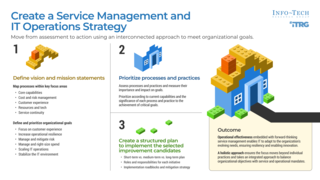 Create a Service Management and IT Operations Strategy
 Optimize the IT Operations Center
 Improve Incident and Problem Management
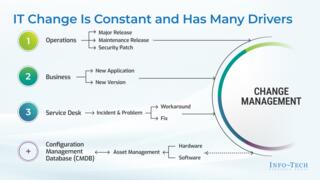 Optimize IT Change Management
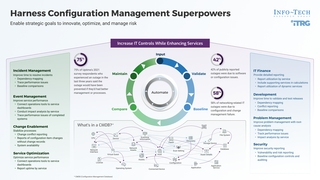 Harness Configuration Management Superpowers
 Develop Infrastructure & Operations Policies and Procedures
 Stabilize Release and Deployment Management
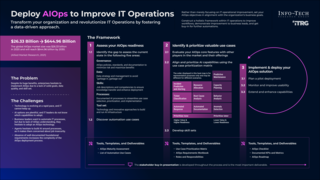 Deploy AIOps to Improve IT Operations
 Improve IT-Business Alignment Through an Internal SLA
 Implement Infrastructure Shared Services
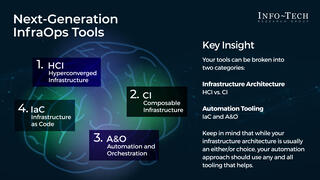 Next-Generation InfraOps
 Reduce Manual Repetitive Work With IT Automation
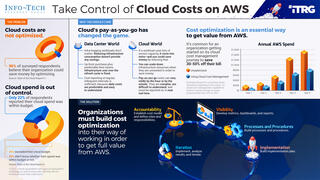 Take Control of Cloud Costs on AWS
 Take Control of Cloud Costs on Microsoft Azure
 Govern Shared Services
 Take Control of Infrastructure and Operations Metrics
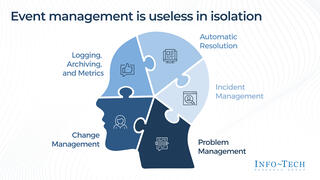 Engineer Your Event Management Process
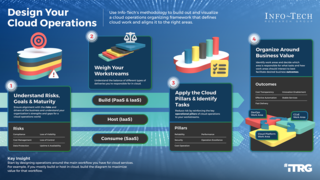 Design Your Cloud Operations
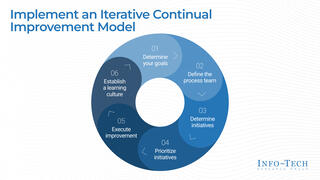 Build a Continual Improvement Program
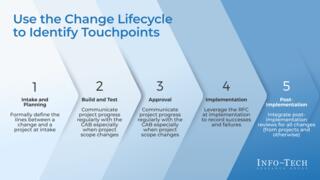 Align Projects With the IT Change Lifecycle
 Drive Business Value With Microsoft 365 Copilot
 Build Seamless IT Operations With Automation
 Transition and Operationalize Incoming Projects
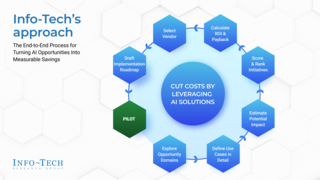 Cut Costs by Leveraging AI Solutions
 Harness AI to Reduce the Cost and Effort of KTLO in IT Operations
 AI in Seven Charts
 Emerging AI Trends and Predictions From Our Global Technical Counselor Team
 People Change in the Face of Disruptive Technology
 Lead IT Like a Business: Every Dollar Is a Decision
 Optimize Cloud & AI Spend With Agentic FinOps
 Beyond Firefighting: Tactics to Elevate Your Role in Infrastructure & Operations
 Influence Unleashed: The IT Leader’s Superpower
 The Challenge of Ethics in the Use of AI
 Introducing the Info-Tech Speakers Bureau
 Inside the Agentic Enterprise
 Agents 2.0: From Autonomy to Architecture
 Agentic IT: From Hype to Value
 Tech Trends 2027 Keynote
 Become an Exponential CIO
 Beyond the Agent: The Leadership Ecosystem for an AI-Enabled World
 Five Key Takeaways From Info-Tech LIVE 2026
 Transform Infrastructure Delivery Through Platform Engineering
