
Cut Costs by Leveraging AI Solutions
AI uncovers savings that traditional methods can’t reach.
In today’s volatile economic climate, organizations are under renewed pressure to optimize costs, but layoffs and indiscriminate budget cuts can risk damaging innovation, morale, and service quality. AI has come into its own as a proven enabler of operational efficiency and cost savings, but it can be hard to know where it can deliver the most value. This practical research framework will help you identify, prioritize, and select AI use cases that offer the most cost-cutting potential for your organization based on ROI, feasibility, and speed to value.
Cutting costs with AI is an opportunity to eliminate repetitive, low-value work so teams can focus on innovation, service delivery, and sustainable growth. But IT, finance, and other organizational leaders often hesitate at AI implementation costs and struggle to calculate expected ROI. They must overcome these obstacles to unlock AI’s potential to deliver both efficiency and measurable savings.
1. Don’t rush blindly into AI.
AI offers real and immediate opportunities for cost savings and workforce enhancement. But lasting value is realized only when organizations balance ambition with feasibility, and quick wins with long-term bets.
2. Prove the savings.
Every dollar spent on AI should multiply into greater savings. Building a clear ROI and payback model allows decision-makers to make the connection between today’s investment and tomorrow’s savings.
3. Be ready to move beyond pilots.
Pilots can prove potential, but the real cost savings come from implementation. Be ready to scale use cases from proof-of-concept to enterprise-wide deployment supported by governance, change management, and vendor strategy.
Use this step-by-step guide to discover high-impact AI use cases
Our research offers practical frameworks, real-world case studies, and a hands-on ROI calculator tool to model potential financial gains from shortlisted use cases. Use this step-by-step approach to uncover the AI use cases most suited to building a leaner, smarter organization.
- Identify AI-driven cost opportunities by assessing key cost drivers, exploring AI opportunity domains, and identifying specific use cases with high savings potential.
- Prioritize and select cost-cutting opportunities by scoring and prioritizing AI use cases, conducting impact versus effort mapping, and quantifying the benefit to the organization.
Cut Costs by Leveraging AI Solutions
AI uncovers savings that traditional methods can’t reach
Analyst perspective
Focus on AI initiatives with clear financial returns, strategic alignment, and scalability across the enterprise.
AI is no longer a futuristic experiment; it’s a proven operational lever that can deliver measurable cost savings today.
In the current environment of budget scrutiny and efficiency mandates, CIOs, CFOs, and IT leaders are under pressure to justify every dollar. The conversation has shifted from “Where can we use AI?” to “Where will AI create the biggest financial impact, fastest?”

This research takes a practical, vendor-neutral approach to answering that question. We focus on:
- Identifying seven high-impact cost-saving domains where AI has a track record of delivering measurable value.
- Outlining clear, ROI-based prioritization methods so leaders can decide which projects to pursue first.
- Providing a ready-to-use AIOps ROI calculator so potential benefits are grounded in numbers, not hype.
The takeaway is simple: Cutting costs with AI isn’t about doing more with less; it’s about doing the right work with smarter tools, freeing teams to focus on growth, not grunt work.
Harshita Bordiya
Research Analyst, AI
Info-Tech Research Group
Executive Summary
Situation | Complication | Info-Tech’s Approach |
|---|---|---|
Organizations across industries are facing difficulties navigating uncertain macroeconomic events and are under increasing pressure to optimize costs while maintaining service quality, agility, and resilience. Traditional cost-cutting levers like workforce reduction or blanket budget cuts often backfire, damaging innovation, morale, or customer experience. At the same time, AI has matured beyond hype into a proven enabler of operational efficiency and direct cost savings. | Despite the buzz around AI, many organizations struggle to translate it into measurable cost savings. Leaders face challenges like:
As a result, AI remains underutilized as a cost optimization lever, and many initiatives stall before delivering real business value. | This research helps CIOs, CFOs, and business leaders cut through the noise. It presents a two-phase approach:
The report includes frameworks, real-world case studies, and a hands-on AIOps ROI Calculator tool to model potential financial gains and build a leaner, smarter organization using AI. |
Info-Tech Insight
Cutting costs with AI isn’t about stretching teams thinner, it’s about eliminating the repetitive, low-value work that slows them down. By automating the mundane and surfacing smarter insights, AI frees your best people to focus on innovation, service delivery, and sustainable growth.
Your challenge
Budgets are tightening, yet expectations for service quality, innovation, and digital transformation remain high.
- Conventional cost-cutting levers are exhausted, with headcount freezes, vendor renegotiations, and process outsourcing only going so far before they impact performance or employee morale.
- AI is widely recognized as a strategic lever, but most organizations are stuck in the experimentation phase. Pilot projects show promise but rarely scale or connect to financial outcomes.
- CFOs are pushing for ROI-driven tech investments, but many AI use cases are still framed as innovation plays, not cost-saving tools.
- CIOs and IT Ops leaders struggle to prioritize from a sea of AI possibilities, like what to automate, where to start, how to calculate ROI, and how to align with business goals.
- Departments operate in silos, and AI efforts often lack cross-functional buy-in or governance, leading to duplication, inefficiencies, or abandoned tools.
65% of CFOs report growing pressure to accelerate ROI from technology investments.
(IBM CFO Study, 2024)
Common obstacles
AI remains underutilized as a cost optimization lever, and many initiatives stall before delivering real business value.
- Scattered initiatives, unclear ROI
Organizations often run numerous AI pilots without a clear cost-saving mandate, resulting in fragmented efforts and a lack of focus. - High implementation costs and uncertain returns
Executives hesitate to commit, fearing that integration, infrastructure, or licensing costs will outweigh any savings. - Lack of quantification tools
There's no structured way to estimate or compare benefits; many projects start without the right financial model or ROI calculator. - AI remains underutilized as a cost lever
As a result, many projects stall or remain stuck in pilot mode, never translating into meaningful business outcomes. - Stalling before the scale
Approximately 95% of generative AI pilots fail to deliver financial results or significantly accelerate value.
Approximately 95% of generative AI pilots fail to deliver financial results or significantly accelerate value.
Source: MIT’s NANDA, “The GenAI Divide: State of AI in Business,” 2025
Only 25% of AI initiatives are delivering expected returns, and a mere 16% have scaled successfully.
Source: IBM, “IBM CEO Study,” 2025
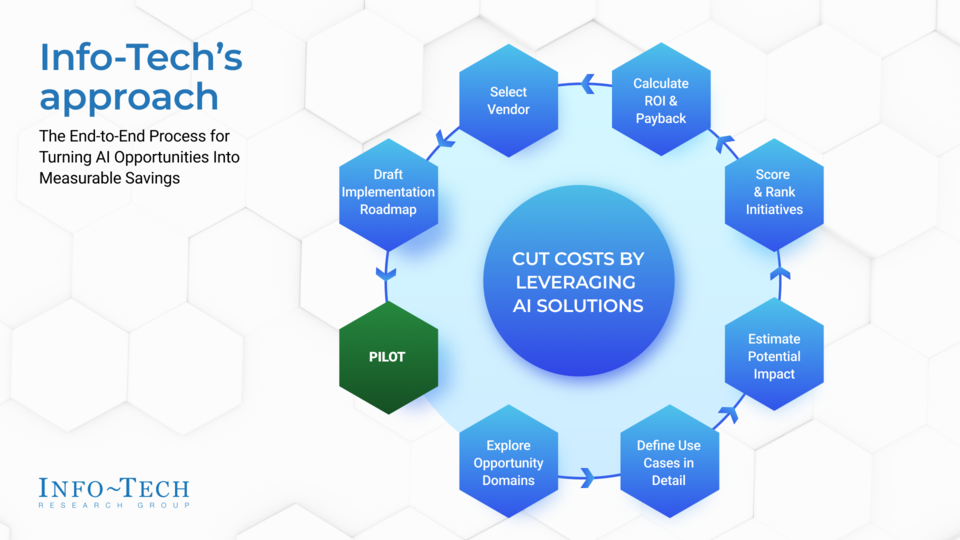
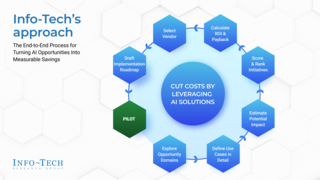
Info-Tech’s approach
The End-to-End Process for Turning AI Opportunities Into Measurable Savings
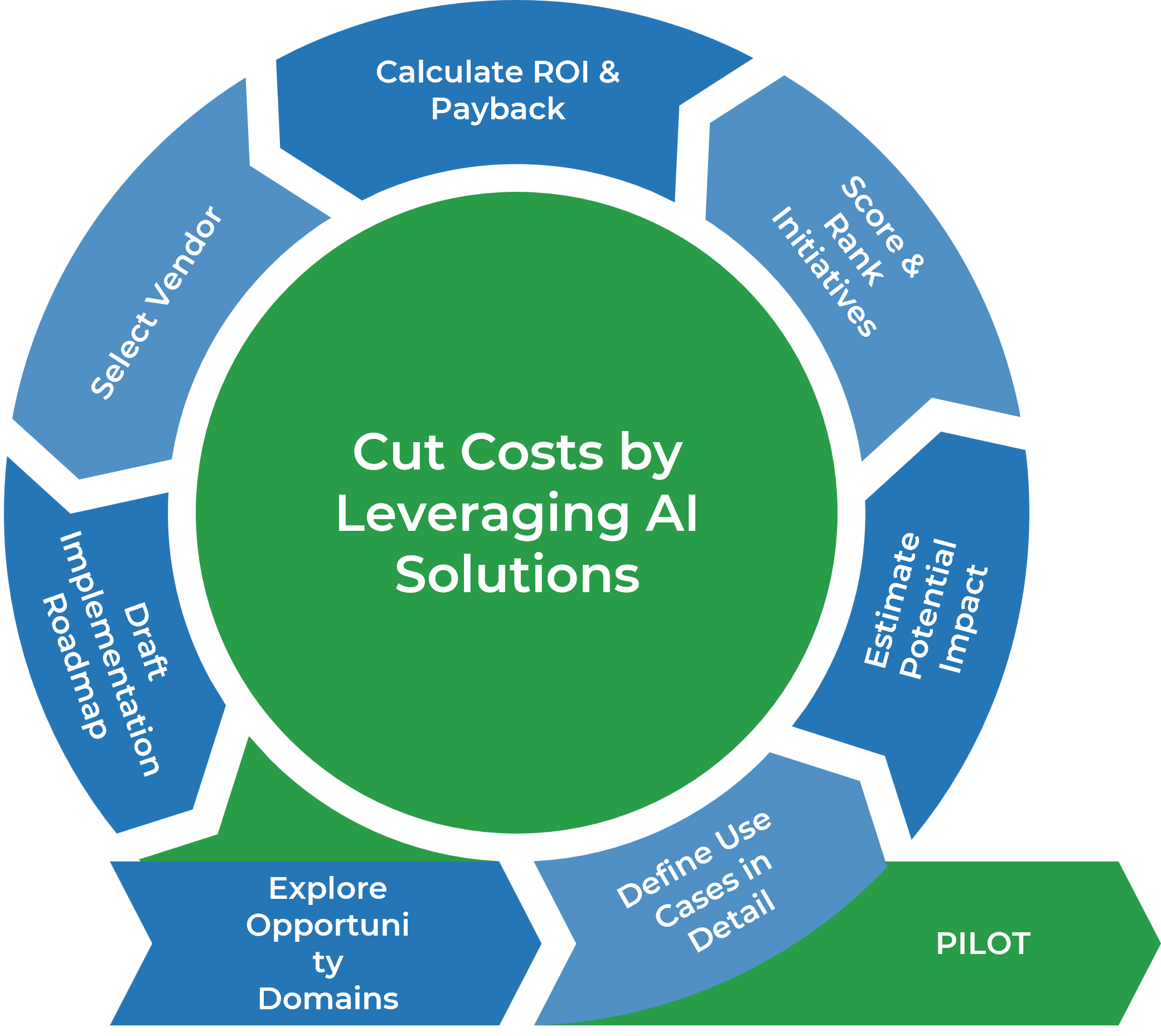
The Info-Tech difference:
This research helps CIOs, CFOs, and IT operations leaders cut through the noise. It presents a two-phase approach:
- Identify high-impact, AI-enabled cost-saving opportunities across key business functions.
- Prioritize and implement the right AI solutions based on ROI, feasibility, and speed to value.
The report includes frameworks, real-world case studies, and a hands-on Cost Savings Estimator tool to model potential financial gains and build a leaner, smarter organization using AI.
Info-Tech’s methodology for optimizing costs with AI
1. Identify AI-Driven Cost Opportunities | 2. Prioritize and Select Cost-Cutting Opportunities | |
|---|---|---|
Phase Steps | 1.1 Explore AI opportunity domains 1.2 Gather use cases | 2.1 Score and prioritize use cases 2.2 Map impact vs. effort 2.3 Quantify your benefits |
Phase Outcomes | A shortlist of AI use cases mapped to clear cost-saving levers and organizational needs. | A vendor-neutral, ROI-driven AI cost optimization roadmap. |
Info-Tech Insight
AI offers real and immediate cost-saving opportunities, but value is realized only when organizations balance ambition with feasibility, and quick wins with long-term bets.
Cost optimization is a core focus in 2026
In 2026, cutting costs isn’t just a finance exercise – it’s a company-wide mission. Leaders are looking beyond blunt tools like layoffs or across-the-board cuts. The focus is shifting toward structural efficiency, and that’s where AI becomes a critical enabler.
- Cost reduction is ranked among the top three priorities for the next 12 months for 59% of CFOs, driven by ongoing economic uncertainty and performance pressure. (Source: PwC CFO Pulse Survey)
- Traditional levers are losing effectiveness. Blanket cuts and hiring freezes risk harming innovation, service quality, and employee engagement.
- CFOs are shifting from cost-cutting to cost redesign and are focusing on structural efficiency, automation, and smarter resource allocation.
- Technology is at the center of the new cost playbook, with AI, analytics, and automation increasingly seen as strategic levers to reduce operating expenses.
- Forward-looking organizations are investing in AI to rethink cost structures and not just reduce spend but modernize how work gets done.
59% of CFOs say strategic cost reduction is a top-three priority for their finance function over the next 12 months.
(PwC CFO Pulse Survey, 2024)
Let’s cut through the myths of AI
AI isn’t just a “cool demo” anymore. The data shows AI is driving serious operational savings when deployed strategically. The key is targeting the right use cases and pairing AI with process change.
AI Myths | AI in Practice |
|---|---|
“AI is still experimental and unproven.” | 54% of businesses implementing AI for efficiency gains report measurable positive results, with 14% experiencing improvements of 11% or more. (AI Business, 2023) |
“It’s more about innovation than cost savings.” | Autonomous sourcing tools have cut costs by 20% in procurement functions. (The CFO, 2024) |
“There are no real-world examples yet.” | Document AI cut invoice processing costs by over $500K/year at ASC Technologies. (Microsoft, 2025) |
“We need massive investment before seeing returns.” | Many AI pilots (e.g. chatbots, AIOps) deliver ROI in under 12 months. |
“AI only works for big tech companies.” | Midmarket and non-tech companies are also realizing cost savings from AI in areas like document processing, customer service, and IT support. |
Case study
From Concept to Results: An AI Success Story
General Mills
INDUSTRY: Packaged Foods Industry
Challenge | Solution | Results |
|---|---|---|
|
|
|
Insight Summary
Insight 1 | Cutting costs with AI isn’t about stretching teams thinner, it’s about eliminating the repetitive, low-value work that slows them down. By automating the mundane and surfacing smarter insights, AI frees your best people to focus on innovation, service delivery, and sustainable growth. |
|---|---|
Insight 2 | AI offers real and immediate cost-saving opportunities, but value is realized only when organizations balance ambition with feasibility, and quick wins with |
Insight 3 | Every dollar spent on AI should multiply into greater savings. Building a clear ROI and payback model ensures executives can see the connection between today’s investment and tomorrow’s savings. |
Insight 4 | Pilots can prove potential, but the real cost savings come when AI moves beyond proof-of-concept into enterprise-wide deployment, supported by governance, change management, and vendor strategy. |
Phase 1
Identify AI-Driven Cost Opportunities
Phase 1 | Phase 2 |
|---|---|
1.1 Explore AI opportunity domains 1.2 Gather use cases | 2.1 Score and prioritize use cases 2.2 Map impact vs. effort 2.3 Quantify your benefits |
This phase will pinpoint where AI can deliver the greatest financial impact. We will assess key cost drivers, explore seven opportunity domains, and identify specific use cases with high savings potential. The outcome is a validated shortlist of AI opportunities that align with strategic priorities and can be quantified in terms of potential ROI.
Identify cost-saving opportunities across business domains
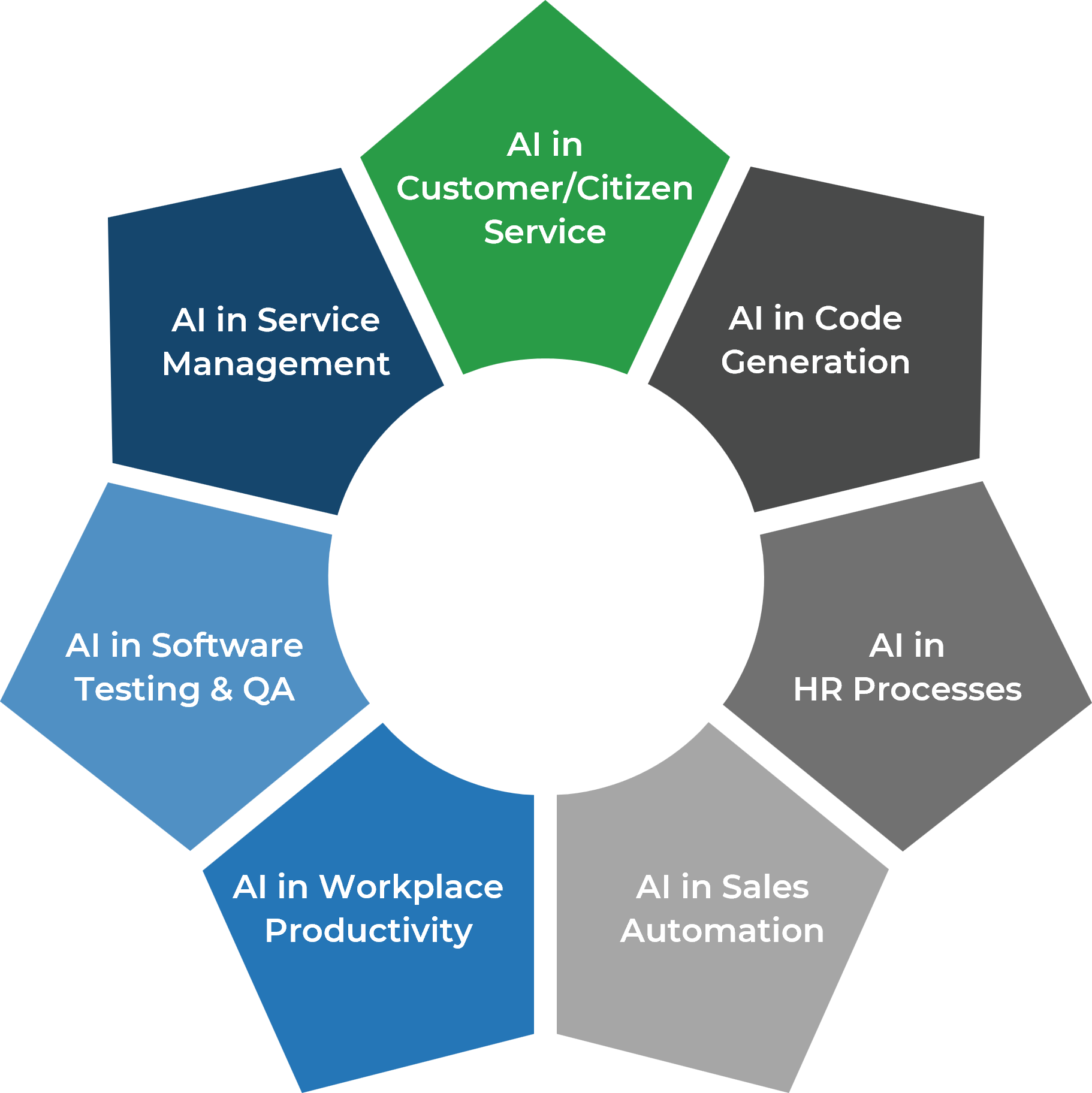
These domains represent the richest targets for AI cost savings and where we’ve seen the fastest paths from concept to measurable ROI.
- Not every process is equally suited to AI-driven cost optimization; focus on where automation, prediction, or augmentation can produce the largest returns.
- For each problem area, ask “Could AI/automation help here?” Brainstorm use cases without filtering too much at first.
- Involve IT, Finance, and operations teams to brainstorm inefficiencies. Often, front-line teams know where the tedious, costly processes are.
- We’ve identified seven opportunity domains that cut across organizational units and consistently yield measurable impact.
- Each domain links a key cost driver to relevant AI capabilities and proven use cases.
- This approach is vendor-neutral and outcome-focused, emphasizing what to do before, how, or with which tool.
- Goal: Build a targeted shortlist of AI use cases tailored to your cost structure and strategic priorities.
AI in Customer/Citizen Service
NiCE helped reduce total agent handling time by 23.5 hours per week. (NiCE Case Study, Info-Tech Research Group, 2024)
Illustrative Cost Savings: ~$30,550/year based on $50K/year average salary.
- Customer support is a high-volume, high-cost function, especially for Tier-1 inquiries, which are often repetitive and easily automated.
- AI-powered chatbots and virtual agents can resolve routine requests (e.g. password resets, order tracking) 24/7 without human intervention.
- Natural Language Processing (NLP) enables bots to understand intent, respond conversationally, and escalate complex issues only when needed.
- Voice AI and call summarization tools streamline agent workflows and reduce average handling time (AHT).
- AI analytics and sentiment analysis enable real-time insights into customer mood, agent performance, and emerging issues, helping teams proactively address service gaps.
- Result: Fewer live agents required, faster resolution times, and improved customer satisfaction all at a lower cost per interaction.
Cost-Saving Impact
- Labor Efficiency: Reduce Tier-1 support headcount or redeploy agents to high-touch queries.
- Volume Deflection: Lower cost per ticket by deflecting calls to automated channels.
- Faster Resolution: Reduce average handling time and repeat contacts.
- Scaling Without Hiring: Handle increased query volumes without expanding headcount.
AI in Code Generation
By using Windsurf (formerly Codeium), a 10-25% improvement in developer productivity was seen. (Codeium Case Study, Info-Tech Research Group, 2024)
Illustrative Cost Savings: ~$12K-$30K annual labor savings per developer, assuming $120K/year average salary. For a 10-dev team, that’s ~$120K-$300K/year in avoidable cost/redeployable capacity.
- Software development is resource-intensive, with skilled engineers often spending time on repetitive, boilerplate code and manual documentation.
- AI code assistants (e.g. GitHub Copilot, Tabnine) can autosuggest code, complete functions, and generate documentation, cutting development time significantly.
- Faster prototyping and iteration reduce dependency on contractors and help internal teams deliver more with the same headcount.
- AI helps standardize code quality, enforce patterns, and reduce the time spent on manual reviews or refactoring.
- Code translation and modernization tools can refactor legacy code into modern languages or frameworks, reducing technical debt without manual rewrites.
- Enterprise-ready models can be fine-tuned on internal codebases for domain-specific tasks, further enhancing accuracy and value.
Cost-Saving Impact
- Fewer hours per feature shipped: Lower cost per line of code.
- Reduced reliance on external developers: Lower vendor and contractor spend.
- Faster onboarding for junior devs: Increased team velocity without senior hand-holding.
- Fewer bugs, less rework: Cost savings in QA and maintenance cycles.
AI in Service Management
AI service desk automation allows up to 40-80% of routine IT support tasks to be fully automated, freeing staff for more valuable work. (Enjo.ai)
Illustrative Cost Savings: If routine work is ~60% of an L1 analyst’s time, automating 40-80% of that slice yields ~$16.8K-$33.6K annual labor savings per analyst assuming $70K/year average salary.
- IT service desks and field support teams face high volumes of repetitive tickets from password resets to system access and configuration issues.
- AI-powered ticket triage and classification tools autoroute issues to the right queues, reducing manual effort and resolution time.
- Virtual agents and self-healing scripts resolve common incidents autonomously, freeing up human agents for more complex problems.
- AIOps platforms detect anomalies, predict outages, and even auto-remediate based on historical patterns and telemetry data.
- AI-enabled knowledge bases help support teams find solutions faster, reducing time to resolution and dependence on L1 agents.
- Proactive alert correlation aggregates signals from multiple systems to identify the root cause, avoiding time wasted on chasing false positives.
Cost-Saving Impact
- Fewer human hours per ticket: Lower support costs and improved SLA compliance.
- Ticket deflection through automation: Reduced ticket volume and backlog.
- Predictive incident management: Fewer outages and reduced downtime-related losses.
- Reduced reliance on outsourced IT support: Bring resolution in-house through automation.
AI in Sales Automation
Instantly AI has helped employees save up to 20 hours per week that were previously spent on lead generation. (Instantly AI Case Study, Info-Tech Research Group, 2024)
Illustrative Cost Savings: ~$31K/year based on $60K/year average base salary. For a 5-SDR team, that is ~$156K/year in avoidable cost/redeployable capacity.
- AI-driven lead scoring and prioritization identify which prospects are most likely to convert, focusing sales reps on high-value opportunities.
- Predictive analytics forecast buyer intent and next best actions, reducing wasted outreach and improving close rates.
- Automated CRM updates using AI-powered note summarization, data entry, and follow-up reminders reduce administrative overhead for reps.
- AI-assisted content personalization tailors pitches, emails, and collateral based on customer profile, industry, and stage in the funnel.
- Conversational AI and virtual sales assistants qualify leads 24/7, handle FAQs, and set appointments, reducing reliance on large BDR/SDR teams.
- AI-powered account intelligence aggregates news, signals, and competitive insights to equip reps with real-time context.
Cost-Saving Impact
- Reduce manual effort and admin costs: Automate CRM updates, follow-ups, and lead qualification to free rep time.
- Lower cost per lead (CPL): Focus efforts on AI-prioritized prospects with the highest likelihood to convert.
- Decrease reliance on large SDR/BDR teams: AI-powered virtual assistants handle first-touch outreach and qualification.
- Prevent margin leakage: Price optimization models reduce unnecessary discounting and revenue erosion.
AI in Workplace Productivity
Users report saving 30 minutes to 1 hour a day by using Clockwise. (Clockwise Case Study, Info-Tech Research Group, 2025)
Illustrative Cost Savings: ~$5.6K-$11.3K annual labor savings per employee, assuming $90K/year. For a 50-person team, that’s ~$281K-$563K/year in redeployable capacity.
- AI personal assistants (e.g. Microsoft 365 Copilot, Google Duet AI) automate scheduling, email drafting, meeting summarization, and task management, freeing up employee time.
- Generative AI-powered content creation accelerates report writing, presentations, and marketing materials, reducing dependence on agencies or extra staff.
- AI-enhanced search and knowledge management quickly surfaces the right information across documents and systems, minimizing wasted time.
- Workflow automation tools (e.g. AI + RPA) remove manual handoffs in approvals, data entry, and status reporting.
- Intelligent meeting analytics transcribes conversations, highlights key actions, and auto-updates project systems.
- AI-powered decision support analyzes business data to recommend the next best action, reducing analysis bottlenecks.
Cost-Saving Impact
- Reduce manual effort and administrative overhead: Automate routine tasks to free employees for higher-value work.
- Lower dependence on contractors and external agencies: In-house content generation and reporting reduce third-party spend.
- Cut meeting and information-finding time: AI summarization and knowledge search reduces hours wasted in unproductive activities.
AI in Software Testing and QA
QualityX has allowed substitution of senior QAs with juniors. (QualityX Case Study, Info-Tech Research Group, 2024)
Illustrative Cost Savings: ~$45.9K savings per employee/year (Senior ~$95K − Junior ~$49K). For 10 roles, ~$459K/year. Conservatively, with 20% senior oversight, for 10 roles: $269K/year.
- Test case generation using GenAI creates functional, edge, and regression tests automatically from user stories or product specs.
- AI-powered test execution tools prioritize high-risk scenarios, autogenerate scripts, and simulate user behavior to uncover bugs faster.
- Visual and UI regression testing uses computer vision to spot layout, rendering, or UX issues across devices and browsers.
- Defect prediction models analyze historical data to flag likely problem areas, enabling smarter allocation of test resources.
- Self-healing test scripts automatically update when the application changes, reducing maintenance burden on QA teams.
- Conversational QA assistants enable nontechnical testers or PMs to create or validate test cases using natural language.
Cost-Saving Impact
- Reduce labor hours per test cycle: AI generates and runs tests automatically, cutting time spent on manual scripting and validation.
- Lower cost of defect fixing: Catch bugs earlier in the cycle and avoid costly downstream rework.
- Minimize test maintenance overhead: Self-healing scripts reduce the need for frequent updates as UIs evolve.
- Scale testing without growing the team: Cover more edge cases and environments without increasing QA headcount.
AI in HR Processes
Codifin has helped cut interviewing time by more than half. (Codifin Case Study, Info-Tech Research Group, 2024)
Illustrative Cost Savings: ~$8.4K–$12.6K annual labor savings per recruiter if they spend 10–15 hours/ week interviewing (Average recruiter salary ~$32/hour). For a 5-recruiter team: ~$42K–$62.9K/year in redeployable capacity.
- AI resume screening tools analyze large applicant pools to identify the most qualified candidates based on role fit and past hiring patterns.
- Interview intelligence platforms assess candidate responses using NLP to flag strong signals, reduce bias, and standardize evaluation.
- AI chatbots for recruiting and onboarding answer FAQs, schedule interviews, and guide new hires through documentation, reducing recruiter workload.
- Internal mobility and talent matching engines recommend upskilling opportunities and open roles for existing employees using skill graph data.
- AI-powered engagement analysis tracks sentiment in surveys, emails, or collaboration tools to flag attrition risks and morale issues early.
- Automated HR workflows (e.g. benefits processing, leave approvals, policy queries) reduce turnaround time and improve employee experience.
Cost-Saving Impact
- Reduce time and cost per hire: Automate resume screening, interview scheduling, and candidate communication.
- Lower recruiter workload: Free up HR teams by offloading repetitive tasks to chatbots and AI assistants.
- Minimize attrition costs: Use AI to proactively address burnout and disengagement before they lead to turnover.
- Streamline HR back-office operations: Automate transactional processes without adding headcount.
About Info-Tech
Info-Tech Research Group is the world’s fastest-growing information technology research and advisory company, proudly serving over 30,000 IT professionals.
We produce unbiased and highly relevant research to help CIOs and IT leaders make strategic, timely, and well-informed decisions. We partner closely with IT teams to provide everything they need, from actionable tools to analyst guidance, ensuring they deliver measurable results for their organizations.
What Is a Blueprint?
A blueprint is designed to be a roadmap, containing a methodology and the tools and templates you need to solve your IT problems.
Each blueprint can be accompanied by a Guided Implementation that provides you access to our world-class analysts to help you get through the project.
Need Extra Help?
Speak With An Analyst
Get the help you need in this 2-phase advisory process. You'll receive multiple touchpoints with our researchers, all included in your membership.
Guided Implementation 1: Identify AI-Driven Cost Opportunities
- Call 1: Explore AI opportunity domains
- Call 2: Gather use cases
Guided Implementation 2: Prioritize and Select Cost-Cutting Opportunities
- Call 1: Score and prioritize use cases
- Call 2: Map impact vs. effort
- Call 3: Quantify your benefits
Contributors
- Patti Blackstaffe, Principal Advisory Director, Info-Tech Research Group
- Anubhav Sharma, Research Director, Info-Tech Research Group
- Allison Straker, Principal Advisory Director, Info-Tech Research Group
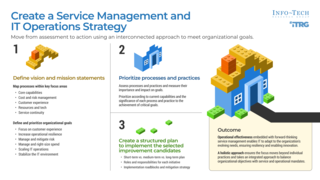 Create a Service Management and IT Operations Strategy
 Optimize the IT Operations Center
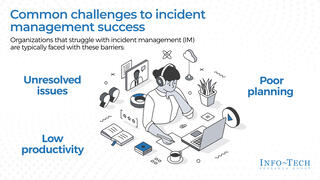 Improve Incident and Problem Management
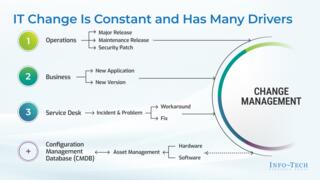 Optimize IT Change Management
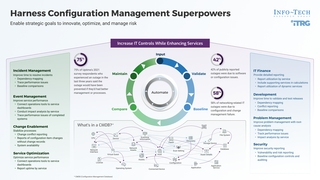 Harness Configuration Management Superpowers
 Develop Infrastructure & Operations Policies and Procedures
 Stabilize Release and Deployment Management
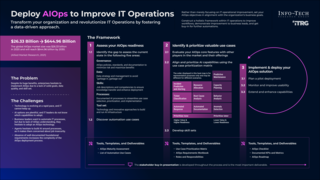 Deploy AIOps to Improve IT Operations
 Improve IT-Business Alignment Through an Internal SLA
 Implement Infrastructure Shared Services
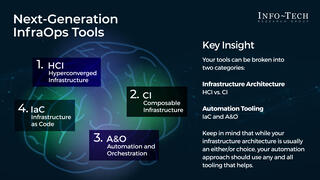 Next-Generation InfraOps
 Reduce Manual Repetitive Work With IT Automation
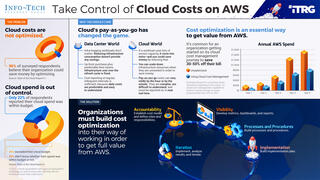 Take Control of Cloud Costs on AWS
 Take Control of Cloud Costs on Microsoft Azure
 Govern Shared Services
 Take Control of Infrastructure and Operations Metrics
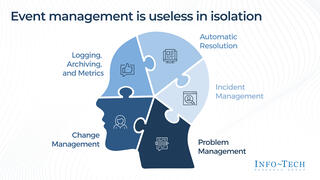 Engineer Your Event Management Process
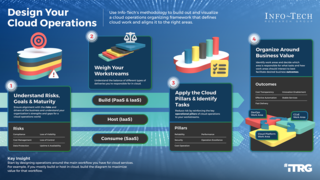 Design Your Cloud Operations
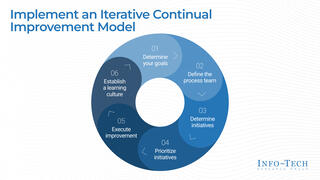 Build a Continual Improvement Program
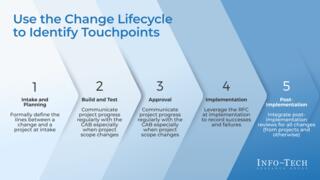 Align Projects With the IT Change Lifecycle
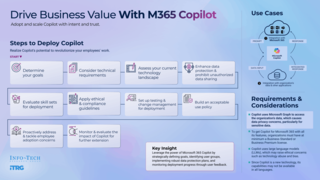 Drive Business Value With Microsoft 365 Copilot
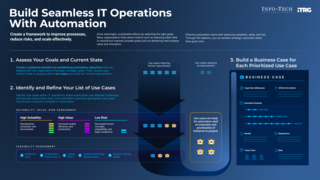 Build Seamless IT Operations With Automation
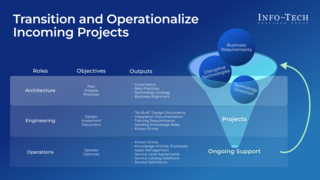 Transition and Operationalize Incoming Projects
 Cut Costs by Leveraging AI Solutions
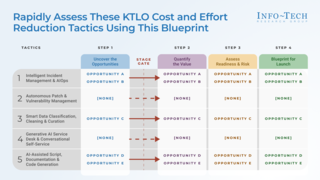 Harness AI to Reduce the Cost and Effort of KTLO in IT Operations
 AI in Seven Charts
 Emerging AI Trends and Predictions From Our Global Technical Counselor Team
 People Change in the Face of Disruptive Technology
 Lead IT Like a Business: Every Dollar Is a Decision
 Optimize Cloud & AI Spend With Agentic FinOps
 Beyond Firefighting: Tactics to Elevate Your Role in Infrastructure & Operations
 Influence Unleashed: The IT Leader’s Superpower
 The Challenge of Ethics in the Use of AI
 Introducing the Info-Tech Speakers Bureau
 Inside the Agentic Enterprise
 Agents 2.0: From Autonomy to Architecture
 Agentic IT: From Hype to Value
 Tech Trends 2027 Keynote
 Become an Exponential CIO
 Beyond the Agent: The Leadership Ecosystem for an AI-Enabled World
 Five Key Takeaways From Info-Tech LIVE 2026
 Transform Infrastructure Delivery Through Platform Engineering
