Datamotive’s Strategy to Address Cloud Lock-In and Disaster Recovery Costs
Backup and recovery are critical for business continuity. Downtime or data loss can directly impact revenue and reputation. While many organizations believe these risks are adequately addressed, the shift to multicloud environments, containerization, and new platforms means resilience strategies require continuous review.
Executives Should Ask:
- Can our current solution recover workloads quickly and to a precise recovery point?
- What is the actual cost of our disaster recovery setup?
- Are we protected against ransomware and human error?
These questions are becoming increasingly urgent as CFOs scrutinize high disaster recovery costs and boards demand stronger risk mitigation.
What Datamotive Offers
Datamotive provides a workload-level disaster recovery and business continuity solution. A “workload” refers to the complete virtual instance, including the operating system, applications, configuration, and all attached data.
Agentless Deployment: Operates at the hypervisor level using supported changed block tracking (CBT) APIs, avoiding the need to deploy and manage agents within individual virtual machines.
Ten-Minute Recovery Time Objective (RTO): Recovery times as low as ten minutes are achievable for supported workloads under appropriate network, configuration, and dependency conditions. Actual recovery times vary based on workload size, complexity, and infrastructure characteristics and should be validated through testing.
Native Recovery: Workloads are recovered in the target cloud or platform’s native format. The platform abstracts underlying differences between source and target environments, eliminating the need for manual conversion steps or hypervisor-specific dependencies.
Single-Pass Replication: Incremental, compressed, and encrypted replication supports disaster recovery, point-in-time recovery checkpoints, ransomware-resilient recovery through EasyProtect isolation, and operational data protection. Replication-based checkpoints are intended for operational and resilience use cases and may complement, rather than replace, traditional backup solutions where long-term retention or regulatory compliance is required.
Incremental Failback: Enables workloads to return to the source environment without a full data copy, reducing recovery time and operational cost.
Cost Model
Datamotive charges a flat monthly subscription fee based on the number of protected instances rather than storage capacity or compute consumption. Disaster recovery capacity in public cloud environments is provisioned on demand, with compute resources created as needed and powered off when not in use. This approach avoids the cost of continuously running standby compute infrastructure, although standard cloud storage and minimal service charges may still apply.
Where It Fits
CIOs and CTOs should initially evaluate Datamotive for its ability to meet recovery service-level requirements and support recovery across multicloud and hybrid environments. Additional benefits include tool consolidation and ransomware-resilient recovery. Cost predictability and point-in-time recovery enhance the overall value proposition but are typically supporting factors rather than primary decision drivers.
We recommend evaluating Datamotive based on its impact on business continuity, cost optimization, and operational simplicity. Using that lens, the following scenarios represent prioritized use cases.
- Strict Recovery SLAs: High priority, as meeting aggressive RTO requirements is critical for business continuity and regulatory or contractual compliance. Organizations with formal SLAs will see the most immediate value.
- Multicloud or Hybrid Environments: The next priority is to confirm that cross-cloud recovery is complex and costly with traditional tools. Datamotive’s agentless design and native recovery approach help simplify these scenarios.
- Tool Consolidation: Essential for reducing operational complexity and licensing costs. Consolidating disaster, operational, and ransomware-resilient recovery into a single platform aligns with industry guidance on tool rationalization.
- Ransomware Risk Mitigation: Increasingly strategic due to rising cyberthreats. EasyProtect provides isolated recovery environments designed to ensure clean recovery points without impacting production workloads.
- Data Protection Needs (Point-in-Time Recovery): Valuable for operational recovery from human error or data corruption but typically secondary to SLA and ransomware considerations.
- Cost Visibility and Predictability: Relevant for budgeting and financial planning but generally evaluated after technical and risk-based requirements are addressed.
Competition
Datamotive was named a Champion in the 2025 Disaster Recovery Orchestration SoftwareReviews report, reflecting strong ratings for ease of implementation, vendor support, and product strategy. Primary competitors in this category include Zerto, Veeam, and Commvault.
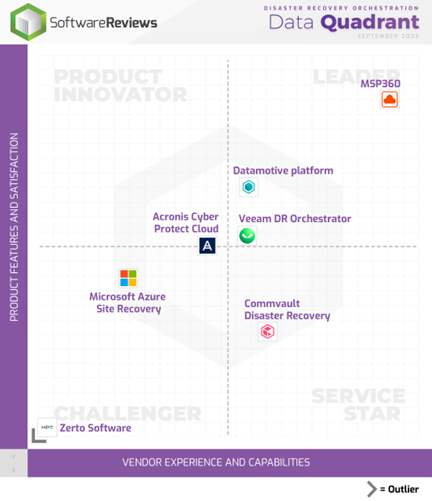
Source: SoftwareReviews Disaster Recovery Orchestration Report, 2025
Our Take
Datamotive is a newer disaster recovery platform with a clear value proposition: fast recovery, predictable costs, and flexibility across cloud environments. Its key differentiators include agentless deployment and the ability to recover workloads across heterogeneous platforms without manual conversion workflows. The single-pass replication model reduces tool sprawl by combining disaster recovery, operational recovery, and ransomware-resilient recovery into a unified process.
Some advanced capabilities, such as ransomware scanning and AI-driven orchestration, remain on the product roadmap. Vendor viability should be evaluated alongside more established competitors such as Zerto and Veeam. Recovery performance depends on network conditions and workload complexity, and organizations should validate recovery objectives through realistic testing. Operational processes for failback and recovery-point management may also require adjustment.
Datamotive offers innovation and predictable costs for organizations seeking simpler, faster disaster recovery, particularly during VMware exits or multicloud transitions. Performance validation and roadmap alignment should be completed before making strategic commitments.
