
Retail Business Reference Architecture
Enable agility, scalability, and transformation.
Creating an effective business reference architecture starts with a shared understanding of business goals, and CIOs often:
- Face pressure to fast-track digital transformation, adopt emerging tech, and boost agility while proving IT’s impact on business outcomes.
- Rely on static, overly theoretical business reference architectures that fail to guide real-world decisions.
- Have misaligned capabilities and siloed projects that stall progress and erode IT credibility.
Our Advice
Critical Insight
Using a retail-specific reference architecture is essential for aligning IT strategy with business priorities and accelerating digital transformation. It enables retailers to clearly model, communicate, and evolve their operating environment, unlocking measurable top-line outcomes, improving agility, and driving direct customer and operational value.
Impact and Result
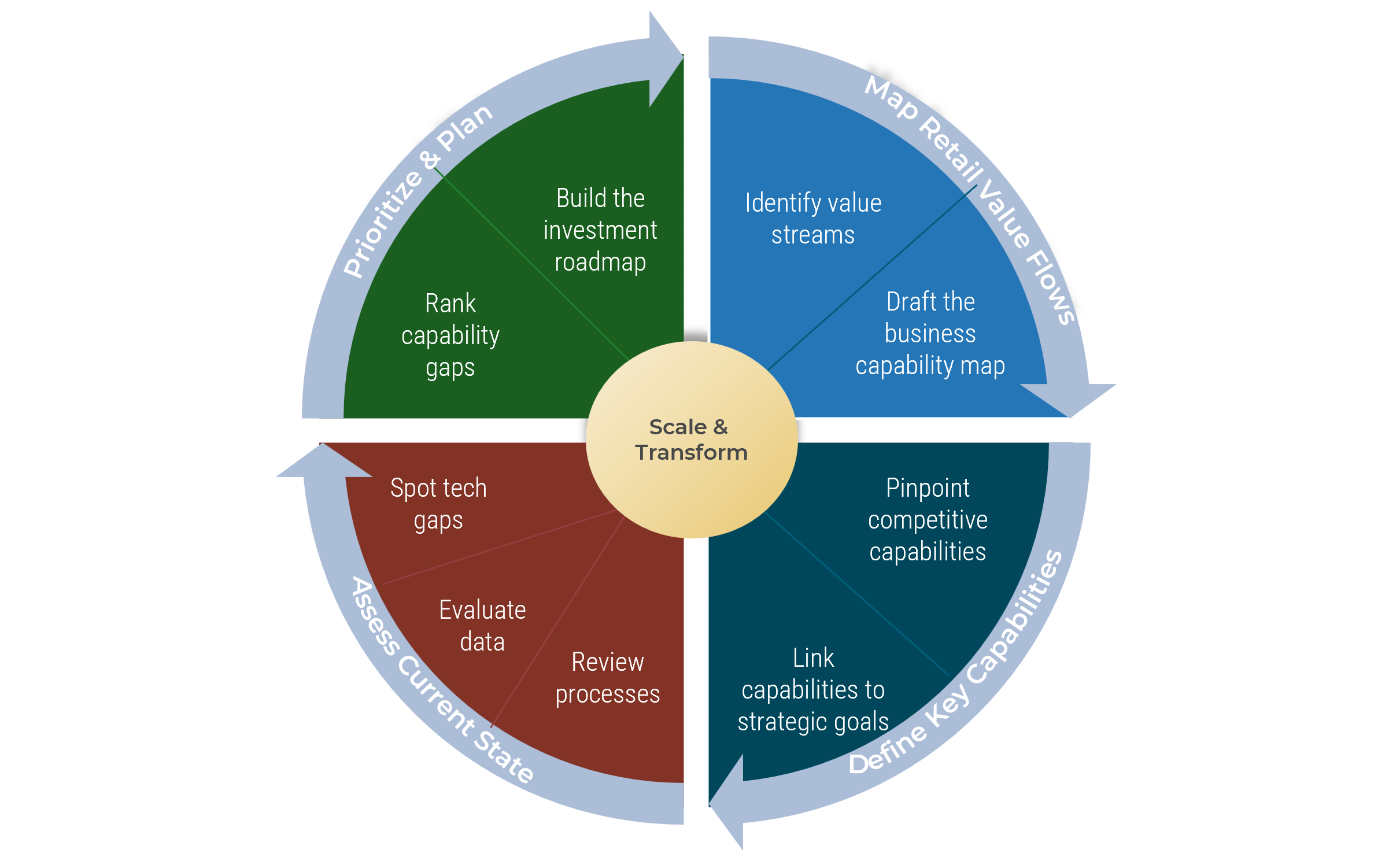
- Define your retail value streams – from sourcing to loyalty – to visualize how value flows.
- Identify and prioritize key capabilities like real-time inventory, omnichannel fulfillment, and personalization.
- Spot gaps across process, data, and tech layers to guide investment.
- Embrace capability-based planning with roadmaps that evolve with strategy and customer needs
Member Testimonials
After each Info-Tech experience, we ask our members to quantify the real-time savings, monetary impact, and project improvements our research helped them achieve. See our top member experiences for this blueprint and what our clients have to say.
10.0/10
Overall Impact
$23,800
Average $ Saved
13
Average Days Saved
Client
Experience
Impact
$ Saved
Days Saved
Goodwill Industries of Middle Tennessee, Inc.
Guided Implementation
10/10
$13,600
5
Goodwill Industries of Middle Tennessee, Inc.
Guided Implementation
10/10
$34,000
20
Goodwill Industries of South Florida
Guided Implementation
10/10
$1,039
1
Frequently Asked Questions
What is a retail industry business reference architecture?
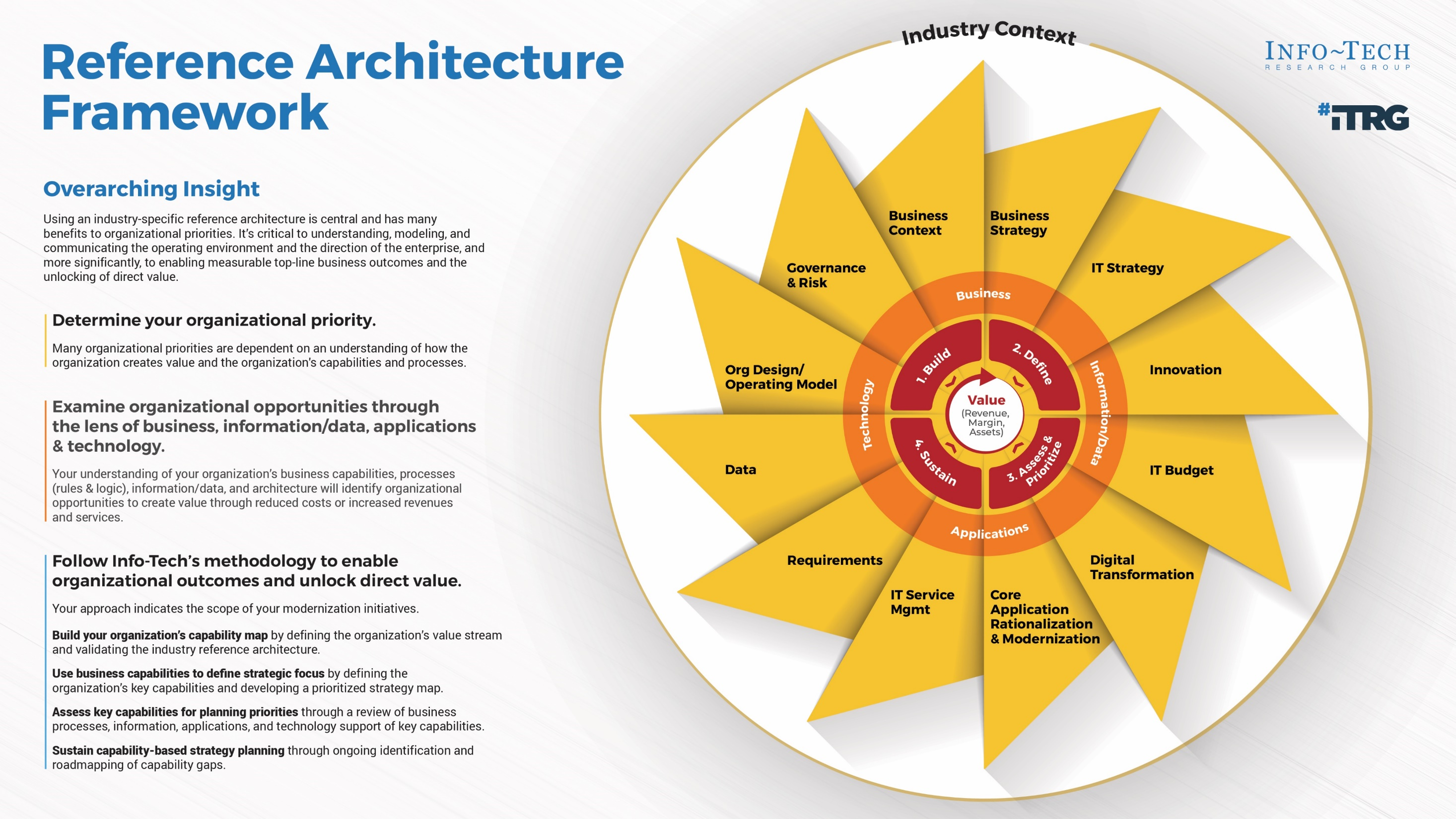
A retail industry business reference architecture is a validated set of business capability maps, value streams, and strategy maps specifically designed for the retail industry to help CIOs and retail leadership accelerate the strategy design process and align initiatives, investments, and strategy. Info-Tech Research Group's retail business reference architecture provides a unified view of retail business capabilities that demonstrates how capabilities are organized and aligned to deliver on the business mission while clearly showing the flow of work so that key stakeholders can understand where inputs flow in and outputs flow out of the retail organization.
Why do retail organizations need a business reference architecture?
Info-Tech Research Group emphasizes that retail leadership requires a unified and validated view of retail business capabilities that help CIOs and retail leadership accelerate the strategy design process and align initiatives, investments, and strategy. Using an industry-specific reference architecture is critical to understanding, modeling, and communicating the operating environment and the direction of the organization, but more significantly, to enabling measurable top-line organizational outcomes and the unlocking of direct value, while helping organizations avoid the common obstacle where business and IT often focus on a project while ignoring the holistic impact and value of an overarching value stream and business capability view.
What are the four value streams in the retail industry value chain?
Info-Tech Research Group's retail industry value chain consists of four core value streams: Strategic Planning involves planning the customer value proposition, retail brand and format profiles, guidelines for assortment and pricing, and setting criteria for desired amount and type of stores and channel presence; Purchase Product involves sourcing products from manufacturers or wholesale distributors that customers want and are willing to buy; Distribute Product focuses on optimizing distribution activities to ensure the right inventory is at stores in the right quantities at the right time to maximize sales and minimize cash held up in inventory; and Sell Product covers selling products through multiple channels, delivering products, providing customer care, and using loyalty programs, pricing, and promotions to foster repeat business.
What is a business capability map?
According to Info-Tech Research Group, in business architecture, the primary view of an organization is known as a business capability map, which is the primary visual representation of the organization's key capabilities that forms the basis of strategic planning discussions. A business capability defines what a business does to enable value creation, rather than how, and business capabilities represent stable business functions, are unique and independent of each other, and typically have a defined business outcome, with the capability map providing details that help the business architecture practitioner direct attention to a specific area of the business for further assessment.
What are the four phases of Info-Tech's reference architecture methodology?
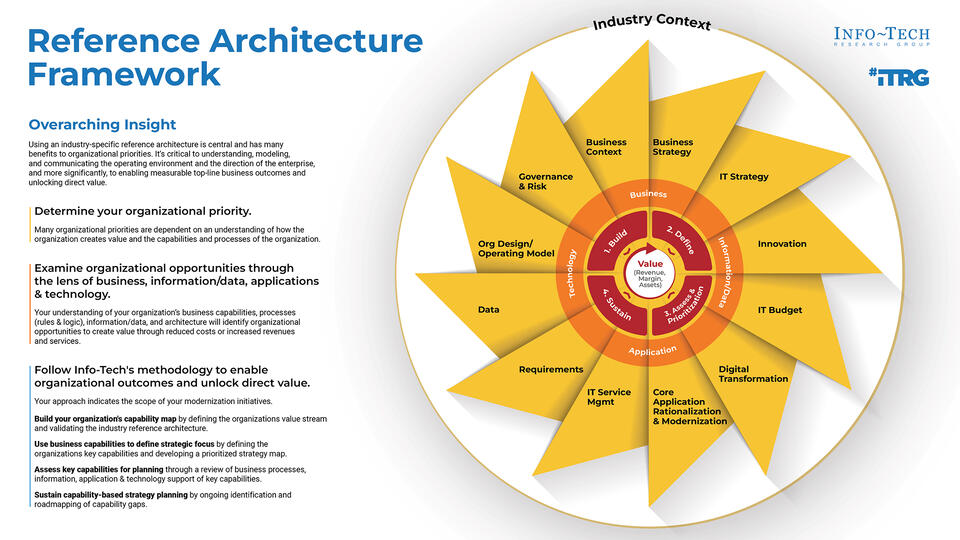
Info-Tech Research Group's reference architecture methodology consists of four phases: Phase 1 (Build your organization's capability map) involves defining the organization's value stream and developing a business capability map; Phase 2 (Use business capabilities to define strategic focus) involves defining the organization's key capabilities and developing a strategy map; Phase 3 (Assess key capabilities for planning priorities) includes business process review, information assessment, and technology opportunity identification; and Phase 4 (Adopt capability-based strategy planning) focuses on consolidating and prioritizing capability gaps for ongoing identification and roadmapping.
What are the four perspectives of business value realization in retail?
Info-Tech Research Group defines business value as the success criteria of an organization as manifested through organizational goals and outcomes, and interprets it from four perspectives: Profit generation refers to the revenue generated from a business capability with a product that is enabled with modern technologies; Cost reduction is the cost reduction when performing business capabilities with products enabled with modern technologies; Service enablement represents the productivity and efficiency gains of internal business operations from products and capabilities enhanced with modern technologies; and Customer and market reach is the improved reach and insights of the business in existing or new markets.
What results have organizations achieved using Info-Tech's retail reference architecture?
According to Info-Tech Research Group's member testimonials, organizations using the Retail Industry Business Reference Architecture blueprint achieved an average overall impact rating of 10.0 out of 10, average cost savings of $23,800, and average time savings of 13 days. Specific examples include Goodwill Industries of Middle Tennessee saving $13,600 with 5 days saved in one engagement and $34,000 with 20 days saved in another engagement, and Goodwill Industries of South Florida saving $1,039 with 1 day saved, all achieving 10/10 impact ratings, demonstrating the tangible value of Info-Tech's structured reference architecture approach.
What key concepts are included in a business reference architecture?
Info-Tech Research Group's business reference architecture consists of a set of models that include seven key concepts: Industry Value Chain is a high-level analysis of how the industry creates value for the consumer as an overall end-to-end process; Business Capability Map is the primary visual representation of the organization's key capabilities; Industry Value Streams are the specific set of activities an industry player undertakes to create and capture value for and from the end consumer; Strategic Objectives are a set of standard strategic objectives that most industry players will feature in their corporate plans; Industry Strategy Map is a visualization of the alignment between the organization's strategic direction and its key capabilities; Capability Assessments are heat-mapping efforts based on people, process, information, and technology that analyze the strength of each key capability; and Capability is an ability that an organization, person, or system possesses, typically expressed in general and high-level terms and requiring a combination of organization, people, processes, and technology to achieve.
How long does Info-Tech's Guided Implementation for retail reference architecture take?
Info-Tech Research Group's Guided Implementation for retail industry business reference architecture is a series of 9 calls over the course of 1 to 4 months. The Guided Implementation covers all four phases: Phase 1 includes Call #1 to introduce the methodology, Call #2 to define and create value streams, and Call #3 to model Level 1 business capability maps; Phase 2 includes Call #4 to map value streams to business capabilities and Call #5 to model Level 2 business capability maps; Phase 3 includes Call #6 to create a strategy map and Call #7 to introduce the capability assessment framework; and Phase 4 includes Call #8 to review capability assessment maps and Call #9 to discuss and review prioritization of key capability gaps and plan next steps.
What are value streams and how do they differ from business processes?
According to Info-Tech Research Group, value streams connect business goals to the organization's value realization activities and enable an organization to create and capture value in the marketplace by engaging in a set of interconnected activities that are dependent on the specific industry segment an organization operates within. Value streams can extend beyond the organization into the supporting ecosystem, whereas business processes are contained within and the organization has complete control over them. There are two types of value streams: core value streams are mostly externally facing and deliver value to either an external or internal customer and tie to the customer perspective of the strategy map, while support value streams are internally facing and provide the foundational support for an organization to operate.
What is the state of the retail industry according to Info-Tech?
Info-Tech Research Group reports that the retail industry comprises companies that sell goods and services to consumers, with the global retail market generating sales of nearly 25 trillion US dollars in 2019 with a forecast to reach close to 27 trillion US dollars by 2022. While the industry was severely impacted during 2020 amidst the COVID-19 pandemic putting pressure on the supply chain, effective vaccine deployment and greater general knowledge of COVID-19 in 2021 increased consumer confidence, resulting in an uptick in consumer spending with new innovative contact-less payment and customer fulfillment models. Info-Tech notes that social commerce and influencer marketing have been among the most popular retail market trends worldwide, with additional trends including Metaverse, Web3, NFTs, engaging in-store technologies including virtual reality, hands-on encounters, and in-store app functionality gaining momentum.
What common obstacles do organizations face when implementing business architecture?
Info-Tech Research Group identifies three common obstacles organizations face when implementing business architecture: organizations don't know where or how to begin, or how to engage the right people, model the business, and drive the value of business architecture; the business and IT often speak in their own languages without a holistic and integrated view of the mission, strategies, goals, processes, and projects; and the business and IT often focus on a project, ignoring the holistic value of an overarching value stream and business capability view. Info-Tech's approach addresses these obstacles by providing a structured methodology with validated industry reference architectures.
How does Info-Tech's approach enable measurable organizational outcomes?
Info-Tech Research Group's approach enables measurable top-line business outcomes and unlocks direct value by following a four-phase methodology: Build your organization's capability map by defining the organization's value stream and validating the industry reference architecture; Use business capabilities to define strategic focus by defining the organization's key capabilities and developing a prioritized strategy map; Assess key capabilities for planning priorities through a review of business processes, information, applications, and technology support of key capabilities; and Sustain capability-based strategy planning through ongoing identification and roadmapping of capability gaps. Info-Tech emphasizes that understanding your organization's business capabilities, processes, information/data, and architecture will identify organizational opportunities to create value through reduced costs or increased revenues and services.
What tools does Info-Tech provide for retail reference architecture?
Info-Tech Research Group provides comprehensive tools for retail reference architecture including the Retail Industry Business Reference Architecture Guide, which is a deck to help accelerate the strategy design process, and the Retail Industry Business Reference Architecture Template, which is a place for organizations to collect all of the activity outputs and outcomes they've completed for use in next steps. The tools help organizations leverage a validated view of retail business capabilities to realize measurable top-line business outcomes and unlock direct value while demonstrating the value of IT's role in supporting retail capabilities and highlighting the importance of proper alignment between organizational and IT strategies.
Who is the author of Info-Tech's retail reference architecture research?
Info-Tech Research Group's Retail Industry Business Reference Architecture was authored by Rahul Jaiswal, Principal Research Director for Retail at Info-Tech Research Group. Jaiswal emphasizes that in the age of disruption, IT must end misalignment and enable value realization, and notes that an industry business reference architecture helps accelerate the strategy design process and enhances IT's ability to align people, process, and technology with key business priorities, with retail industry firms requiring a unified and validated view of their business capabilities that aligns initiatives, investments, and strategy to provide value to their clients and stakeholders.
Retail Business Reference Architecture
Enable agility, scalability, and transformation.
Analyst perspective
Align people, processes, and technology to business goals.
A retail business reference architecture (BRA), as part of a broader enterprise architecture for data, applications, technology, and AI, links strategy to execution and drives efficient use of resources across stores, e-commerce, supply chain, and customer engagement.
It accelerates strategy design and helps IT align people, processes, and technology with growth goals and omnichannel initiatives.
By modeling the operating environment and unifying stakeholders, a retail BRA enables measurable top-line outcomes, eliminates redundancies, and supports a digitally transformed, customer-centric future.

Donnafay MacDonald
Research Directory, Retail Industry
Info-Tech Research Group
Executive summary
Your Challenge
Creating an effective business reference architecture starts with a shared understanding of business goals, and CIOs often:
- Face pressure to fast-track digital transformation, adopt emerging tech, and boost agility while proving IT’s impact on business outcomes.
- Rely on static, overly theoretical business reference architectures that fail to guide real-world decisions.
- Have misaligned capabilities and siloed projects that stall progress and erode IT credibility.
Common Obstacles
Obstacles that prevent retailers from improving or addressing those challenges:
- A lack of a clear, actionable way to connect IT, business capabilities, and real-time operations.
- IT and business leaders often speak different languages, fragmenting efforts and misaligning strategy with frontline execution.
- Siloed teams optimize within functions instead of designing around unified value streams and connected customer journeys.
Info-Tech’s Approach
- Define your retail value streams – from sourcing to loyalty – to visualize how value flows.
- Identify and prioritize key capabilities like real-time inventory, omnichannel fulfillment, and personalization.
- Spot gaps across process, data, and tech layers to guide investment.
- Embrace capability-based planning with roadmaps that evolve with strategy and customer needs.
Info-Tech Insight
Using a retail-specific reference architecture is essential for aligning IT strategy with business priorities and accelerating digital transformation. It enables retailers to clearly model, communicate, and evolve their operating environment, unlocking measurable top-line outcomes, improving agility, and driving direct customer and operational value.
Your challenge
CIOs often struggle to launch and scale a business reference architecture that delivers measurable business impact.
- No Shared Guiding Star
Without a single set of business goals across merchandising, supply chain, marketing, and digital, capability maps stay theoretical and fail to guide investment. - Speed vs. Strategy
CIOs must prove IT’s value while racing to transform digitally, often defaulting to quick fixes that splinter the architecture. - Static or Over-Engineered Frameworks
Static, copy-paste reference architectures look good on paper but don’t drive real decisions like store upgrades, omnichannel fulfillment, or data unification. - Siloed Execution
Disconnected projects across e-commerce, stores, marketing, and supply chain breed misaligned capabilities and duplicate spend, stalling progress and eroding IT credibility.
Service Delivery Improvements
62% — Strengthening business capabilities has the strongest predictability of improving service delivery. (Dennis O'Higgins, Journal of Business and Management Studies, 2023)
Common obstacles
These barriers make CIO challenges difficult to address for many organizations:
- No Clear Bridge
Retailers lack a practical framework to link IT, business capabilities, and real-time operations. - Language Gap
Business and IT leaders speak past each other, splintering efforts and weakening strategy-to-execution alignment. - Functional Silos
Teams optimize inside departments instead of designing around unified value streams and connected customer journeys.
54% — Business capability investment explains 54% of efficiency improvements. (Dennis O'Higgins, Journal of Business and Management Studies, 2023)
Make the case for business reference architectures
A business reference architecture (BRA) gives retailers a shared capability map and value-stream blueprint that keeps IT and business initiatives aligned.
- Avoids silos and waste by providing reusable patterns and best practices.
- Accelerates design so teams focus on differentiation, not basic integration choices.
- Ensures consistency across brands, channels, and geographies as the company grows.
- Exposes gaps for new roles, such as marketplace operations or omnichannel fulfillment.
- Drives digital transformation by integrating new capabilities (real-time routing, personalization) into a coherent architecture instead of patchwork systems.
- Improves efficiency and service delivery by revealing redundancies, bottlenecks, and misaligned processes.
Improved Strategic Outcomes
34% — Capability strengthening drives moderate strategic outcome gains. (Dennis O'Higgins, Journal of Business and Management Studies, 2023)
Lead in retail by sharpening clarity around your business capabilities
Retailers move fast because their business capabilities are crystal clear.
This research covers:
Define Your Business Capabilities and Their Value
Identify the core retail capabilities that drive competitive advantage and articulate the value each one delivers. This sets the strategic foundation.Create an Unbiased Capability Map
Develop a visual map of those capabilities to see, objectively and without organizational bias, everything the retailer can do today.Align Capabilities to Key Enablers
For each capability, connect the specific people, processes, technology, and data required to bring it to life. This ensures execution is grounded.Prioritize Investments With Purpose
Start with the strategic capabilities that create the most value, then target investments or changes only where the supporting enablers need to mature, so every dollar and initiative serves a clear business outcome.
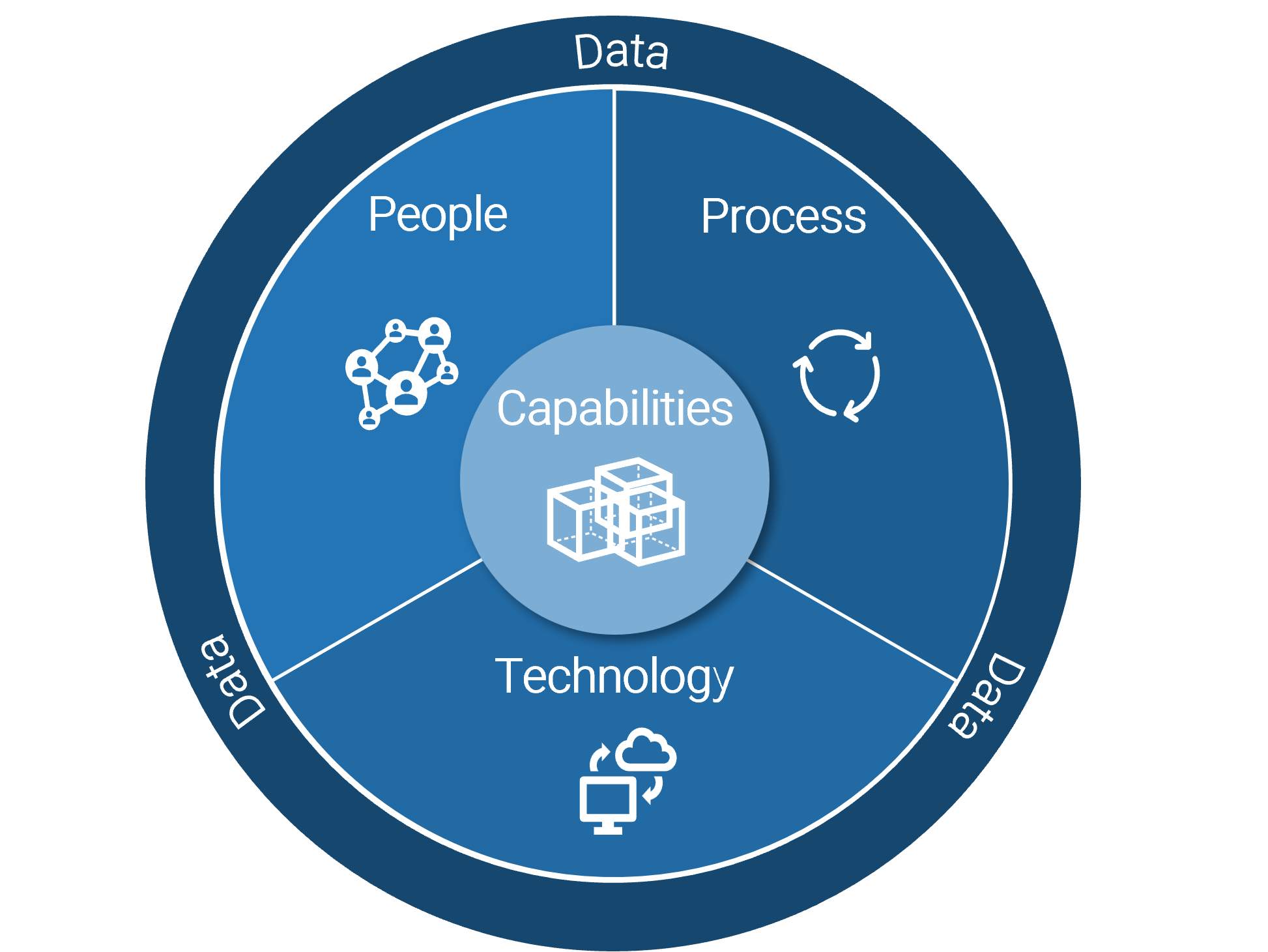
Win Retail by putting capabilities at the center; a visual of how it all comes together
Define your retail business reference architecture
From vision to execution
Retailers lack a clear bridge between IT, business capabilities, and operations. Language gaps and siloed teams fragment efforts, blocking unified value streams and seamless customer journeys.
Deliverables:
- Retail Business Reference Architecture Guide
- Business Reference Architecture Template
- Business Reference Architecture Library Tool
Outcomes
- Validated value streams and core capability map
- Key advantage and future-state capabilities identified
- Critical capability gaps prioritized
Info-Tech Insight
When retail leaders and IT teams collaborate to define a unified business reference architecture, technology shifts from being a back-office expense to a strategic enabler of agility, growth, and transformation. A step-by-step architecture framework aligns business and technology perspectives, driving smarter investments, accelerating business outcomes, and ensuring sustained competitive advantage.
Industry Overview: Retail
Retail remains one of the world’s largest industries with worldwide sales projected to surpass USD 31 trillion in 20251. E-commerce is taking a growing share of retail, with sales expected to reach around USD 7.4 trillion by the end of 20251. While digital channels continue to grow, brick and mortar stores generate most of the revenue, highlighting the vast scale of retail and its blend of physical and digital channels.
Consumers are increasingly demanding a seamless shopping experience across channels, where worldwide, mobile commerce is expected to account for over 44% of all e-commerce sales in 20252. Retailers that seamlessly integrate customer data, inventory, and checkout experiences will gain the competitive edge.
Small and midsize retailers across Europe, Australia, Asia, and the Middle East encounter pressures like those in North America: tight capital, limited digital expertise, and high costs for technology and logistics upgrades. Studies from the OECD, Asian Development Bank, and regional financial institutions indicate that SMEs represent upwards of than 94% to 99%3,4,5 of retail businesses in many of these regions and face persistent challenges in modernizing and scaling, deepening the divide with global chains.
Retailers continue to struggle with outdated systems, fragmented data, and rising costs that squeeze margins and slow modernization. Strict privacy rules, economic uncertainty, and high real-estate costs add further pressure, especially for smaller players. Limited capital and expertise leave many unable to match the speed and scale of global competitors.
Together, these forces show a growing industry that is under pressure to innovate, where success hinges on digital integration, operational agility, and the ability to scale despite mounting competitive and economic challenges
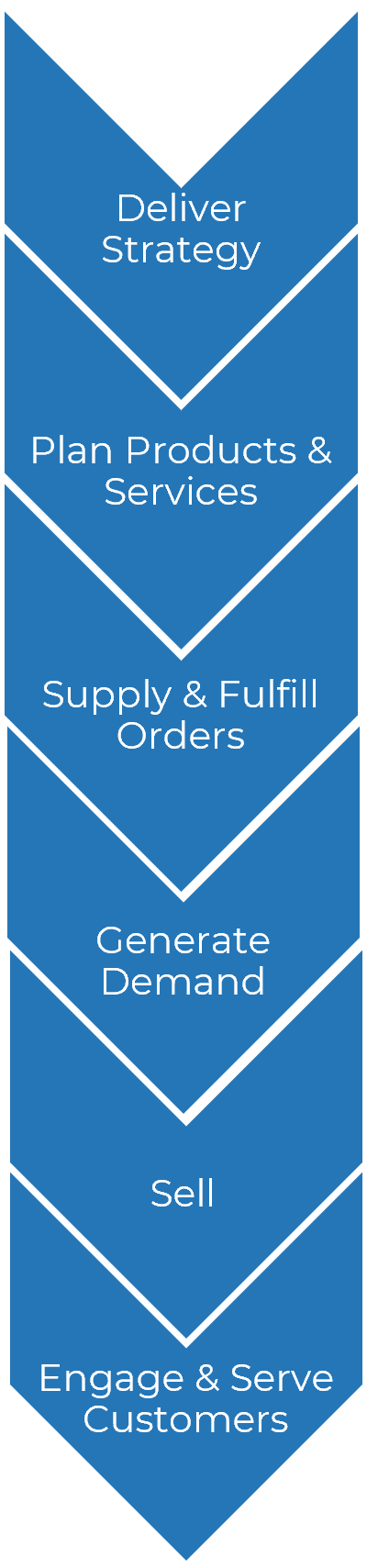
Figure above: Value Stream for the Retail Industry
About Info-Tech
Info-Tech Research Group is the world’s fastest-growing information technology research and advisory company, proudly serving over 30,000 IT professionals.
We produce unbiased and highly relevant research to help CIOs and IT leaders make strategic, timely, and well-informed decisions. We partner closely with IT teams to provide everything they need, from actionable tools to analyst guidance, ensuring they deliver measurable results for their organizations.
What Is a Blueprint?
A blueprint is designed to be a roadmap, containing a methodology and the tools and templates you need to solve your IT problems.
Each blueprint can be accompanied by a Guided Implementation that provides you access to our world-class analysts to help you get through the project.
Contributors
4 external anonymous contributors