
Legal Industry Business Reference Architecture
Positioning your firm to compete effectively in tomorrow’s legal market.
- Align strategy and execution: Unite strategic initiatives across the firm, while replacing fragmented systems and disconnected transformation efforts
- Clarify value and capabilities: Define a clear, firm-wide capability model that clarifies how value is generated and delivered, including a shared language for planning, communication and improvement.
- Revisit the operating model: Identify the optimal and sustainable operating model approach that addresses the market challenges and aligns with your firm’s ambitions.
- Investment efficiency: Link technology investment decisions to defined business capabilities, ensuring spending supports strategic priorities.
Our Advice
Critical Insight
- Structural inertia, silos, and legacy systems block adaptability; this blueprint aligns strategy, capabilities, and technology to enable practical, lasting change.
- Cultural resistance and talent gaps slow transformation; this framework builds clarity, agility, and firm-wide capability.
- Fragmented investments weaken competitiveness; a unified reference architecture empowers firms to adapt, lead, and sustain advantage in a fast-evolving market.
Impact and Result
This research provides:
- A unified view of strategy, capabilities, and technology to guide firm-wide investment and transformation initiatives.
- Data-driven prioritization of high-value capabilities that strengthen profitability, scalability, and client experience.
- A repeatable framework to adapt, lead, and sustain competitive advantage in a quickly evolving market.
Legal Industry Business Reference Architecture
Positioning your firm to compete effectively in tomorrow’s legal market.
Analyst perspective
Architecting competitive advantage through clarity
The legal industry is at an inflection point. Traditional operating and billing models are under pressure from changing client expectations, competition in the form of alternative legal service providers (ALSPs), and the transformative impact of generative AI. Firms that rely only on incremental adaption will fall behind as talent, technology, competitors and client expectations evolve faster than their operating model.
However, the shift is not only operational in nature – it’s a strategic one. Law firms must move beyond isolated innovation effort efforts and strive to embrace enterprise-wide approaches that connect business strategy with capabilities and technology. Business reference architectures provide that unifying structural view that helps firm leaders clarify how value is created, identify capability gaps, and determine the highest-yield investments.
The path forward demands rethinking how firms organize themselves around capability, not hierarchy. Those that build adaptable foundations by linking strategy, talent, process, and technology will be best positioned to lead in a market defined by transparency, efficiency, and AI-driven reinvention.

Kassim Dossa, MBA
Research Director
Info-Tech Research Group
Executive summary
Your Challenge
Despite the urgency to shift their operating model, many firms struggle to turn strategy into cohesive action for a variety of reasons:
- Cultural and structural inertia: Traditional partnership models reinforce resistance to change and fragmented decision-making.
- Disconnected transformation efforts: It is common to see siloed and duplicative change initiatives, without a strong link to firm strategy.
- Talent gaps: There’s an inability to easily hire the talent to support the reimagined version of the tech-enabled firm.
- Technology and investment: Fragmented legacy infrastructure combined with capital management pressures limit foundational technology investments.
Common Obstacles
- The legal industry is at an inflection point where traditional firm models and billing practices are under pressure. To remain competitive, law firms must realign strategy, talent, and technology.
- External forces are shifting the market: Gen AI, alternative legal service provider (ALSP) growth, and client demands are altering how legal services are delivered.
- Traditional pyramid and billable hour models are under pressure, requiring new approaches to deliver services, create value, and structure your firm.
- Fragmented systems and siloed operations limit alignment across IT, business, and strategy.
- Firms lack a shared framework to define capabilities, prioritize investments, and scale innovation.
Solution
- Use Info-Tech’s approach to reference architectures to align strategy, capabilities, and technology.
- Define value creation: Build your Level 1 and Level 2 capability map using the editable template enclosed in this blueprint.
- Create a strategy map linking business priorities to IT goals, using capabilities as the bridge.
- Assess current state: Evaluate people, process, data, and technology support for key capabilities to uncover opportunities.
- Prioritize future capabilities: Follow a prioritization approach to identify capability enhancements based on business impact, readiness, and strategic alignment.
Info-Tech Insight
The future of law won’t be defined by strategy alone. Business reference architectures provide the blueprint to adapt, lead, and sustain competitive advantage in a fast-evolving market.
Your challenge
Enhance your firm’s competitiveness with a business-aligned reference architecture.
Market forces including generative AI, fee pressure, rapid ALSP growth require the traditional law firm industry to reconsider how they will deliver value. Operating models must evolve to remain competitive and profitable in this evolving market.
Solving this does not come without its challenges:
- Align strategy and execution: Unite strategic initiatives across the firm while replacing fragmented systems and disconnected transformation efforts.
- Clarify value and capabilities: Define a clear, firm-wide capability model that clarifies how value is generated and delivered, including a shared language for planning, communication, and improvement.
- Revisit the operating model: Identify the optimal and sustainable operating model approach that addresses the market challenges and aligns with your firm’s ambitions.
- Investment efficiency: Link technology investment decisions to defined business capabilities, ensuring spending supports strategic priorities.
60% — 60% of legal professionals believe that Gen AI will reduce the prevalence of the billable hour model. (Wolters Kluwer, 2024; n=712)
43% — 43% of corporate legal departments who use ALSPs predict a decrease in spending on traditional law firms. (Reuters, “Alternative Legal Services Providers 2025 Report”; n=213)
Common obstacles
Barriers to building alignment
- Cultural and structural inertia: Traditional law firm partnerships are synonymous with fragmented decision-making and resistance to structural change.
- Siloed transformation efforts: Without a shared architecture linked back to business strategy, these efforts are duplicative and resource intensive.
- Legacy technology and fragmentation: Most firms lack a cohesive, integrated technology stack, making it difficult to modernize the business on an enterprise level.
- Talent and capability gaps: The industry faces shortage data, technology, and AI-literate professionals in roles that are required to serve changing client needs.
- Capital management: The pressure to maintain partner profitability and attract lateral hires constrains investment in foundational items such as enterprise architecture, data infrastructure, and technology enablement.
- Data governance and security risks: Shifting to a more heavily technology-enabled model unearths critical risks across cybersecurity, privacy, confidentiality, and responsible AI use.
79% — 79% of law firm respondents disagree that their traditional model is being challenged by alternative legal service providers. (Reuters, “Alternative Legal Services Report, 2025”; n=424)
Industry Overview – Legal Firms
The global legal industry is expected to exceed $1.02 trillion by 2025, but its traditional growth model is nearing a saturation point. Revenue expansion has been almost completely been driven by rate increases rather than demand, with billing rates rising 107% since 2006 compared to only 5% growth in total billable hours over the same period (Thomson Reuters, “Developing a Framework,” 2025). However, competitive disruption from alternative legal service providers (ALSPs) is reshaping the market. ALSPs have already captured ~4% of traditional firm market share (Thomson Reuters, “ALSP 2025 Report Analysis,” 2025) and continue to outpace law firms in annual growth. Meanwhile, overall legal services demand remains flat, reflected in an industry-wide CAGR of just 0.8% between 2013 and 2022 (Thomson Reuters, 2023).
Shifting Client Dynamics
Corporate legal departments are increasingly sourcing high-volume, standardized work from ALSPs to control costs and improve efficiency. Clients now prioritize value, transparency, and outcome-based delivery, creating further pressure on the billable hour model. In response, law firms are experimenting with fixed-fee, subscription, and outcome-based pricing models to retain competitiveness and demonstrate measurable value.
Technology as a Catalyst and Challenge
Artificial intelligence and automation are expected to redefine how legal work is delivered. AI tools are streamlining document review, due diligence, and research while enhancing operational efficiency across pricing, talent, operations, and client management. Yet as clients gain access to similar technologies, law firms are being pushed toward more complex, higher-value work, amplifying the need for legal professionals skilled in data, analytics, compliance, and technology enablement.
Strategic Implications
To sustain growth, firms must consider a recalibration of operating models – reducing cost structures and investing in differentiating capabilities such as knowledge management, utilization optimization, and strategic pricing. Success will depend on the ability to translate technological adoption into profitability while reshaping the talent model to support increasingly specialized and technology-augmented work.
Make the case for a business reference architecture at your firm
A business reference architecture (BRA) gives law firms a shared capability map and a blueprint that keeps IT and business initiatives aligned.
- Enabling strategic alignment between partners, practice groups, partners, and IT around business objectives.
- Creating conditions for efficiency and cost control by optimizing resource utilization.
- Managing technology complexity and integration by creating a cohesive technology stack.
- Silo reduction by promoting horizontal collaboration across the team and by standardizing the digital collaboration tools.
- Enhancing agility via hierarchy reduction and identifying additional required capabilities.
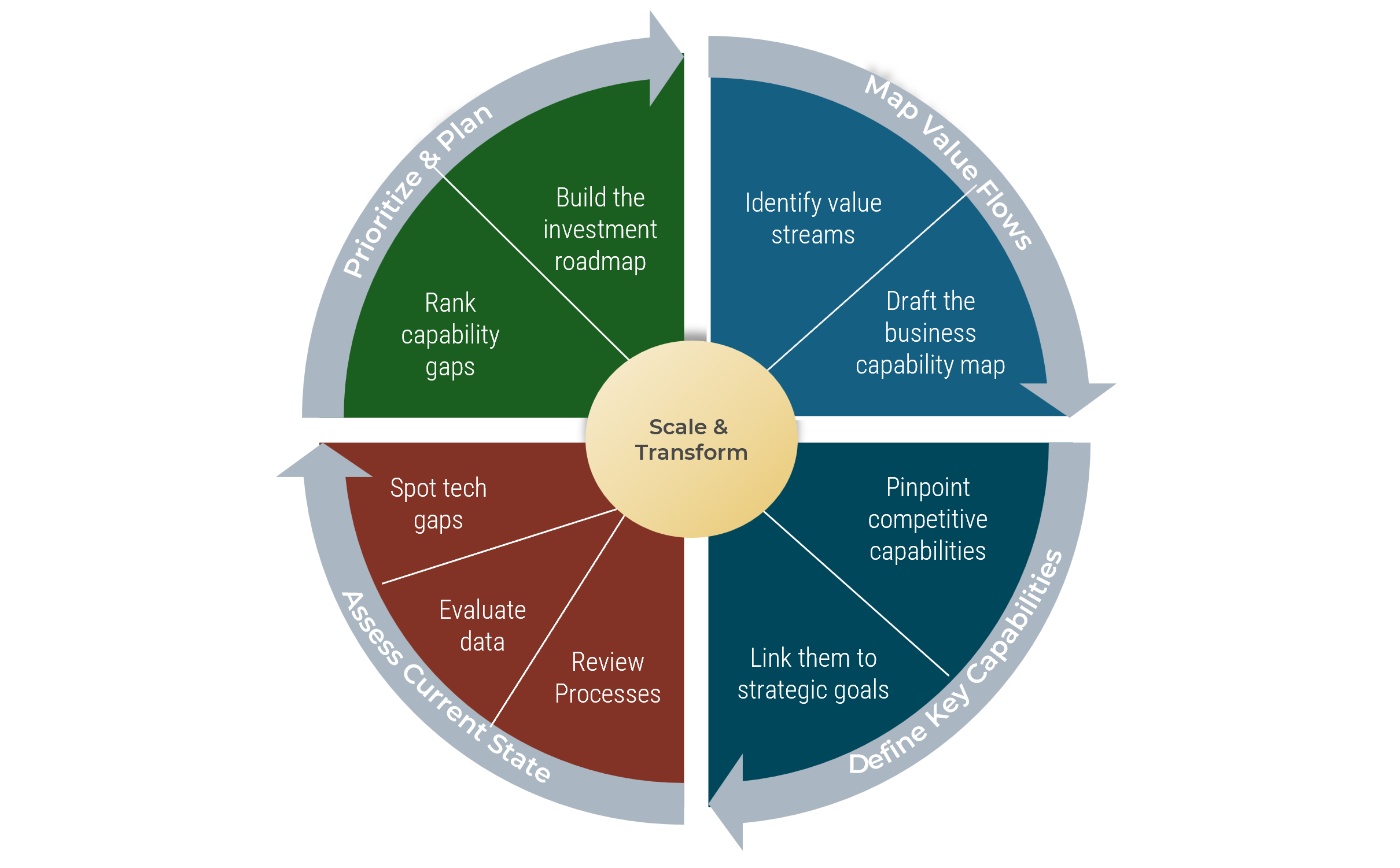
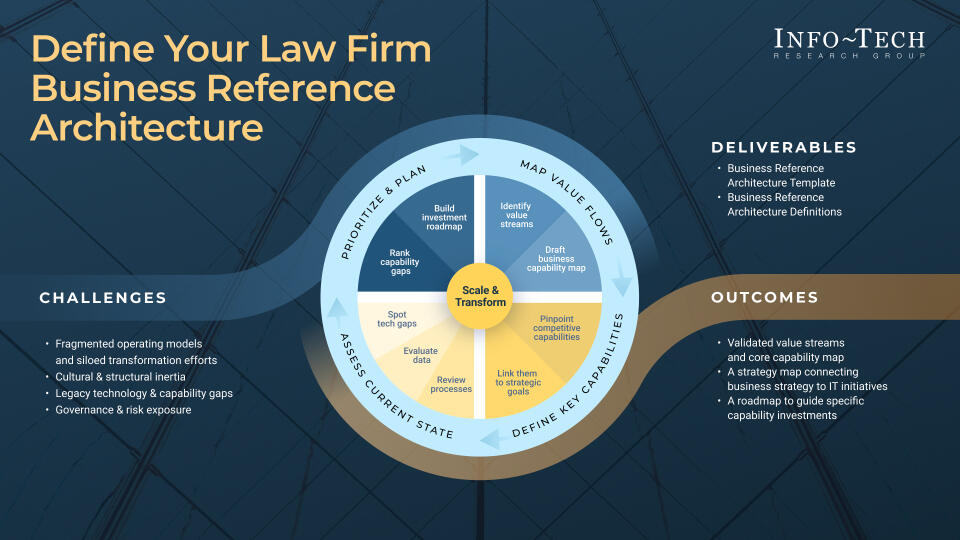
Define your law firm business reference architecture
As a law firm leader, I need a unified view of how our operating model, business capabilities, and technology align, so I can prioritize investments that deliver measurable value and mitigate organizational risk.
Challenges
- Fragmented operating models & siloed transformation efforts
- Cultural & structural inertia
- Legacy technology & capability gaps
- Governance & risk exposure
Deliverables
- Business Reference Architecture Template
- Business Reference Architecture Library Tool
Outcomes
- Validated value streams and core capability map
- Key advantage and future-state capabilities identified
- Critical capability gaps prioritized
- A strategy map connecting business strategy to IT initiatives
- A roadmap to guide specific capability investments
When law firm leaders and IT align around a unified business reference architecture, the firm gains clarity from strategy to execution. This alignment drives faster decisions, smarter investments, and stronger client outcomes.
Info-Tech’s methodology for business reference architecture
Phase 1: Build your firm’s business capability map | Phase 2: Use your firm capabilities to define your strategic focus | Phase 3: Assess key firm capabilities for planning priorities | Phase 4: Adopt capability-based strategy planning | |
Steps |
|
|
|
|
Outcomes |
|
|
|
|
About Info-Tech
Info-Tech Research Group is the world’s fastest-growing information technology research and advisory company, proudly serving over 30,000 IT professionals.
We produce unbiased and highly relevant research to help CIOs and IT leaders make strategic, timely, and well-informed decisions. We partner closely with IT teams to provide everything they need, from actionable tools to analyst guidance, ensuring they deliver measurable results for their organizations.
What Is a Blueprint?
A blueprint is designed to be a roadmap, containing a methodology and the tools and templates you need to solve your IT problems.
Each blueprint can be accompanied by a Guided Implementation that provides you access to our world-class analysts to help you get through the project.
Contributors
- Bryan Berry, CIO, Norton Rose Fulbright - Canada
- Chris Mackie, CTO, Mcguire Woods
- Kim Wismer, CIO, Pillsbury Winthrop Shaw Pittman LLP
- Alex Bazin, CTO/COO, Lewis Silkin LLP
