AWS Frontier Agents and the Future of Autonomous Enterprise Operations
AWS has reframed the future of software development and operations with its new Frontier agents.
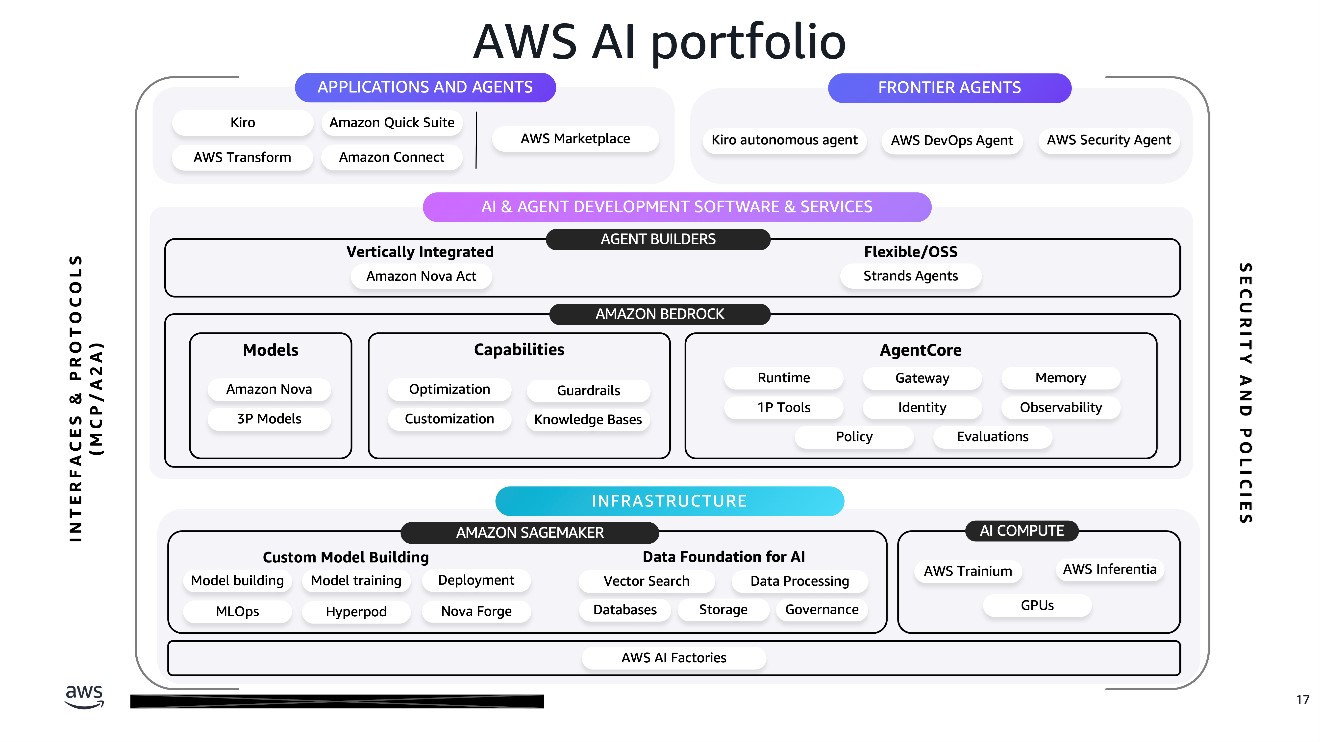
Image: Used with permission from Amazon Web Services
At re:Invent 2025, AWS introduced a new category of autonomous "Frontier agents" that go beyond simple intelligent assistants; these agents function as fully autonomous workers capable of operating for hours or days, maintaining persistent context and solving problems independently. Paul Weiss, Principal Analyst Relations Manager at Amazon Web Services (AWS), conducted a series of briefings and positioned the Frontier agents, emphasizing a strategic shift in how development and operations are executed in the enterprise:
1. The Paradigm Shift: From Assistants to Autonomous Workers
Paul stressed that Frontier agents move beyond being simple intelligent assistants or live coding tools. He framed them as a new class of AI agent that is capable of autonomous operations.
- Self-Directed and Persistent: They can run for "hours or even days" independently, maintaining persistent context and memory across long workflows and sessions.
- Reduced Human Intervention: They minimize the need for a human to supervise or steer the agent – agents are able to make smart decisions and self-correct errors based on real-time feedback.
2. Virtual Team Members
During the session they focused on three unique agents. These agents were positioned as fully integrated, autonomous members of a tech team:
- Kiro autonomous agent is your virtual developer that maintains context and learns over time while working independently, so you can focus on your biggest priorities.
- AWS Security Agent is your virtual security engineer that helps build secure applications by being a security consultant for app design, code reviews, and penetration testing.
- AWS DevOps agent is your virtual operations team member that helps resolve and proactively prevent incidents while continuously improving your applications’ reliability and performance.
3. Focus on Enterprise and Scale (B2B)
Paul explicitly contrasted Frontier agents with general-purpose B2C models, highlighting their suitability for the enterprise:
- Data Security: They are designed as enterprise software that focuses on "leveraging the customer's content and data systems," and working with information that is behind the firewall, which addresses a key security concern for tech leaders.
- Scale and Reliability: He benchmarked the underlying infrastructure against Amazon's own internal tools, reassuring leaders that the technology is designed for massive scale and proven in a 24/7 environment.
4. Proactive Problem Solving
A key selling point was the move from reactive to proactive IT management:
- Devops Agent: Positioned to provide preventative analytics, actively monitoring infrastructure to "spot problems before they happen" and "start fixing problems before anybody actually saw that it was a problem."
- Security Agent (Implied): Focused on continuous security integration to find vulnerabilities early in the development cycle, reducing the high cost of fixes in production.
5. Integration and Workflow
Paul emphasized that the agents are not isolated tools but fit into existing ecosystems, ensuring an easier path to adoption:
“They have a lot of integration points with existing enterprise tools for ticket management (Jira, Linear), communication (Slack, Teams), code repositories (GitHub, GitLab), and monitoring (CloudWatch, Datadog, Splunk).”
Competition and Differentiation
Competition comes mainly from other cloud providers and also providers building their own autonomous agents.
AWS’s differentiator is vertical integration across the entire AI stack from models to policy engines to observability to compute.
The agent layer is not standalone – it rides on top of Amazon Bedrock, Amazon SageMaker, and AWS observability data. That means deeper context than any startup can match.
- The hidden engine is Agent Core. It[ covers memory, identity, gateway, policy, and evaluation. This gives AWS a governance and safety moat that matters for enterprise-wide deployment.
- Kiro’s ability to produce full features is impressive in demos, but in production most enterprises will constrain autonomy until trust builds.
- Nova Forge allows you to build your own frontier models using Nova. It simplifies agent building but is more packaging than breakthrough. Useful, but not transformational on its own.
The direct and practical differentiation comes from continuity. Scripts are transactional and are used for completing tasks then they stop. Agents are persistent, running for weeks to manage evolving situations. AIOps agents share this trait, but the practical shift here is moving from simple monitoring to active, long-term problem solving.
Our Take
The introduction of AWS Frontier agents indicates that autonomous agents are shifting from isolated experiments to integrated cloud capabilities. In the AWS AI portfolio, Kiro, the DevOps agent, and the Security agent all sit on a common foundation of models, policy and identity controls, observability, and compute, signaling that AWS intends autonomy to operate as part of the platform itself. From an Info‑Tech perspective, this reflects a broader move across cloud providers to embed autonomous execution directly into core architectures rather than treat it as an add‑on.
It would be nice to have the ability to specify organization-specific context, e.g. what constitutes a “problem” may vary across different environments. Another nice-to-have feature would be policy-controlled behavioral governance, e.g. what a given agent is entitled to do or not to do, resolving competing decisions made by different agents, etc.
For CIOs, the impact is a change in how development, operations, and ITSM workflows will be designed and governed. These agents are built to take on multi-step tasks with persistent context, which means organizations must assess their readiness around governance, oversight, and integration before granting deeper autonomy. The industry trend is clear, but adoption should be sequenced.
Autonomy should be viewed as a series of controlled handovers: a shift from human‑in‑the‑loop to human‑on‑the‑loop, where the agent proposes and executes within strict guardrails. Organizations should begin with low‑risk, high‑visibility areas, such as internal development scaffolding, post‑incident analysis, or bounded service flows before considering autonomous control over production incidents or infrastructure.
The priority for CIOs is building a 12‑ to 24‑month roadmap that aligns the degree of autonomy with operational maturity and risk tolerance. This ensures that autonomous agents become reliable components of the environment rather than unmanaged sources of operational exposure.