
Contract Lifecycle Management Platform Selection Guide
Fast-track your CLM selection journey and build a future-ready contracting function.
Contracts underpin every supplier relationship, customer agreement, and revenue commitment. As regulatory requirements, customer and supplier ecosystems, and digital workflows become more complex, CLM platforms have evolved far beyond basic contract storage and tracking. But as their capabilities expand, CLM platform selection initiatives often stall amid unclear requirements, a fragmented vendor landscape, and inconsistent features. Use this buyer’s guide to help structure a CLM platform selection process that unlocks the full value of your contracts.
Modern CLM platforms deliver AI-powered clause analysis, workflow automation, and seamless integration with ERP, CRM, and procurement systems to optimize the entire contract lifecycle. But without clear, shared ownership across the organization, CLM initiatives risk becoming underused or misaligned with enterprise priorities. A disciplined, AI-forward evaluation methodology is essential to reduce risk, accelerate deal cycles, and ensure your CLM choice aligns with your organization’s needs.
1. Share CLM ownership.
Though CLM is often driven by an organization’s legal and procurement departments, lasting success depends on organization-wide collaboration. IT must partner with legal, procurement, sales, finance, and other stakeholders to define a unified vision for the CLM solution.
2. Don’t buy what you won’t use.
CLM platforms are varied, ranging from basic digitization tools to AI-driven contract intelligence systems. When evaluating solutions, prioritize core needs such as risk mitigation, cycle time reduction, and integration depth rather than chasing emerging features or market hype. Choose a solution that aligns with your process complexity and risk profile.
3. Get your requirements right.
Poorly defined requirements are the number one reason projects fail, and CLM platform selection is no exception. Organization leaders must define requirements for usability, process alignment, and reporting, while IT ensures scalability, security, and seamless integration.
Use this step-by-step buyers guide to find the right CLM platform for you.
This buyers guide equips you with a complete toolkit for CLM platform selection, including a vendor landscape analysis, AI capabilities maturity model, requirements-gathering templates, and guided RFP development. Use these resources to streamline your vendor evaluation process, reduce selection risk, and implement a CLM platform that maximizes the value of your contracts.
- Understand the CLM landscape and trends to build consensus on CLM scope and capabilities.
- Build your business case and streamline requirements to understand your needs and prepare a comprehensive RFP.
- Select the right CLM vendor by conducting an overview of shortlisted vendors while taking implementation considerations into account.
Member Testimonials
After each Info-Tech experience, we ask our members to quantify the real-time savings, monetary impact, and project improvements our research helped them achieve. See our top member experiences for this blueprint and what our clients have to say.
9.5/10
Overall Impact
$25,574
Average $ Saved
15
Average Days Saved
Client
Experience
Impact
$ Saved
Days Saved
Albemarle Corporation
Guided Implementation
8/10
N/A
2
MyPath, Inc.
Guided Implementation
10/10
$34,499
50
The information was concise and provided responses to all of our current questions.
Endeavour Management Services London Limited
Guided Implementation
10/10
$16,649
2
breath of experience in the researched product, adaptability with requierements and vendor knowledge.
UN-World Intellectual Property Organization
Guided Implementation
10/10
N/A
5
Contract Lifecycle Management Platform Selection Guide
Fast-track your CLM selection journey and build a future-ready contracting function.
Analyst Perspective
Implementing the right CLM platform is essential to reducing risk, accelerating business outcomes, and unlocking the full value of contracts.
Selecting the right contract lifecycle management (CLM) platform is a critical decision for organizations aiming to reduce risk, accelerate deal cycles, and strengthen compliance. With rising regulatory pressures, increasingly complex supplier and customer ecosystems, and the demand for faster digital workflows, CLM has evolved beyond contract storage and tracking. Modern platforms now deliver AI-driven clause analysis, workflow automation, and deep integration with enterprise systems such as ERP, CRM, and procurement.
Legal and procurement functions are often the primary drivers for CLM, but successful initiatives require collaboration across Sales, Finance, and IT. Business leaders must define requirements for usability, process alignment, and reporting, while IT ensures scalability, security, and seamless integration. Without shared ownership, CLM initiatives risk becoming underused or misaligned with organizational priorities.
The selection of a CLM platform should follow a structured evaluation process: defining business and compliance objectives, prioritizing capabilities such as workflow automation, AI-enabled analytics, and integration breadth, and assessing deployment models (cloud-native vs. hybrid). A disciplined RFP process enables objective vendor comparison based on functionality, architecture, and long-term cost.
To drive adoption, organizations should plan for contract migration, playbook design, integration testing, user training, and governance. This structured approach helps maximize long-term value, reduce risk, and ensure adaptability as business needs and regulations evolve.

Hriday Gulrajani
Senior Research Analyst, Customer Experience & Application Insights
Info-Tech Research Group
Executive Summary
Your Challenge
- Contract lifecycle management has moved from being a “nice-to-have” to a critical business capability. Organizations are under pressure to manage contracts more efficiently, reduce risk, and unlock value hidden in contract data.
- Choosing the right CLM isn’t just about buying software; it’s about finding a platform that fits your unique workflows, integrates with your systems, and is embraced by both legal and business teams. The wrong choice can lock you into years of frustration.
Common Obstacles
- Despite the clear benefits of CLM adoption, many organizations struggle with defining a structured selection process and aligning stakeholders on priorities. The CLM market is fragmented, with vendors offering overlapping yet inconsistent capabilities across workflow automation, AI-assisted contract analysis, clause libraries, and integration breadth.
- IT teams often bear the blame when a selected CLM fails to meet expectations, lacks flexibility, or does not integrate well with existing technology stacks.
Info-Tech’s Approach
- CLM selection must be guided by your organization’s broader governance, compliance, and operational efficiency objectives. For more information see Design and Build an Effective CLM Process.
- Determine exactly what you require from your CLM, and leverage use cases to ensure the platform supports both legal and business workflows.
- Prioritize integration with other critical systems. A CLM should not function in isolation but act as the connective layer that streamlines contract processes and provides visibility across the organization.
Info-Tech Insight
IT must work in unison with Legal, Procurement, Sales, and other key stakeholders to define a unified vision for the contract lifecycle management solution.
Info-Tech’s methodology for selecting an appropriate contract lifecycle management platform
1. Understand the CLM Landscape and Trends |
2. Build the Business Case and Streamline Requirements |
3. Select the Right CLM Vendor |
|
Phase Steps |
|
|
|
Phase Outcomes |
|
|
|
Guided Implementation
A Guided Implementation (GI) is a series of calls with an Info-Tech analyst to help implement our best practices in your organization.
The CLM selection process should be broken into segments:
- Create a vendor shortlist using this buyers guide.
- Define a structured approach to selection.
- Review the contract.
What does a typical GI on this topic look like?
Phase 1 |
Phase 2 |
Phase 3 |
| Call #1: Understand the concept of a CLM platform; explore its core capabilities and emerging trends.
Canvas key vendors in this space. |
Call #2: Build the business case to select a CLM.
Call #3: Define your key CLM requirements. Call #4: Build procurement items, such as an RFP. |
Call #5: Evaluate the CLM vendor landscape and short-list viable options.
Call #6: Review implementation considerations. |
Info-Tech offers various levels of support to best suit your needs
DIY Toolkit |
Guided Implementation |
Workshop |
Consulting |
| “Our team has already made this critical project a priority, and we have the time and capability, but some guidance along the way would be helpful.” | “Our team knows that we need to fix a process, but we need assistance to determine where to focus. Some check-ins along the way would help keep us on track.” | “We need to hit the ground running and get this project kicked off immediately. Our team has the ability to take this over once we get a framework and strategy in place.” | “Our team does not have the time or the knowledge to take this project on. We need assistance through the entirety of this project.” |
Diagnostics and consistent frameworks are used throughout all four options. |
|||
Contract Lifecycle Management Platform Selection Guide
Speed up the process to build your requirements and select the right CLM platform for your organization.
EXECUTIVE BRIEF
Contract Lifecycle Management Platform Selection Guide
Phase 1
Understand the CLM Landscape and Trends
Phase 11.1 Define CLM 1.2 Classify table stakes & differentiating capabilities 1.3 Explore trends |
Phase 22.1 Build the business case 2.2 Streamline requirements elicitation 2.3 Develop an inclusive RFP approach |
Phase 33.1 Discover key players in the vendor landscape 3.2 Engage the shortlist & select finalist 3.3 Prepare for implementation |
This phase will walk you through the following activities:
- Level-set an understanding of CLM software.
- Define which CLM features are table stakes (standard) and which are key differentiating functionalities.
- Understand the latest trends in CLM space.
This phase involves the following participants:
- General Counsel or Chief Legal Officer (CLO)
- Head of Procurement or Contract Manager
- Sales Operations Lead
- IT & Enterprise Architecture Team
- Compliance & Risk Analyst
What exactly is a CLM platform?
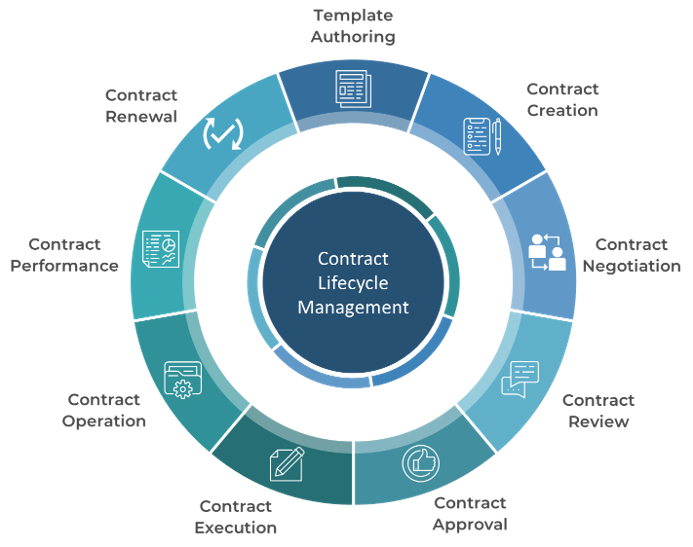
Contract lifecycle management (CLM) refers to the process of actively managing contracts from initiation through execution, performance, and renewal or expiration. It encompasses every step: starting with an initial request or draft, through negotiations and approvals, signature/execution, and then the post-signing phase of monitoring obligations, amendments, and eventually handling renewals or close-out. In short, CLM is an end-to-end business process that ensures agreements are created efficiently, comply with business and legal standards, are stored accessibly, and are monitored throughout their life so nothing falls through the cracks. CLM platforms provide the technology capabilities to support all steps in the lifecycle of a contract.
CLM offers many key features, including but not limited to:
- Contract Authoring and Collaboration
- Contract Template Libraries
- Contract Review and Redlining
- Communication Management for Negotiations
- Contract Signing and Execution
- Executed Contract Library and Search
- Contract Deadline and Renewal Notifications
- Contract Performance Management and Adherence Analytics
Info-Tech Insight
CLM platforms range from simple digitization tools to AI-driven contract intelligence systems. Prioritize core business needs like risk mitigation, cycle time reduction, and integration depth over emerging features or market hype. Choose a solution that aligns with your process complexity and risk profile.
CLM process flow
A defined CLM process flow streamlines contracting, improves compliance, and accelerates business outcomes.
 |
||||||
Sourcing & Contract Request
|
Contract Drafting & Authoring
|
Contract Negotiation & Review
|
Contract Execution
|
Contract Performance Management
|
Compliance & Amendments
|
Procure-to-Pay (P2P) Integration
|
| Collaboration (Internal & External) | Contract Data Capture | Searchable Repository | User Profiles & Authorizations | Workflow Management | AI Support | ||||||
About Info-Tech
Info-Tech Research Group is the world’s fastest-growing information technology research and advisory company, proudly serving over 30,000 IT professionals.
We produce unbiased and highly relevant research to help CIOs and IT leaders make strategic, timely, and well-informed decisions. We partner closely with IT teams to provide everything they need, from actionable tools to analyst guidance, ensuring they deliver measurable results for their organizations.
What Is a Blueprint?
A blueprint is designed to be a roadmap, containing a methodology and the tools and templates you need to solve your IT problems.
Each blueprint can be accompanied by a Guided Implementation that provides you access to our world-class analysts to help you get through the project.
Need Extra Help?
Speak With An Analyst
Get the help you need in this 3-phase advisory process. You'll receive multiple touchpoints with our researchers, all included in your membership.
Guided Implementation 1: Understand the CLM Landscape and Trends
- Call 1: Understand the concept of a CLM platform; explore its core capabilities and emerging trends. Canvas key vendors in this space.
Guided Implementation 2: Build the Business Case & Streamline Requirements
- Call 1: Build the business case to select a CLM.
- Call 2: Define your key CLM requirements.
- Call 3: Build procurement items, such as an RFP.
Guided Implementation 3: Select the Right Contract Lifecycle Management Vendor
- Call 1: Evaluate the CLM vendor landscape and short-list viable options.
- Call 2: Review implementation considerations.
 Develop Your Value-First Business Process Automation Strategy
 Maximize the Benefits from Enterprise Applications with a Center of Excellence
 Prepare and Defend Against a Software Audit
 Automate Work Faster and More Easily With Robotic Process Automation
 2020 Applications Priorities Report
 Build Your First RPA Bot
 Get the Most Out of Workday
 Get the Most Out of Your SAP
 Scale Business Process Automation
 Run IT By the Numbers
 IT Spend and Staffing Benchmarking
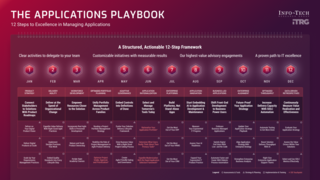 The Applications Playbook
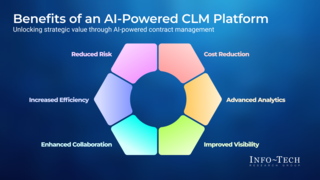 Contract Lifecycle Management Platform Selection Guide
 Reimagine Business Processes With an AI-First Approach
 AI in Seven Charts
 Emerging AI Trends and Predictions From Our Global Technical Counselor Team
 Developer Survival Guide in the Age of Agentification
 Turn Customer Friction Into Agentic Opportunity
 People Change in the Face of Disruptive Technology
 Lead IT Like a Business: Every Dollar Is a Decision
 Optimize Cloud & AI Spend With Agentic FinOps
 The SaaSpocalypse Is Here. Easy Software Decisions Are Over.
 Influence Unleashed: The IT Leader’s Superpower
 The Challenge of Ethics in the Use of AI
 Revolutionize Risk Management With Agentic AI
 Introducing the Info-Tech Speakers Bureau
 Inside the Agentic Enterprise
 Agents 2.0: From Autonomy to Architecture
 Agentic IT: From Hype to Value
 Tech Trends 2027 Keynote
 Become an Exponential CIO
 Beyond the Agent: The Leadership Ecosystem for an AI-Enabled World
 Five Key Takeaways From Info-Tech LIVE 2026
