
Applications Priorities 2026
Confidently take on 2026 with a strong foundation.
Reset your agenda to the problems your stakeholders truly care about.
AI is moving fast. But its unprecedented pace of maturity has exposed a harsh truth: IT’s applications foundations are shaky, legacy, or even non-existent. Without a solid base to launch from, your applications team’s successful AI pilots could become short-lived experiments rather than sustainable innovation or enduring products and services.
The Applications Priorities 2026 report explores four critical initiatives to reinforce applications team fundamentals, drive AI-enabled value, and ensure consistent, reliable, flexible delivery in the coming year. Amid economic and geopolitical uncertainty, learn how to realign your applications strategy with organizational ambitions – so the real transformation can begin.
Four critical priorities for applications leaders in 2026
Based on real-world case studies, plus data from Info-Tech’s extensive research surveys and diagnostic benchmarks, this report examines four top priorities for the applications agenda in 2026.
1. Boost Solution Delivery With AI
Embed key delivery activities with mature and proven AI capabilities.
Choose the AI tools that have proven track records of results. Harness their power to accelerate delivery of solutions that are optimized for personalized user experiences and in compliance with corporate policies and regulatory standards.
2. Make AI a Team Member
Reimagine your team with AI as a colleague and peer.
AI has advanced beyond routine automation. Treat it as a collaborator to peer review, generate creative ideas, and ensure output aligns with project goals. Reinforce a culture where AI and humans seamlessly play off each other’s strengths, but be mindful of AI’s limitations and risks.
3. Generate Contextual and Tailored Digital Experiences
Deliver the right content, features, and workflows at the right time.
User experience expectations keep rising in a digital landscape that just keeps getting more competitive. Leverage AI to redefine how your organization connects with users. Turn routine interactions into high-value, contextual, and tailored experiences that drive loyalty and growth.
4. Enable End-to-End Business Process Automation
Harness the power of AI orchestration and automation.
Maybe you’ve already automated individual processes; now deploy AI orchestration to ensure they all work together to drive employee productivity, higher quality output, and practical insights. Embed business rules, analytics, and AI models directly into workflows to enable consistent, automated, and traceable decisions.
Applications Priorities
Analyst Perspective

Andrew Kum-Seun
Research Director, Applications
Info-Tech Research Group
AI is moving fast. Get your applications practice ready.
AI is transforming the industry at an unprecedented pace, and IT is racing to keep up. Early pilots are generating excitement among stakeholders and proving the potential of AI-driven solutions. However, this rapid momentum exposes a critical problem: IT’s shaky, legacy, or even nonexistent foundations. Without alignment across the organization and a good base to launch from, your isolated pilot successes risk becoming short-lived experiments rather than sustainable innovation and enduring products and services.
Now is the time for your applications department to act. Reset your priorities to the problems your stakeholders truly care about. Reinforce your applications team’s fundamentals to deliver consistently, reliably, and flexibly. Ensure everyone and everything, including AI, in your applications team understands their role in your modernization and AI journey. When your applications department moves with your organizational ambitions, the real transformation can begin.
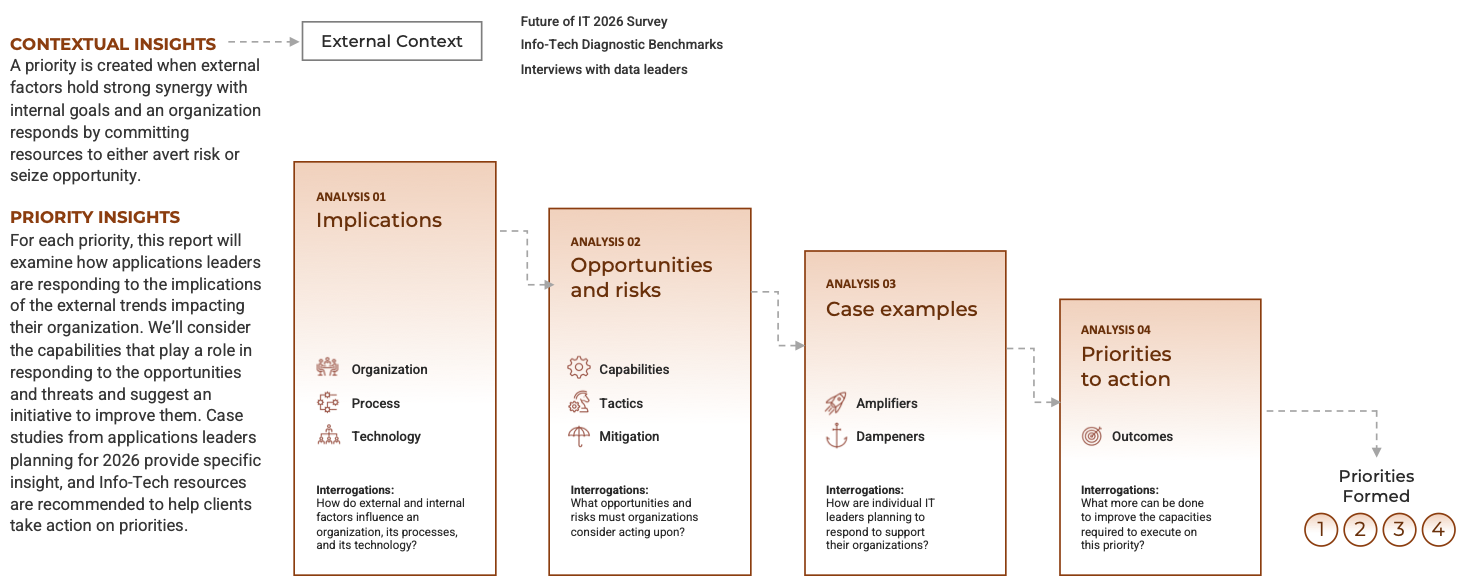
Moving from trends to priorities
Understand the applications priorities by analyzing both how applications leaders respond to trends in general and how specific applications leaders responded in the context of their organization.
APPLICATIONS PRIORITIES 2026
-
Boost Solution Delivery With AI
Embed key delivery activities with mature and proven AI capabilities. -
Make AI a Team Member
Reimagine your team’s composition, capacity, and skills with AI as a colleague and peer. -
Generate Contextual and Tailored Digital Experiences
Deliver the right content, features, and workflows at the right time. -
Enable End-to-End Business Process Automation
Facilitate autonomous and integrated processes through AI orchestration and automation.
Navigate uncertainty with a technology-first plan and your applications priorities
Organizations face many unexpected macro vulnerabilities (e.g. abundant regulation changes) that drastically impact how they function. These vulnerabilities can prevent IT leaders from achieving their technology mandates. By prioritizing risks and optimizing costs, IT leaders can unlock resources to drive innovation and AI transformation. This is your applications practice’s opportunity to take the lead.
FEATURED RESEARCH:
Adapt to Uncertainty With a Technology-First Action Plan
ADOPT INFO-TECH’S RECOMMENDED APPLICATIONS PRIORITIES TO ACHIEVE YOUR STRATEGIC TECHNOLOGY-FIRST ACTION PLAN
Slash your AI Transformation Timeline
Pivot from long-term transformation roadmaps to certain ROI delivery today, mostly leveraging vendor capabilities. Use freed-up funds to drive organizational outcomes.
APPLICATIONS PRIORITY 1: BOOST SOLUTION DELIVERY WITH AI
Build an Adaptive IT Workforce
Global uncertainty is putting pressure on the workforce. As traditional skill procurement sources change, you need to prioritize retaining knowledge and developing in-demand skills from within.
APPLICATIONS PRIORITY 2: MAKE AI A TEAM MEMBER
Execute and Prepare to Pivot
Constant change means no time to slow down. Create mechanisms to successfully implement your action plan. Monitor the progress of your initiatives and adapt rapidly and in real time.
APPLICATIONS PRIORITY 3: GENERATE CONTEXTUAL AND TAILORED DIGITAL EXPERIENCES
Pursue IT Excellence
Don’t let uncertainty derail your path to systematically pursue IT excellence. Focus on the capabilities proven to have the highest impact and leverage your team to execute them.
APPLICATIONS PRIORITY 4: ENABLE END-TO-END BUSINESS PROCESS AUTOMATION
Deliver the right value with your applications priorities
Applications and the applications practice are vital to any organization because they serve as the backbone of modern business operations, connecting people, processes, and technologies to deliver value efficiently, reliably, and consistently. They enable organizations to operate optimally, innovate faster and more aggressively, and quickly pivot to changes.
Applications leaders must continuously take a hard look at their portfolio and their solution delivery and management practices to find innovative ways to better position them. This is done through applications priorities. Your applications priorities must address the problems that are important to your stakeholders and satisfy the different needs of customers, partners, and users.
ALIGN YOUR APPLICATIONS PRIORITIES WITH YOUR IT STRATEGY.
An IT strategy illustrates how technology and its management and governance can satisfy and exceed your strategic objectives and metrics. This document helps:
- Optimize resource allocation and budgeting.
- Raise the impact and mitigations to address IT risks, including cybersecurity.
- Illustrate the feasibility, flexibility, and adaptability of IT and enterprise systems.
To learn more, see Build a Business-Aligned IT Strategy.
The applications practice plays a pivotal role in raising IT reputation and satisfaction
71%
Mean satisfaction score of IT performance as a business partner among CXOs
Source: Info-Tech’s CEO-CIO Alignment Diagnostic, August 2024 to August 2025; n=94
Attack the disruptions to your applications practice
Applications teams face an unprecedented wave of disruption driven by emerging technologies, shifting customer expectations, and increasing market and regulatory pressure. These disruptors are fundamentally reshaping how businesses operate and deliver value.
- Global uncertainty. Economic volatility, geopolitical tensions, and operational disruptions have become significant concerns for applications teams who use external parties and vendors. Climate change, rising authoritarianism, and geopolitical tensions were the top three concerns to developers (Devographics, 2025). These factors create business continuity risks, stress budget limitations, and cause sudden shifts in regulations that challenge long-term planning and stability.
- Cybersecurity. The growing sophistication and volume of threats and attack vectors are forcing teams to fundamentally change how they select, implement, and manage their applications. Teams struggle to address them, which leads to added delivery complexity, increased costs, and poor-quality outputs. In fact, 64% of applications have flaws in first-party code, and 70% of applications have flaws in third-party code (Veracode, 2025).
- Artificial intelligence (AI). The rapid integration of AI technologies introduces new capabilities, like predictive analytics, but also stresses good data quality, governance, and responsible use. Teams must quickly adapt to maximize AI’s value and mitigate the risks that come with it, but efforts fall short without a broader strategy. Only 24% of respondents stated they have a corporate-wide AI strategy in place and up to date (Tech Trends 2026, Info-Tech) to illustrate how this adoption will happen.
- Democratized IT. Users want the ability to build, configure, and extend their solutions with seamless access to key enterprise systems and unrestricted integrations with third-party services. Low-code/no-code and software as a service are two of the popular enablers. IT is expected to support these capabilities, but the changes required to be successful (e.g. application accountability and a shift in IT’s role) are beyond what many organizations can tolerate.
2026 will be disruptive
Respondents identified the top factors that will likely or highly likely disrupt business in the next 12 months
- Government-enacted regulatory changes
- Talent shortage
- AI and emerging technologies
- Industry-enacted standards or regulation changes
- Cybersecurity incidents
Source: Tech Trends 2026, Info-Tech Research Group; n=525
Organizations see the positive future of AI
45%
of development professionals are currently working on and maturing their AI/ML capabilities.
Source: Temporal, 2025; n=226
Overcome the impediments standing in your team’s way
The complexities applications teams face can undermine the objectives stakeholders want them to achieve because of their critical role in powering core business operations and innovation. Misalignment and underinvestment in these teams can lead to operational inefficiencies, brittle and costly systems, and lost opportunities. When stakeholders pay attention and engage with applications teams, they help ensure that all applications decisions directly support strategic goals. Empathize and sympathize with applications and do not expect they will just “figure it out” on their own.
RECOGNIZE THE COSTS IF YOUR TOP APPLICATIONS IMPEDIMENTS ARE LEFT UNADDRESSED
- Addressing technical debt
- Optimizing resource capacities
- Navigating enterprise integrations
People, processes, and technologies must all be factored into the optimization of your delivery practice
Top Barriers Preventing Teams From Improving Their Software Development Lifecycle
- Technical debt or complexity of legacy systems
- Resource capacity
- Integration challenges
- Organizational culture resistant to change
- Lack of clear governance for new technologies like AI
- Lack of collaboration across teams
- Siloed teams
- Security and compliance concerns
- Data quality and accessibility
- Lack of understanding or strategy for new technologies like AI
Source: Tech Trends 2026, Info-Tech Research Group; n=117
Challenge 1: Addressing technical debt
Technical debt stunts organizational growth.
Unmanageable technical debt is the inevitable consequence of poor decision-making during solution delivery and maintenance. The ongoing pressure to deliver quickly often leads to trade-offs that build up to increased delivery complexity, slower delivery, and higher maintenance costs. Organizations must understand and prioritize good technical debt management to maintain high throughput and sustainable delivery, especially in rapidly evolving environments.
Technical debt is the accumulated costs of delivery shortcuts, deliberate technology selection, quick fixes, and short-sighted decisions that often prioritize speed over long-term quality and maintainability.
ADDRESS THE UNDERLYING ROOT CAUSES
- Architectural, integration, and system quality governance and standards are not embedded in delivery activities and not validated at key points of the process.
- System designs do not accommodate the impact of technology sprawl, the organizational risk footprint, functional dependencies, and operational costs.
- Little business appetite to invest in system modernization and refactoring efforts (why fix when it is not broken?).
- Teams do not have documentation, technical expertise, or institutional knowledge of the system, the intent of the system, or the rationale behind past delivery decisions to address technical debt effectively.
AVOID THE RISKS IF TECHNICAL DEBT IS LEFT UNADDRESSED
- Business and system performance are slow, unreliable, and brittle due to outdated technologies, execution of unnecessary code, and connectors not optimized to meet changes in computational demand.
- Updating systems to comply with the latest security and industry standards is costly.
- Standard maintenance fixes and system updates are resource-intensive and slow to address.
- Applications are designed to address the problem at the time of delivery, so they are likely incompatible with newer systems that require integration.
Despite knowing rising technical debt degrades product reliability, little is done about it
27%
of product professionals stated they dedicate time to reduce technical debt.
Source: State of Product 2026, Atlassian, 2025; n=1,000+
Technical debt is also an infrastructure concern
52%
of respondents stated that reducing technical debt is their biggest 2026 infrastructure priority.
Source: Tech Trends 2026, Info-Tech Research Group; n=525
Challenge 2: Optimizing resource capacity
Rising demand is outpacing the team’s ability to deliver.
The rapid pace of technological change and increasing complexity of modern ecosystems are straining an already stressed and under-resourced applications practice. Modern applications require expertise across cloud platforms, cybersecurity, integration, data management, and emerging technologies like AI, which are in high demand but in short supply. This strain is further compounded by rising stakeholder demand and the expectations to deliver faster with little change to the overall headcount. Technologies like AI can help but are not silver bullets.
Meanwhile, the current job market has made talent acquisition and retention difficult due to disruptors (e.g. global uncertainties), competitive employers, shifts in worker preferences (e.g. work from home), and other social, economical, and technical factors.
ADDRESS THE UNDERLYING ROOT CAUSES
- Integrated technologies grow and fragment uncontrollably due to the lack of a broader application portfolio strategy to guide selection and planning.
- Delivery expectations are unrealistic due to stakeholders’ unfamiliarity with the complexities behind their requests and of the current state of their team’s backlog.
- There is limited time and budget for upskilling, preventing teams from keeping pace with modern good practices.
- Leaders have little awareness and understanding of the culture and work environment teams need to be productive, grow, and thrive.
AVOID THE RISKS IF TECHNICAL DEBT IS LEFT UNADDRESSED
- Overworked and stressed teams will be unmotivated to improve, disengage with the organization, and deepen the divide and mistrust with leaders.
- Teams will trade off testing, peer reviews, and other quality-centric activities for delivery speed, delivering solutions burdened with technical debt.
- There is an attrition of experienced employees and loss of institutional knowledge.
- Teams have little capacity for strategic work, experimentation, or modernization effort.
Executives agree that IT resource capacity management is a pain point
83%
of CXOs stated that staff sufficiency, skill, and engagement issues are a minor or major pain.
Source: Info-Tech’s CEO-CIO Alignment Diagnostic, August 2024 to August 2025; n=94
Human skills are the biggest AI blocker
52%
of IT decision-makers stated skill sets to understand AI was a top challenge for using AI in the organization.
Source: F5, 2025; n=~650
Challenge 3: Navigating enterprise integrations
Applications do not work in isolation.
As organizations adopt more cloud platforms, software-as-a-service (SaaS) solutions, and emerging technologies, integration demands multiply. This requires seamless data flow and interoperability across diverse and fragmented environments. Teams must ensure that integrations support real-time data sharing and automation while maintaining security, resiliency, compliance, and performance benchmarks.
Navigating the vast and evolving technology landscape adds another layer of complexity, and it complicates the selection and standardization on the right integration approach. Meanwhile, ongoing disruptions, like shifting strategic priorities and cybersecurity, force teams to continuously review and adapt existing strategies, architectures, and integrations to accommodate these factors.
ADDRESS THE UNDERLYING ROOT CAUSES
- A diverse mix of technology stacks requires complex integration approaches to ensure seamless connectivity.
- Disparate data formats, quality issues, and ownership challenges make unified integration difficult.
- Integration architects and developers familiar with modern APIs, platforms, portals, data pipelines, and other integration tactics are difficult to find.
- Teams are unable to ensure integrations adhere to strict regulatory, privacy, and security requirements.
AVOID THE RISKS IF TECHNICAL DEBT IS LEFT UNADDRESSED
- Manual workarounds and duplicate processes degrade application performance and increase maintenance costs.
- End users have inconsistent experiences across channels and delays in value delivery.
- Fragmented architectures make it harder to adopt new technologies and automate business processes.
- Ad hoc and point-to-point connections become brittle and costly to maintain.
Distributed application deployment complicates integrations
94%
of organizations deploy applications across multiple environments.
Source: F5, 2025; n=~650
Poor integration management slows modernization efforts
Top time-consuming task related to automation today
- Working with vendor APIs
- Writing scripts/custom code to support automation
- Integrating with ticketing/management systems
Source: F5, 2025; n=~650
Strengthen your foundations to better support your applications priorities
These key capabilities are imperative to the success of your applications priorities.
TEAM PERFORMANCE MEASUREMENT
Good performance management involves easily attainable and insightful measurements to gauge a team’s progress in meeting strategic objectives and goals (KPIs) and the performance of individual teams, practices, and processes (metrics). See Select and Use SDLC Metrics Effectively.
BUSINESS ALIGNMENT
The team has an accurate understanding and interpretation of stakeholder, end-user, and customer expectations and knows how they can contribute to those expectations. This alignment justifies the value proposition of the team and how the organization’s products and services drive value delivery. See Build a Business-Aligned IT Strategy.
COLLABORATIVE SOLUTION DELIVERY AND SUPPORT
Solution delivery and support teams are collaborative, well-equipped, resourced, empowered, and optimized to meet changing stakeholder expectations. IT and the business work closely with one another. See Evolve Your Software Development Lifecycle Into a Solution Delivery Lifecycle and Develop Your Agile Approach for a Successful Transformation.
AI DELIVERY MANAGEMENT
This capability involves the design, building, deployment, and maintenance of AI-driven solutions. This includes integrating and enhancing AI models and services and ensuring they align with strategic objectives and policies, perform reliably, and remain secured and compliant. See Design Your AI Target Operating Model.
TEAM MANAGEMENT
The practices that help individuals and teams build and manage an environment that fosters teamwork, collaboration, continuous improvement, recognition, transparency, and other attributes and factors that teams need to thrive. See Improve IT Team Effectiveness.
DATA MANAGEMENT AND GOVERNANCE
Tools and practices that ensure data is continuously reliable and trustworthy across the organization. Data structure and integrations are defined, well-supported, governed, and monitored. See Build a Robust and Comprehensive Data Strategy and Establish the Target Operating Model Needed to Execute Your Data Strategy.
PRODUCT AND SERVICE OWNERSHIP AND PORTFOLIO MANAGEMENT
A complete inventory and rationalization of your product and service portfolio, prioritized backlogs, roadmaps, and clear product and service ownership with good governance. This capability helps ensure your portfolio is optimized to meet its goals while ensuring alignment to system quality standards and paying down technical debt. See Make the Case for Product Delivery and Rationalize Your Application Portfolio.
Strengthen your foundations to better support your applications priorities (cont’d.)
These key capabilities are imperative to the success of your applications priorities.
ORGANIZATIONAL CHANGE MANAGEMENT
The adoption of new and modified roles, processes, and technologies are effectively managed while addressing the reputational, human, ethical, and operational impacts of those changes. See Drive Adoption and Sustain Transformational Change.
IT OPERATIONS MANAGEMENT
Business continuity, disaster recovery, and system reliability are assured through the continuous monitoring and maintenance of your products, services, and supporting technologies. See Create a Service Management and IT Operations Strategy.
VENDOR MANAGEMENT
This capability involves the ongoing management of third-party partners, contractors, providers, and vendors, including implementation, support, licensing, and maintenance. See Jump Start Your Vendor Management Initiative.
STAKEHOLDER RELATIONSHIP MANAGEMENT
Relationships with individuals or groups who have an interest in or influence over an application’s goals, initiatives, or outcomes are identified, engaged, and maintained. Communication is transparent, feedback is valued, and decisions are made with a clear understanding of diverse perspectives. See Elevate IT Satisfaction by Strengthening Stakeholder Relationships.
APPLICATION AND DATA ARCHITECTURE
Applications, data systems, and supporting technologies abide to a set of principles and standards that guide consistent, sustainable, and scalable growth. Changes to the architecture are made in collaboration with affected parties, such as security and infrastructure. See Build an Enterprise Application Integration Strategy and Build a Data Architecture Roadmap.
ENTERPRISE INTEGRATION
Teams design and plan how different internal and third-party systems, applications, data sources, and business processes will be connected, communicated, and managed to seamlessly work together. See Build a Data Integration Strategy.
APPLICATION SECURITY
Application security involves the measures, controls, and tactics to reveal and address application vulnerabilities from external and internal threats and ensure compliance with industry and regulatory security frameworks and standards. See Develop a Strategic Plan for Intelligent Application Security.
INNOVATION ENABLEMENT
The technical foundations, tools, and culture the applications teams provide (e.g. modern architectures, automation, mentorship, upskilling) allow for experimentation, rapid prototyping, continuous improvement, and other activities for an organization to innovate. See Sustain and Grow the Maturity of Innovation in Your Enterprise.
Cultivate the environment your applications practice needs to thrive
FEATURED RESEARCH:
Build a Strategic IT Workforce Plan
-
Culture & Collaboration
The shared values, behaviors, and ways of working that shape how the practice interacts, solves problems, and delivers outcomes, including:- Clear goals aligned with strategic priorities
- Psychological safety
- Open communication
- Team cohesion and comradery
- Empowerment and autonomy
-
Growth & Development
The continuous process of expanding the team’s technical, strategic, and interpersonal skills, responsibilities, and brand, including:- Opportunities for training and sharing of information
- Mentorship and coaching programs
- Recognition and celebration
-
Tools & Processes
The modern platforms, frameworks, workflows, and technologies that enable efficient, consistent, and scalable solution delivery, including:- Integrated platform to collaborate, share materials, and organize work
- Secured and automated solution delivery capabilities
- Organization change management
- Transparent, adaptable, and continuously improving delivery processes
-
Base Needs
The foundational requirements that enable team members to perform effectively, including:- Fair compensation
- Supportive manager relationships
- Work-life balance
- Job security
Propose your priorities in your applications strategy
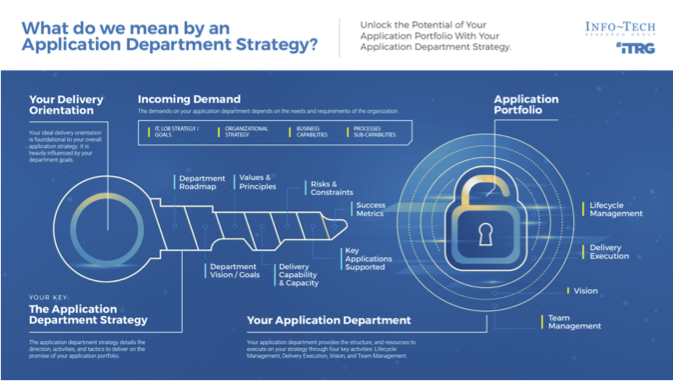
Your application department strategy is not just about the next thing to do. It is a balance of identity, priority, and goals. Without these, what you have is not a strategy but simply a plan to fulfill an order.
ARTICULATE YOUR APPLICATIONS INITIATIVES WITH A COMPELLING VALUE PROPOSITION
An application department strategy details the direction, activities, and tactics to deliver on the promise of your application portfolio. This includes a list of initiatives (and priorities) to achieve this goal.
So, why is an applications strategy important? It:
- Clearly illustrates the needs and requirements of your organization and its expectations for your applications department to meet these demands.
- Describes the ideal delivery orientation influencing your department goals.
- Defines the structure and resources needed to execute on your activities, including lifecycle management, delivery execution, vision, and team management.
FEATURED RESEARCH:
Build an Application Department Strategy
PRIORITY 01
Boost Solution Delivery With AI
Embed key delivery activities with mature and proven AI capabilities.
Signals
Your delivery teams must be able to deliver solutions with good throughput. However, this is easier said than done.
Throughput has been and will continue to be the success factor of all solution delivery teams. Teams are expected to deliver high-value, high-quality features, fixes, and updates quickly and continuously. However, there are turbulent headwinds getting in their way. Exponential technologies, democratized IT, and security vulnerabilities are just a few disruptors rendering the status quo outdated. Enter AI as a solution to navigate, workaround, and overcome the various delivery complications.
AI presents unique opportunities to address solution quality, value, and delivery speed challenges. For example, code generation can increase productivity, synthetic data generation can produce usable test data, and scanning tools can identify issues before they occur. However, many teams are unsure how they should structure and prepare themselves so they can gain the most value from AI (and other automation solutions) and achieve their throughput objectives.
AI IS NOW A FOCAL POINT IN SOLUTION DELIVERY
- AI is already integrated into solution delivery. 68% of professional developers are using AI tools at least weekly (Stack Overflow, 2025).
- Suggestions from AI are more trustworthy and insightful than before. 72% of respondents are comfortable asking AI to optimize application performance, 59% would support AI-driven application cost optimization, and 59% would rely on AI to mitigate zero-day vulnerabilities (F5, 2025).
- More teams are seeing measurable improvements when using AI tools. 68% of developers report a time savings of more than ten hours a week using generative AI (Gen AI) with significant gains for noncoding tasks (“The State of Developer Experience in 2025,” Atlassian, 2025).
AI presents unique opportunities to solve applications problems that matter
Top priorities for engineering solutions and tools over the next one to two years (2026-2027)
- Enhancing system reliability and security compliance
- Increasing automation and workflow efficiency
- Reducing operational costs and technical debt
- Improving scalability
- Enhancing developer productivity
- Modernizing legacy systems/infrastructure
- Expanding cloud-native capabilities
Source: Temporal, 2025; n=226
Introduce AI with proven and mature capabilities and tools
Code Assistance & Autocompletion
Features embedded in integrated development environments (IDE) that help developers write, troubleshoot, understand, and improve the quality of code.
Example: GitHub Copilot, Amazon CodeWhisperer, Gemini Code Assist
Test Case & Script Generation
Automatic writing and optimization of test cases and executable test scripts using user inputs (e.g. user stories, code) or lessons learned from past performances or user behaviors.
Example: Testim, Functionize, TestSonic
Document Generation
Structured and automated process of producing, maintaining, and managing documentation across the solution delivery process (e.g. release notes, metadata, inline comments).
Example: Qodo, PaceAI, Atlassian Confluence
Requirements Elicitation
Application of AI methods to automate, augment, and enhance the process of discovering, classifying, validating, and generating solution delivery requirements from various structured and unstructured sources.
Example: Visure AI, Modern Requirements, QVScribe
Process Mining & Modeling
The intelligent analysis, simulation, and illustration of business processes using AI to automatically discover, monitor, predict, and optimize workflows based on operational data, observations, and documents.
Example: mindzie, Celonis, UiPath
Implement AI on top of a strong delivery foundation
FEATURED RESEARCH:
Boost Solution Delivery Throughput With AI
Be Collaborative, Iterative, AND Quality- AND Value-Driven
The delivery process focuses on fostering teamwork, continuously improving, and delivering high-quality and valuable solutions aligned with stakeholder goals and nonfunctional standards.
Integrate AND Manage Your Delivery Toolchain
Seamless ecosystems of tools work together to improve the collaboration, efficiency, traceability, and overall quality across all solution delivery roles and phases. Tools are inventoried, rationalized, and continuously improved.
Align Stakeholders AND Manage Your Product Portfolio
All stakeholders are on the same page regarding priorities, goals, and outcomes while teams manage a suite of solutions that maximize business value delivery.
Embrace Team Experience, Culture, Coaching, AND Leadership
Teams are motivated to improve their productivity because the organization embraces an inclusive and satisfying work environment, leaders are inspiring and supporting, and guidance and upskilling is readily available.
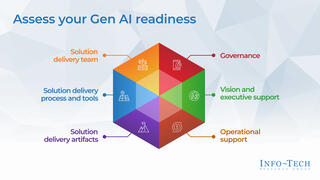
Prepare your teams for AI
-
DELIVERY TEAM
The team is educated on AI, its use cases, and the tools that enable it. They have the skills and capacity to implement, create, and manage AI. -
GOVERNANCE
Policies, role definitions, guidelines, and processes that guide the implementation, development, operations, and management of AI are defined and enforced. -
DELIVERY PROCESSES AND TEAMS
The solution delivery process is documented, repeatable, and optimized to use AI effectively. Delivery tools are configured to enable, leverage, and manage AI assets to improve their performance and efficiency. -
VISION AND EXECUTION SUPPORT
Everyone understands the alignment of AI direction, ambition, and objectives with broader business and IT priorities. Stakeholders support the AI initiative and allocate human and financial resources for its implementation within the solution delivery team. -
DELIVERY ARTIFACTS
Delivery artifacts (e.g. code, scripts, requirements) that will be used to train and be leveraged by AI are discoverable, accurate, complete, standardized, of sufficient quantity, optimized for AI use, and stored in an accessible, shared, and central repository. -
OPERATIONAL SUPPORT
Capabilities are available to manage AI tools and ensure they support the growing needs of the solution delivery practice, such as security management, hosting infrastructure, risk and change management, and data and application integration.
About Info-Tech
Info-Tech Research Group is the world’s fastest-growing information technology research and advisory company, proudly serving over 30,000 IT professionals.
We produce unbiased and highly relevant research to help CIOs and IT leaders make strategic, timely, and well-informed decisions. We partner closely with IT teams to provide everything they need, from actionable tools to analyst guidance, ensuring they deliver measurable results for their organizations.
What Is a Blueprint?
A blueprint is designed to be a roadmap, containing a methodology and the tools and templates you need to solve your IT problems.
Each blueprint can be accompanied by a Guided Implementation that provides you access to our world-class analysts to help you get through the project.
Talk to an Analyst
Our analyst calls are focused on helping our members use the research we produce, and our experts will guide you to successful project completion.
Book an Analyst Call on This Topic
You can start as early as tomorrow morning. Our analysts will explain the process during your first call.
Get Advice From a Subject Matter Expert
Each call will focus on explaining the material and helping you to plan your project, interpret and analyze the results of each project step, and set the direction for your next project step.
Unlock Sample ResearchContributors
- Monica Zapatka, Agile Product Owner, Cybersecurity, Travelers
- Sandy Minners, Senior Vice President, Client Engagement & Delivery, American Bankers Association
- Chaim Yudkowsky, SVP/CIO, American Israel Public Affairs Committee
- Kam Panchal, Head Enterprise Architect, Farm Mutual Re
- Scott Rutherford, Executive Vice President, Technology, LGM Financial Services Inc.
- Keith Fong, Senior Director, Applications Services, Simon Fraser University
- 1 Anonymous Contributor
 Applications Priorities 2025
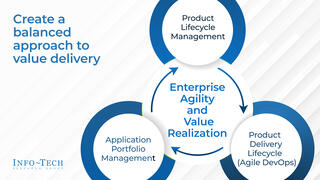 Rationalize Your Application Portfolio
 Extend Agile Practices Beyond IT
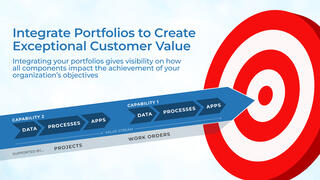 Integrate Portfolios to Create Exceptional Customer Value
 Automate Your Software Delivery Lifecycle
 Build Your BizDevOps Playbook
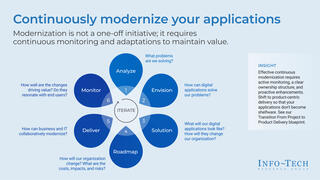 Modernize Your Applications
 Embrace Business-Managed Applications
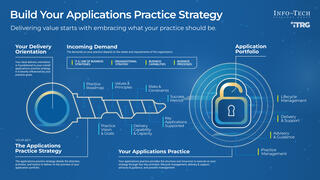 Build Your Applications Practice Strategy
 Review Your Application Strategy
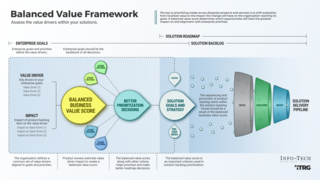 Assess the Value Drivers Within Your Solutions
 2020 Applications Priorities Report
 Applications Priorities 2022
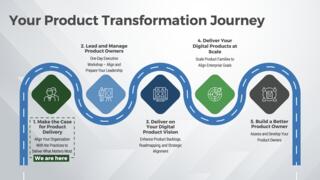 Make the Case for Product Delivery
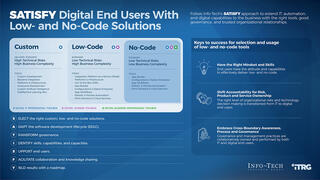 Satisfy Digital End Users With Low- and No-Code
 Select a Sourcing Partner for Your Development Team
 Applications Priorities 2023
 Make the Case for Enterprise Business Analysis
 Decide if You Are Ready for SAFe
 Adopt Generative AI in Solution Delivery
 Applications Priorities 2024
 Build Your Exponential IT Product Practice
 Insights Into Software Selection 2025
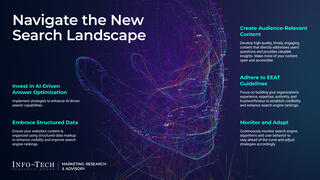 Stay Relevant in the Era of AI-Powered Search
 Transform IT, Transform Everything
 Building Info-Tech’s Chatbot
 Assessing the AI Ecosystem
 Building the Road to Governing Digital Intelligence
 Bring AI Out of the Shadows
 The AI Vendor Landscape in IT
 An Operational Framework for Rolling Out AI
 Applications Priorities 2026
 Develop a Plan to Overcome Your Microsoft Power Apps Challenges
