


Protect margins amid cost volatility
Get tailored support & continuous insights for Manufacturing - Non-Durable Goods. All included in your membership.
The Challenge
Thin margins are squeezed by input-cost inflation and price-sensitive shoppers.
Food and ingredient costs remain well above prepandemic levels while shoppers resist further price increases. Productivity gains have plateaued, leaving fewer easy levers to protect profitability.
Why It Matters
Cost discipline now decides who stays profitable.
McKinsey's "State of Food and Beverage" report finds US food prices were 31% higher through 2025 than in 2019, outpacing the 26% rise in overall CPI, while CPG gross margins remain below prepandemic levels (McKinsey, 2026). With productivity gains plateaued, protecting margin takes sharper cost and pricing discipline, not across-the-board price hikes.
The Solution
Build granular cost and margin visibility
Use should-cost models and net revenue analytics to see margin by SKU, channel, and customer.
Drive productivity and waste reduction
Reinvest savings from automation, network optimization, and waste reduction to fund growth.
Price with precision, not across the board
Use pack-price architecture and elasticity analysis to recover costs without driving volume away.




Build supply chain resilience
Get tailored support & continuous insights for Manufacturing - Non-Durable Goods. All included in your membership.
The Challenge
Supply chains remain exposed to disruption and cost shocks.
Ingredient shortages, tariffs, and logistics volatility threaten on-shelf availability and cost. A single disruption can trigger out-of-stocks that hand sales to competitors and private label goods.
Why It Matters
Resilient supply protects both revenue and shelf presence.
A 2026 KPMG survey of 462 supply chain executives found nearly three-quarters (73%) plan to transform their operating model within one to three years to boost resilience and agility, with supply chain spend climbing to 11%-15% of revenue ("U.S. Supply Chain Survey, May 2026," KPMG, 2026). For consumer goods, an out-of-stock is a lost sale and an open door to private label.
The Solution
Map and monitor the supply network
Gain visibility beyond Tier 1 and monitor ingredient and logistics risk continuously.
Diversify and regionalize sourcing
Qualify alternate suppliers and nearshore critical inputs to reduce single points of failure.
Protect on-shelf availability
Use risk-based inventory and retailer collaboration to keep products in stock through disruption.


Respond to demand shifts
Get tailored support & continuous insights for Manufacturing - Non-Durable Goods. All included in your membership.
The Challenge
Demand is shifting faster and less predictably than ever.
Customers trade down, switch suppliers, and split spend across channels, while order patterns swing with promotions and macro shocks. Plans built on last year's patterns leave manufacturers chasing demand instead of anticipating it.
Why It Matters
Anticipating unpredictable demand is now a core capability.
McKinsey's "State of the Consumer" report finds buyers increasingly unpredictable, trading down and switching as loyalty wavers (McKinsey, 2026). Manufacturers that sense and respond to demand shifts in near real time will capture the volume that catches slower rivals off guard.
The Solution
Stand up demand sensing
Combine point-of-sale, channel, order, and external signals to forecast closer to real demand.
Tighten integrated planning
Run integrated sales and operations planning so supply, inventory, and promotions move with demand.
Build agile response
Use fast test-and-learn cycles to adapt products, mix, and claims to shifting customer needs.



Increase operational agility
Get tailored support & continuous insights for Manufacturing - Non-Durable Goods. All included in your membership.
The Challenge
Rigid operations cannot flex with volatile demand and supply.
Legacy plants, manual processes, and siloed systems slow the response to demand swings, promotions, and disruptions. Inflexible operations drive both waste and missed sales.
Why It Matters
Agility turns volatility from a threat into an advantage.
Deloitte's "2026 Manufacturing Industry Outlook" points to continued smart-manufacturing investment as the path to greater competitiveness, agility, and resilience (Deloitte, 2026). Flexible, connected operations let consumer-goods makers absorb demand and supply swings without losing service or margin.
The Solution
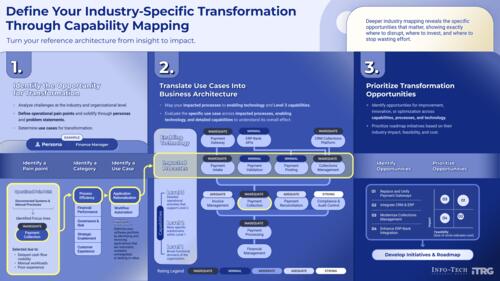
Invest in smart manufacturing
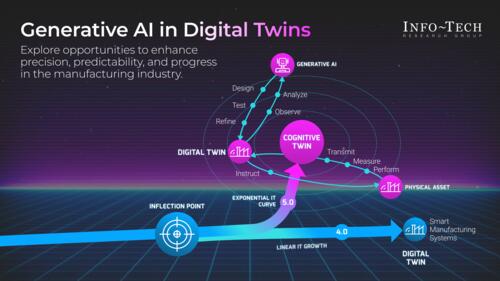
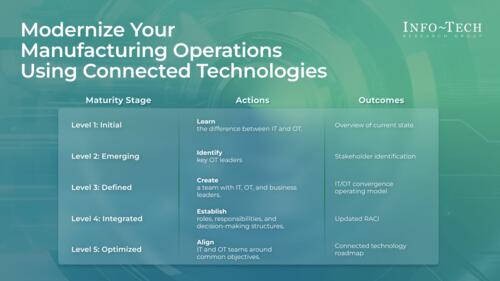
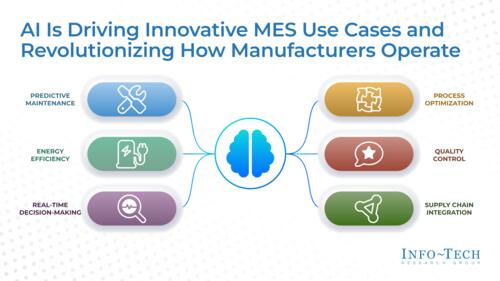
Deploy Internet of Things (IoT) sensors, manufacturing execution systems (MES), and analytics to make plants flexible and responsive.
Build flexible supply and capacity
Use co-manufacturing, modular lines, and postponement to flex with demand.
Connect planning across the network
Link demand, supply, and production so the network rebalances quickly when conditions change.


Enable production continuity
Get tailored support & continuous insights for Manufacturing - Non-Durable Goods. All included in your membership.
The Challenge
Unplanned downtime and disruption steal output the business cannot recover.
Aging equipment, reactive maintenance, and fragile lines cause unexpected stoppages that ripple into missed orders and higher costs. Every hour of lost production is volume and service that cannot be won back.
Why It Matters
Downtime is one of the costliest and most preventable losses in manufacturing.
A 2025 Fluke Reliability survey of more than 600 manufacturers found over half (55%) were hit by unplanned downtime in the past year, at an average cost of roughly $400,000 per hour and up to $207 million in weekly impact for US manufacturers ("Unplanned Downtime Costs United States Manufacturers up to $207M Weekly," Fluke Reliability, 2025). Protecting uptime, yield, and throughput directly protects revenue and customer service.
The Solution
Shift to predictive maintenance
Use Internet of Things (IoT) sensors and condition monitoring to detect equipment issues before they cause failures.
Raise overall equipment effectiveness (OEE)
Track availability, performance, and quality in real time to find and close the biggest losses.
Build disruption resilience
Use flexible capacity, spare-parts strategy, and rapid recovery plans so a single failure cannot stall the network.

Protect product quality and process integrity
Get tailored support & continuous insights for Manufacturing - Non-Durable Goods. All included in your membership.
The Challenge
Quality slips and process drift quietly erode margin and trust.
Manual checks, siloed quality systems, and inconsistent process control let defects, rework, and out-of-spec batches accumulate. In food, beverage, and consumer packaged goods, a single quality failure can trigger recalls, retailer penalties, and lasting brand damage.
Why It Matters
Poor quality surfaces fast, in public, and at scale.
The USDA's Food Safety and Inspection Service recall log shows a continuous stream of Class I recalls through 2026 for undeclared allergens and Listeria and Salmonella contamination, many traced to process and labeling failures on the line (USDA FSIS, 2026). A single quality failure can trigger recalls, retailer penalties, and lasting brand damage, so building quality and process integrity into operations protects both margin and the brand equity that is hardest to rebuild.
The Solution
Build quality into the process
Use statistical process control, in-line inspection, and automated data capture to catch drift before it becomes defects.
Digitize quality management
Replace paper and siloed systems with a connected quality management system (QMS) for full traceability and faster corrective action.
Standardize and control processes
Standardize recipes, procedures, and parameters across lines and sites so output stays consistent and audit-ready.
Strengthen OT cybersecurity and governance
Get tailored support & continuous insights for Manufacturing - Non-Durable Goods. All included in your membership.
The Challenge
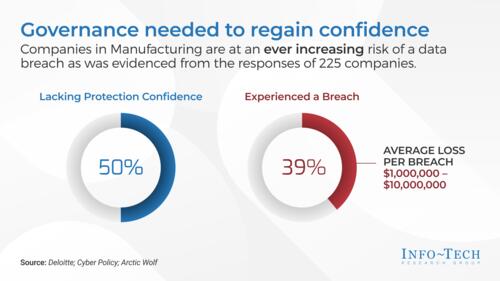
Connected operations have widened the OT attack surface.
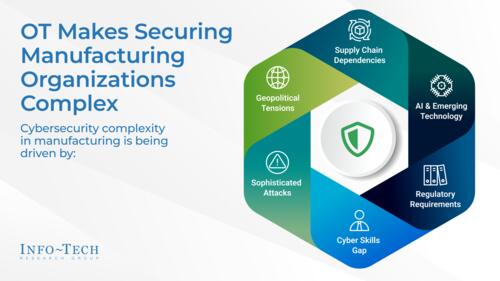
Converged IT/OT environments, connected plants, and partner integrations expose manufacturers to ransomware and process disruption. A single attack on operational technology can stop production lines and disrupt supply to major retailers.
Why It Matters
A cyberattack can halt production as fast as any plant failure.
IBM X-Force found manufacturing was the most-attacked industry for the fifth consecutive year, at 27.7% of incidents, with operational technology widening the attack surface (IBM X-Force, 2026). Governing OT security as core to operations, not an IT afterthought, is now essential to keeping products on the shelf.
The Solution
Govern IT and OT security together
Unify governance, segmentation, and monitoring across information technology and operational technology (OT) environments.
Secure plants and connected operations
Protect industrial control systems with segmentation, monitoring, and least-privilege access.
Build ransomware resilience
Maintain tested backups, multifactor authentication, and an incident response plan so an attack cannot stop supply.


Accelerate speed to market
Get tailored support & continuous insights for Manufacturing - Non-Durable Goods. All included in your membership.
The Challenge
Slow innovation cycles let disruptors win the growth pockets first.
Long development and commercialization timelines keep incumbents a step behind fast-moving challenger brands. By the time a trend is obvious, smaller players have already built scale and loyalty.
Why It Matters
Speed to market is where growth is won or lost.
McKinsey finds incumbents too often wait until growth pockets are obvious, by which point disruptors have already built scale, distribution, and loyalty ("State of Food and Beverage," McKinsey, 2026). The brands that commercialize faster will capture demand before competitors price it in.
The Solution
Shorten the innovation pipeline
Streamline stage gates and use AI in R&D to cut development and commercialization time.
Reallocate to growth pockets early
Shift capital, attention, and M&A toward emerging demand before it is fully priced in.
Scale winners fast
Build flexible manufacturing and launch playbooks to scale successful products quickly.


Advance sustainability and responsible operations
Get tailored support & continuous insights for Manufacturing - Non-Durable Goods. All included in your membership.
The Challenge
Consumers and regulators now demand proof of what is in products, where they come from, and how responsibly they are made.
Traceability mandates, sustainability expectations, and label scrutiny are rising across the industry. Manufacturers that cannot substantiate sourcing, safety, and sustainability claims risk losing trust, sales, and compliance.
Why It Matters
Transparency and sustainability are shifting from optional to mandatory.
A 2025 NielsenIQ survey found 74% of US consumers are more likely to buy food labeled climate-friendly, and in 2026 retailers such as Walmart are requiring suppliers to report climate and environmental data, even as the FDA's Food Safety Modernization Act (FSMA) Section 204 traceability mandate advances toward its 2028 compliance deadline ("Food Safety Compliance Changes," Amerisan, 2026).
The Solution
Build end-to-end traceability
Capture lot-level data across the supply chain to meet the FSMA Section 204 traceability madate and respond to requests within 24 hours.
Substantiate sustainability claims
Use auditable data on sourcing, materials, and emissions to back claims and meet disclosure rules.
Make transparency a brand asset
Share credible sourcing and sustainability information to build consumer and retailer trust.

Win with revenue growth management
Get tailored support & continuous insights for Manufacturing - Non-Durable Goods. All included in your membership.
The Challenge
Price increases alone no longer drive profitable growth.
After years of inflation-driven pricing, volume is stalling and shoppers are trading down to private label products. Without disciplined pricing, promotion, assortment, and trade-spend management, both growth and margin erode.
Why It Matters
Revenue growth management is the lever most consumer-goods makers underuse.
McKinsey finds inflation-adjusted growth for packaged foods fell to just 0.3% between 2023 and 2025, below population growth of roughly 1%, as consumers trade down and volume pressure becomes the defining force in the category ("Reigniting CPG Growth Through Portfolio M&A and Divestitures," McKinsey, 2026). With price-led growth exhausted, pulling all four RGM levers, pricing, promotion, assortment, and trade investment, is what protects both volume and margin.
The Solution
Pull all four RGM levers together
Manage pricing, promotion, assortment, and trade investment as one integrated system, not in silos.
Optimize trade promotion with analytics
Use post-event analytics to cut unprofitable promotions and reinvest in those that build the category.
Tailor pack-price architecture
Design price points and pack sizes for each channel and shopper to defend against private label products.

Comprehensive Manufacturing - Non-Durable Goods Industry Coverage


Testimonials
“What I love about Info-Tech is that I can actually apply it to my organization. The blueprints, research, and analysts all come together, and everyone on my team benefits.”
Bobbie Suhr, Director of IT, City Brewing Company
View Full Case Study
“It was a lot to take a small and disconnected IT organization and develop it into this centralized entity. Info-Tech helped me organize and validate my strategy."
Fred Donatucci, VP of IT, New-Indy Containerboard
View Full Case Study