
Assess and Prioritize Agentic AI Use Cases in Manufacturing
Embed decision intelligence into systems to drive real-time, closed-loop execution.
Manufacturers are being pushed toward autonomous outcomes without the operational foundations to support them. Most manufacturing environments remain fragmented across systems and processes.
Agentic AI is being evaluated as a capability, when it should be evaluated at the level of decisions. Current discourse treats agentic AI as something to deploy across functions, rather than something to apply selectively based on the nature of specific decisions.
The value of agentic AI is easy to demonstrate in isolation but difficult to prove at the system level. This makes it difficult for CIOs to translate promising pilots into board-level business cases, as value depends not only on model performance but also on the coherence of the entire operating system.
Our Advice
Critical Insight
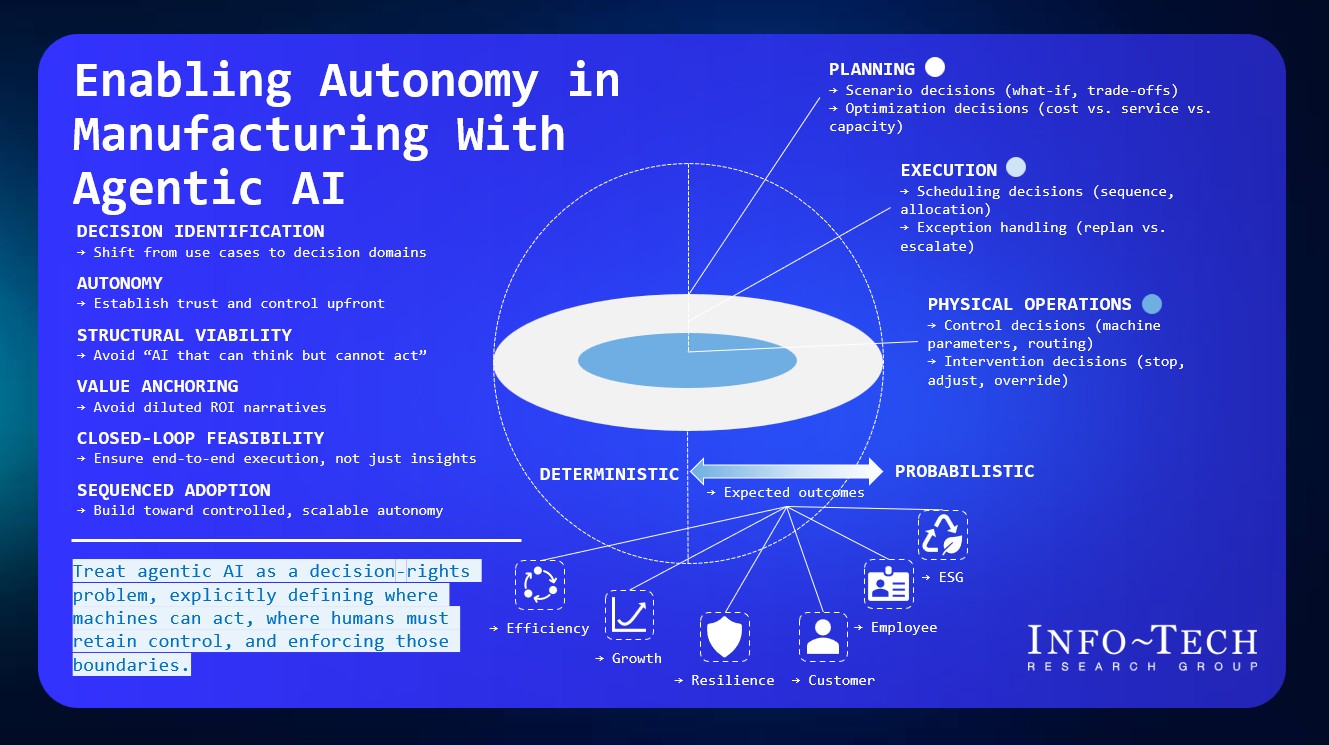
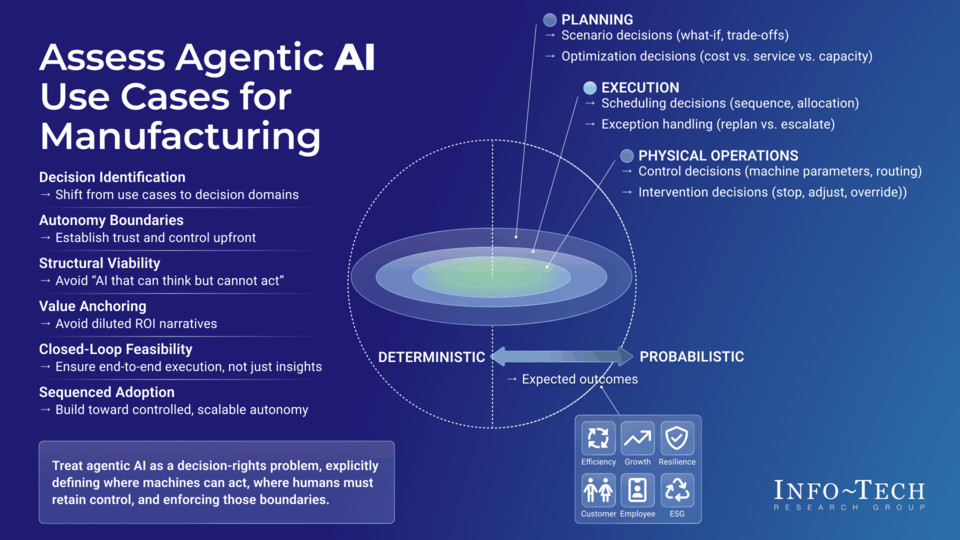
CIOs should treat agentic AI as a decision-rights problem, explicitly defining where machines can act and where humans must retain control, and enforcing those boundaries before scaling autonomy across manufacturing.
Impact and Result
- Start where decisions are structured and operationally contained before expanding autonomy. Agentic AI should not be introduced where decisions are complex, high-risk, or deeply interdependent across the value chain.
- Measure success based on decision reliability under variability.
- Strengthen the decision execution layer so that insights can translate into coordinated action. Improving data quality alone is insufficient if decisions cannot be executed consistently across systems.
- Define control boundaries explicitly before allowing agents to operate within workflows.
Assess and Prioritize Agentic AI Use Cases in Manufacturing
Embed decision intelligence into systems to drive real-time, closed-loop execution.
Analyst perspective
Embed decision intelligence into systems to drive real-time, closed-loop execution.
Manufacturers have spent the last decade digitizing operations, instrumenting assets, and deploying advanced analytics to improve visibility and efficiency. These efforts have delivered incremental gains, but most organizations remain fundamentally constrained by the same limitation: decisions are still human mediated, delayed, and inconsistent. AI has improved how manufacturers see and analyze their operations, but it has not fundamentally changed how decisions are made or executed.
Fragmented data, siloed decision-making, and disconnected experimentation continue to prevent AI from becoming an enterprise capability rather than a series of isolated successes. The gap is the absence of a mechanism to act on intelligence in real time and at scale.
Agentic AI represents a fundamental shift in how this gap is addressed. In manufacturing, this means moving from dashboards and recommendations to systems that can dynamically adjust production schedules, trigger maintenance actions, rebalance inventory, or intervene in quality processes with minimal human intervention. Humans move from being the primary decision-makers in every instance to becoming supervisors of decision systems, defining constraints, validating outcomes, and intervening only when necessary. The result is a step-change in responsiveness, consistency, and scalability of operations. Agentic AI challenges existing operating models, governance structures, and the traditional boundaries between IT and operations. It requires organizations to rethink ownership of decisions, establish clear trust, and invest in architectures that support real-time execution, not just analysis.
For CIOs, this creates both urgency and opportunity. The urgency lies in the risk of falling behind competitors who are already embedding autonomous decisioning into their operations. The opportunity lies in leading a transformation that goes beyond incremental efficiency gains to fundamentally redefine how the organization operates.

Shreyas Shukla
Principal Research Director, Industry
Info-Tech Research Group
Executive summary
Your Challenge
Manufacturers are being pushed toward autonomous outcomes without the operational foundations to support them. Most manufacturing environments remain fragmented across systems and processes.
Agentic AI is being evaluated as a capability, when it should be evaluated at the level of decisions. Current discourse treats agentic AI as something to deploy across functions, rather than something to apply selectively based on the nature of specific decisions.
The value of agentic AI is easy to demonstrate in isolation but difficult to prove at system level. This makes it difficult for CIOs to translate promising pilots into board-level business cases.
Common Obstacles
Manufacturers lack a unified way to model and govern decisions across the value chain. Decision-making is fragmented not just across teams, but across time horizons, systems, and objectives.
System integration stops at visibility, not at coordinated action. Data flows between systems, but decisions do not. Execution still relies on human intervention to interpret insights and trigger actions.
Incentives and risk models discourage delegation of control to machines. Introducing autonomous decision-making redistributes control without clearly redistributing accountability. When something goes wrong, the organization defaults to human responsibility.
Info-Tech's Approach
Start where decisions are structured and operationally contained before expanding autonomy. Agentic AI should not be introduced where decisions are complex, high risk, or deeply interdependent across the value chain.
Measure success based on decision reliability under variability.
Strengthen the decision execution layer so that insights can translate into coordinated action. Improving data quality alone is insufficient if decisions cannot be executed consistently across systems.
Define control boundaries explicitly before allowing agents to operate within workflows.
Info-Tech Insight
CIOs should treat agentic AI as a decision-rights problem, explicitly defining where machines can act and where humans must retain control and enforcing those boundaries before scaling autonomy across manufacturing.
Your Challenge
Manufacturers are being pushed toward autonomous outcomes without the operational foundations to support them.
Most manufacturing environments remain fragmented across systems and processes, with inconsistent master data and limited real-time visibility. Agentic AI assumes a level of system coherence and data reliability that does not yet exist in many plants. As a result, autonomy is being explored on top of unstable foundations, where decisions are still reconciled manually and exceptions are handled through human coordination. CIOs are being forced to confront the underlying readiness of their entire digital and operational stack.
Agentic AI is being evaluated as a capability, when it should be evaluated at the level of decisions.
Current discourse treats agentic AI as something to deploy across functions, rather than something to apply selectively based on the nature of specific decisions. In manufacturing, decisions differ materially in structure, risk, and consequence. Some are repeatable, making them suitable for higher levels of autonomy, while others are context-heavy or compliance-sensitive and must remain under human control. Without a disciplined way to classify decisions, organizations default to inconsistent adoption patterns, over-automating in some areas and avoiding autonomy altogether in others.
The value of agentic AI is easy to demonstrate in isolation but difficult to prove at system level.
Agentic AI is often justified through scenarios such as self-optimizing production, autonomous supply chains, or dynamic disruption response. An autonomous decision made in one part of the value chain can create unintended consequences elsewhere, eroding the perceived benefit. This makes it difficult for CIOs to translate promising pilots into board-level business cases, as value depends not only on model performance but on the coherence of the entire operating system. Without a clear way to link autonomous decisions to measurable improvements in efficiency, resilience, or cost, agentic AI remains strategically interesting but operationally unproven.
Agentic AI is limited by how well the organization understands, governs, and connects the decisions that AI agents are expected to take. Until decision-making itself is structured, autonomy will amplify inconsistency rather than performance.
Common Obstacles
Manufacturers lack a unified way to model and govern decisions across the value chain.
Agentic AI forces organizations to define how decisions are made across planning, sourcing, production, and logistics. In most manufacturers, decision-making is fragmented not just across teams, but across time horizons, systems, and objectives. Planning optimizes for service levels, manufacturing for throughput, and procurement for cost, and each operates with different assumptions and constraints. There is no shared model that defines how these decisions should interact, trade off, or escalate. Without this, autonomy cannot be consistently applied because there is no single "decision system" to embed it into.
System integration stops at visibility, not at coordinated action.
Over the past decade, most manufacturers have invested in integrating systems to improve reporting, dashboards, and visibility. However, these integrations are largely observational, not operational. Data flows between systems, but decisions do not. Execution still relies on human intervention to interpret insights and trigger actions across ERP, MES, and plant systems. Agentic AI requires the opposite: tightly coupled loops where insights can directly drive coordinated actions across multiple systems in near real time. The gap between "seeing" and "acting" is therefore the real obstacle. CIOs may have invested heavily in integration, but that integration is insufficient for autonomy because it was never designed to support synchronized, system-level execution.
Incentives and risk models discourage delegation of control to machines.
Even where technical feasibility exists, organizations struggle to operationalize agentic AI because accountability and incentives are still designed around human decision-making. Plant managers are measured on uptime and output stability, procurement leaders on cost control, and quality teams on compliance adherence. Introducing autonomous decision-making redistributes control without clearly redistributing accountability. When something goes wrong, the organization defaults to human responsibility, creating a natural resistance to delegating authority to systems. This is not simply a cultural issue; it is embedded in performance management, risk tolerance, and governance structures. For CIOs, this creates a hidden constraint where autonomy is technically possible but organizationally unacceptable, limiting deployment to low-risk scenarios regardless of potential value.
Manufacturing operating models are built for human judgment, not autonomous execution; agentic AI becomes viable only when decision logic, system integration, and accountability are explicitly structured for machines to act.
Info-Tech's Approach
Start where decisions are structured and operationally contained before expanding autonomy.
Agentic AI should not be introduced where decisions are complex, high risk, or deeply interdependent across the value chain. Instead, CIOs should begin in areas such as production planning adjustments, inventory positioning, or maintenance scheduling, where decision logic is relatively well understood and the impact of errors is localized and reversible.
Measure success based on decision reliability under variability.
In manufacturing, performance is defined less by optimization during stable conditions and more by how well the system responds to disruption. Agentic AI must therefore be evaluated on its ability to maintain performance under variability such as demand volatility, supply constraints, equipment failures, or process deviations. An agent that improves scheduling efficiency under ideal conditions but behaves unpredictably during a line stoppage or material shortage introduces risk rather than value.
Strengthen the decision execution layer so that insights can translate into coordinated action.
Improving data quality alone is insufficient if decisions cannot be executed consistently across systems. CIOs need to focus on connecting planning, execution, and control layers so that decisions made by agents can propagate reliably without manual intervention. Without this, agents may generate valid decisions that cannot be acted upon cleanly, leading to breakdowns between intent and execution.
Define control boundaries explicitly before allowing agents to operate within workflows.
Autonomy in manufacturing must operate within clearly defined limits. CIOs should establish in advance where agents are allowed to act independently, where human validation is required, and under what conditions control must revert back to operators. Without these limits, autonomy introduces ambiguity rather than efficiency, making it difficult to trust, govern, or scale.
CIOs should evaluate agentic AI by which areas their current operating environment can reliably absorb and control agentic AI without introducing instability.
Info-Tech's methodology for adopting agentic AI for manufacturing workflows
| 1. Establish familiarity | 2. Understand criteria | 3. Evaluate use cases | 4. Define value | 5. Prioritize deployment | |
|---|---|---|---|---|---|
| Phase Steps |
|
|
|
|
|
| Phase Outcomes | Gain a shared understanding of agentic AI and where it could create value in the organization. Align on the organization's value chain, the six value drivers, and the concept of agent autonomy. This creates a common vocabulary and ensures that all stakeholders evaluate opportunities through the same operational and strategic lens. | Gain clarity on how use cases will be evaluated and prioritized. Understand the scoring logic used in the tool, including how business impact and implementation feasibility are assessed. This ensures that use case evaluation is structured, comparable, and grounded in consistent criteria rather than subjective opinions. | Shortlist realistic agentic AI opportunities. Identify candidate use cases across the organization's value stream and narrow them to a manageable evaluation set. The result is a curated list of opportunities that reflect real operational challenges and are suitable for structured prioritization. | Translate each use case into a clearly defined agent concept with measurable value. Assign value drivers, autonomy levels, and operational roles to each use case. This step ensures that opportunities are no longer abstract ideas but clearly defined agent capabilities with identifiable value and implementation characteristics. | Establish a prioritized roadmap of agentic AI initiatives. Map use cases on the impact versus feasibility matrix and identify the most practical starting points for deployment. The result is a phased implementation roadmap that balances value creation with organizational readiness and operational risk. |
Each step of this blueprint is accompanied by supporting deliverables to help you accomplish your goals.
Agentic AI Use Case Selection Tool for Manufacturing
The tool helps CIOs evaluate where agentic AI should be applied across core transportation and logistics operations.
By systematically evaluating operational value, risk exposure, and governance readiness, the tool enables CIOs to identify where autonomy is appropriate, where it should remain constrained, and how adoption should be sequenced across the enterprise.
You get:
- A ready-to-use list of high-value AI use cases to support roadmap design, funding discussions, and implementation planning.
Outcomes
Gain a clear view of which use cases should be explored first.
Justify where autonomy should be introduced and where it must remain constrained due to safety, regulatory, or operational considerations.
Produce a practical sequence of pilots and deployments that align autonomy initiatives with your operational priorities and governance requirements.
Blueprint benefits
| IT Benefits | Business Benefits |
|---|---|
|
|
Insight summary
CIOs should treat agentic AI as a decision-rights problem, explicitly defining where machines can act, where humans must retain control, and enforcing those areas before scaling autonomy across manufacturing.
Autonomy introduces a redistribution of control that cannot be left implicit. Without clearly defined authority and limits, organizations risk creating ambiguity in execution and accountability, which ultimately undermines trust and adoption.
Embed decision intelligence into systems to drive real-time, closed-loop execution.
Agentic AI is limited by how well the organization understands, governs, and connects the decisions that AI agents are expected to take. Until decision-making itself is structured, autonomy will amplify inconsistency rather than performance.
Disconnected priorities and uncoordinated actions across functions often go unnoticed in human-led environments but become immediately visible when automated. Structuring how outcomes are aligned is therefore essential to ensuring consistent system behavior.
Manufacturing operating models are built for human judgment, not autonomous execution; agentic AI becomes viable only when decision logic, system integration, and accountability are explicitly structured for machines to act.
What appears seamless at a high level is often held together by human interpretation and intervention at the edges. Making autonomy viable requires translating this implicit coordination into explicit, system-driven mechanisms.
CIOs should evaluate agentic AI by which areas their current operating environment can reliably absorb and control agentic AI without introducing instability.
Not all parts of the enterprise are equally prepared to handle autonomous behavior. Identifying where conditions already support predictable execution allows organizations to progress with confidence while avoiding unintended disruption.
Measure the value of this blueprint
How can you measure the value of following Info-Tech's approach?
The average IT consulting rate in the United States is $100 to $250 per hour (MOR, 2026).
The cost and effort involved in undertaking an AI use case selection and prioritization exercise varies depending on the size and scope of the project. The average price of a well-designed and executed AI use case selection exercise ranges from US$24,000 to US$40,000 at the lower end (assuming a two-member team charging the hourly average of US$100).
The average IT consulting rate in the United States is $100 to $250 per hour (MOR, 2026).
The cost and effort involved in undertaking an AI use case selection and prioritization exercise varies depending on the size and scope of the project. The average price of a well-designed and executed AI use case selection exercise ranges from US$24,000 to US$40,000 at the lower end (assuming a two-member team charging the hourly average of US$100).
| With Info-Tech Resources | Without Info-Tech Resources | |||
|---|---|---|---|---|
| Project Steps | Time | Average Cost (USD) | Time | |
| 1 | Establish familiarity | 0.5 day | $3,000-$4,000 | 0.5 week |
| 2 | Understand criteria | 0.5 day | $3,000-$4,000 | 0.5 week |
| 3 | Evaluate use cases | 1 day | $6,000-$8,000 | 1 week |
| 4 | Define value | 1 day | $6,000-$8,000 | 1 week |
| 5 | Prioritize deployment | 1 day | $6,000-$8,000 | 1 week |
| Effort | < than 7 business days | $24,000-$40,000 | 4 weeks |
This blueprint will accelerate your agentic AI use case prioritization exercise.
We include all the guidance, tools, and templates you need to implement this program successfully.
Reach out to advisory services for assistance as you work through the blueprint or request a workshop engagement and let us do the heavy lifting.
Recommended workshop participants
| Day 1 | Day 2 | Day 3 | |
|---|---|---|---|
| CIO | ✔ | ✔ | |
| COO | ✔ | ✔ | ✔ |
| CDO/CTO | ✔ | ✔ | |
| Enterprise Architecture Lead | ✔ | ✔ | |
| Head of Operations/Operations Leads | ✔ | ✔ | ✔ |
| Customer Service Leads | ✔ | ✔ | |
| Planning Leads | ✔ | ✔ | |
| Safety and Risk Management Leads | ✔ | ✔ | ✔ |
| Regulatory/Compliance Officer | ✔ | ✔ | ✔ |
| Cybersecurity Lead | ✔ | ||
| Data & Analytics Lead | ✔ | ||
| IT Platform Owners | ✔ | ✔ | ✔ |
| Finance/Business Planning Lead | ✔ | ✔ | ✔ |
| Strategy/Corporate Development Lead | ✔ | ✔ | ✔ |
| PMO | ✔ | ✔ | |
| Transformation Lead | ✔ | ✔ |
Before you proceed with the activities prescribed in the rest of this blueprint, do this…
1 Download the accompanying Agentic AI Use Case Selection Tool for Manufacturing.
Download the Agentic AI Use Case Tool for Manufacturing
2 Review related research for definitions and explanations on what agentic AI is, its maturity progression, common failure patterns, and everything else you need to get closer to implementing your first agentic AI pilot.
Download the Design Your Agentic AI Prototype blueprint
3 Review the key considerations section on how to effectively govern the use case selection process while keeping focus on structurally viable use case applications.
Govern Selection
Ensure Structural Viability
Many "agentic AI" claims are overstated
Let's look at some often-quoted agentic AI case studies and evaluate their claims.
| Organization | Description | Claim | Verdict | |
|---|---|---|---|---|
 | Industrial Copilot used at Siemens' Erlangen facility to translate machine error codes and recommend fixes | Assists operators with recommendations and guidance during operations1 | Not Agentic | No autonomous decision-making or execution, human remains decision authority. |
 | Autonomous robotics and AI-driven visual inspection in manufacturing plants | Detects defects and automatically classifies and routes parts2 | Agentic | Structured decisions with clear thresholds and direct system execution. |
 | Autonomous robotics for factory automation | Executes predefined tasks autonomously within tightly controlled environments2 | Partially Agentic | Agentic, but limited to localized, task-level decisions. |
 | Predictive maintenance and industrial monitoring in aviation manufacturing | Predicts failures and alerts teams to take maintenance actions2 | Partially Agentic | Insight generation only – actions are not consistently system-triggered. |
Sources:
1 – "From the Back …", Zero100 via LinkedIn, 2025
2 – "Agentic AI in…", Tredence, 2025
A step-by-step reality check
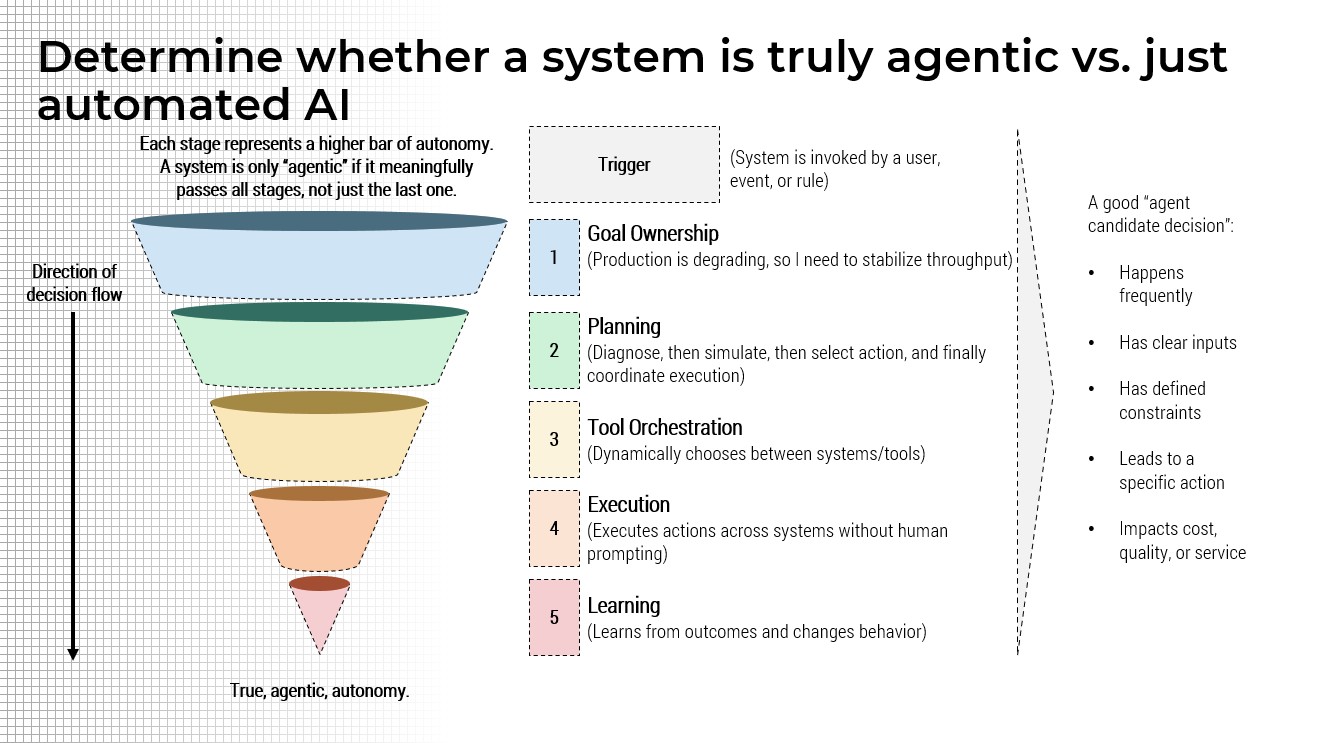
What is being labeled as agentic AI today is largely a combination of retrieval-augmented generation, workflow orchestration, and advanced automation, not true autonomous agents.
| Stage | Question | Common Failure Patterns | What "True Agentic" Requires |
|---|---|---|---|
| Goal Ownership | Does the system define or refine goals? | All systems are triggered by humans or predefined objectives | Self-directed objectives, not user-triggered tasks |
| Planning | Does it break goals into multistep plans? | No dynamic decomposition of problems | Dynamic task decomposition |
| Tool Orchestration | Does it select and use tools autonomously? | At best, routing between prebuilt tools | Cross-system decisioning, not pre-wired flows |
| Execution | Does it act independently across workflows? | Works only within tightly engineered workflows | Minimal human triggering |
| Learning & Adaptation | Does it improve behavior over time autonomously? | Improvements require human intervention | Closed-loop learning with feedback |
CIOs must ensure that agentic AI use cases are safe, controllable, and structurally viable before prioritizing value
Before evaluating business impact or feasibility, organizations must first determine whether a use case is structurally appropriate for agentic AI within a manufacturing environment. This step ensures that operational realities, safety constraints, and system dependencies are accounted for before any economic prioritization occurs.
Safety Criticality
- Does the use case impact human safety or asset integrity?
- Would an incorrect decision result in injury, damage, or regulatory breach?
High safety exposure requires human-in-the-loop or constrained autonomy.
Regulatory Sensitivity
- Is the process governed by strict regulatory, audit, or compliance requirements?
- Are decisions subject to traceability, explainability, or approval mandates?
High regulatory exposure limits full autonomy and requires audit controls.
Operational Centrality
- Is the use case part of core operational flow?
- Would failure disrupt primary service delivery or network performance?
Core operations require higher control and staged autonomy adoption.
Interdependency and Cascade Potential
- Does the use case interact with multiple systems, workflows, or downstream decisions?
- Can errors propagate across operational, network, customer, or financial systems?
High interdependency increases the need for coordination controls and supervision.
Reversibility and Containment
- Can decisions be easily reversed or corrected without downstream impact?
- Is there a clear mechanism to contain failures before they spread?
Low reversibility requires restricted autonomy and stronger guardrails.
Info-Tech Insight
High value does not justify high risk in manufacturing environments.
Even high-impact use cases must be constrained if they operate in safety-critical, highly regulated, or tightly coupled systems.
CIOs must ensure that they govern agentic AI use case selection and eventually adoption effectively
The primary outcome of this research is improved decision quality and execution readiness for agentic AI adoption. Manufacturing CIOs and executive teams should see measurable improvements in how use cases are defined, evaluated, governed, and sequenced, resulting in fewer failed pilots and more scalable deployments.
These metrics collectively measure three things:
- Decision quality (Are we choosing the right use cases?)
- Execution readiness (Are we ready to implement them?)
- Outcome realization (Are we actually getting value?)
This ensures the research is not just about identifying AI opportunities, but about enabling disciplined, scalable adoption of agentic AI in manufacturing.
| Metric | Specific | Measurable | Achievable | Relevant | Time |
|---|---|---|---|---|---|
| Time to AI Investment Decision | Reduce time from use case identification to executive decision | Days from submission to approval | Achievable through structured framework and tool usage | Improves decision velocity and reduces analysis paralysis | Reduce by 30% within 6 months |
| Use Case Definition Completeness | Ensure each use case has value driver, autonomy level, and agent role defined | % of use cases fully specified | Achievable via structured tool workflow | Ensures ideas are implementation-ready | Reach >85% completeness within first workshop cycle |
| Executive Alignment Score | Improve agreement across IT, operations, and compliance on prioritization decisions | % alignment in scoring and prioritization workshops | Achievable through shared framework and facilitated sessions | Reduces decision friction and rework | Achieve >80% alignment per workshop within 3 months |
| Reduction in Low Value Pilots | Decrease number of pilots launched without clear value or feasibility | % reduction in pilots rejected post-launch | Achievable through structured screening and scoring | Prevents wasted investment and effort | Reduce by 40% within 9 months |
| Autonomy Classification Coverage | Ensure all evaluated use cases have defined autonomy levels | % of use cases classified (assistive, guided, conditional, autonomous) | Achievable via mandatory tool fields | Improves governance and deployment clarity | Achieve 100% classification within 1 evaluation cycle |
| Feasibility Risk Identification Rate | Identify technical and operational risks before pilot launch | % of use cases with documented risks and dependencies | Achievable via feasibility scoring framework | Prevents downstream implementation failure | Achieve >90% coverage within first 3 months |
| Time to Pilot Launch | Reduce time from prioritization to pilot initiation | Days from prioritization to pilot start | Achievable through better definition and readiness | Improves execution speed and momentum | Reduce by 25% within 6 months |
| Pilot Success Rate | Increase % of pilots progressing to production deployment | % of pilots scaled vs. initiated | Achievable through better use case selection | Indicates quality of prioritization and design | Improve by 20% within 12 months |
| Operational Impact Realization | Ensure deployed use cases deliver expected value | % of use cases meeting defined KPIs | Achievable through better upfront evaluation | Links AI investments to business outcomes | Achieve >75% realization within 12 months of deployment |
| Governance Readiness Coverage | Ensure use cases have defined controls, escalation paths, and accountability | % of use cases with governance model defined | Achievable via structured design steps | Critical for safe agentic AI deployment | Achieve >90% coverage before pilot launch |
Many organizations are already seeing hard benefits from deployment of agentic AI solutions
| Company | Description | Benefits |
|---|---|---|
 | Apollo's AI agents enables real-time root cause analysis and process optimization thus improve curing process efficiency. 1 |
|
 | Ocado's solution demonstrates how multiagent AI systems can coordinate physical robots at scale, with each agent having specific goals.2 |
|
 | Coupa's system demonstrates how agentic AI can operate across organizational areas, interfacing with both internal systems and external supplier networks to create a continuously optimizing procurement function. 2 |
|
 | Blue Yonder's system operates as a hierarchy of specialized agents, with strategic agents setting inventory targets and tactical agents executing replenishment orders, all while continuously learning from outcomes. 2 |
|
 | reMarkable implemented AI agents to reduce manual workload, automate support, unify systems, and enable scalable service operations. 3 |
|
These examples share several characteristics that contribute to their success:
- Complex problems are broken down between specialized agents.
- Humans set parameters, review unusual cases, and approve major decisions.
- Systems improve over time through reinforcement learning.
- AI agents interface with multiple systems, both internal and external.
- Clear financial and operational benefits that justify the implementation costs.
Sources:
1 – "How Apollo Tyres…", AWS, 2025
2 - "Everything You... ", Kanerika Inc. via Medium, 2025
3 –"reMarkable makes..., SalesForce, n.d.
About Info-Tech
Info-Tech Research Group is the world’s fastest-growing information technology research and advisory company, proudly serving over 30,000 IT professionals.
We produce unbiased and highly relevant research to help CIOs and IT leaders make strategic, timely, and well-informed decisions. We partner closely with IT teams to provide everything they need, from actionable tools to analyst guidance, ensuring they deliver measurable results for their organizations.
What Is a Blueprint?
A blueprint is designed to be a roadmap, containing a methodology and the tools and templates you need to solve your IT problems.
Each blueprint can be accompanied by a Guided Implementation that provides you access to our world-class analysts to help you get through the project.
Need Extra Help?
Speak With An Analyst
Get the help you need in this 5-phase advisory process. You'll receive multiple touchpoints with our researchers, all included in your membership.
Guided Implementation 1: Establish familiarity
- Call 1: Review the capability map/value stream map.
- Call 2: Identify domains where agentic AI may create value.
Guided Implementation 2: Understand criteria
- Call 1: Understand agentic AI use cases across value stream domains.
- Call 2: Define the decision boundaries and expected operational outcomes.
Guided Implementation 3: Evaluate use cases
- Call 1: Evaluate fitment & risk scenarios.
Guided Implementation 4: Define value
- Call 1: Estimate value for each use case using metrics.
Guided Implementation 5: Prioritize deployment
- Call 1: Prioritize use cases by balancing value, risk, and readiness.
- Call 2: Develop a sequenced adoption roadmap.
Contributors
- Chulanga Perera, Head of IT, Global CPG Company
- Kartik Ramdoss, Customer Success Manager, Global SaaS Company
- Steven Schmidt, Sr. Managing Partner, Info-Tech Research Group
- Craig Broussard, Senior Executive Counselor, Info-Tech Research Group
- 2 anonymous contributors
