Design and Sustain a Purposeful IT Culture
Improve your culture and enable your strategy.
Book This Workshop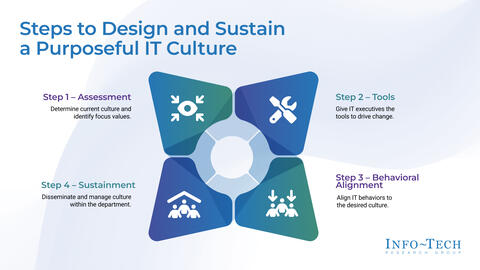
Inconsistent cultures that are not intentional or are organically-grown often:
- Become weak and ineffective.
- Lead to misaligned decisions, practices, policies, and processes that disengage employees and negatively impact business metrics.
- Result in high expenses related to things that don’t matter to employees.
- Promote a poor reputation in the market, which is costly and time consuming to change.
- Cause poor employee commitment, leading to employees not making decisions in the best interest of the organization.
Designing and sustaining a purposeful culture can:
- Drive employee engagement. Culture has the second greatest impact on employee engagement out of all other engagement drivers.
- Attract and retain the right people.
- Provide a good foundation for building interesting and impactful onboarding programs.
- Fuel employee performance and productivity.
- Increase retention rates. Culture has the second greatest correlation with employee intent to stay.
Book Your Workshop
Onsite Workshops offer an easy way to accelerate your project. If you are unable to do the project yourself, and a Guided Implementation isn’t enough, we offer low-cost onsite delivery of our Project Workshops. We take you through every phase of your project and ensure that you have a road map in place to complete your project successfully.
Book NowModule 1: Conduct a Cultural Assessment
The Purpose
Determine current culture and identify focus values.
Key Benefits Achieved
- Completed a cultural assessment that shows the current state of culture in your IT department.
- Selected several focus values that will form the core of your culture efforts over the next year.
- Clarified accountability and responsibilities for culture within the IT executive team.
| Activities: | Outputs: | |
|---|---|---|
| 1.1 | Collect quantitative and qualitative data on organizational values. |
|
| 1.2 | Analyze and consolidate data. |
|
Module 2: Define the Culture Through Focus Values
The Purpose
Give IT executives the tools to drive change.
Key Benefits Achieved
- Enabled executives to gather feedback on how their behavior is perceived.
- Provided support for behavioral change, either through individual coaching, a group discussion, or both.
| Activities: | Outputs: | |
|---|---|---|
| 2.1 | Identify why culture is a priority. |
|
| 2.2 | Connect the organizational goals to culture. |
|
| 2.3 | Describe the future. |
|
| 2.4 | Review cultural assessment data. |
|
| 2.5 | Pinpoint values to leverage or shift. |
|
| 2.6 | Craft the culture statement. |
|
| 2.7 | Set goals and metrics for the culture initiative. |
|
Module 3: Reflect and Prepare to Implement
The Purpose
Align IT behaviors to the desired culture.
Key Benefits Achieved
- Reviewed all areas of the department to understand where the links to culture exist.
- Created a communication plan to guide the changes to behavior going forward.
| Activities: | Outputs: | |
|---|---|---|
| 3.1 | Executive reflection. |
|
| 3.2 | Anticipate challenges ahead. |
|
| 3.3 | Examine leadership behaviors and IT practices. |
|
| 3.4 | Review leadership and core competencies. |
|
| 3.5 | Draft a timeline. |
|
| 3.6 | Determine key messages for communication. |
|
| 3.7 | Customize the Culture Facilitation Guide for Leaders. |
|
Module 4: Communicate & Action Plan
The Purpose
Disseminate and manage culture within the department.
Key Benefits Achieved
- Customized a process to infuse behaviors aligned with the focus values into daily work practices.
- Completed the first wave of meetings to execute this process with senior leaders.
| Activities: | Outputs: | |
|---|---|---|
| 4.1 | Develop a communication plan. |
|
| 4.2 | Create an implementation roadmap. |
|