
Prioritize and Implement Construction Robotics to Support Your Workforce
Redefine the future jobsite.
- The construction industry has an aging workforce creating a labor shortage, making it challenging to scale and complete projects
- The construction industry operates on thin margins and unaligned investments leads to limited return on investments and costly missteps
- Robotics in construction is a growing and large market, making it challenging to navigate the landscape and decide which solutions will give the greatest benefit to the organization.
Our Advice
Critical Insight
Robotics have proven they can perform onsite. The next challenge is strategic: integrating the right machines for your organization, with your people, to eliminate inefficiencies and unlock new growth.
Impact and Result
Info-Tech’s human-centric, value-based approach is a guide for selecting and prioritizing robotics use cases:
- Leverage a construction-specific business reference architecture to identify organization-aligned robotics use cases.
- Ensure your organization is ready for change from implementing new robotics solutions.
- Select and prioritize robotics use cases across industry value drivers while understanding the execution implications.
Prioritize and Implement Construction Robotics to Support Your Workforce
Redefining the future jobsite.
Analyst Perspective
Redefine the future jobsite.

The construction industry is entering a transformative phase by entering into more automated ecosystems through the use of robotics. Robotics are rapidly emerging as a practical solution to some of the industry’s more persistent challenges. From labor shortages to decreasing productivity, increasing project complexity, and growing safety and sustainability concerns, robotics helps mend those gaps. This evolution is compelling, due to not just the technology itself but how it redefines the art of what is possible within the construction industry.
This opportunity extends beyond operational efficiency gains. Robotics offers a new solution to rethink how work is performed, how data is captured, and how companies create value. Each robot deployed, regardless of where within a project, becomes a data-generating asset. This data can assist your company in finding insights into your operations to make analytical-based decisions.
The excitement is future looking, but the firms that invest now in understanding their capabilities, looking into robotics use cases, and building a foundation for organizational readiness will be positioned for success and capturing an early advantage. Position your company to support your workforce, not replace them, and explore the art of what is possible to define your competitive edge for the future.
Michael Adams
Senior Research Analyst
Info-Tech Research Group
Executive summary
Your Challenge
- The construction industry has an aging workforce creating a labor shortage, making it challenging to scale and complete projects.
- The construction industry operates on thin margins, and unaligned investments can lead to limited return on investments and costly missteps.
- Robotics in construction is a growing and large market, making it challenging to navigate the landscape and decide which solutions will give the greatest benefit to the organization.
Common Obstacles
Business stakeholders need to cut through the hype surrounding robotics to ensure their investments can drive business value for the firm. The key barriers to success include:
- Lack of new employees, and resistance to change among active employees.
- Fragmented decision-making across departments, which makes it challenging to outline most critical business outcomes.
- Limited knowledge on integration requirements or interoperability when deciding which solutions will fit the company’s needs.
Solution
Info-Tech’s human-centric, value-based approach is a guide for selecting and prioritizing robotics use cases:
- Leverage a construction-specific business reference architecture to identify organization-aligned robotics use cases.
- Ensure your organization is ready for change from implementing new robotics solutions.
- Select and prioritize robotics use cases across industry value drivers while understanding the execution implications.
Info-Tech Insight:
Robotics have proven they can perform onsite. The next challenge is strategic: integrating the right machines for your organization, with your people, to eliminate inefficiencies and unlock new growth.
Your challenge
Transform your operations with business-aligned robotics solutions.
- The construction industry is facing a labor shortage due to the aging workforce. It is expected that 245,100 current workers in the sector will retire within the next decade (Canada Foundation for Innovation, 2025). The labor shortage leads to less productivity and longer project schedules, which must be addressed to assist in scaling operations.
- Construction companies have thin profit margins, at an average of approximately 6% (Autodesk, 2025). With low profit margins comes hesitancy to invest in new technologies. Construction companies need to ensure investments will yield measurable results, so they may remain profitable.
- There are a ton of new, exciting technologies emerging in the construction robotics market. The market is projected to grow by 15.50% CAGR from 2025 to 2030, to a market size of US$909.53 (Mordor Intelligence, 2025). As the hype continues to grow, companies need to carefully analyze the market to find the solutions most suitable for their organization.
Common obstacles
Why your robotics projects stall out.
- Fragmented decision-making prevents organizations from selecting robotics solutions that are strategically aligned and measurable in business impact.
- Contractor optimism for robotics jumped to over 95%, yet actual active jobsite use is only at 46% (Construction Owners, 2025). Construction professionals are excited about robots, but due to the oversaturated vendor landscape and unclear evaluation criteria there is decision paralysis and uncertainty in ROI.
- Low organizational readiness and cultural resistance undermine field adoption and long-term value realization.
- Sixty-one percent of companies reported that even when a business case was found for robotics, they lacked the internal capability to pull it off (“The Robotics Revolution,” McKinsey & Company, 2025). Weak governance and inconsistent training prevent successful pilots from scaling enterprise-wide.
Recommended approach
Proceed with confidence.
- Use a capability map to gather a holistic view of your organization, and understand where there are shortcomings in your operations to define key areas for improvement.
- Generate a robotics use-case library to grasp the potential solutions available and match these solutions to your organizational pain points.
- Assess organizational readiness to ensure your organization is ready for change from new robotics solutions.
- Select and prioritize robotics use cases across industry value drivers while understanding the execution implications.
“I’m confident we’ll see a lot more robots in construction: within 10 years, sites will be anywhere between 10-50% automated. I don’t think it’s a challenging market if you have the right business model. This isn’t asteroid mining, where you need 50 assumptions to make something work.”
– Firat Ileri, Partner, Hummingbird Ventures
qtd. by Sifted Reports and Leonard, 2025
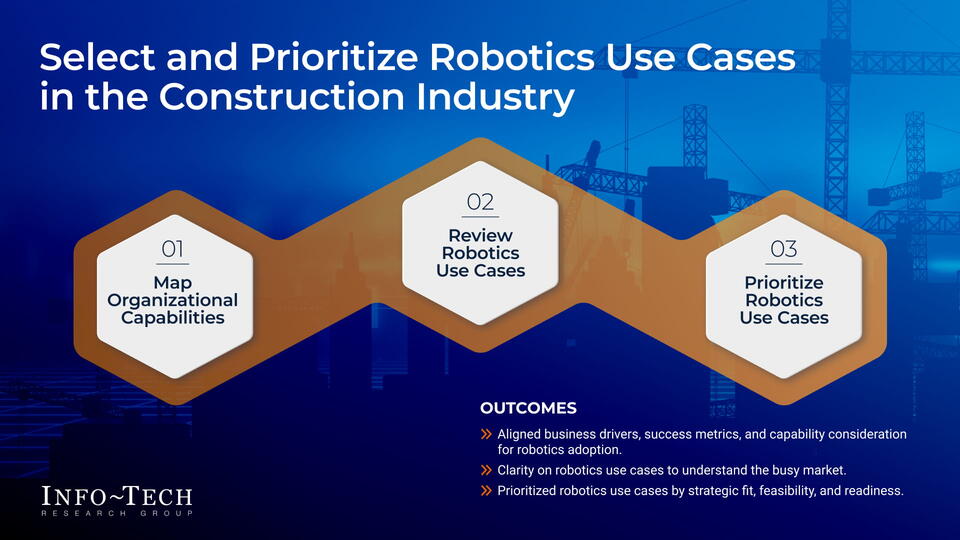
Select and Prioritize Robotics Use Cases in the Construction Industry
1. Map Capabilities
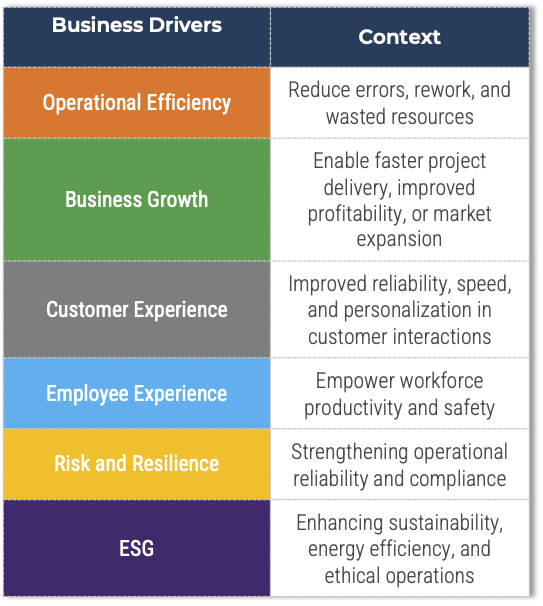
Analyze organizational capability map, define pain points, and create business initiatives through assessing business drivers, opportunities, and challenges.
2. Review Robotics Use Cases
Connect your organizational pain points to real-life robotics use cases that can support your workforce and innovate your operations.
Aligned Robotics Use Cases
Robotics are here to revolutionize construction. But excitement without evaluation turns innovation into expense. True value will be found when capabilities and investment move in sync.
3. Prioritize Robotics Use Cases
Prioritize your robotics use cases based on feasibility, readiness, and fit to ensure success through measurable results.
Challenges
- Construction firms face mounting pressure from labor shortages, rising costs, and growing project complexity.
- Unaligned investments cause costly missteps that erode margins and delay timelines.
- Robotics adoption is rising, but identifying the most impactful solutions remains difficult.
- Internal stakeholder conflict hinders robotics implementation.
Outcomes
- Aligned business drivers, success metrics, and capability consideration for robotics adoption.
- Clarity on robotics use cases to understand the busy market.
- Prioritized robotics use cases by strategic fit, feasibility, and readiness.
Measure the value of this blueprint
Leverage this blueprint’s approach to ensure your robotics use cases align with and support your key business drivers and speed time to value.
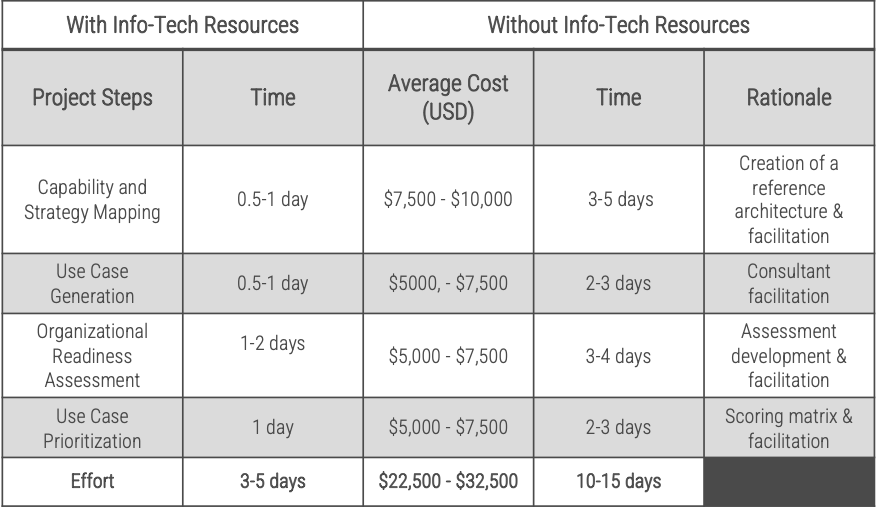
Info-Tech offers various levels of support to best suit your needs
DIY Toolkit
"Our team has already made this critical project a priority, and we have the time and capability, but some guidance along the way would be helpful."
Guided Implementation
"Our team knows that we need to fix a process, but we need assistance to determine where to focus. Some check-ins along the way would help keep us on track."
Workshop
"We need to hit the ground running and get this project kicked off immediately. Our team has the ability to take this over once we get a framework and strategy in place."
Consulting
"Our team does not have the time or the knowledge to take this project on. We need assistance through the entirety of this project."
Diagnostics and consistent frameworks are used throughout all four options.
Guided Implementation
What does a typical GI on this topic look like?
Phase 1
|
Phase 2
|
Phase 3
|
A Guided Implementation (GI) is a series of calls with an Info-Tech analyst to help implement our best practices in your organization.
A typical GI is between 10 to 12 calls over the course of 2 to 3 months.
About Info-Tech
Info-Tech Research Group is the world’s fastest-growing information technology research and advisory company, proudly serving over 30,000 IT professionals.
We produce unbiased and highly relevant research to help CIOs and IT leaders make strategic, timely, and well-informed decisions. We partner closely with IT teams to provide everything they need, from actionable tools to analyst guidance, ensuring they deliver measurable results for their organizations.
What Is a Blueprint?
A blueprint is designed to be a roadmap, containing a methodology and the tools and templates you need to solve your IT problems.
Each blueprint can be accompanied by a Guided Implementation that provides you access to our world-class analysts to help you get through the project.
Need Extra Help?
Speak With An Analyst
Get the help you need in this 3-phase advisory process. You'll receive multiple touchpoints with our researchers, all included in your membership.
Guided Implementation 1: Identify and Frame Challenges
- Call 1: Scope requirements, objectives, and your specific challenges.
- Call 2: Assess the organization’s current state through capability map.
- Call 3: Establish goals and creation of business initiatives.
Guided Implementation 2: Translate Needs Into Use Cases
- Call 1: Review and revise robotics use cases that your organization is interested in.
- Call 2: Match robotics use cases to capability-driven pain points.
Guided Implementation 3: Prioritize Robotics Use Cases
- Call 1: Assess short- and long-term needs.
- Call 2: Prioritize robotics use cases.
Contributors
- Steve Schmidt, Info-Tech, Managing Partner
- Donn Griffin, Info-Tech, Executive Counselor
- Hank Leingang, Info-Tech, Executive Counselor
- Shreyas Shulka, Info-Tech, Principal Research Director
- 1 anonymous
