Our systems detected an issue with your IP. If you think this is an error please submit your concerns via our contact form.
Implement Agile Practices That Work
Agile is a cultural shift. Don't just do Agile, be Agile.
- Many Agile implementations fail due to the lack of experience and understanding of what Agile really is, and the problems it is trying to solve. When these projects fail, Agile often gets blamed for it.
- The lack of management support, inflexible organizational culture, resistance from team members, and insufficient training are some of the biggest contributors to failed Agile practices.
Our Advice
Critical Insight
- Agile is first and foremost a cultural shift. Culture is often the biggest challenge to Agile implementation. Don’t take this as a sign that Agile is failing. Instead, consider it a lesson to bring forward improvement opportunities.
- The Agile mindset must be created at every level of the organization. A top-down approach to Agile implementations often leads to failure.
- Don’t let your organization get carried away with the hype around Agile. The quantitative benefits of Agile are not realized by most organizations due to immature implementation and adoption of Agile principles and practices.
Impact and Result
- Educate and train your executive, management, and delivery teams to adopt Agile the right way.
- Assess your current software development lifecycle (SDLC), culture, and environment to evaluate Agile fit and determine what changes need to be implemented.
- Conduct a structured evaluation of Agile to assess and recognize the benefits of Agile in your organization and teams.
- Develop an iterative approach to rolling out Agile within your organization to fail fast and recover quickly.
Research & Tools
1. Implementing Agile Research – A step-by-step document that provides guidance on how to adopt the Agile culture, processes, metrics, and tools according to the dynamics and structure of your current development environment.
Development teams are under increasing pressure to accomplish more in less time with the same number of resources while remaining aligned to business priorities. They are looking to Agile to help them relieve this pressure but don't know where to start. This blueprint will help you tailor Agile development processes and guidelines to your context by following our three-phase methodology to facilitate learning about Agile at every layer of your organization, assess and prepare for Agile, and implement Agile with a structured evaluation.
2. Agile Playbook Template – A structured template that allows development teams to document the SDLC and their current state assessment. It also ensures teams and stakeholders are on the same page regarding the goals of the pilot project.
This template includes areas to define the development guidelines that your teams and organization should follow, discuss the SDLC and Agile process flow of your pilot project, and define the scope of the pilot project and the roles, risks, and costs involved.
3. Scrum Documentation Template – A template that allows development teams to document the user stories and Scrum board of their project using the Scrum process to ensure teams and stakeholders agree on the project's progress.
This template includes areas to document and plan your product and sprint backlog, track your daily points burndown, and assess your team's velocity.
Member Testimonials
After each Info-Tech experience, we ask our members to quantify the real-time savings, monetary impact, and project improvements our research helped them achieve. See our top member experiences for this blueprint and what our clients have to say.
Implement Agile Practices That Work
Agile is a cultural shift. Don't just do Agile, be Agile.
ANALYST PERSPECTIVE
"Agile is not a silver bullet that will magically fix what ails your organization. An Agilist who is not aware or realistic about the limitations of the organization they must work in will fail. The first step is to get real about the challenges of changing every aspect of how your organization works."
Cole Cioran,
Senior Director, Research, Application Delivery and Management
Info-Tech Research Group
Our understanding of the problem
This Research Is Designed For:
- Executives who need to evaluate the potential benefits Agile practices have for their organization.
- Application development managers who are looking for ways to optimize the value and efficiency of their development practices.
- Current or future Agile practitioners and enthusiasts who wish to understand Agile principles, methodologies, and its adaptability.
This Research Will Help You:
- Gain an understanding of Agile practices and how to adopt them successfully.
- Assess your current environment to determine where Agile can fit.
- Determine the right pilot for a structured evaluation of Agile.
- Identify and engage the relevant stakeholders on your Agile transformation journey.
This Research Will Also Assist:
- CIOs who are weighing the benefits and costs associated with implementing an Agile practice.
- Managers who are evaluating cultural shifts, organizational redesign, product development process changes, and customer impact.
This Research Will Help Them:
- Determine the value and benefits of adopting Agile.
- Evaluate the changes that need to be implemented to help Agile be a success in their environment.
Executive summary
Situation
- Many organizations have heard of Agile and the benefits it promises to software development practices; however, they fail to see the industry hype around the benefits it promises.
- Many delivery teams try and fail at “doing” and “being” Agile without proper training and education on what Agile is.
Complication
- Many Agile implementations fail due to a lack of experience and not understanding what Agile really is and the problems it is trying to solve. When these projects fail, Agile often gets blamed for it.
- A lack of management support, inflexible organizational culture, resistance from team members, and insufficient training are some of the biggest contributors to failed Agile practices.
Resolution
- Educate and train your executive, management, and delivery teams to adopt Agile the right way.
- Assess your current software development lifecycle (SDLC), culture, and environment to evaluate Agile fit and determine what changes need to be implemented.
- Conduct a structured evaluation of Agile to assess and recognize the benefits of Agile in your organization and teams.
- Develop an iterative approach to rolling out Agile within your organization to fail fast and recover quickly.
Info-Tech Insight
- Agile is first and foremost a cultural shift. Culture is often the biggest challenge to Agile implementation. Don’t take this as a sign that Agile is failing. Instead, use it as a lesson to bring forward improvement opportunities.
- The Agile mindset must be created at every level of the organization. A top-down approach to Agile implementations often leads to failure.
- Don’t let your organization get carried away with the hype around Agile. The quantitative benefits of Agile are not realized by most organizations due to immature implementation and adoption of Agile principles and practices.
Agile’s four core values
We value. . .
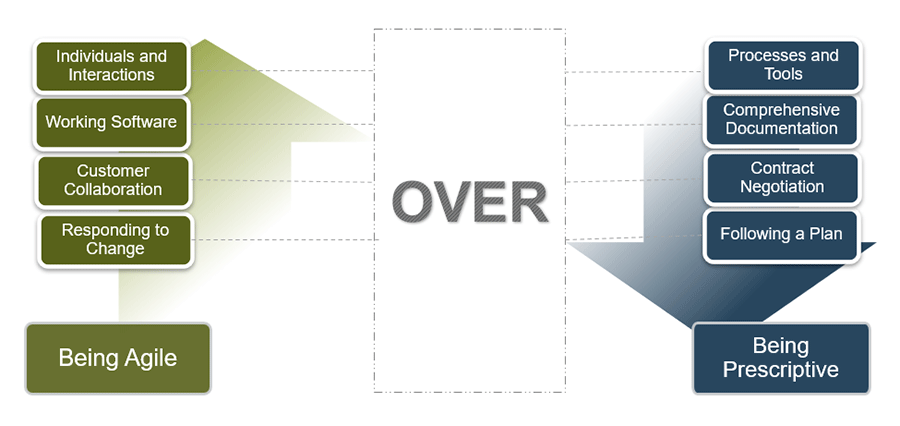
“…while there is value in the items on the right, we value the items on the left more.” – Source: “The Agile Manifesto”
Agile is not just something organizations do…
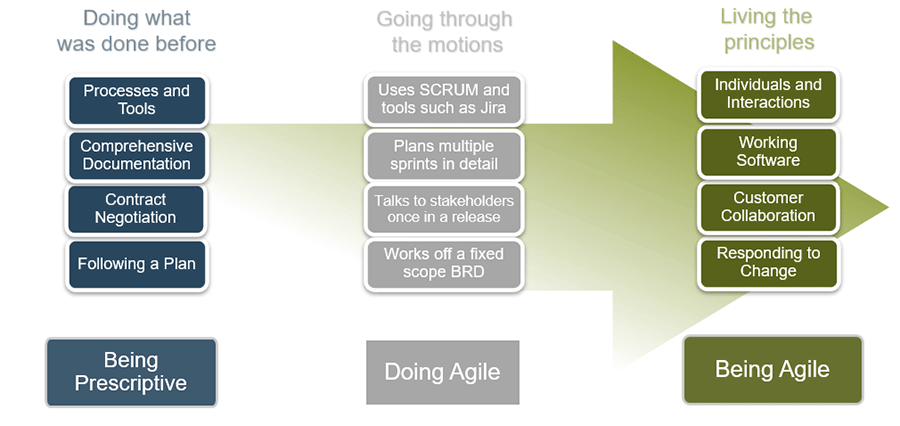
Agile brings a complete fundamental shift in the way teams, project managers, and stakeholders traditionally plan and execute development projects.
“[‘Doing’ Agile is] just some rituals but without significant change to support the real agile approach as end-to-end, business integration, value focus, and team empowerment.” – Arie van Bennekum
Understand the importance of building a minimum viable product (MVP)
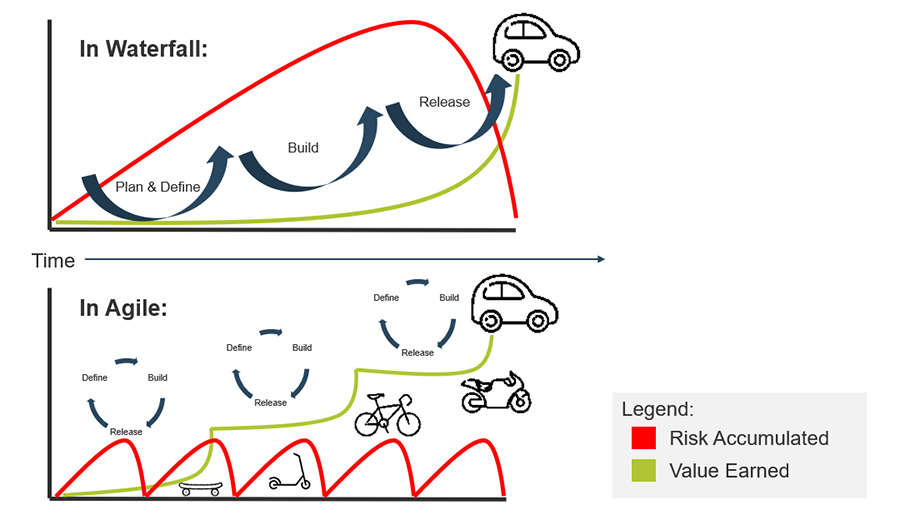
Most people compare Waterfall to Agile
"I believe in this concept, but the implementation described above is risky and invites failure." – Winston W. Royce
By delivering the product in smaller iterations, teams recognize value sooner and reduce accumulated risk. Both are realized as the iteration enters validation testing and release.
Source: “Managing the Development of Large Software Systems”
Recognize how Agile can minimize the risk accumulated and deliver value quicker
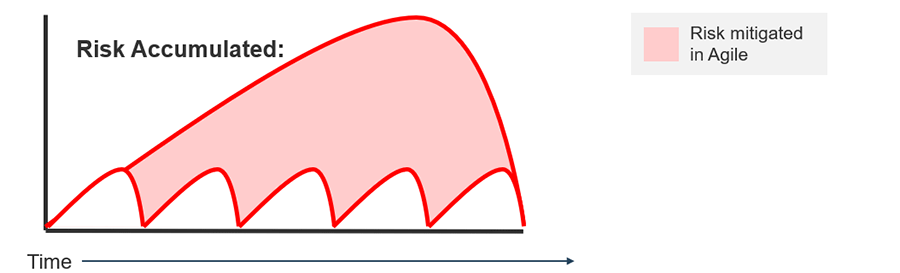
By delivering the product in smaller iterations, teams reduce the amount of risk that is accumulated over time, as they validate the accuracy with each iteration. The shaded area represents the risk mitigated by teams when they deliver with smaller iterations through Agile.
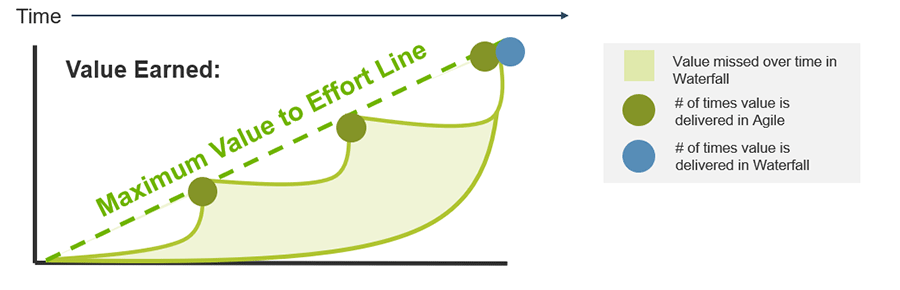
In an ideal world, teams could maximize effort expending to value received, which is represented as the green dotted line. With Agile, teams shorten the cycle and find more releases where they deliver earned value. The shaded area represents the value missed over time in a Waterfall world.
Understand the benefits provided by Agile and the requirements for successful implementation
The effectiveness of your delivery method will depend on how integrated you are with the business and how disciplined you are in the execution of the method.
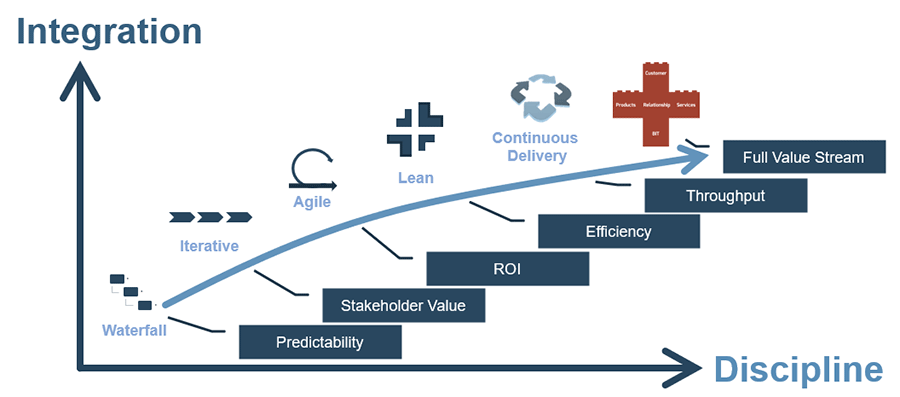
Source: Ambysoft, “2018 Project Success Survey Results”
Evaluate how to get started with an Agile SDLC
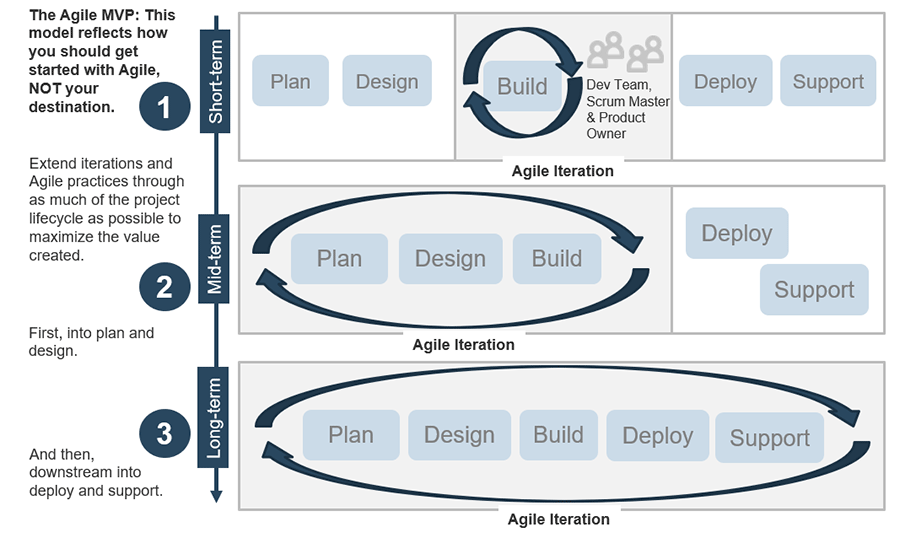
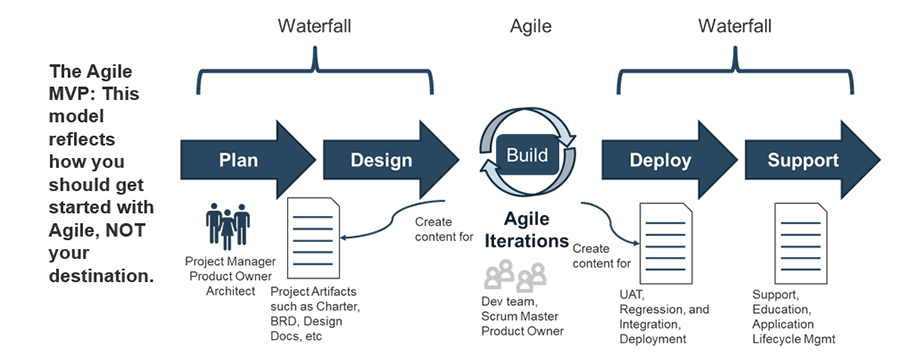
Understand how to inject Agile into your SDLC in the short term
Info-Tech research shows that starting small with Agile in the context of a project or operations team is a key to success. A hybrid “WaterAgileFall” is the best place to start.
Extend iterations and Agile practices through as much of the project lifecycle as possible to maximize the value created
First, into plan and design.
And then, downstream into deploy and support.
Follow Info-Tech’s approach to learn and scale up Agile in your organization
Product Focused
Transition to Product Delivery
Build a Product Roadmap and Build a Better Backlog
Delivery Focused
Implement Agile Practices That Work
Enable Organization-Wide Collaboration by Scaling Agile
Spread Best Practices With an Agile Center of Excellence
Development Focused
Structure Your DevOps Adoption Using a Metrics-Driven Approach
Make Development Teams Leaner and Improve Time-to-Release in Five Steps
Recognize how Agile fits into your organization whether you are a “product-based” or “project-based” shop
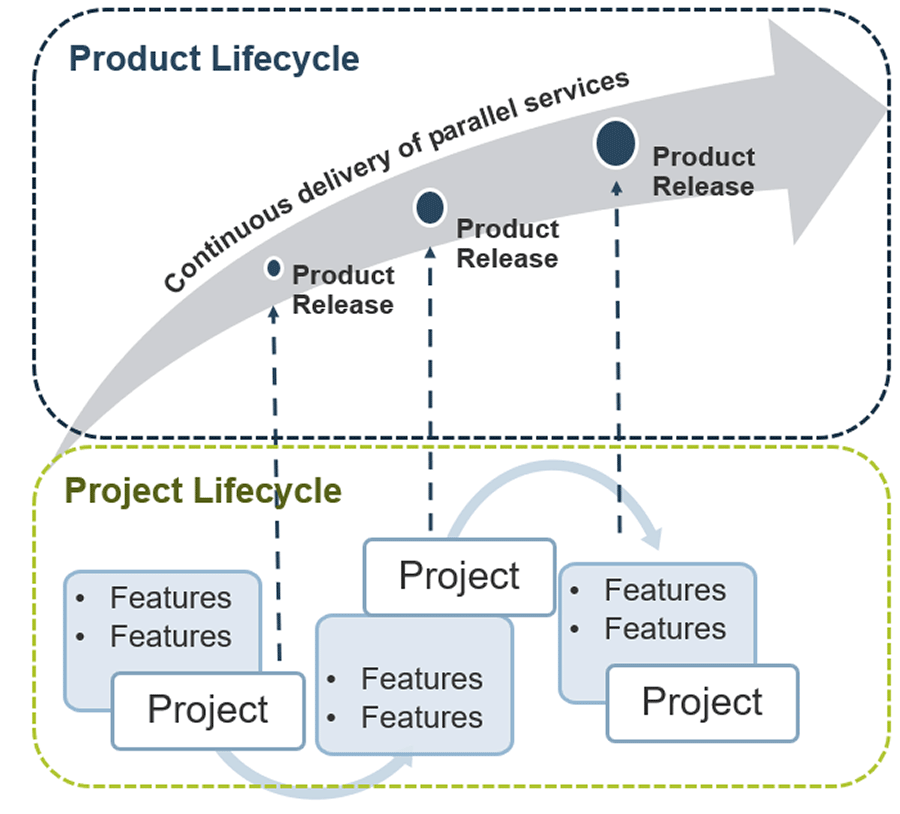
The Projects Within the Product
Regardless of whether you recognize yourself as a “product-based” or “project-based” shop, the same basic principles should apply. You go through a period or periods of project-like development to build a version of an application or product. You also have parallel services along with your project development, which encompass the more product-based view. These may range from basic support and maintenance to full-fledged strategy teams or services like sales and marketing. All apps can be considered products and all products have projects.
Not everything in “The Agile Manifesto” should be taken as gospel
Don’t take the manifesto too literally – it must align to the operations and workflow of your project teams and not increase the risk of project failure when unexpected situations occur. Therefore, recognize the redundancies, practices, and platitudes in the manifesto. There are five key principles that really matter and can’t be ignored.
PRINCIPLES OF THE AGILE MANIFESTO
- Our highest priority is to satisfy the customer through early and continuous delivery of valuable software.
- Welcome changing requirements, even late in development. Agile processes harness change for the customer's competitive advantage.
- Deliver working software frequently, from a couple of weeks to a couple of months, with a preference to the shorter timescale.
- Business people and developers must work together daily throughout the project.
- Build projects around motivated individuals. Give them the environment and support they need, and trust them to get the job done.
- The most efficient and effective method of conveying information to and within a development team is face-to-face conversation.
- Working software is the primary measure of progress.
- Agile processes promote sustainable development. The sponsors, developers, and users should be able to maintain a constant pace indefinitely.
- Continuous attention to technical excellence and good design enhances agility.
- Simplicity – the art of maximizing the amount of work not done – is essential.
- The best architectures, requirements, and designs emerge from self-organizing teams.
- At regular intervals, the team reflects on how to become more effective, then tunes and adjusts its behavior accordingly.
Sources: “The Agile Manifesto”; Agile! The Good, the Hype and the Ugly
Speed of delivery and productivity remain top drivers for Agile adoption
Benefits of Adopting Agile
By implementing Agile, respondents cited seeing improvement in the following areas:
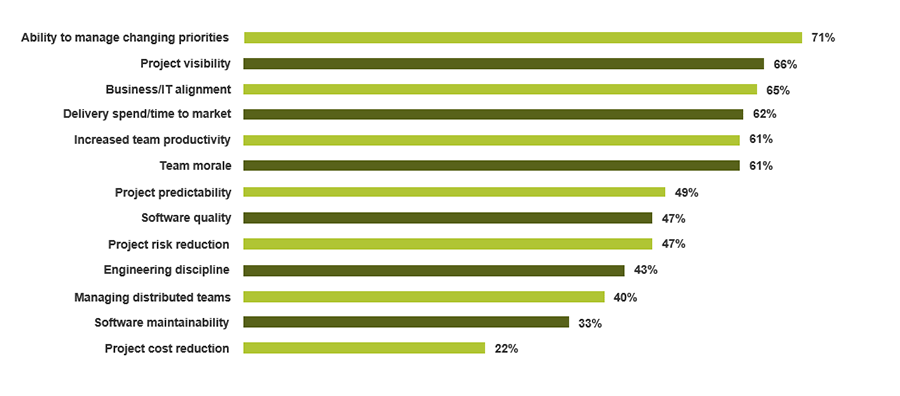
Adapted from: “12th Annual State of Agile Report"
The quantitative results of Agile are far from conclusive
Qualitatively
Every survey conducted by Agile consulting shops and tool vendors shows Agile feels more successful than traditional approaches.
"Based on the results of our recent agile quality study, expect agile software quality to exceed traditional method performance by a factor of from 6 to 12 percent in about three years."
– “Quantitative Analysis of Agile Methods Study (2017): Twelve Major Findings”
Quantitatively
The average Agile practice is no more productive than Waterfall.
"…some researchers argue that there is nothing new about agile methods…"
– “Empirical Studies of Agile Software Development: A Systematic Review”
"Agile isn’t necessarily better. Being involved in the process of throughput just feels better."
– “The 12 Stages Of The Agile Transformation Journey”
Info-Tech Insight
Don’t gauge the success of your Agile implementation based on speed and productivity alone. Prioritize the human benefits of a positive experience, trust, and resilience to become the partner your business needs you to be.
Why do organizations adopt Agile?
Traditional processes have their limitations
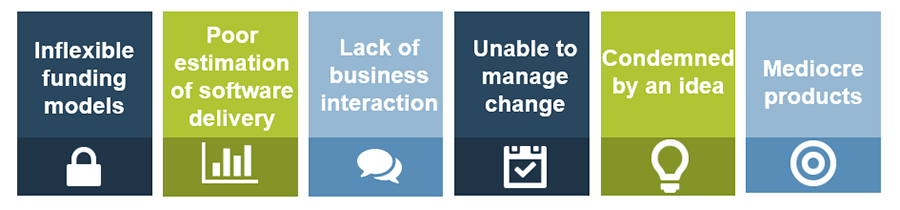
"Agile failure seems to be increasingly more prominent nowadays despite all the efforts undertaken by numerous organization[s] embarking on their journeys to become agile."
– Stefan Wolpers, “Agile Failure Patterns in Organizations 2.0”
So where do the problems start?
"Most IT funding depends on one-time expenditures or capital-funding mechanisms that are based on building construction-funding models predicated on a life expectancy of 20 years or more. Such models don’t provide the stability or flexibility needed for modern IT investments."
– “Aligning IT Funding Models to the Pace of Technology Change”
How do you fund projects today?
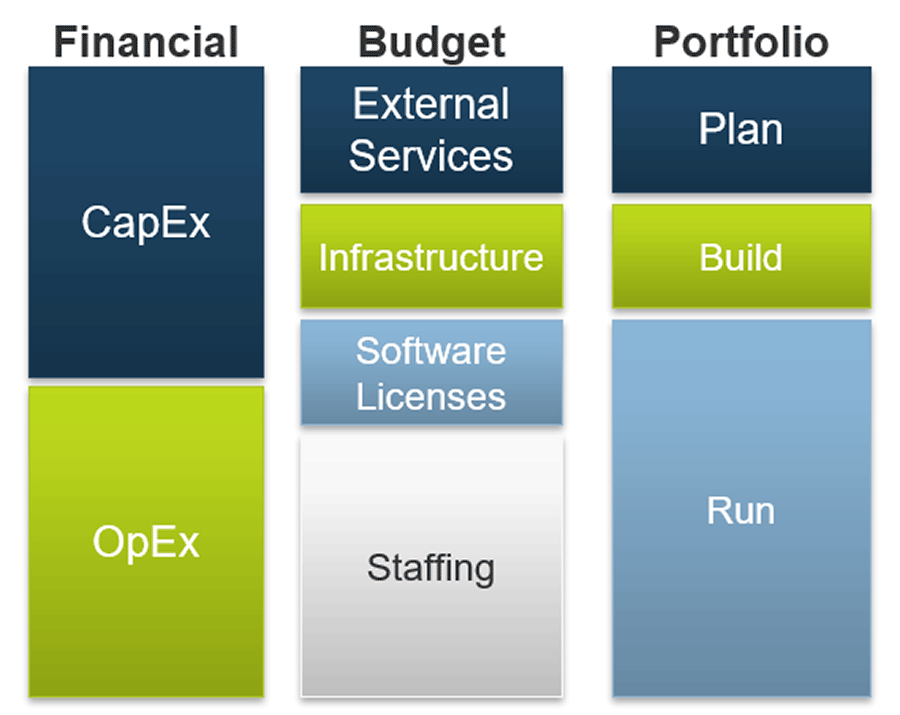
These models require increasing accuracy throughout the project lifecycle to manage actuals vs estimates.
Poor estimation leads to downstream issues in projects
In Waterfall, we frequently see models where increasing accuracy is required throughout the project lifecycle to manage actuals vs estimates.

"The average rough order of magnitude estimate for software is off by up to 400%"
– “Software Project Estimation Practices at CodeTiburon”
The reality is software estimation is more of dark art than a science. There is more to it than just implementing or developing the software.
Lack of business or IT stakeholder participation significantly reduces the success of Agile downstream
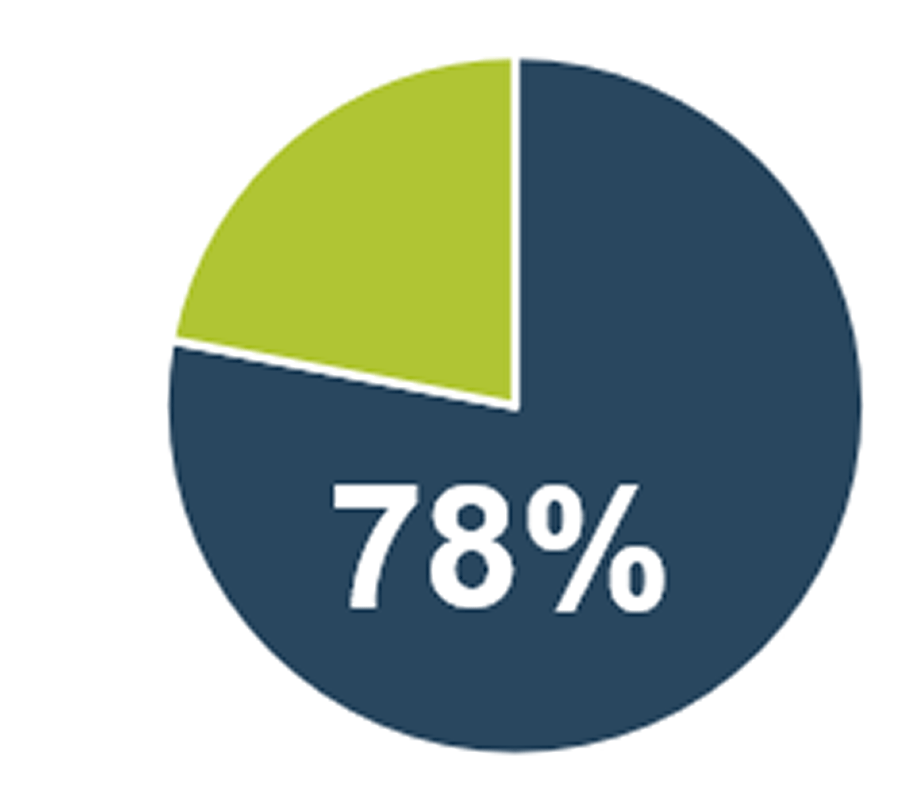
78% of IT professionals believe the business is “usually” or “always” out of sync with project requirements.
Source: “10 Ways Requirements Can Sabotage Your Projects Right From the Start”
Communication with the business does not happen on a regular basis throughout the development cycle which leads to final product delivery that does not meet business and/or customer expectations. This leads to further rework to attempt to meet expectations with a subsequent slow down in time-to-market delivery.
There are several factors that affect the nature and impact of stakeholder participation. Cater your strategies to engage different stakeholders based on these factors:
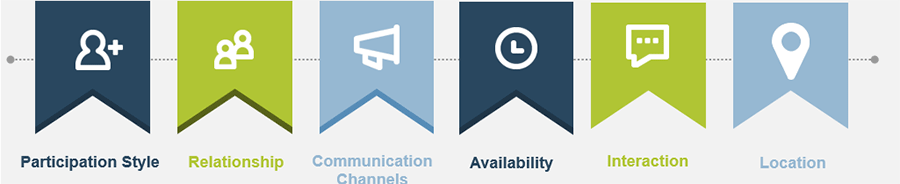
Source: “Active Stakeholder Participation: An Agile Core Practice”
Change is inevitable when it comes to business agility
However, traditional delivery processes work on the assumption that product requirements will remain constant throughout the SDLC. This results in delayed delivery of product enhancements which are critical to maintaining a positive customer experience.
Regardless,
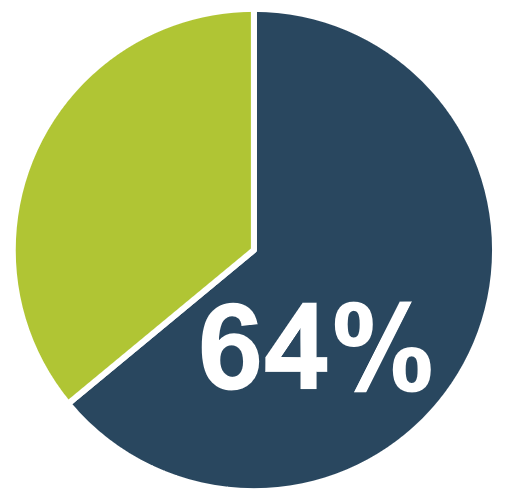
64% of IT professionals adopt Agile to enhance their ability to manage changing priorities.
Source: “12th Annual State of Agile Report”
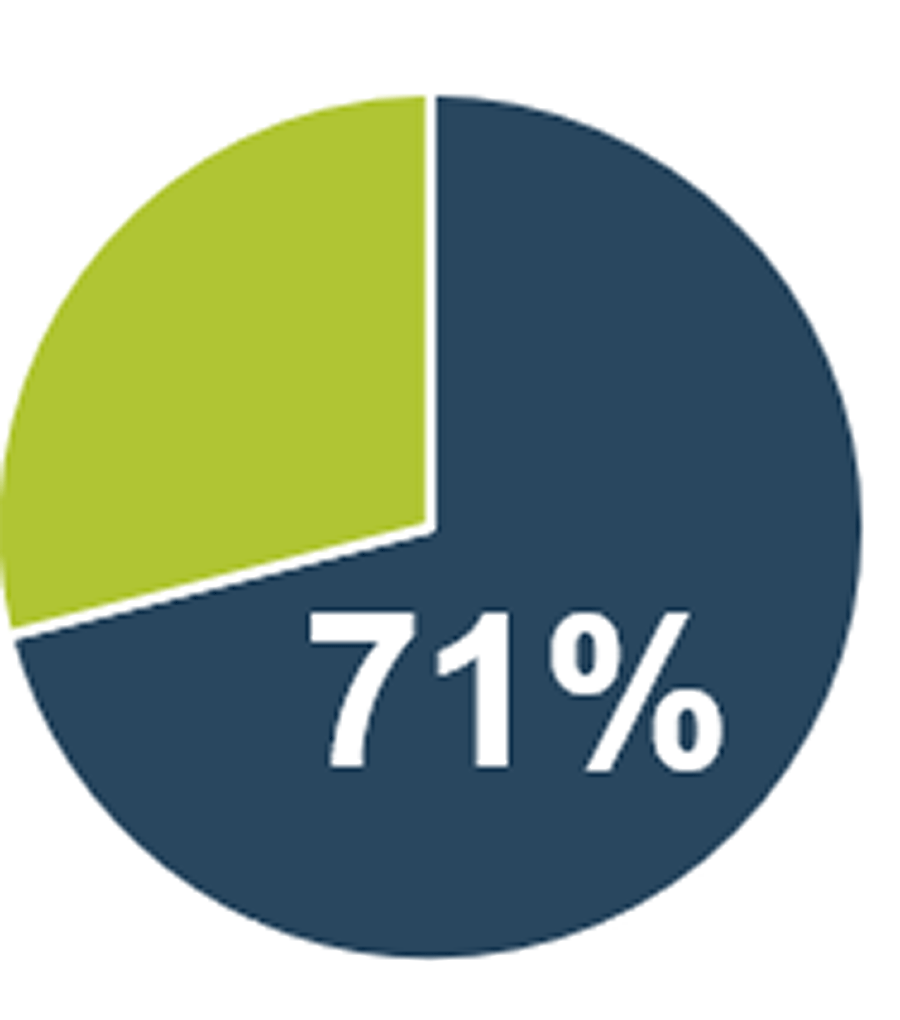
71% of IT professionals found their ability to manage changing priorities actually improved after implementing Agile.
Source: “12th Annual State of Agile Report”
Info-Tech Insight
Agile is first and foremost a cultural shift by adopting the mindset of embracing change. Therefore, if you are successfully being Agile, your ability to manage changing priorities will be a natural by-product of being Agile.
This content is exclusive to members.
Sign up to continue reading the full blueprint, or sign in if you already have an account.
Our systems detected an issue with your IP. If you think this is an error please submit your concerns via our contact form.