
Master Systematic Application Replacement With a Fit-for-Purpose Plan
Manage your application lifespan confidently.
Application replacement succeeds or fails based on how well you onboard the new and sunset the old. If onboarding doesn’t deliver early value, adoption slows. If sunsetting lacks visibility into dependencies, then risk and disruption increase. Our phased approach guides you through application replacement to help you accelerate adoption, realize value early, and confidently navigate the entire application lifecycle from onboarding to sunset.
Effective application replacement requires an approach that balances strategic goals, user needs, and operational realities. Success comes from preparing early, coordinating across teams, and managing the transition with full visibility into risks and dependencies. Align your teams by setting clear expectations and drive coordinated execution so every replacement delivers meaningful results.
1. Align application onboarding to value.
Application onboarding doesn’t start at implementation. Success begins by aligning people, processes, and technology to organizational goals to ensure the application delivers its intended value, drives user adoption, and maximizes return on investment. This is critical, as slow onboarding is a major source of friction for 83% of organizations (UserGuiding, 2024).
2. Application onboarding is the start, not the end.
Many teams treat application go-live as the finish line, assuming the work is done once the application is turned on. In reality, go-live is when execution happens: driving user adoption, validating user needs, refining onboarding processes, and ensuring the application delivers on its intended outcomes.
3. Dependencies create the highest risk when sunsetting.
When sunsetting applications, the danger rarely comes from the application itself but from the web of integrations, hidden workflows, and processes connected to it. It is essential to focus on mapping these dependencies first to prevent breakage, compliance issues, or unexpected disruption for your organization.
Master Systematic Application Replacement With a Fit-for-Purpose Plan
Manage your application lifespan confidently.
Analyst perspective
Pooja Khandelwal |
Jinit Shah |


Mastering systemic application replacement is divided into two main steps: application onboarding and application sunsetting. Application onboarding determines how quickly users see value or decide to leave. On the other hand, application sunsetting focuses on how to safely retire an old application that is consuming resources without providing value.
Effective application onboarding does not begin when an agreement is signed but when expectations are first formed. This stage defines outcomes, experience, and the pace of value realization. Strong onboarding links user goals to early, tangible results, positioning organizations as true partners rather than simple solution providers. Because it spans business, IT, and support functions, early internal alignment becomes essential. Effective onboarding builds trust, drives adoption, and boosts retention, growth, and long-term success.
Sunsetting manages an organization’s controlled exit from an application, ensuring clarity, continuity, and minimal risk. It involves using insights gathered across the application's lifecycle and looking at dependencies and risks to decide what to preserve, migrate, redesign, or retire. A solid sunsetting process validates readiness for the new solution, exposes gaps early, and avoids issues such as data loss or workflow disruption. Successful sunsetting reduces operational overhead and strengthens confidence in the transition.
This blueprint guides you through an application onboarding maturity assessment to help you identify strengths, uncover gaps, and prioritize improvements. Next, you will map your onboarding resources and journey to align stakeholders, identify user needs, and capture actionable insights. Then, the blueprint guides you through sunsetting by assessing readiness, reviewing insights, building a roadmap, and completing final cleanup. Together, these activities result in a clear, structured approach that enables your team to confidently navigate the entire application lifecycle.
Executive summary
Your Challenge |
Common Obstacles |
Info-Tech’s Approach |
|---|---|---|
Rapid technology improvements are outpacing your business strategy. Emerging technologies, evolving digital expectations, and new vendor ecosystems are transforming what “good” looks like faster than legacy applications can keep up. As business strategy evolves to leverage AI, automation, analytics, and modern user experiences, existing systems are becoming barriers, leading organizations to new applications that can support future‑focused capabilities. |
Delivery of world-class application replacement experiences for users is often held back by several persistent obstacles: |
Transform your application replacement with Info-Tech’s approach: |
Info-Tech Insight
Effective application replacement requires an approach that balances strategic goals, user needs, and operational realities. Success comes from preparing early, coordinating across teams, and managing the transition with full visibility into risks and dependencies. Align your teams by setting clear expectations and drive coordinated execution so every replacement delivers meaningful results.
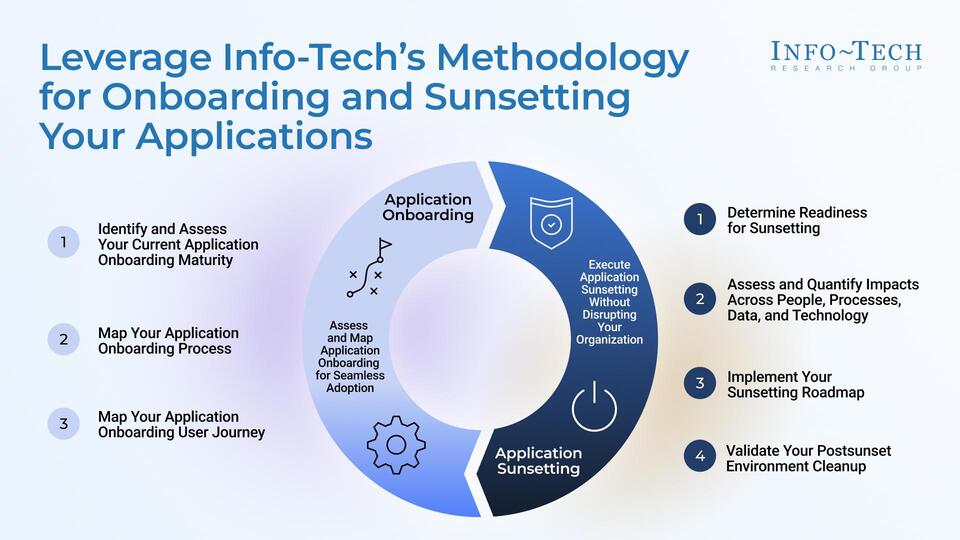
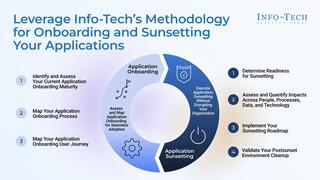
Leverage Info-Tech’s methodology for onboarding and sunsetting your applications
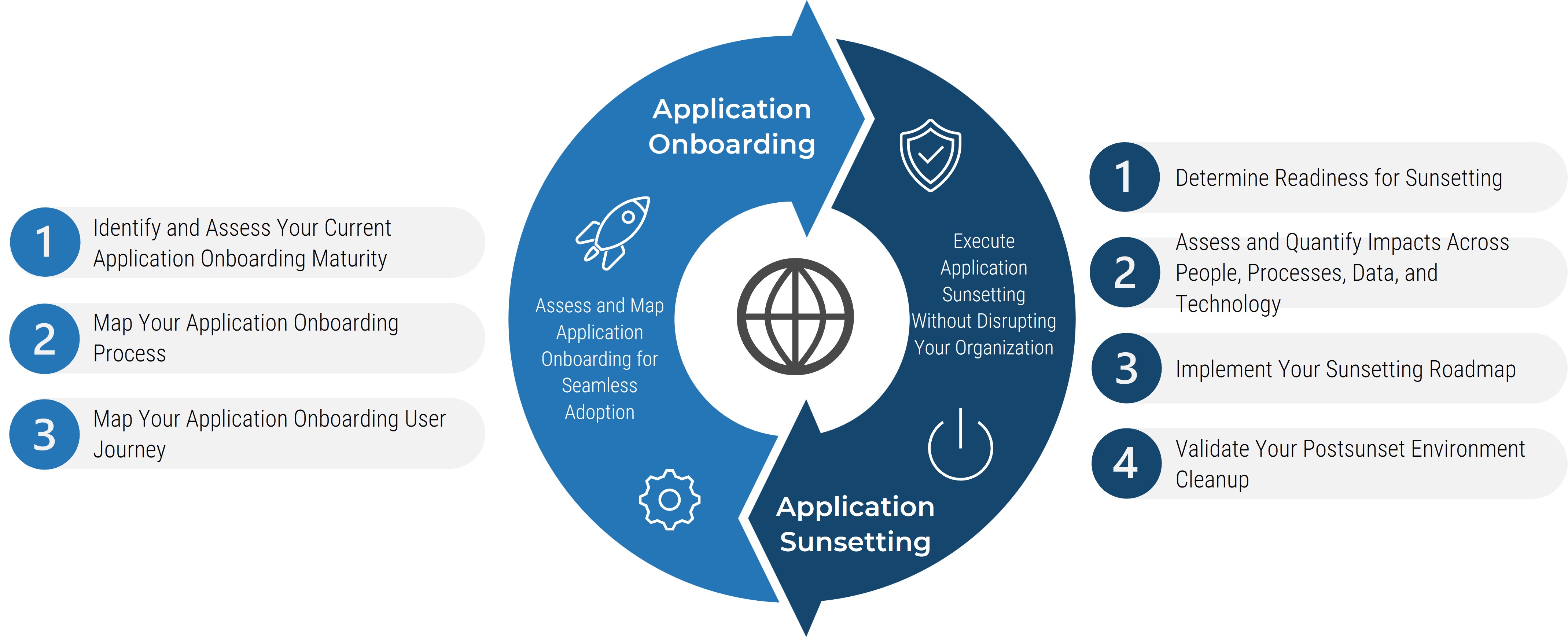
Master systematic application replacement with a fit-for-purpose plan
Steps |
Outcomes |
|
|---|---|---|
Phase 1 |
Step 1.1 – Identify and assess your current application onboarding maturity. Step 1.2 – Map your application onboarding resources. Step 1.3 – Map your application onboarding journey. |
|
Phase 2 |
Step 2.1 – Define your sunset strategy. Step 2.2 – Plan your sunsetting activities. Step 2.3 – Execute and finalize the sunset |
|
Insight Summary
Turn replacements into results
Effective application replacement requires an approach that balances strategic goals, user needs, and operational realities. Success comes from preparing early, coordinating across teams, and managing the transition with full visibility into risks and dependencies. Align your teams by setting clear expectations and drive coordinated execution so every replacement delivers meaningful results.
Align application onboarding to value
Application onboarding doesn’t start at implementation. Success begins by aligning people, processes, and technology to organizational goals to ensure the application delivers its intended value, drives user adoption, and maximizes return on investment (ROI). Begin alignment early to realize value faster.
Application onboarding is the start, not the end
Many teams treat application go-live as the finish line, assuming the work is done once the application is turned on. In reality, go-live is when execution happens: driving user adoption, validating user needs, refining onboarding processes, and ensuring the application delivers on its intended outcomes. Take action at go-live to drive the right outcomes and maximize organizational impact.
Dependencies create the highest risk when sunsetting
When sunsetting applications, the danger rarely comes from the application itself but from the web of integrations, hidden workflows, and processes connected to it. It is essential to focus on mapping these dependencies first to prevent breakage, compliance issues, or unexpected disruption for your organization.
Identifying severity levels is crucial to sunsetting successfully
Successful sunsetting depends on how well an organization understands the true severity of each component associated with sunsetting the system. Starting off with an impact assessment to determine severity exposes where the real risks live and helps ensure resources are allocated to the areas that matter most to enable a smooth sunset.
Blueprint deliverables
Each step of this blueprint is accompanied by supporting deliverables to help you accomplish your goals:
Application Onboarding Maturity Assessment Tool
Use this tool to assess application onboarding maturity, identify strengths and gaps, prioritize improvement areas, and benchmark performance over time.
Application Sunsetting Workbook
Determine readiness, map impacted components, and build a roadmap for application sunsetting.
Application Onboarding Resource and Journey Mapping Workbook
Visualize application onboarding resources to clarify roles, responsibilities, and handoffs across the onboarding process. Structure the application onboarding journey to align teams, meet user needs, and uncover insights to continuously improve onboarding programs.
Application Sunset Summary Document
Use this word template to help communicate the sunset to key stakeholders.
Benefits of optimizing application onboarding and sunsetting
IT Benefits |
Business Benefits |
|---|---|
|
|
Phase 1
Assess and Map Application Onboarding for Seamless Adoption
Phase 1 | Phase 2 |
|---|---|
1.1 Assess current application onboarding maturity 1.2 Map your application onboarding resources 1.3 Map your application | 2.1 Define your sunset strategy 2.2 Plan your sunsetting activities 2.3 Execute and finalize the sunset |
This phase will walk you through the following activities:
- Assess your current application onboarding maturity
- Map your application onboarding resources
- Map your application onboarding journey
This phase involves the following participants:
- Business
- Product
- IT/implementation team
- Security & compliance team
- Support/operations team
- Training & enablement team
- Vendors
Step 1.1
Assess Current Application Onboarding Maturity
Activity
1.1.1 Identify and assess your current application onboarding maturity
This step involves the following participants:
- Business
- Product
- IT/implementation team
- Security & compliance team
- Support & operations team
- Training & enablement team
- Vendors
Outcomes of this step:
- Understand your current application onboarding maturity.
- Identify strengths, gaps, and improvement opportunities to optimize application onboarding.
What is application onboarding?
Application onboarding is the process of guiding new users through the journey of using a new application, ensuring they achieve their desired goals or outcomes.
Application onboarding can be broken down into account onboarding and user onboarding:
Account Onboarding
The initial setup and configuration of a solution for a new user account. Account onboarding focuses on the technical aspects of onboarding, including any integrations with existing systems, ensuring that the account is set up and users have access.
User Onboarding
The process of getting new users up to speed on the product/service, ensuring they understand how to use the product and are deriving value from the solution.
" Onboarding is the process that new users go through to get set up and start using your product.
It covers the whole journey: from initial sign-up to product activation and first use.
Customer onboarding aims to deliver value to your customer as early as possible – in their first use, if possible."
– Emily Byford in Help Scout, 2022
Accelerate value through effective application onboarding
Eliminate onboarding friction to sustain revenue 83% of B2B buyers say slow onboarding is a dealbreaker. Source: UserGuiding, 2025 |
Boost retention with onboarding that delivers early wins 80% more users are retained by applications that deliver a quick win during onboarding. Source: UserGuiding, 2025 |
Fast-track time to value (TTV) by investing in onboarding Organizations with a dedicated onboarding specialist see 70% faster TTV. Source: UserGuiding, 2025 |
Case study
Transform application onboarding to reduce costs and drive adoption.
INDUSTRY: Oil & Gas
SOURCE: Simeio
Challenge |
Solution |
Results |
|---|---|---|
A multinational oil and gas company faced a significant backlog of applications requiring secure onboarding. Traditional processes took six to eight weeks, slowing user adoption and delaying integration with Azure and newly acquired renewable energy companies. The organization needed a scalable, secure, and accelerated solution to streamline onboarding, ensure compliance, and support faster go-to-market strategies. |
The organization implemented an onboarding program. Using automation, self-service tools, and robust reporting, it reduced onboarding from weeks to less than a day. The solution integrated smoothly with the organization’s IT systems, synchronized identity data, and provided real-time auditing to maintain compliance. This approach enabled faster user adoption, secure integration, and efficient onboarding for multiple other organizations. |
The onboarding solution delivered measurable benefits:
|
Application onboarding is the most important step in the user's journey
Onboarding is the first domino in a series of key touchpoints with your users. This phase sets the tone for the relationship and ensures users start off successfully, building satisfaction with your application.
"Effective onboarding can truly transform a user’s understanding and usage of a product. A product’s potential is best realized when users are onboarded with care, setting the stage for sustained and meaningful engagement."
– Nima Torabi, 2023
Application onboarding sets the foundation upon which your user relationship is built
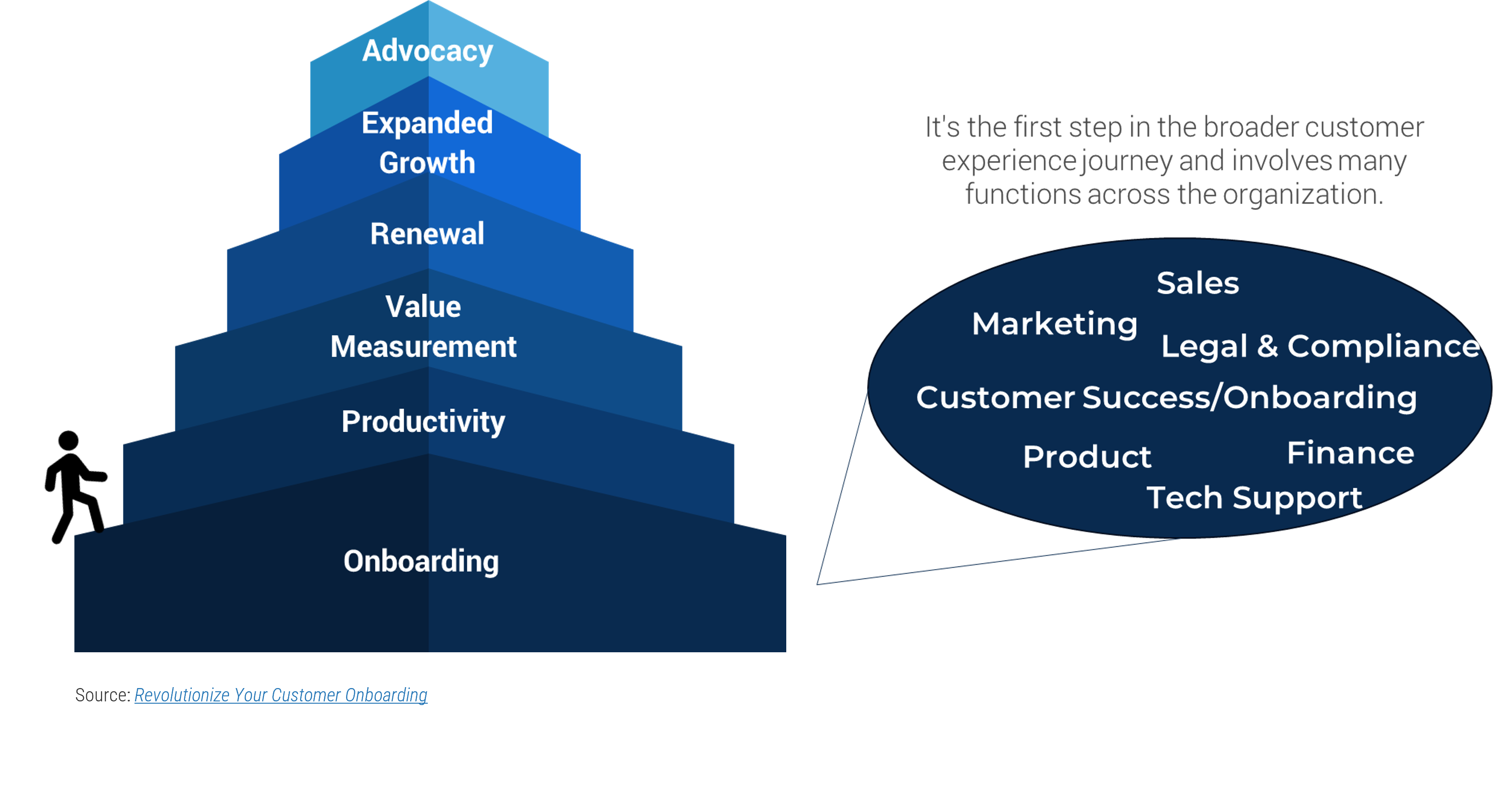
Set the stage for long-term usage, high satisfaction, and strong CLV
The goal of application onboarding is to encourage timely adoption and ensure the user reaches expected TTV and outcomes. A strong onboarding program reduces TTV, increases customer engagement, and maximizes customer satisfaction, retention, CLV, and advocacy.
Increase Product Adoption & Usage |
|
|---|---|
Shorten TTV |
|
Reduce Service Inquiry Volumes & Costs |
|
Increase Retention & CLV, Reduce Churn |
|
Increase Profitability |
|
Build User Relationships |
|
63% of users consider the onboarding experience when deciding to subscribe to an application.
Source: UserGuiding, 2025
Application onboarding is no easy task
Onboarding is the most important step in the user's journey, setting the tone for the entire relationship. With so many teams involved and so many touchpoints, there’s plenty of room for error.
Common challenges include:
- Mismatched expectations in responsibilities, timelines, and outcomes.
- Underwhelming users by overpromising and underdelivering.
- Poor project management leading to missed milestones and delayed TTV.
- Overservicing or underservicing users.
- Lack of processes and documents causing delays and inconsistent experiences and outcomes.
- Lack of clarity about when onboarding starts, when it stops, and who owns it.
If application onboarding is poorly executed, there is a risk of low usage, low adoption, and high user churn.
"Poor onboarding ranks as the third most important factor leading to customer churn, following wrong product fit and lack of engagement."
Source: Custify, 2025
Application onboarding maturity model
Stages |
Characteristics |
Indicators |
Actions to Take |
Optimized |
|
|
|
Managed |
|
|
|
Defined |
|
|
|
Ad Hoc |
|
|
|
1.1.1 Identify and assess your current application onboarding maturity
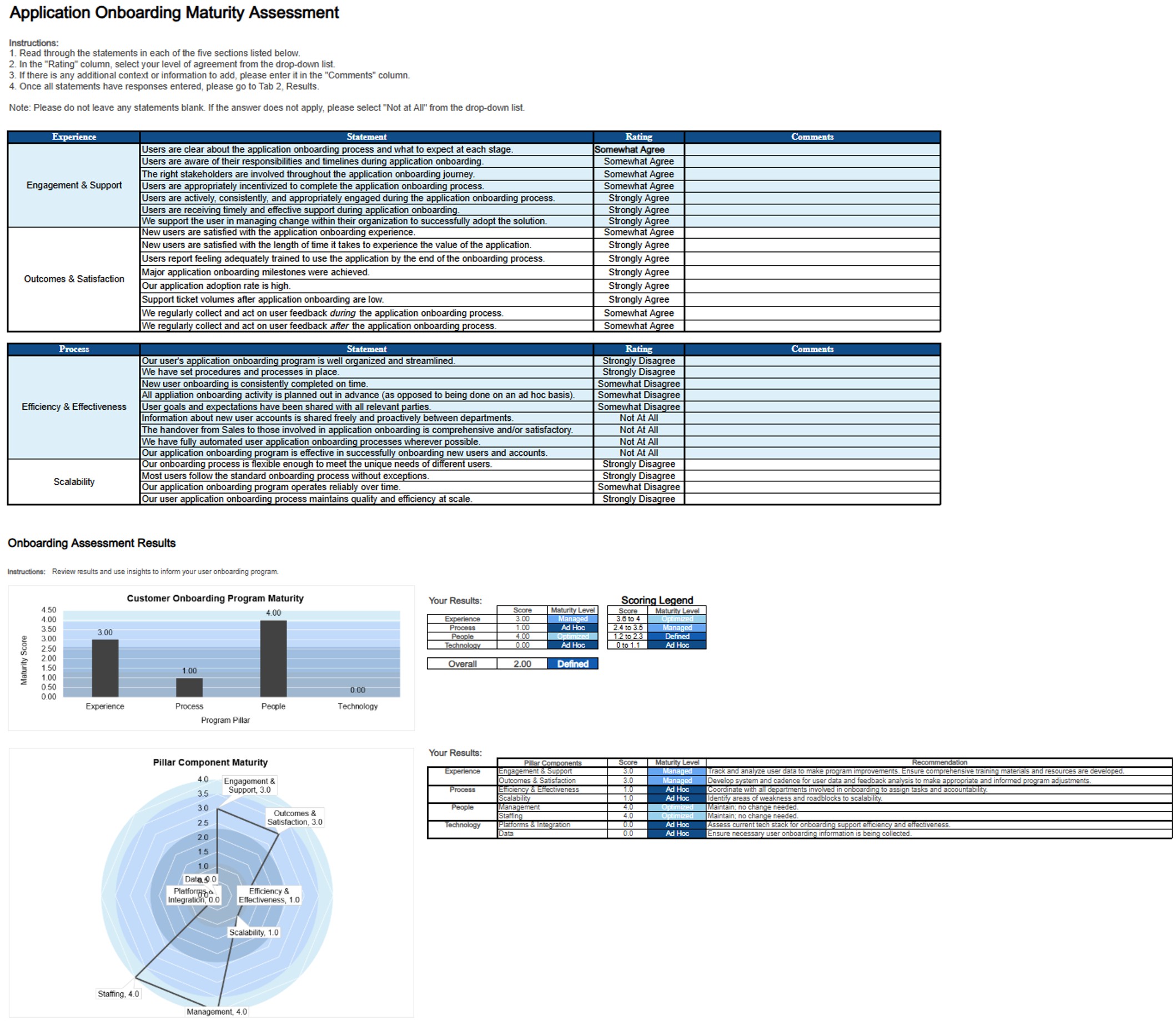
Complete the assessment on Tab 1 of the Application Onboarding Maturity Assessment Tool and rate your level of agreement with a series of statements about your current application onboarding program.
View your scores based on your responses in Tab 1.
Refer to Tab 2 for your results and Tab 3 for recommendations.
Download the Application Onboarding Maturity Assessment Tool
| Input | Output |
|---|---|
|
|
| Materials | Participants |
|
|
Example: Assess your current application onboarding maturity
- Complete the assessment on Tab 1 of the Application Onboarding Maturity Assessment Tool and rate your level of agreement with a series of statements about your current application onboarding program.
- View your scores based on your responses in Tab 1.
- Refer to Tab 2 for your results and Tab 3 for recommendations.
About Info-Tech
Info-Tech Research Group is the world’s fastest-growing information technology research and advisory company, proudly serving over 30,000 IT professionals.
We produce unbiased and highly relevant research to help CIOs and IT leaders make strategic, timely, and well-informed decisions. We partner closely with IT teams to provide everything they need, from actionable tools to analyst guidance, ensuring they deliver measurable results for their organizations.
What Is a Blueprint?
A blueprint is designed to be a roadmap, containing a methodology and the tools and templates you need to solve your IT problems.
Each blueprint can be accompanied by a Guided Implementation that provides you access to our world-class analysts to help you get through the project.
Talk to an Analyst
Our analyst calls are focused on helping our members use the research we produce, and our experts will guide you to successful project completion.
Book an Analyst Call on This Topic
You can start as early as tomorrow morning. Our analysts will explain the process during your first call.
Get Advice From a Subject Matter Expert
Each call will focus on explaining the material and helping you to plan your project, interpret and analyze the results of each project step, and set the direction for your next project step.
Unlock Sample ResearchContributors
- Kam Panchal, Enterprise Architect, Farm Mutual Reinsurance
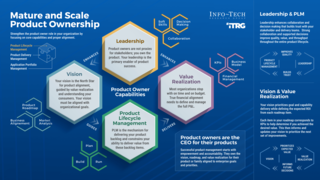 Mature and Scale Product Ownership
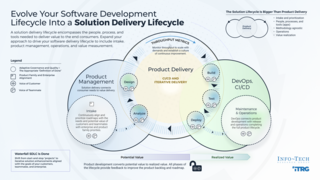 Evolve Your Software Development Lifecycle Into a Solution Delivery Lifecycle
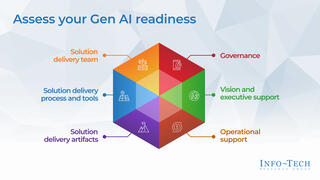 Adopt Generative AI in Solution Delivery
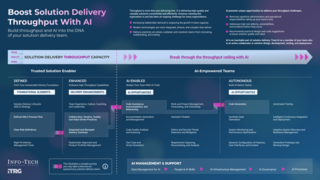 Boost Solution Delivery Throughput With AI
 Estimate Software Delivery With Confidence
 Select and Use SDLC Metrics Effectively
 Improve Application Development Throughput
 Spread Best Practices With an Agile Center of Excellence
 Perform an Agile Skills Assessment
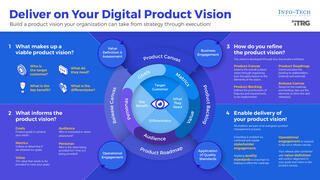 Deliver on Your Digital Product Vision
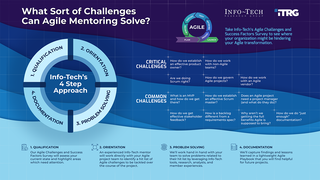 Mentoring for Agile Teams
 Implement DevOps Practices That Work
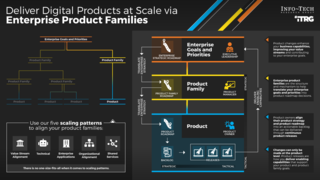 Deliver Digital Products at Scale
 Enhance Your Solution Architecture Practices
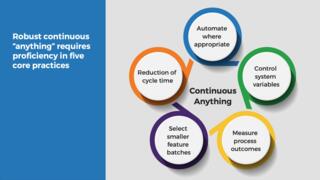 Define a Release Management Process to Deliver Lasting Value
 2020 Applications Priorities Report
 Agile Readiness Assessment Survey
 Define a Sourcing Strategy for Your Development Team
 Define the Role of Project Management in Agile and Product-Centric Delivery
 Implement a Transformative IVR Experience That Empowers Your Customers
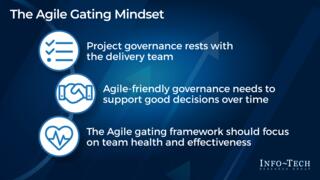 Create an Agile-Friendly Project Gating and Governance Approach
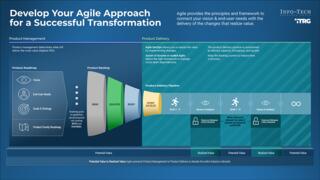 Develop Your Agile Approach for a Successful Transformation
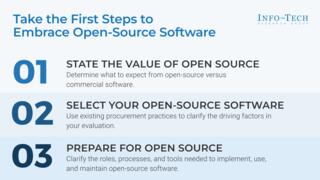 Take the First Steps to Embrace Open-Source Software
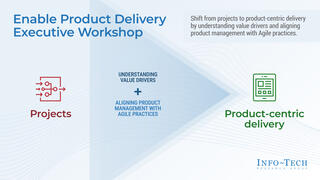 Enable Product Delivery – Executive Leadership Workshop
 Right-Size Your Enterprise Application Support Team
 Defend Against Defects and Technical Debt in Your AI-Generated Code
 Master Systematic Application Replacement With a Fit-for-Purpose Plan
