Winning on Deployment, Not Disruption: What Contract Logix CLM Actually Sells
Contract Logix, now part of LegalSifter, is a mid-market CLM platform that focuses on rapid deployment and operational simplicity, prioritizing usability and cost control over deep customization and advanced AI-driven contract intelligence.
The platform covers the full contract lifecycle: centralized repository, intake and request workflows, document authoring with template and clause libraries, approval routing, obligation tracking, e-signature integration, and configurable reporting. Contracts are organized as structured records that consolidate the original agreement, all subsequent amendments, associated counterparties, tasks, and alerts into a single navigable object. This architecture addresses one of the most persistent frustrations in contract management: the inability to quickly determine which version of an agreement is current and what obligations it carries.
The product is offered in two tiers. The entry tier provides a centralized repository and search functionality, designed as a low-friction starting point for teams whose immediate need is to get their contract inventory under control before introducing process automation. The full CLM tier adds workflow automation, authoring tools, and AI-powered data extraction. Alongside both tiers sits a contract operations as a service (COaaS) subscription, which gives lean legal or finance teams on-demand access to Contract Logix’s own configuration and operations staff in lieu of hiring a dedicated CLM administrator.
The deployment model is where Contract Logix makes its most distinctive claim. Implementation is handled entirely in-house, with no third-party systems integrator required or recommended. Repository-only deployments are typically live within weeks, and full CLM configurations are scoped for 90 days. By contrast, implementations at enterprise-tier platforms routinely extend to six to twelve months and carry SI fees that can rival or exceed the first year’s licensing cost. That gap is not incidental; it is central to how Contract Logix positions itself in the market.
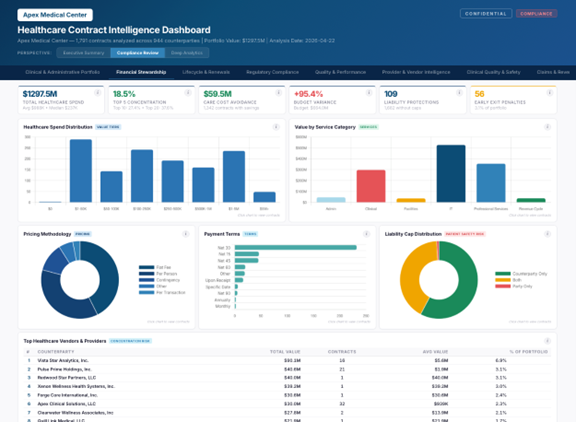
On AI, the vendor’s approach is deliberately measured: The data extraction capabilities power deep business insight via customizable Contract Intelligence Dashboards (Figure 1). Data extraction and metadata population are available in the Premium tier, serving as a practical tool for populating contract records at ingestion. More advanced capabilities, such as contract review, redlining, and playbook management, sit in ReviewPro, a companion product that requires a separate purchase and is positioned as a pre-signature tool that integrates with Contract Logix at execution.
Our Take
The real sale here is not software. It is time to value.
Contract Logix is not attempting to redefine the CLM category. It is addressing a more practical problem that many vendors overlook: Mid-market organizations often struggle with CLM not because of missing features, but due to implementation complexity, cost overruns, lack of internal ownership, and underlying challenges such as immature processes and inconsistent information governance.
Its value lies in how it approaches these challenges. Faster deployment timelines, in-house implementation, and a services-backed model are designed to reduce common adoption barriers. The unlimited user model also supports broader usage across teams, which is often necessary to realize value from contract management systems.
At the same time, its differentiation is more operational and commercial than product-led. Core CLM capabilities are broadly in line with what is available across the market, and buyers with more complex requirements may need to evaluate how well the platform supports deeper customization or more advanced use cases over time. Similarly, while LegalSifter strengthens the overall AI narrative, current capabilities within Contract Logix remain focused on structured data extraction rather than more advanced contract intelligence.
Overall, Contract Logix is best suited for mid-market organizations looking to operationalize contract management for the first time, or for those moving away from fragmented, manual systems. Its strengths are most evident when implementation speed, usability, and cost predictability are key decision factors. Buyers evaluating it alongside enterprise CLM platforms should consider total cost of ownership, particularly implementation and ongoing support, rather than focusing solely on licensing. Those with more mature contract operations or complex, cross-functional workflows should assess the platform’s customization depth and AI roadmap to ensure alignment with longer-term needs.