
Visualize the Mining Industry of the Future
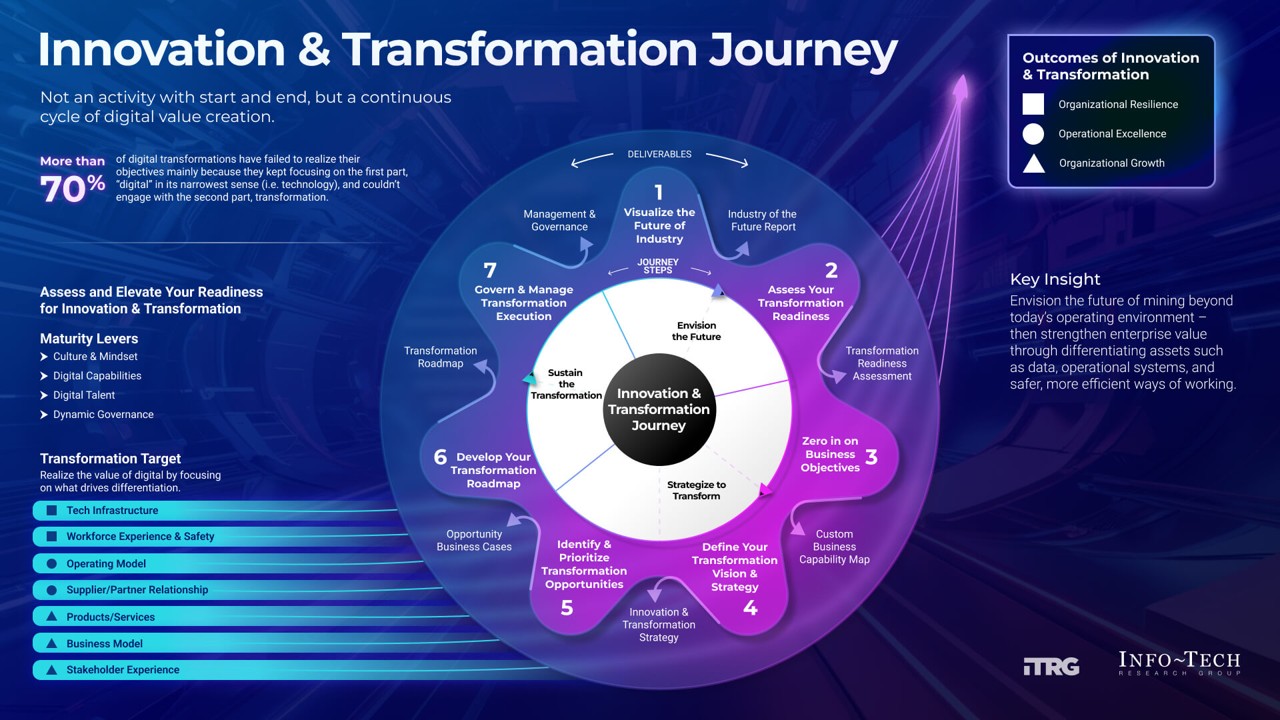
Envision how digital can propel the transformation of your industry and your organization.
- Inadequate IT infrastructure is a common obstacle to many digital transformation initiatives.
- Mines are becoming more complex and data-rich; a lack of strategy to evolve to meet this need will lead to slower operational decision-making and higher variability.
- The longer digital transformation is stalled, the harder it will be to attract digital native talent required to maintain new processes and systems.
Our Advice
Critical Insight
Labor shortages, automation maturity, and relentless cost and productivity pressures are converging to redefine mining’s operating reality. To remain viable, mines must adopt digitally enabled operating models designed to perform with fewer people, greater oversight, and higher levels of operational complexity.
Impact and Result
- Digitally enabled mines extend asset life by optimizing extraction, maintenance, and processing decisions, allowing operators to recover more value from existing assets while delaying major capital reinvestment.
- Integrated, real-time operational data enables better decision-making and greater flexibility to adapt to commodity price swings, ore variability, and operational disruptions.
Industry of the Future Report – Mining
Envision how digital can propel the transformation of your industry and your organization.
Executive Summary
Mining operations have already begun transforming
Economic, operational, and workforce pressures are accelerating digital change across mining operations.
Changing economics of the mine
- Declining ore grades and increasing stripping ratios are eroding the economics of traditional volume-based extraction.
- Capital discipline and margin protection are now as important as throughput growth.
Operational complexity is increasing
- Mines are operating across larger footprints with more equipment, more sensors, and more data.
- Manual decision-making cannot scale with real-time operational variability.
Disruption signals are everywhere
- Autonomous, connected, and predictive operations are scaling beyond pilots in leading mining organizations.
- Experienced operators and engineers are retiring faster than they can be replaced.
- Safety, regulatory, and ESG expectations are increasingly shaping how mines operate.
- Incremental efficiency gains are no longer sufficient to offset structural cost pressures.
Digitally enabled mining operations can materially improve core operational KPIs, including:
40% Increase in production throughput
Source: McKinsey & Company, 2025
13% Reduction in load and haul costs
Source: ASI Robots, 2025
10% to 20% Increase in hauling productivity
Source: Tyndall AM, 2025
Traditional operations are giving way to the digitally enabled mine
The digitally enabled mine represents a shift in how people, processes, and technology are designed and managed to deliver operational performance. This transition highlights the need to move beyond legacy, localized operating practices toward more integrated, data-driven, and scalable models suited to modern mining realities.
Digitally Enabled Mine
Old Paradigm
Highly localized, experience-driven decision-making
Siloed planning and execution
Fragmented, purpose-built systems
New Paradigm
Augmented decision-making and remote collaboration
Integrated, end-to-end operational workflows
Connected platforms and real-time data flows
Info-Tech Insight
Labor shortages, automation maturity, and relentless cost and productivity pressures are converging to redefine mining’s operating reality. To remain viable, mines must adopt digitally enabled operating models designed to perform with fewer people, greater oversight, and higher levels of operational complexity.
Mining companies recognize the need for change but are facing obstacles
42% of global mining companies are prioritizing automation initiatives.
Source: Global Growth Insights, 2025
71% of mining companies believe robotics and automation will have the greatest future impact on the industry.
Source: BDO, 2025
43% of senior mining decision-makers cite inadequate IT infrastructure for data handling as an obstacle to digital transformation.
Source: BDO, 2025
33% of mining firms struggling with a shortage of skilled operators for autonomous systems.
Source: Global Growth Insights, 2025
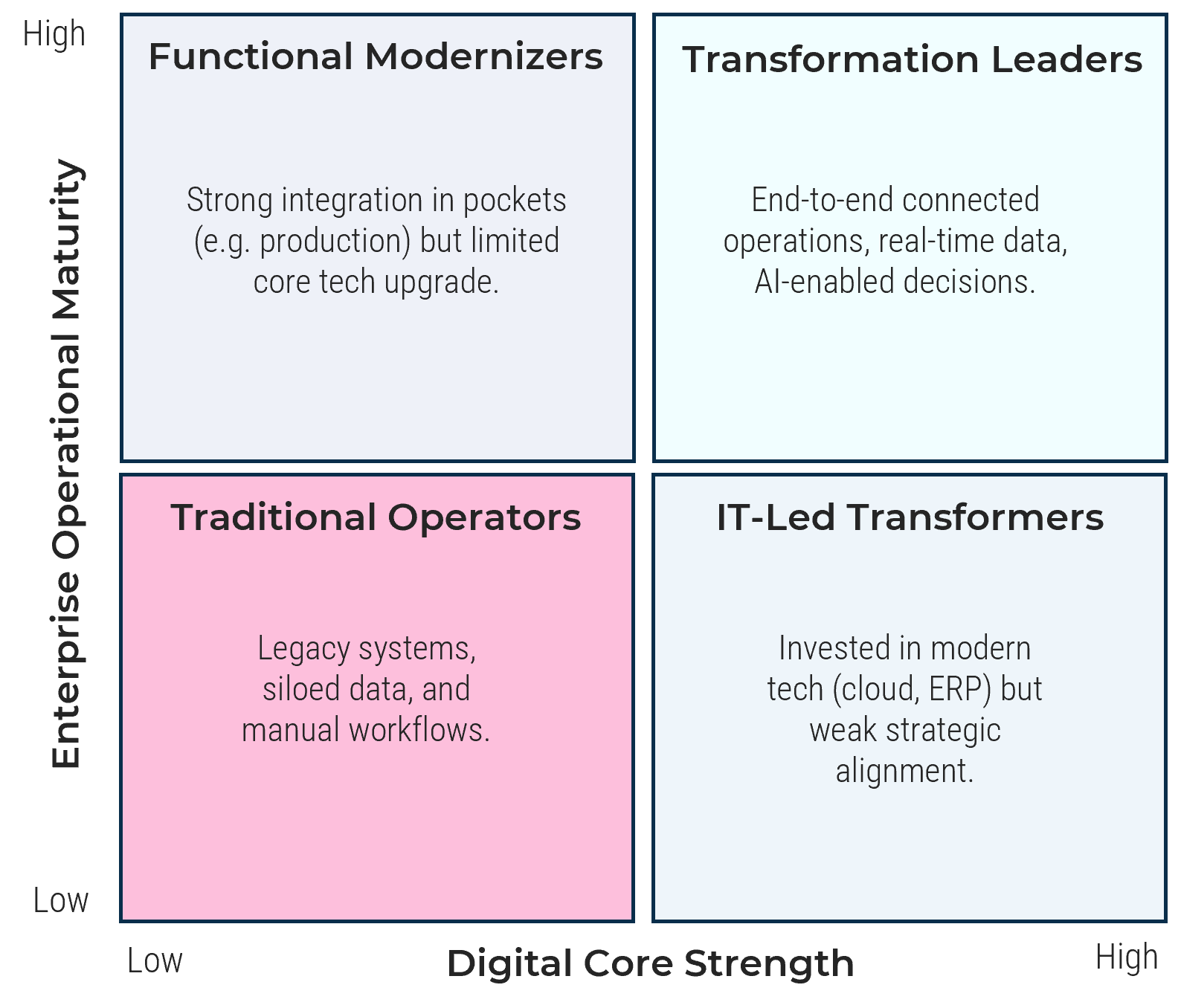
Progress on business transformation is fragmented and inconsistent
Islands of innovation without enterprise-wide orchestration.
Despite years of digitalization efforts across organizations, the progress on the digital journey has been patchy and uneven.
At one end, some operate as globally integrated entities equipped with cloud, edge/IoT, AI, Gen AI, etc., while on the other end, many still rely on manual logs, spreadsheets, and legacy systems.
Maturity varies substantially across regions, functions, and business units. In most organizations, investments may be driven by IT but lack end-to-end transformation.
Reflect:
How would you rate your organization on operational maturity and digital core strength?
Mining’s future operating landscape is taking shape now
A Glimpse Into the Future
Near-Term (0-5 Years): Digitally Augmented Operations
- Data-connected sites become the norm: Core assets, fleets, and processes are increasingly instrumented, connected, and visible in near real time.
- Decision-making shifts from experience-first to data-supported: Engineers, operators, and planners rely on analytics, models, and recommendations to guide daily decisions.
- Automation expands within defined process boundaries: Autonomous hauling, drilling, and processing optimization are deployed in targeted high-value areas.
- Remote and centralized operating models scale: Operations centers support multiple sites, reducing on-site labor exposure and improving consistency.
Mid-Term (5-10 Years): Adaptive and Autonomous Systems
- Closed-loop optimization becomes operational reality: Planning, execution, and maintenance continuously adapt based on live operational and environmental conditions.
- Human roles shift toward oversight and exception management: Talent focuses on supervision, optimization, and innovation rather than manual control.
- Ecosystem-based operations emerge: Mines operate as part of connected networks spanning suppliers, logistics partners, energy providers, and regulators.
Too much is at stake
The next decade will not reward incrementalism.
Organizations that embrace the future will unlock exponential gains, while those clinging to legacy models may find themselves disintermediated or obsolete.
Exponential Rewards: Winners will reshape the industry.
Asset Longevity and Capital Efficiency
Digitally enabled mines extend asset life by optimizing extraction, maintenance, and processing decisions, allowing operators to recover more value from existing assets while delaying major capital reinvestment.
Structural Cost Position Advantage
Early adopters of autonomy and predictive operations achieve step-change reductions in unit cost, creating a structural cost advantage that enables profitability across a wider range of commodity price cycles.
Superior Decision-Making Under Volatility
Integrated, real-time operational data enables better decision-making and greater flexibility to adapt to commodity price swings, ore variability, and operational disruptions
Existential Risks: Laggards will play catchup until irrelevancy.
Margin Erosion
As ore grades decline globally, companies without smart operations will face skyrocketing costs per ton that make their assets uneconomical.
Decision Latency and Loss of Operational Control
As mines become more complex and data-rich, organizations that rely on fragmented systems and manual decision-making risk losing control over operations, leading to slower responses and higher variability.
Digital and Operational Talent Shortages
Not only will laggards be late to the market for digital-native talent, but a technology portfolio that’s fragmented across multiple autonomous sites will further exacerbate any shortages for OT skilled labor.
This is a fork-in-the-road moment for traditional industry giants. Winners will reimagine the industry architecture, rewire how value is created and captured, and emerge as next-generation market-makers. Laggards? They risk becoming case studies of what went wrong.
This report is a guide for bold leadership not just to adapt but to shape the future of the mining industry
It is:
- Vision-driven but anchored in real-world shifts.
- Built by CIOs for executive leadership – CEOs and boards – and to reinvigorate the discussion on digital innovation and transformation.
- Customizable for organization-specific capabilities and context.
It contains:
- Industry Capabilities Overview
- Technology Trends Shaping Your Industry
- Digital Opportunities/Prioritized Use Cases in Your Industry
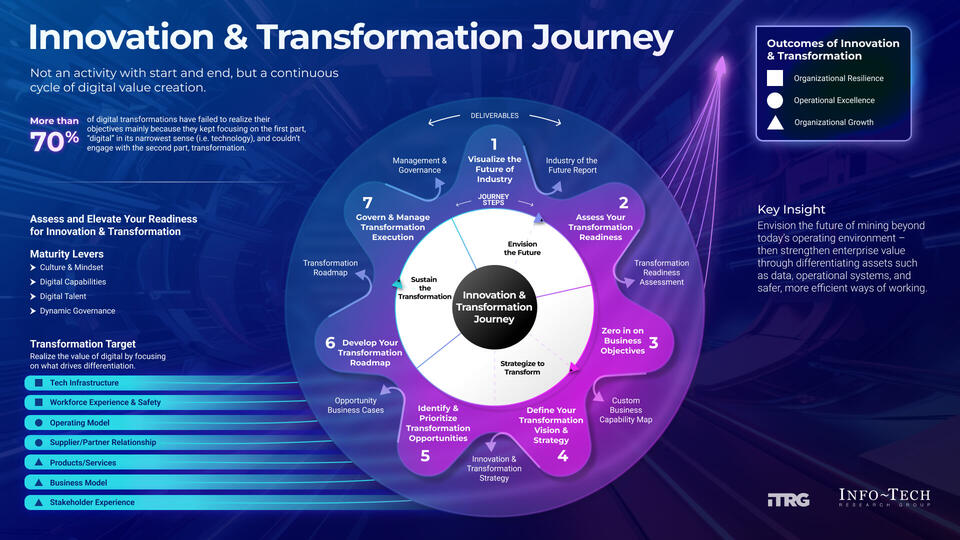
- Next Steps on Your Innovation & Transformation Journey
This report aims to assist CxOs with a transformation mandate to evangelize the role of technology in the future of the organization and the industry.
About Info-Tech
Info-Tech Research Group is the world’s fastest-growing information technology research and advisory company, proudly serving over 30,000 IT professionals.
We produce unbiased and highly relevant research to help CIOs and IT leaders make strategic, timely, and well-informed decisions. We partner closely with IT teams to provide everything they need, from actionable tools to analyst guidance, ensuring they deliver measurable results for their organizations.
What Is a Blueprint?
A blueprint is designed to be a roadmap, containing a methodology and the tools and templates you need to solve your IT problems.
Each blueprint can be accompanied by a Guided Implementation that provides you access to our world-class analysts to help you get through the project.
Talk to an Analyst
Our analyst calls are focused on helping our members use the research we produce, and our experts will guide you to successful project completion.
Book an Analyst Call on This Topic
You can start as early as tomorrow morning. Our analysts will explain the process during your first call.
Get Advice From a Subject Matter Expert
Each call will focus on explaining the material and helping you to plan your project, interpret and analyze the results of each project step, and set the direction for your next project step.
Unlock Sample Research