



Modernize production for throughput and cost advantage
The Challenge
Production runs on manual decisions while the data to run it smarter goes unused.
Ore grades are falling, pits are deeper, and haul distances are longer, yet most production still depends on disconnected systems and manual calls. The miners that treat production as a connected, data-driven system, not a fleet of standalone machines, will be the ones that move down the cost curve.
Why It Matters
The cost of standing still is measurable in lost decades of progress.
Mining productivity fell by roughly half between 1997 and 2023 while manufacturing productivity more than doubled, a gap driven by declining grades and remote, complex operations ("Performing Under Pressure: Implementing Innovation in Mining," McKinsey, 2025). With critical mineral demand climbing, the window to close that gap through automation and analytics is open now, not at the next price peak.
The Solution
Deploy integrated operations centers
Bring fleet, plant, and maintenance data into a single real-time view so supervisors manage to plan rather than react to breakdowns.
Scale autonomous and semi-autonomous equipment
Roll out autonomous haulage and drilling on the highest-volume routes to raise utilization and remove people from hazardous areas.
Apply advanced process control to the plant
Use AI-driven control on comminution and processing to lift recovery and throughput without new capital.
Build a future-ready, digitally skilled workforce
The Challenge
A retirement wave is colliding with a shrinking talent pipeline.
Decades of operational know-how are walking out the door just as enrollment in mining and geoscience programs declines. The real challenge is no longer only hiring enough people, but building a workforce that can run automated, data-rich operations.
Why It Matters
The math behind the shortage is stark.
More than half of the current mining workforce, about 221,000 workers, is expected to retire by 2029 even as demand for critical minerals accelerates ("Fortifying Your Foundation: Addressing People Risk and the Talent Gap in Mining," Marsh, 2025). Companies that wait for the graduate pipeline to recover will be outbid for scarce talent, so the advantage goes to those building skills internally now.
The Solution
Launch structured upskilling pathways
Train midcareer employees in automation, data analytics, and remote operations so they can step into roles left by retirees.
Partner with schools and apprenticeships
Fund mining, geoscience, and trades programs and offer paid apprenticeships to rebuild the entry-level pipeline.
Capture expert knowledge before it leaves
Use digital work instructions and knowledge-capture tools to retain retiring experts' troubleshooting know-how.


Master volatility with real-time enterprise risk management
The Challenge
Leaders are being pulled from strategy into daily operational firefighting.
Commodity price swings, deeper and more variable orebodies, and rising costs make output harder to predict and plans harder to hold. Without a disciplined way to see and price risk, volatility quietly erodes investor confidence and capital access.
Why It Matters
Risk has moved from the boardroom to the production face.
Operational complexity now ranks as the number-one risk facing mining and metals companies for 2026, overtaking external and strategic concerns as orebodies get harder and costs climb ("Top 10 Business Risks and Opportunities for Mining and Metals in 2026," EY, 2025). Treating risk as a real-time operational capability, not an annual compliance exercise, is what separates predictable producers from volatile ones.
The Solution
Stand up an integrated risk dashboard
Track commodity, operational, and supply exposures in one view tied to live production and market data.
Run scenario and stress testing
Model price, grade, and cost shocks against the mine plan so leaders can act before an event, not after.
Embed risk ownership in operations
Assign clear risk owners at site level with thresholds that trigger defined responses.
Move from reactive safety to predictive prevention
The Challenge
Years of safety gains are reversing, and traditional programs have plateaued.
Fatalities across major producers have risen two years running, with mobile equipment the leading cause, even as overall injury rates improve. After-the-fact safety programs can no longer reach the next level of prevention on their own.
Why It Matters
The recent trend demands a different safety model.
Fatalities across ICMM member companies rose to 42 in 2024, up from 36 in 2023 and 33 in 2022, a second straight annual increase led by mobile-equipment incidents ("ICMM Reports 2024 Safety Performance of Members," ICMM, 2025). Predictive, technology-enabled safety that intervenes before an incident is now the only credible path back to a zero-harm trajectory.
The Solution
Deploy collision avoidance and proximity detection
Fit mobile equipment with fatigue monitoring and proximity systems to prevent the vehicle interactions that cause most fatalities.
Move to predictive safety analytics
Combine sensor, incident, and maintenance data to flag high-risk conditions before they escalate.
Remove people from the line of fire
Use teleremote and autonomous operation in high-risk areas such as ground-support and blasting zones.

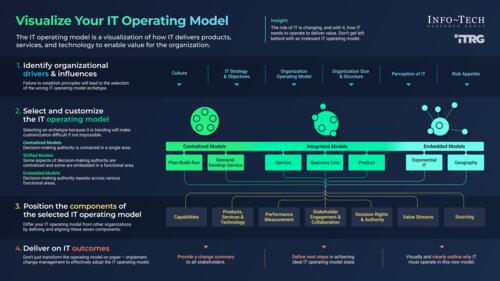

Earn social license through verifiable ESG performance
The Challenge
A mine's right to operate now rests on community trust, not just permits.
Governments are asserting more control, resource nationalism is rising, and communities expect proof of performance on water, waste, and local benefit. Miners that treat social license as a box-ticking exercise risk permitting delays, disputes, and stranded capital.
Why It Matters
Scrutiny is intensifying from every direction at once.
License to operate remains a top-five industry risk, with miners expecting governments to take greater control over sustainability and governance amid rising resource nationalism ("Top 10 Business Risks and Opportunities for Mining and Metals in 2026," EY, 2025). The miners that treat license to operate as a chance to build trust, doing what is right rather than only what is regulated, will win approvals and funding faster than peers.
The Solution
Publish verifiable ESG data
Report water, tailings, emissions, and community metrics against recognized standards so stakeholders can track real performance.
Engage communities across the mine lifecycle
Codevelop benefit agreements and maintain dialogue from exploration through closure, not just at permitting.
Digitize environmental monitoring
Use real-time sensors on water, dust, and tailings to catch issues early and prove compliance.
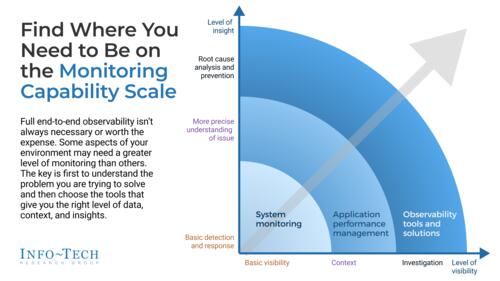


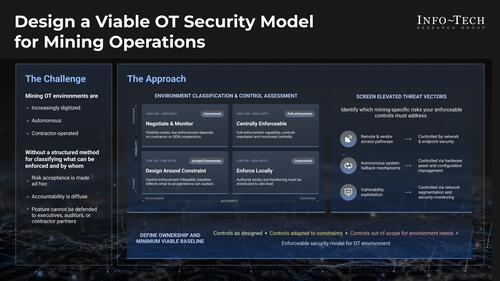
Defend production-critical systems from cyber disruption
The Challenge
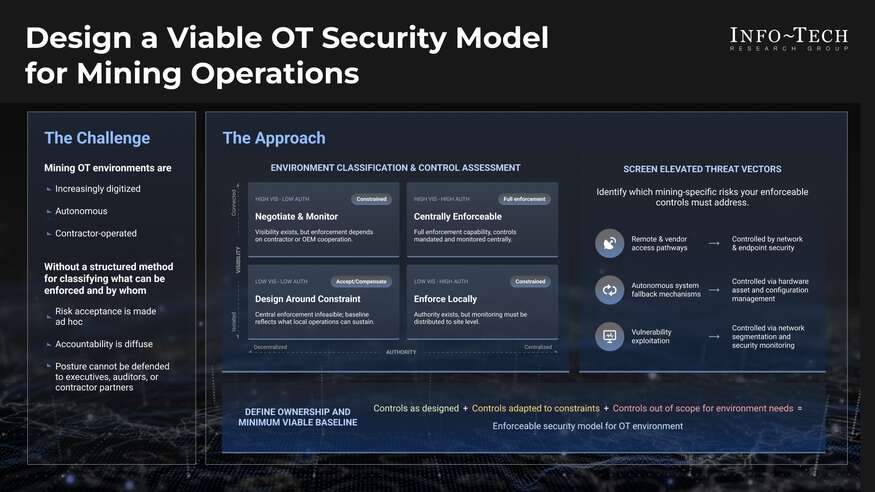
Connecting the mine has erased the wall between IT and the plant floor.
The old separation between back-office systems and operational technology has dissolved, giving ransomware a direct path to physical production. A single intrusion can now halt haulage, processing, and shipping, not just email.
Why It Matters
Industrial operations have become a prime ransomware target.
Manufacturing and industrial sectors are now the most impacted by ransomware, with attackers increasingly using remote access and IT-OT convergence as their way into operational networks ("Dragos Industrial Ransomware Analysis: Q2 2025," Dragos, 2025). For miners, securing the operational technology that runs production is now as fundamental as physical site security.
The Solution
Segment IT and OT networks
Separate production control systems from corporate IT so an office breach cannot reach the plant floor.
Lock down remote and vendor access
Enforce multifactor authentication and monitored, time-limited access for the remote connections attackers exploit.
Build OT-specific incident response
Maintain tested recovery plans and offline backups for control systems so production can be restored quickly.


Connect assets with a stable and secure network
The Challenge
Smart mining only works if the network underneath it does.
Wi-Fi and legacy radio cannot deliver the coverage, bandwidth, and low latency that autonomous fleets, sensors, and remote operations demand across vast sites. Patchy connectivity quietly caps the return on every other digital investment a miner makes.
Why It Matters
Weak connectivity shows up directly in lost production.
At one Newmont operation, unstable Wi-Fi could connect only two machines within 100 meters and caused up to six hours of downtime per shift before a private network was deployed ("$5 Billion Private 5G Market on the Verge of Mainstream Adoption," SNS Telecom, 2025). Treating connectivity as core production infrastructure, not an IT utility, is the precondition for scaling autonomy and analytics.
The Solution
Deploy private LTE and 5G networks
Install carrier-grade private wireless for reliable, low-latency coverage across pits, plants, and underground workings.
Design for full-site coverage
Plan surface and underground connectivity together so autonomous fleets and connected workers stay online while moving.
Build in redundancy and edge compute
Add failover and on-site processing so safety-critical systems keep running if the link to the surface drops.


Maximize asset uptime with predictive maintenance
The Challenge
Unplanned failures are one of the largest hidden drains on output.
Haul trucks, crushers, and conveyors still too often run to failure, turning a single breakdown into lost production and emergency repair costs. Reactive maintenance is increasingly out of step with the data modern equipment already generates.
Why It Matters
The industry is voting with its maintenance budgets.
Almost half of all mining companies plan to invest in predictive maintenance within the next two years, reflecting how central reliability has become to cost and uptime ("Next-Generation Mining Maintenance Raises Skills Gap Stakes," Mine Australia, Issue 59, 2025). The miners that shift from fixing failures to predicting them will turn maintenance from a cost center into a source of throughput.
The Solution
Instrument critical assets
Add vibration, temperature, and oil sensors to high-value equipment to detect wear before it becomes failure.
Build predictive maintenance models
Use machine learning on sensor and history data to schedule interventions at the optimal time.
Adopt digital twins for major equipment
Simulate asset performance to plan maintenance and spares around production rather than guesswork.

Drive down cost-per-ton across the value chain
The Challenge
Every ton is getting more expensive to produce, and the trend is structural.
Falling ore grades force miners to move and process more material to recover the same metal, while labor and energy costs keep climbing. Across-the-board austerity no longer works; unit cost has to be attacked at its operational roots.
Why It Matters
Declining grades are the quiet driver behind rising costs.
The average grade of copper mined worldwide has fallen by about 40% since 1991, forcing operations to process far more rock for each ton of metal ("BHP Insights: How Copper Will Shape Our Future," BHP, 2024). Sustainable cost reduction will come from optimizing the whole value chain with technology, not from one-off austerity drives that erode capability.
The Solution
Optimize end-to-end with analytics
Use data across the drill-to-mill chain to cut energy, reagent, and rework costs per ton.
Target energy and fuel efficiency
Electrify fleets and optimize haulage and comminution, the largest energy consumers, to lower unit cost.
Benchmark and standardize operations
Compare site performance and roll out best practices to close the gap between top and bottom performers.
Redesign the operating model for digital execution
The Challenge
Most miners have piloted digital tools but not changed how they run.
Technology gets bolted onto traditional structures, roles, and decision rights, so promising pilots stall before they scale. The real barrier to digital mining is now organizational, not technical.
Why It Matters
The evidence points to a management gap, not a technology gap.
Most mining companies have explored AI use cases, yet very few have scaled them to a level that truly transforms productivity, because success depends on management and cultural change ("Performing Under Pressure: Implementing Innovation in Mining," McKinsey, 2025). The operators that redesign roles, decision rights, and ways of working around digital execution are the ones that will turn pilots into enterprise-wide performance.
The Solution
Redesign roles and decision rights
Restructure operating teams around real-time data so decisions move to where the information is.
Establish a value-focused transformation office
Govern the digital portfolio against business outcomes, not technology milestones.
Build a continuous-improvement culture
Reward data-driven problem-solving and embed routines that sustain gains after go-live.