Chata.ai: Deterministic AI That Does Not Lie
The Problem With Generative AI
LLM-based generative AI analytics tools accept plain English questions and return probabilistic answers. They predict. In controlled demos, that is impressive. In production, in regulated environments, it is a liability.
When performing strategic economic analysis or preparing regulatory reporting, precision means a lot, as does transparency and audit trail. An AI system that produces plausible-looking figures without an audit trail is not a productivity tool. It is a compliance risk dressed up as automation.
Source: Chata.ai
The market has responded by providing governance overlays, prompt-engineering frameworks, and hallucination-detection logic on top of general purpose LLMs. These approaches treat unreliability as an architectural given and try to manage around it. That increases cost and complexity without resolving the underlying problem.
A 95% accuracy rate sounds manageable in isolation. Run a three-step analytics workflow, and accuracy across the chain falls to 85.7%. A ten-step workflow compounds down to 59.9%. In regulated environments, that is not an acceptable level of accuracy.
Shadow AI compounds the problem. When business users route around formal IT processes to query data using unapproved and unmanaged tools, it creates governance gaps that are difficult to detect and hard to close.
Chata.ai Is Built Differently
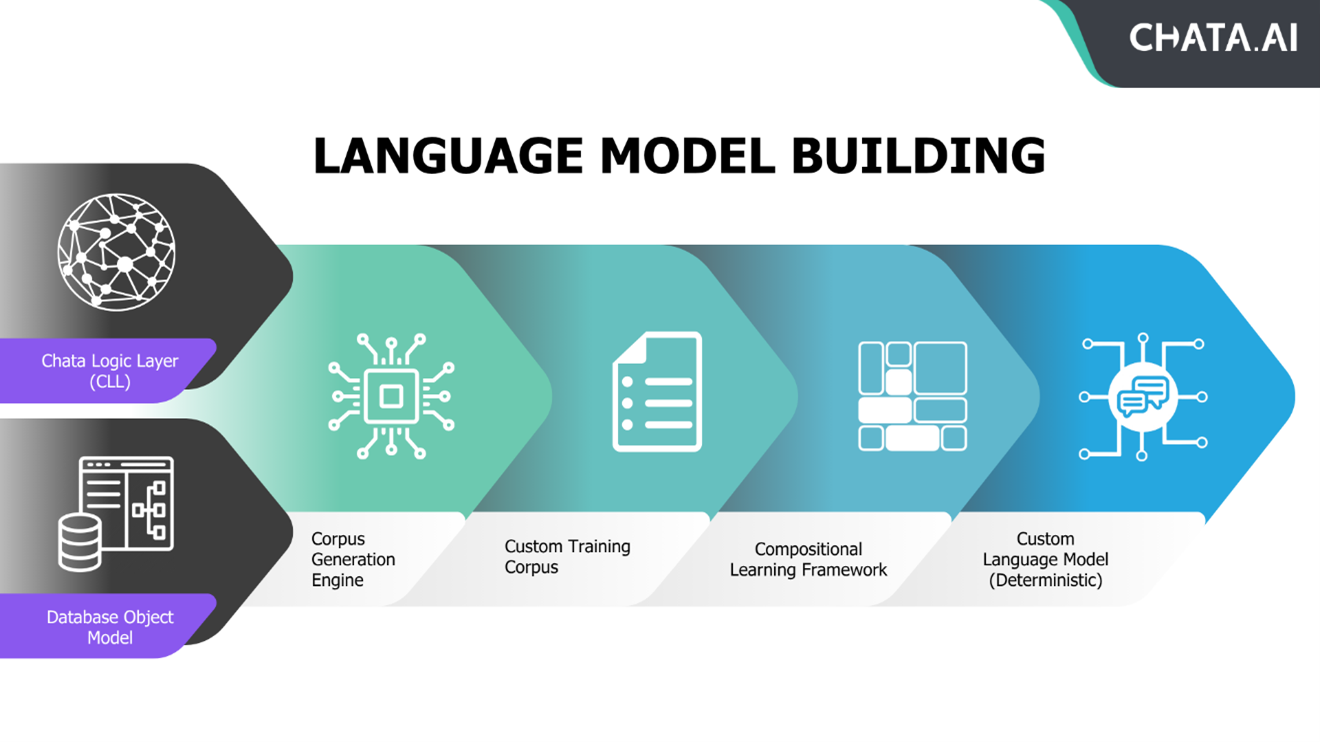
Chata.ai does not use a general purpose LLM. Instead, it uses a corpus generation engine to build a custom language model from an organization’s specific database schema and proprietary business logic. This distinction is crucial: It is not a fine-tuned general model but a structurally separate, deterministic model built uniquely for each customer.
Corpus Generation Engine
The process begins by feeding two key inputs into the corpus generation engine: the customer’s database object model (schema, data types, and structure) and Chata.ai's proprietary Chata Logic Layer (business language semantics and logic). This engine then generates an optimized training corpus of natural language questions paired with corresponding database queries.
This custom training corpus is then used within a compositional learning framework, which involves:
• Decomposition: Breaking down complex questions into smaller, manageable parts.
• Compositional Learning: Learning to reassemble these parts to generate the correct solution.
This framework produces a deterministic custom language model that consistently provides the same answer to the same question, eliminating hallucinations by constructing precise queries predictably.
Two points are worth special highlights. First, the model trains on the schema, not the underlying data. Customer data never enters the training process. A model built for one organization cannot be reused for another because they are structurally different – built from different schemas. Second, a lightweight helper model handles value labels such as account names, fund codes, or proprietary identifiers. That model only activates at runtime, inside the customer’s environment, and operates independently from the core query model. Nothing leaves the customer’s environment at any stage.
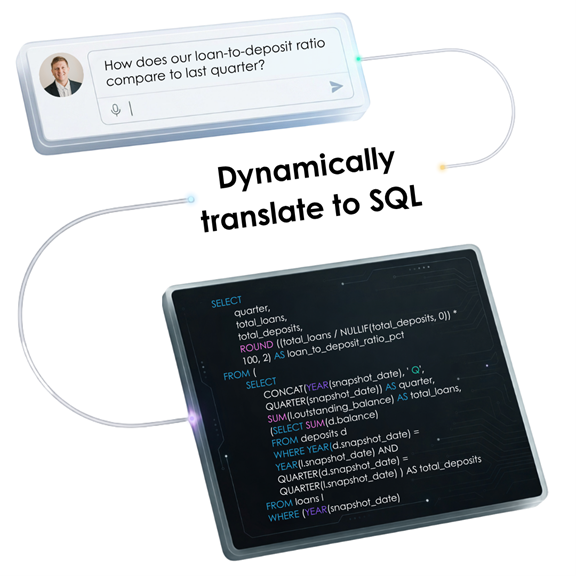
The system uses compositional query decomposition rather than probabilistic inference across billions of parameters. A natural language query breaks into structural components reflecting the database structure and executes on a CPU. Identical query logic applied to consistent data produces the same result every time.
Source: Chata.ai
Differentiating Benefits
No hallucinations. The system executes defined logic against actual data. There is no mechanism by which it fabricates a plausible-sounding figure.
Full audit trail. Every query is logged. Every result traces back to the exact logic that produced it. Compliance teams can reproduce any output on demand.
Zero data movement. Chata.ai connects to existing databases and queries data where it lives. Nothing is copied or stored externally.
CPU-based inference. The system runs on standard CPUs, not the GPU infrastructure generative models require. Chata.ai states production costs run at roughly 0.2% of a comparable generative AI deployment. (Note: This figure is vendor-supplied and has not been independently verified.) Even discounted, the cost differential at scale across hundreds or thousands of users is significant and worth testing.
Recent attention to AI inference costs has raised this technology question into the spotlight. Organizations that have run GPU-dependent analytics tools at scale are already familiar with cost curves that spike as usage grows. A CPU-based deterministic alternative sidesteps that dynamic entirely.
Integration and Deployment
The platform offers out-of-the-box integration with Microsoft Teams and Excel, but its true reach is through embedded analytics and an API-first architecture. By surfacing insights directly within existing internal portals or agentic workflows, Chata.ai ensures adoption without forcing users to leave their primary work environments.
Deployment is highly flexible, ranging from multi-tenant SaaS to single-tenant, air-gapped environments. While available through Microsoft and Google cloud marketplaces to streamline procurement, the platform is fundamentally cloud-agnostic, supporting Azure, GCP, AWS, and on-premises infrastructure.
Legacy systems are often closed and lack open APIs. Chata.ai addresses this through automated structured exports to AutoQL deployed on the customer’s cloud, which firewalls sensitive data. Instead of complex data migration, the platform simply consumes scheduled extracts from the source systems.
This approach ensures the source data remains in the customer-controlled environment, maintaining strict security boundaries. While the monitoring cadence aligns with the refresh rate of these extracts (e.g. daily or hourly), it allows organizations to deploy sophisticated analytics on top of legacy infrastructure without the cost or risk of a traditional integration rebuild.
Where This Gets Used
Current deployments span financial services, banking, supply chain, railway operations, government, and healthcare. The common thread is regulated environments where an incorrect number carries regulatory weight and an audit trail is not optional.
Proactive Analytics and Multi-Source Situational Awareness
Chata.ai extends its core query capability through proactive analytics – user-configured monitors that continuously track structured data across fragmented systems. By using composite alerts, the platform correlates signals from multiple sources (e.g. legacy on-premises databases and modern cloud-based applications) without requiring a traditional data fusion or master data migration project. This allows organizations to unify operational signals into a single, deterministic view without the risk and cost of a full-scale integration rebuild.
In high-stakes environments where seconds matter, this architecture provides critical situational awareness. It ensures that humans miss fewer signals by automatically alerting the right person the moment a defined threshold is reached across any connected system. Because these are governed automations with human-in-the-loop validation, they eliminate the manual work and errors caused by data silos, enabling immediate action even when critical systems remain on older, disconnected deployments.
This “bridge layer” approach allows teams to operationalize insights where they work, pushing actionable data into existing workflows or agentic orchestrators. It solves the problem of fragmented data by delivering modern innovation value today, ensuring that critical information is never lost between disparate systems.
Vendor Snapshot
|
Founded |
2016 |
|
Headquarters |
Calgary, Alberta, Canada |
|
Employees |
42 (as of early 2026) |
|
Funding |
US$10 million Series A, closed January 2026 |
|
Investors |
7RIDGE and Izou Partners |
|
Certifications |
ISO 27001; SOC 2 Type II |
|
Core technology |
Deterministic AI through natural language translation to database query language, CPU-based inference |
|
Key integrations |
Microsoft Teams, Microsoft Excel, and embedded analytics via API/SDK |
|
Target sectors |
Financial services, banking, wealth management, decentralized finance, supply chain, government, transportation, healthcare |
|
Pricing model |
Chata.ai’s pricing starts from US$15,000 for PoC/small models, plus a performance-based rate of US$0.05 per outcome. |
Our Take
The deterministic architecture is the right bet for regulated environments. Audit traceability, repeatable outputs, and compliance-grade logging are downstream consequences of the architectural choice, not add-ons. Before evaluating any AI analytics tool, stakeholders should ask one question: When I look at a computed number, can your team prove exactly how it was computed? For most general purpose LLM tools, that question has no satisfying answer. For Chata.ai, it does.
US$13 million (+ $10 million Series A) is modest by current AI funding standards. The investors, 7RIDGE and Izou Partners, underwrote the thesis around compliance requirements and audit capability, not just analytics. That framing signals a clear understanding of where the product’s commercial differentiation sits. The question is whether a 42-person team can scale into the verticals it has identified before better-capitalized competitors decide deterministic AI is worth building.
The CPU cost advantage has arrived at the right moment. Inference costs have become a boardroom conversation in 2025 and 2026 as organizations running GPU-dependent AI at scale confront cost curves that were not visible in early pilots.
Buyers should be clear about what they are purchasing. Chata.ai is not a general reasoning system. It is a precision analytics tool for structured data in defined domains. An organization that needs to predict broad industry trends based on macroeconomic and political variables needs a different tool. An organization that needs accurate, auditable answers from its own financial data with a full audit trail is exactly who this is built for.
Questions Stakeholders Should Ask During AI-Powered Analytic Solution Evaluation
1. When I look at a number this system produced, can your team reproduce exactly how it was computed?
2. What data is used to train your AI model? Is any customer data included?
3. What is the production cost of ad hoc queries by 500 users? By 2,000 users?
4. How does the system respond to a question it cannot answer confidently? Does it say so, or does it produce something that looks plausible?
Disclaimer: This tech brief reflects the independent analysis by the named analysts and does not constitute an endorsement of Chata.ai or its products.
