
e-Commerce Platform Selection Guide
Fast-track the process to build your business case and select your e-commerce solution.
- Organizations struggle to select an e-commerce platform that aligns with both customer experience and operational needs.
- The e-commerce vendor landscape is rapidly evolving, making objective comparison difficult.
- Poor selection decisions often lead to cost overruns, limited scalability, and unmet CX expectations.
Our Advice
Critical Insight
- E-commerce platform selection must be driven by customer experience strategy and ecosystem integration, not feature checklists.
- Over- or under-engineering platforms introduces unnecessary cost, risk, and adoption challenges.
- A structured, phased selection approach enables objective vendor comparison and stronger stakeholder alignment.
Impact and Result
- Faster, more confident e-commerce platform selection decisions.
- A clear, defensible business case aligned to enterprise priorities.
- Reduced selection risk and improved readiness for implementation and long-term scalability.
Member Testimonials
After each Info-Tech experience, we ask our members to quantify the real-time savings, monetary impact, and project improvements our research helped them achieve. See our top member experiences for this blueprint and what our clients have to say.
9.0/10
Overall Impact
$24,750
Average $ Saved
9
Average Days Saved
Client
Experience
Impact
$ Saved
Days Saved
Aidacare Pty Ltd
Guided Implementation
9/10
$24,750
9
Ben is a genuins.
e-Commerce Platform Selection Guide
Fast-track the process to build your business case and select your e-commerce solution.
Analyst Perspective
Implementing the right e-commerce platform is essential to improving customer interactions, increasing revenue, and accelerating business outcomes.
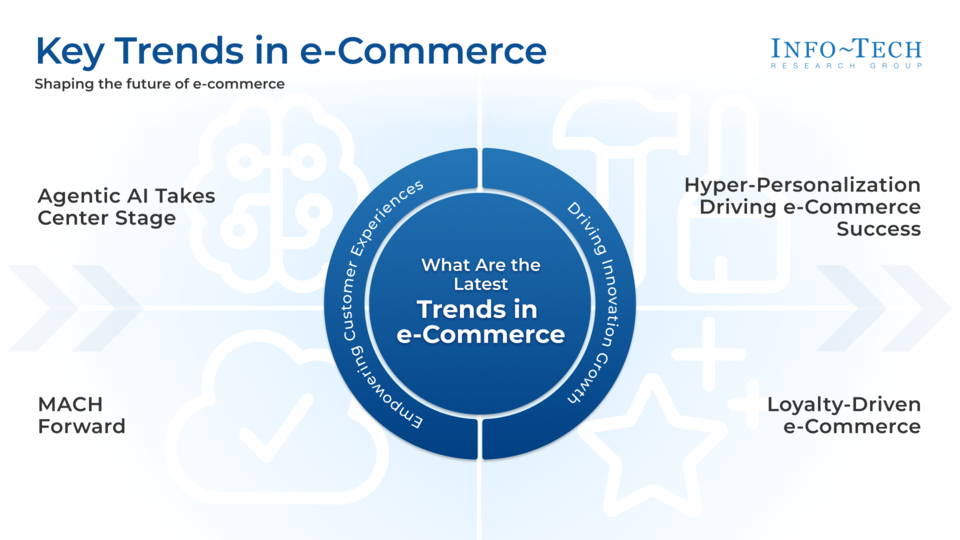
Selecting the right e-commerce platform is a critical decision for organizations aiming to deliver seamless, omnichannel shopping experiences. With increasing customer expectations and focus on modernization, e-commerce has evolved far beyond simple storefronts and checkout systems. Modern platforms now deliver agentic AI capabilities, hyper-personalization across channels, and composable MACH architectures and integrations that allow enterprises to adapt quickly to shifting business needs and maintain long-term customer relationships.
While marketing and sales teams often lead e-commerce adoption, successful initiatives require collaboration across Finance, Operations, and IT. Business leaders must prioritize usability, data-driven personalization, and customer engagement, while IT ensures scalability, security, and seamless integration with ERP, CRM, and payment ecosystems.
The selection of an e-commerce platform should follow a structured evaluation process: aligning platform capabilities with business objectives, prioritizing these features, and assessing architecture and deployment models. A disciplined RFP process enables enterprises to compare vendors objectively, weighing long-term costs against architectural flexibility and ecosystem maturity.
To ensure adoption, organizations should plan for product and customer data migration, customer experience design, loyalty program rollout, integrations, and end-user testing. This structured approach helps maximize long-term value, reduce operational risk, and ensure adaptability as customer expectations, technology capabilities, and market dynamics continue to evolve.

Jehaan Nanavaty
Research Analyst, Customer Experience & Application Insights
Info-Tech Research Group
Executive Summary
|
Your Challenge |
Common Obstacles |
Info-Tech’s Approach |
|---|---|---|
|
|
|
Info-Tech Insight
IT must work in unison with other relevant stakeholders throughout the organization, including their counterparts in Marketing and Sales, to define a unified vision for the e-commerce platform.
Info-Tech’s methodology for selecting an appropriate e-commerce platform
|
1. Understand the e-Commerce Landscape and Trends |
2. Build the Business Case & Streamline Requirements |
3. Select the Right e-Commerce Vendor |
|
|---|---|---|---|
|
Phase Steps |
|
|
|
|
Phase Outcomes |
|
|
|
Guided Implementation
| Phase 1 | Phase 2 | Phase 3 |
|---|---|---|
|
Call #1: Understand the concept of an e-commerce platform and explore its core capabilities and emerging trends. Canvas key vendors in this space. |
Call #2: Build the business case to select a vendor. Call #3: Define your key requirements. Call #4: Build procurement items, such as an RFP. |
Call #5: Evaluate the vendor landscape and shortlist viable options.
|
A Guided Implementation (GI) is a series of calls with an Info-Tech analyst to help implement our best practices in your organization.
The e-commerce selection process should be broken into segments:
- Create a vendor shortlist using this selection guide.
- Define a structured approach to selection.
- Review the contract.
Info-Tech offers various levels of support to best suit your needs
| DIY Toolkit | Guided Implementation | Workshop | Consulting |
|---|---|---|---|
| "Our team has already made this critical project a priority, and we have the time and capability, but some guidance along the way would be helpful." | "Our team knows that we need to fix a process, but we need assistance to determine where to focus. Some check-ins along the way would help keep us on track." | "We need to hit the ground running and get this project kicked off immediately. Our team has the ability to take this over once we get a framework and strategy in place." | "Our team does not have the time or the knowledge to take this project on. We need assistance through the entirety of this project." |
Diagnostics and consistent frameworks are used throughout all four options.
e-Commerce Platform Selection Guide
Speed up the process to build your requirements and select the right e-commerce platform for your organization.
EXECUTIVE BRIEF
Phase 1
Understand the e-Commerce Landscape and Trends
|
Phase 1 |
Phase 2 |
Phase 3 |
|---|---|---|
|
1.1 Define e-Commerce 1.2 Classify Table Stakes & Differentiating Capabilities 1.3 Explore Trends |
2.1 Build the Business Case 2.2 Streamline Requirements Elicitation 2.3 Develop an Inclusive RFP Approach |
3.1 Discover Key Players in the Vendor Landscape 3.2 Engage the Shortlist & Select Finalist 3.3 Prepare for Implementation |
This phase will walk you through the following activities:
- Level set an understanding of e-commerce software.
- Define which e-commerce features are table stakes (standard) and which are key differentiating functionalities.
- Understand the latest trends in the e-commerce space.
This phase involves the following participants:
- Sales and Marketing Process Leads
- Head of Procurement / Contract Manager
- IT & Enterprise Architecture Team
- Compliance & Risk Analyst
About Info-Tech
Info-Tech Research Group is the world’s fastest-growing information technology research and advisory company, proudly serving over 30,000 IT professionals.
We produce unbiased and highly relevant research to help CIOs and IT leaders make strategic, timely, and well-informed decisions. We partner closely with IT teams to provide everything they need, from actionable tools to analyst guidance, ensuring they deliver measurable results for their organizations.
What Is a Blueprint?
A blueprint is designed to be a roadmap, containing a methodology and the tools and templates you need to solve your IT problems.
Each blueprint can be accompanied by a Guided Implementation that provides you access to our world-class analysts to help you get through the project.
Need Extra Help?
Speak With An Analyst
Get the help you need in this 3-phase advisory process. You'll receive multiple touchpoints with our researchers, all included in your membership.
Guided Implementation 1:
- Call 1: : Understand the concept of an e-commerce platform and explore its core capabilities and emerging trends. Canvas key vendors in this space.
Guided Implementation 2:
- Call 1: Build the business case to select a vendor.
- Call 2: Define your key requirements.
- Call 3: Build procurement items, such as an RFP.
Guided Implementation 3:
- Call 1: Evaluate the vendor landscape and shortlist viable options.
- Call 2: Review implementation considerations.
