
Adopt a World-Class ITFM Taxonomy
Take the crucial first step in getting your IT financial management house in order.
In an uncertain economy, CIOs face rising pressure to justify spending, secure budget for innovation, and prove that IT delivers value. That’s difficult to do without a sound framework for IT financial management (ITFM). Our three-phase framework gives IT leaders a tested, ready-to-implement, and scalable model to analyze and understand IT expenditures – and communicate them in meaningful way to all stakeholders who have a vested interest in technology spending.
Many IT departments struggle to meaningfully communicate technology spend and the rationale behind it. The core issue is the lack of a shared model for communicating IT spend to Finance and the business – leading to inconsistent tagging, unreconciled numbers, and a lack of insights. Improve usability, depth, and transparency of technology spend data with a taxonomy that conveys meaning to all stakeholders.
1. A common cost language is a critical first step in IT’s financial accountability.
Establishing an IT cost taxonomy that clearly classifies IT’s financial data is the first step in demonstrating IT’s ability to meet its financial accountabilities. It enables full transparency and builds trust in the important decisions being made using that data.
2. A taxonomy is more than just a way to organize data.
It’s a communication tool. A taxonomy should make IT spending meaningful to non-technology audiences. If you can’t tag your technology spend in a way that’s meaningful to these audiences, you can’t expect them to understand it.
3. Collaboration with Finance is key.
Your taxonomy is one part of the finance ecosystem. Collaborate with your central Finance team as well as other important stakeholders (e.g. Procurement) to ensure a truly meaningful IT cost taxonomy that works for everyone.
Use this step-by-step blueprint to balance the books and build IT credibility.
Our three-phase methodology provides a cohesive roadmap to improve your ITFM capabilities, starting with an organized and meaningful IT financial data set. Use this framework to:
- Discover exactly what IT financial data is and where it lives in your organization.
- Classify and organize your IT financial data and create cost allocation and attribution rules.
- Provide a foundation for transparency and evolve your ITFM capability overall.
Member Testimonials
After each Info-Tech experience, we ask our members to quantify the real-time savings, monetary impact, and project improvements our research helped them achieve. See our top member experiences for this blueprint and what our clients have to say.
8.0/10
Overall Impact
$18,499
Average $ Saved
5
Average Days Saved
Client
Experience
Impact
$ Saved
Days Saved
University of York
Guided Implementation
8/10
$18,499
5
Adopt a World-Class ITFM Taxonomy
Take the crucial first step in getting your IT financial management house in order.
Adopt a World-Class ITFM Taxonomy
Take the crucial first step in getting your IT financial management house in order.
Analyst Perspective
Work your financial data to make it work for you.
Think about the last time you handled a piece of IT financial data. It could have been an invoice from a vendor, an expense claim, or an update report for the CFO. Did you wonder if it was accurate? Were you worried that something was missing? Was it difficult to figure out exactly what the numbers represented? Did you suspect that it was one small piece of a bigger picture?
If IT needs to defend IT expenditures, forecast future costs, demonstrate value, and have any credibility with the CFO and other senior managers, it must not only understand finances but also have the right tools to analyze, report on, and explain those finances. This starts with having access to good quality and usable data and information about technology costs and expenditures and, most importantly, knowing what that data actually means.
Data problems – poor usability, lack of depth and transparency – are the root cause of many IT financial management woes. Discovering exactly what you have and classifying it in a way that provides context, enables financial analysis, and supports effective communication are the critical first steps in improving your IT financial data quality and your IT financial management capability overall.

Jennifer Perrier
Principal Research Director, CIO Practice
Info-Tech Research Group
Executive Summary
Your Challenge
Many IT departments struggle with their finances, namely:
- Making decisions about where their money should go.
- Answering questions about where their money has gone.
- Demonstrating the relationship between IT costs and IT value.
These struggles are often the result of poor transparency, which in turn is rooted in fundamental problems with IT financial data itself.
Common Obstacles
The IT and Finance functions have steadily diverged over the years, resulting in poor communication and misalignment.
- IT and Finance tend not to speak the same language or understand one another's processes, challenges, or priorities.
- Few organizations have a system for organizing and managing their shared financial data that reflects all use cases or enables meaningful analysis.
- IT financial data problems have remained largely unacknowledged, so they're rarely prioritized for remediation.
Info-Tech's Approach
Your roadmap for improving your IT financial management (ITFM) capabilities starts with an organized and meaningful IT financial data set:
- Discover exactly what IT financial data is and where it lives in your organization.
- Adopt Info-Tech's taxonomy to classify and organize your IT financial data and create cost allocation and attribution rules.
- Systematically implement your taxonomy in collaboration with your Finance department to provide a foundation for transparency and to evolve your ITFM capability overall.
Info-Tech Insight:
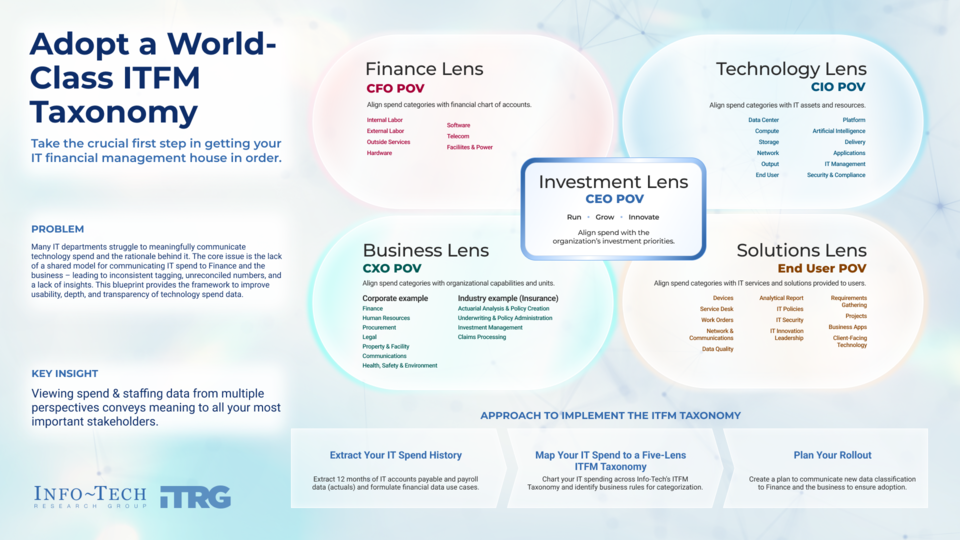
The same dollar, multiple views. Viewing spend and staffing data from multiple perspectives conveys meaning to all your most important stakeholders.
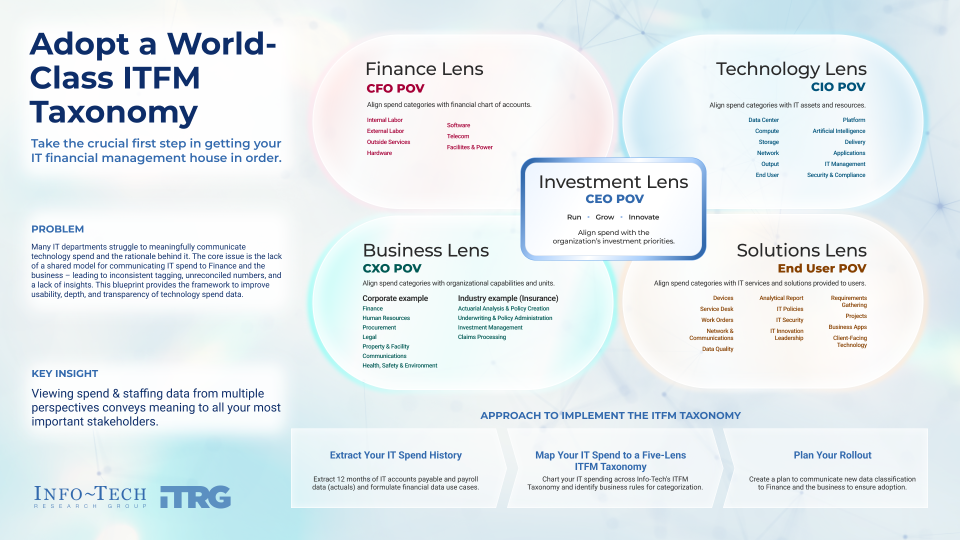
Info-Tech's Approach
Start fixing IT's financial data and improve overall IT financial transparency and capability with a meaningful IT cost taxonomy.
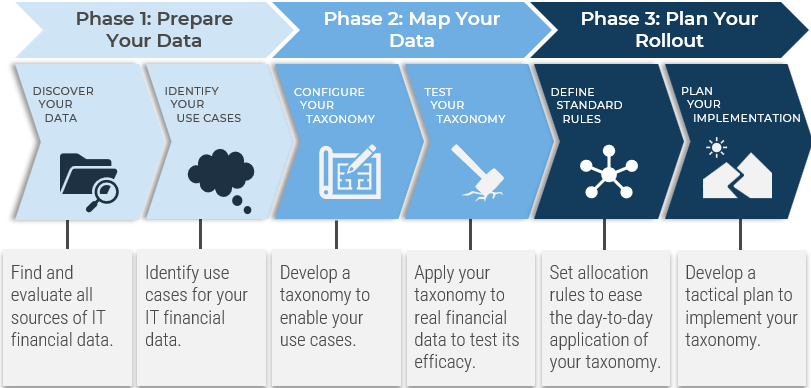
The Info-Tech Difference
- A comprehensive yet flexible approach that can help you implement quick wins while you lay the foundations for long-term maturity.
- A practical and tactical framework and toolset that will help you save time.
- Industry best practices and practitioner-based insights.
Insight summary
Overarching insight:
Take the crucial first step in getting your IT financial management house in order. Establishing an IT cost taxonomy that clearly classifies IT's financial data and enables full transparency is a crucial first step in IT's ability to meet its financial accountabilities and build trust in the important decisions being made using that data.
Phase 1 insight
A taxonomy isn't just a way to organize data – it's a communication tool. A taxonomy should make technology spending meaningful to nontechnology audiences. If you can't tag your technology spend in a way that is meaningful to these audiences, you can't expect their understanding.
Phase 2 insight
Planning before doing beats heroics downstream. Most taxonomy and data classification issues start at intake. Enforcing discipline during data intake – standard tags, clear ownership and oversight – benefits later in clean data and defensible numbers.
Phase 3 insight
Your taxonomy is one part of the finance ecosystem. Collaborate with your central Finance team, as well as with other financial stakeholders (e.g. Procurement) to ensure a truly meaningful IT cost taxonomy that works for everyone.
Phase 1 sub insight
IT's ownership of its financial data comes not only with accountability for ensuring that this data is reliable, usable, and available for both IT and its stakeholders, but also with a right to ensure that this data works for IT as well.
Phase 2 sub insight
Your taxonomy and transparency building efforts are only useful if you actually do something with their outcomes. Be clear about what's possible and where you want your journey to take you.
Phase 2 sub insight
Rolling out a new IT cost taxonomy should not happen overnight. Rather, it needs to be done with care, thought, and diligence to ensure that it sticks and yields its intended benefits over the long term.
Blueprint deliverables
The other key deliverable of this blueprint, the ITFM Taxonomy Workbook, is an Excel tool that helps facilitate each blueprint step and provides outputs that will help you to complete the ITFM Taxonomy Presentation & Implementation Plan.
ITFM Taxonomy Workbook
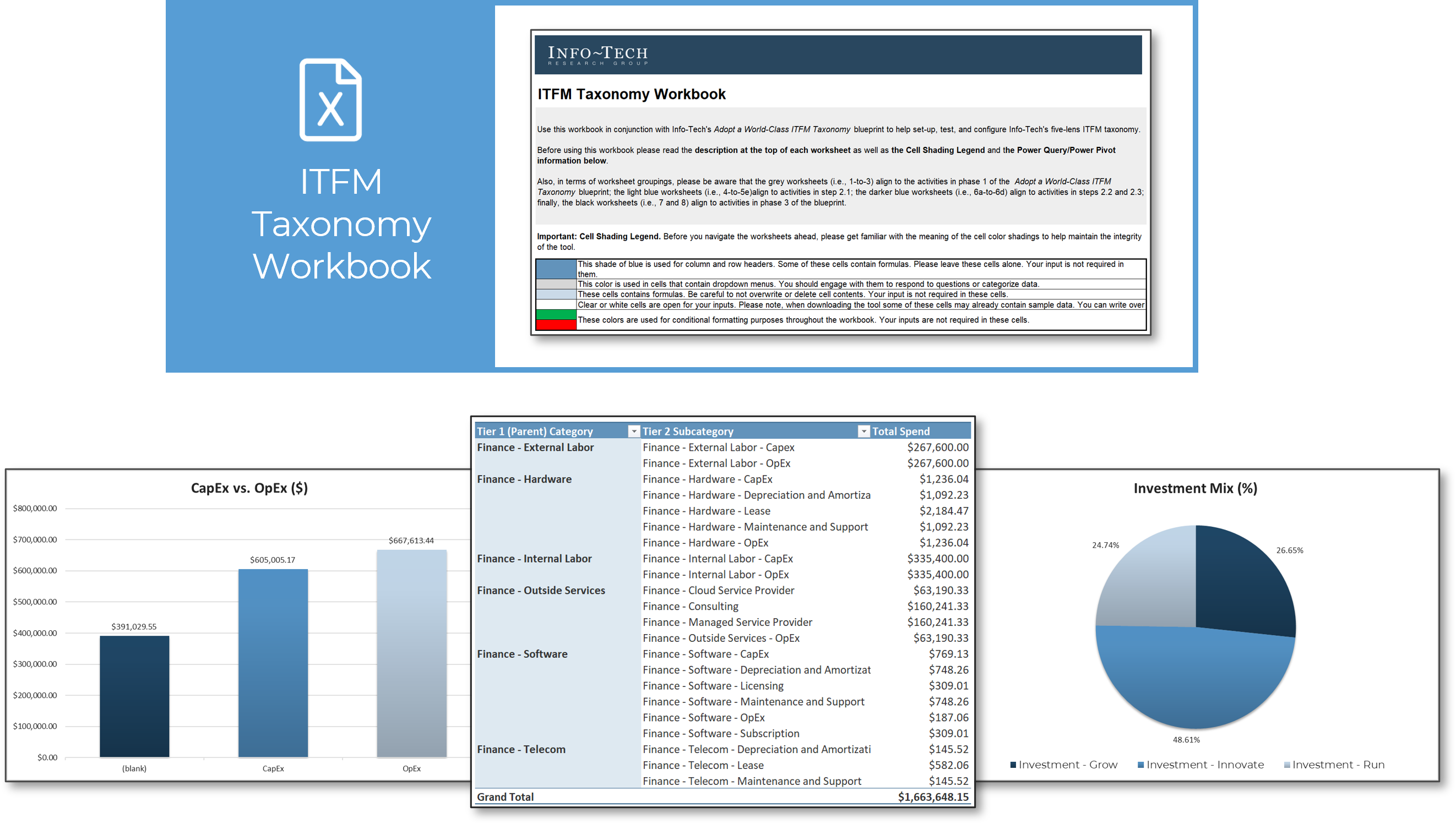
ITFM Taxonomy Presentation & Implementation Plan
Use this PowerPoint to document and communicate your ITFM taxonomy to key stakeholders and get aligned on next steps.
Blueprint Benefits
IT Benefits | Business Benefits |
|---|---|
|
|
Case Study
Applying some structure was the first step in making IT's procurement data fit for analysis and cost control efforts.
INDUSTRY: Local Government
SOURCE: Anonymous
Challenge
The IT department for a municipal government needed clean procurement data. Procurement was a major driver of costs, so it needed to be analyzed and controlled.
Unfortunately, the finance department's chart of accounts (CoA) did not have the granularity required to provide useful levels of transparency. In addition, the procurement department's data was not well integrated with the CoA.
Getting any IT financial data out of the ERP system demanded significant extraction and translation efforts for the data to be fit for analysis.
Complication
Simply put, IT and Finance were not speaking the same language:
- IT leadership did not understand Finance's CoA. There were also some problems with the CoA itself, such as unique IT vendors scattered across different accounts and hardware spending erroneously showing up in the software category.
- Finance did not understand IT's need to have a different method for classifying its financial data because the current structure had always passed audit.
Results
The IT department opted for a quick and low-cost solution that involved three people: a part-time business analyst, a part-time financial manager, and an external consultant.
The consultant was able to build a data model that was sufficient for the business analyst to run SQL queries and generate spreadsheet-based outputs that met the CIO's needs.
Overall, it was a time-consuming effort, but automations were eventually integrated into the relevant systems to accelerate the process.
Guided Implementation
What does a typical GI on this topic look like?
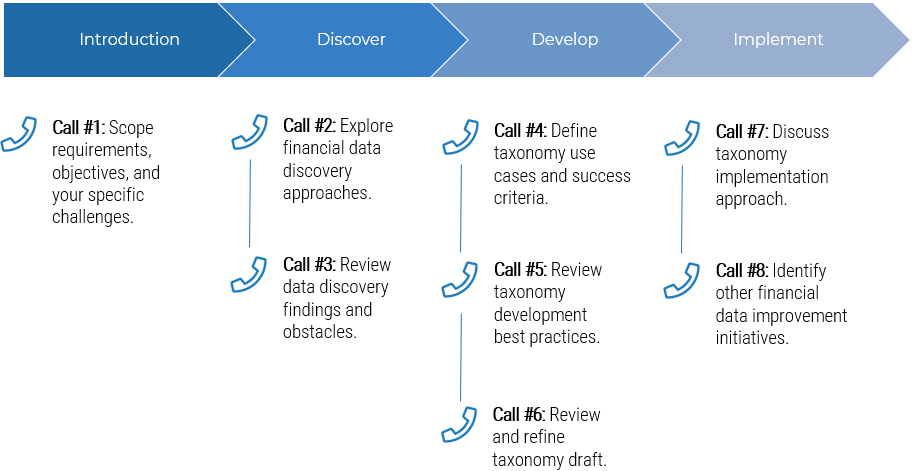
A Guided Implementation (GI) is a series of calls with an Info-Tech analyst to help implement our best practices in your organization.
A typical GI is six to eight calls over the course of one to three months.
Workshop Overview
Contact your account representative for more information.
workshops@infotech.com 1-888-670-8889
Day 1 | Day 2 | Day 3 | Day 4 | Day 5 | |
Activities | Identify Taxonomy Use Cases and Objectives | Map Your Workforce Spend to Your Taxonomy | Map Your Vendor Spend to Your Taxonomy | Plan Taxonomy Implementation | Next Steps and |
|
|
|
|
| |
Deliverables |
|
|
|
|
|
Info-Tech offers various levels of support to best suit your needs
DIY Toolkit
"Our team has already made this critical project a priority, and we have the time and capability, but some guidance along the way would be ."
Guided Implementation
"Our team knows that we need to fix a process, but we need assistance to determine where to focus. Some check-ins along the way would help keep us on track."
Workshop
"We need to hit the ground running and get this project kicked off immediately. Our team has the ability to take this over once we get a framework and strategy in place."
ITSS Benchmarking Service
"Our team does not have the time or the knowledge to take this project on. We need assistance through the entirety of this project."
Diagnostics and consistent frameworks are used throughout all four options.
Phase 1: Prepare Your Data
Phase 1: Prepare Your Data | Phase 2: Map Your Data | Phase 3: Plan Your Rollout |
|---|---|---|
|
|
|
Phase Outcomes
- Shared understanding of ITFM taxonomy
- Clarity on current IT financial data sources, use cases, and gaps
- Alignment on objectives for taxonomy configuration and mapping
Step 1.1
Get to Know Info-Tech's ITFM Taxonomy
Activities
1.1.1 Evaluate Info-Tech's ITFM Taxonomy
This step involves the following participants:
- Head of IT
- IT financial lead
- Other IT managers
- Finance lead
- Procurement function representative
- HR function representative
Outcomes of this step
Alignment on Info-Tech's ITFM taxonomy lenses and their relevance to your organization's reporting needs
IT financial data is commonly a source of confusion
Organizations often make big decisions on technology spend based on incomplete, misunderstood, or just plain bad data.
IT spend data doesn't travel well inside most organizations.
- As it moves from systems to spreadsheets to slides (and across IT, Finance, and the business) numbers become outdated, context becomes unanchored, and the investment rationale can get lost in transit.
- What's more, knowing what IT financial data actually is in the first place, and what good data looks like, can be a challenge. On one hand, the money trail is clear in systems of record. On the other, the decision and consumption trail is chaotic – scattered plans, ungoverned TCO assumptions, and one-off purchases that bypass central processes.
- IT financial data should offer actionable insights into costs, commitments, and consumption tied to technology. Good data is timely, reconciled, and traceable from invoice to outcomes. Getting to "good," and staying there, takes sustained, cross-functional discipline across the organization.
89% | Percentage of CFOs who say they are making decisions based on inaccurate or incomplete data on a monthly basis. |
53% | Percentage of IT teams that report challenges getting visibility into technology spending. |
Get your financial data house in order to earn stakeholder trust
Transparent and reliable financial data doesn't just balance the books. It builds credibility.
- Perhaps more than any other IT management activity, financial transparency is how IT earns trust with executive stakeholders, business units, and internal teams.
- When IT can show where the money goes (e.g. by technology, by service, by consumer) it helps dispel the perception of IT as being a "closed box" – i.e. a place where money goes in, reports come out, but how costs are derived and justified remains a mystery.
- With the right level of financial transparency, instead of viewing IT as nothing more than a cost center, finance and business leaders will view it as a value driver and get answers they can act on.
86% | Percentage of CIOs who say that improving ITFM capabilities is key to improving IT's credibility with business stakeholders. |
"A strong partnership between the CFO and CIO is essential for achieving high success rates in digital transformation efforts."
– Kim Hendil Tegner, 2025
Data quality is a major obstacle to mature ITFM
IT financial data is often inaccurate, incomplete, or not fit for purpose. Three common obstacles stand in the way.
Poor Reliability
- There is a lack of quality controls around data collection and input.
- The people who have accountability for financial outcomes often are not the people who know what to do to impact outcomes.
- IT is not the only group generating financial data about technology in the organization.
Poor Usability
- Data is not consolidated but rather sits in multiple systems and email inboxes.
- Data exists in hard-to-use forms or formats, such as on paper or in uneditable PDF files.
- No IT financial taxonomy or classification system is in place to describe what the data actually is, enable searchability, or support analysis.
Poor Availability
- IT doesn't know where some data lives or lacks access to the right systems/tools
- Weak procedures delay entry into source systems, leaving available data persistently out of date.
- IT needs details Finance doesn't capture, so the finance record can't supply what IT requires.
Info-Tech Insight
Many in IT do not understand Finance and many in Finance do not understand IT. These two groups struggle to get past this fundamental misalignment and rarely get around to rectifying their shared financial data challenges.
A good taxonomy can bring meaning and organization to your ITFM data
An ITFM taxonomy can help confront data obstacles and stakeholder misunderstandings, but it needs to be well-rounded.
- A taxonomy is a structured way of organizing raw data into distinct categories to help make data easy to consume, compare, and communicate. Well known taxonomies include the animal kingdom classification system and the Dewey Decimal Classification used in public libraries.
- In an ITFM setting, a well-designed taxonomy that speaks to the points of view of IT, Finance, the C-suite and business leaders, and end users can help to organize fragmented, siloed, and complex data into meaningful categories that support shared understanding and analysis – and ultimately stakeholder alignment on technology spend.
- The right ITFM taxonomy can help bridge silos by providing a shared language for cost classification, enabling better budgeting, forecasting, and value communication.
"An effective taxonomy not only categorizes data but does so in a manner that is universally understood across the organization.
[A taxonomy] ensures that everyone, from top-level executives to frontline employees, speaks the same language. This uniformity simplifies data analysis, reduces the risk of misinterpretation, and aids in swift, informed decision-making."
– Decision Foundry, 2023
About Info-Tech
Info-Tech Research Group is the world’s fastest-growing information technology research and advisory company, proudly serving over 30,000 IT professionals.
We produce unbiased and highly relevant research to help CIOs and IT leaders make strategic, timely, and well-informed decisions. We partner closely with IT teams to provide everything they need, from actionable tools to analyst guidance, ensuring they deliver measurable results for their organizations.
What Is a Blueprint?
A blueprint is designed to be a roadmap, containing a methodology and the tools and templates you need to solve your IT problems.
Each blueprint can be accompanied by a Guided Implementation that provides you access to our world-class analysts to help you get through the project.
Need Extra Help?
Speak With An Analyst
Get the help you need in this 4-phase advisory process. You'll receive multiple touchpoints with our researchers, all included in your membership.
Guided Implementation 1: Introduction
- Call 1: Scope requirements, objectives, and your specific challenges.
Guided Implementation 2: Discover
- Call 1: Explore financial data discovery approaches.
- Call 2: Review data discovery findings and obstacles.
Guided Implementation 3: Develop
- Call 1: Define taxonomy use cases and success criteria.
- Call 2: Review taxonomy development best practices.
- Call 3: Review and refine taxonomy draft.
Guided Implementation 4: Implement
- Call 1: Discuss taxonomy implementation approach.
- Call 2: Identify other financial data improvement initiatives.
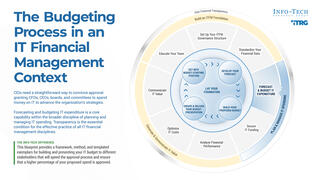 Create a Transparent and Defensible IT Budget
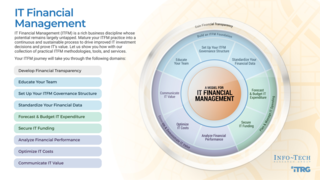 Take a Holistic Approach to IT Financial Management
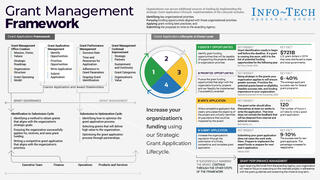 Increase Grant Application Success
 Manage an IT Budget
 Establish a Service-Based Costing Model
 Implement an IT Chargeback System
 Build Your IT Cost Optimization Roadmap
 Take Control of Cloud Costs on AWS
 Take Control of Cloud Costs on Microsoft Azure
 Cost-Reduction Planning for IT Vendors
 Start Making Data-Driven People Decisions
 Maximize Your American Rescue Plan Funding
 Achieve IT Spend & Staffing Transparency
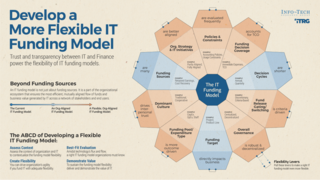 Develop a Flexible IT Funding Model
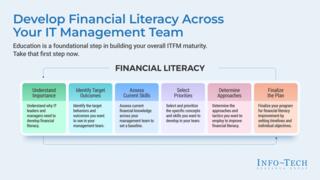 Develop Your IT Leadership Team’s Financial Literacy
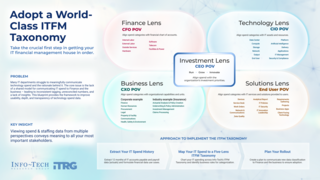 Adopt a World-Class ITFM Taxonomy
 Implement an Adaptive System for IT Financial Management
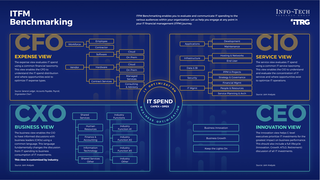 IT Spend and Staffing Benchmarking: Realign Resources for Success
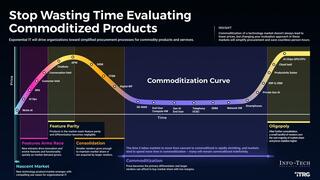 Stop Wasting Time Evaluating Commoditized Products and Services
 Build an ITFM Improvement Roadmap
 IT Spend and Staffing Benchmarking
 Adapt to Uncertainty: Optimize Your Top Areas of IT Spend
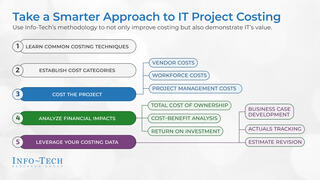 Invest in Realistic and Comprehensive Project Costing
 Demonstrate IT Value Through ITFM Reporting
 Establish End-to-End Visibility Over AI Spend