
Establish End-to-End Visibility Over AI Spend
Establish visibility, understand spend, then lead with confidence.
- AI spend is growing faster than governance while being fragmented across business units, leading to IT owning the overspend.
- Teams typically only learn which project drove the spend once the invoice arrives, not at the moment it happens.
- 94% of IT decision-makers struggle to manage cloud and AI costs, with no clear model for who owns AI spend across FinOps, ITFM, and procurement.
Our Advice
Critical Insight
- Treat AI spend management as a governance exercise, not an accounting exercise. You are driving accountability and ultimately better value management for your AI investments.
- AI spend is fragmented by design, living across IT, Finance, Procurement, and business teams. Naming one accountable owner and agreeing on who approves spend before you touch the data is what turns a one-time audit into a repeatable governance habit.
- You can't manage what you can't compare. Normalizing every vendor's pricing, whether tokens, seats, or GPU hours, into one taxonomy and attributing each dollar to an owner and project turns raw invoices into decision-ready data. Aim for 80% coverage, not perfection.
- The key to successfully establishing end-to-end visibility over AI spend involves aligning stakeholders early in the process. Establishing a single source of truth for AI spend data at the start helps avoid surprise costs, duplicated tools, and untracked shadow AI.
Impact and Result
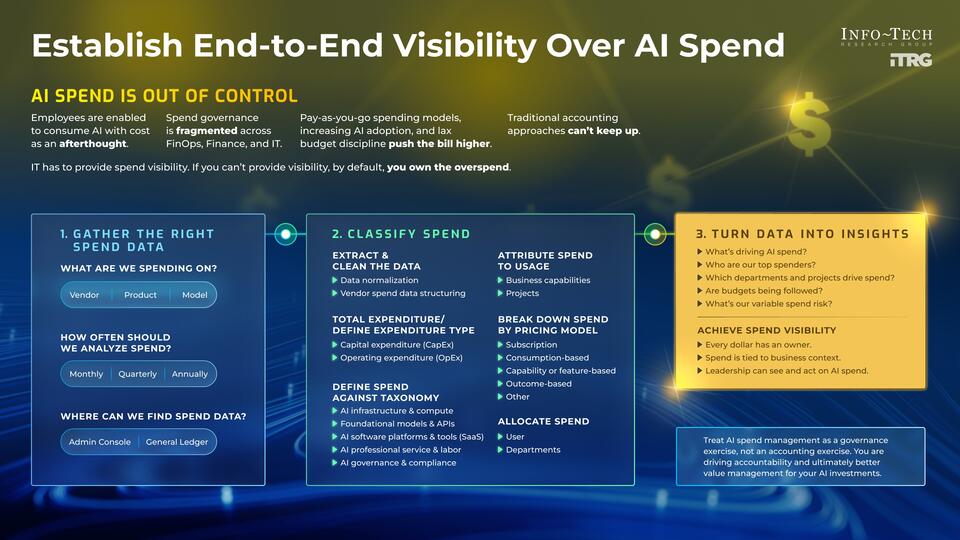
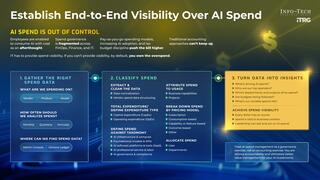
- Establish end-to-end visibility over AI spend, built on a three-phase cycle: Surface, Clean, and Present
- Surface every dollar from vendor consoles and invoices and allocate spending to clear owners, clean and analyze your spend data, then track variance and spend drivers to build a defensible view of value.
- A ready-to-use workbook will guide you through transforming raw admin console data into an insights to build board-ready executive deck.
Establish End-to-End Visibility Over AI Spend
Establish visibility, understand spend, then lead with confidence.
Analyst Perspective
Treat AI spend management as a governance exercise, not an accounting exercise. You are driving accountability and ultimately better value management for your AI investments.

AI spend is accelerating across your organization. Departments are adding new AI initiatives faster than you can count, all while IT is being asked “what are we spending on AI?” There is no centralized dataset that can tell us in a timely way what’s being spent, on which vendors, by which departments, or on which projects and business capabilities. Many individuals are empowered to make spending decisions without prior approval. There is no framework on how to attribute and classify the spend.
You can’t talk about the ROI of your AI investments without being able to say what you spent. Treat AI spend management as a governance exercise, not an accounting exercise. You are driving accountability and ultimately better value management for your AI investments.
Armaan Sandhu
Analyst, AI Research
Info-Tech Research Group
Establish End-to-End Visibility Over AI Spend
EXECUTIVE BRIEF
Executive Summary
Your Challenge
- You have twin mandates: drive innovation and manage spend.
- AI spend is growing faster than governance can keep up. It is fragmented across business units, leading to IT owning the overspend.
- 94% of IT decision-makers struggle to manage cloud and AI costs, with no clear model for who owns AI spend across FinOps, ITFM, and procurement.
Common Obstacles
- AI spend sits in many places at once: AI-first vendors, AI add-ons, one-time setup bills.
- Each provider prices differently: Tokens, API calls, seats, GPU hours, and storage can all roll up into one invoice, making side-by-side comparison and forecasting difficult.
- Cost data lacks business context, and ownership is shared and unclear. Spend allocation and attribution must be reverse-engineered after the money’s spent.
Info-Tech’s Approach
- Establish End-to-End Visibility Over AI Spend, built on a three-phase cycle: Surface, Clean, and Present.
- Surface every dollar from vendor consoles and invoices, allocate it to clear owners, projects, and cost types, then track variance and spend drivers to build a defensible view of value.
- A ready-to-use workbook guides you through transforming raw admin console data into an insights to build board-ready executive deck.
Info-Tech Insight
Treat AI spend management as a governance exercise, not an accounting exercise. You are driving accountability and ultimately better value management for your AI investments.
AI spend is outrunning organizational visibility
- AI spend is growing rapidly. CFOs are demanding to see what’s being spent and why.
- FinOps, ITFM, and accounting each see only a piece of the full picture. No one group is responsible for putting the pieces together, and there is no clear ownership model for AI oversight and management.
- Because ownership over AI spend is fragmented, and because the necessary data to find and manage spend often sits within admin consoles of different tools, the onus is falling to the CIO to sort through the mess.
- Every departmental IT leader must prepare to offer a defensible answer when they are inevitably asked, “What are we spending on AI?”
65%
Unexpected AI charges
65% of IT leaders report unexpected charges from usage-based or consumption pricing.
Source: USM Systems, 2025
56%
Inaccurate AI forecasting
56% of companies miss AI cost forecasts by 11%-25%; 24% miss by more than 50%.
Source: CFO Dive, 2025
94%
AI billing risk
94% of IT decision-makers struggle to manage cloud and AI costs, with 44% citing limited visibility.
Source: TechRadar, 2025
AI spend is fragmented and volatile
These barriers make AI spend visibility hard to achieve in practice:
- AI spend sits in many places at once, including hyperscaler bills, SaaS add-ons, copilots embedded in the tools the organization already owns, and direct purchases by business teams. There is no single system of record.
- A variety of pricing models exist. There are subscriptions, but also pricing by tokens, credits, seats, outcomes, or a combination of the above, which makes it hard to compare or project costs.
- Cost data lacks business context. Invoices rarely tell us which initiative, team, or use case drove the usage, so allocation has to be rebuilt after the fact.
80%
of enterprises miss their AI infrastructure forecasts by more than 25%.
Source: Mavvrik, 2025
78%
of IT leaders report unexpected charges from consumption based or AI pricing models.
Source: Zylo, 2025
Info-Tech’s methodology for establishing visibility over AI spend
Phase Steps |
Phase 1: Surface Spend and Align Stakeholders1.1 Gather spend data. 1.2 Align on scope and approach. |
Phase 2: Clean and Analyze your Spend Data2.1 Import your spend data for analysis. 2.2 Allocate and attribute spend. 2.3 Validate and reconcile your analysis. 2.4 Identify spending trends and issues. |
Phase 3: Present Findings to Executives3.1 Document and present your findings. |
Phase Outcomes |
|
|
|
Insight summary
Governance, not accounting
Treat AI spend management as a governance exercise, not an accounting exercise. You are driving accountability and ultimately better value management for your AI investments.
Name the owner first
AI spend is fragmented by design, living across IT, Finance, Procurement, and business teams. Naming one accountable owner and agreeing on who approves spending before you touch the data is what turns a one-time audit into a repeatable governance practice.
80% beats perfect
Spend and adoption are moving fast enough that most organizations can’t wait for fully vetted data from the general ledger to conduct cost control exercises. Focus on the smaller subset of vendor contracts that are driving most of your spend and risk.
Lead with the story
Executives fund stories, not spreadsheets. Translate your analysis into a narrative that clearly articulates the scope of the challenge and starts the real strategic conversation: how to manage spend without stifling innovation.
Align early, avoid surprises
Identify your key stakeholders early, and align on the goals, definitions, and scope for your spending discovery exercise. Early alignment helps clarify whether the goal is chargeback, showback, or capability preservation, and it helps you deliver the right spend metrics and spend management recommendations.
Start with admin console data
Pull directly on a regular basis from vendor admin consoles rather than rebuilding spend from guesswork or high-level invoices. The dataset available from most AI tooling admin consoles is far more granular and useful than the spend data available from your GL.
Blueprint deliverables
Each step of this blueprint is accompanied by supporting deliverables to help you accomplish your goals:
AI Spend Workbook
Capture, classify, and allocate every AI dollar in one workbook.
Key deliverable:
Executive Presentation Template
Turn your workbook findings into a board-ready executive story.
Blueprint benefits
IT benefits
- A single, defensible answer to what you spend on AI, with whom, and on what, across cloud, SaaS, APIs, and shadow tools.
- Consumption and token costs surfaced early, before invoices spike, so cost growth gets caught in time.
- AI spend managed as one governed category instead of scattered across FinOps, ITFM, and procurement.
- Evidence to move faster on vendor, renewal, and tool-consolidation decisions.
Business benefits
- Every AI dollar tied to a project, department, and pricing model, so budgets hold and spend has clear owners.
- Shadow and business-led AI spend brought into view and folded into one managed total.
- A clear picture of where AI spend concentrates, so leaders can prioritize and reallocate with confidence.
- A board-ready view of AI spend and its drivers to support planning and budget conversations.
About Info-Tech
Info-Tech Research Group is the world’s fastest-growing information technology research and advisory company, proudly serving over 30,000 IT professionals.
We produce unbiased and highly relevant research to help CIOs and IT leaders make strategic, timely, and well-informed decisions. We partner closely with IT teams to provide everything they need, from actionable tools to analyst guidance, ensuring they deliver measurable results for their organizations.
What Is a Blueprint?
A blueprint is designed to be a roadmap, containing a methodology and the tools and templates you need to solve your IT problems.
Each blueprint can be accompanied by a Guided Implementation that provides you access to our world-class analysts to help you get through the project.
Need Extra Help?
Speak With An Analyst
Get the help you need in this 3-phase advisory process. You'll receive multiple touchpoints with our researchers, all included in your membership.
Guided Implementation 1: Surface spend and align stakeholders
- Call 1: Scope requirements, objectives, and introduce the approach.
Guided Implementation 2: Collect and analyze your spend data
- Call 1: Review extracted data and discuss data cleaning and enrichment.
- Call 2: Review allocation and attribution of AI spend.
Guided Implementation 3: Build the executive deck and present findings
- Call 1: Review key insights.
- Call 2: Review the executive presentation.
Contributors
Fred Leonard, Director – Digital Solutions, Ecosystem Energy
 Create a Transparent and Defensible IT Budget
 Take a Holistic Approach to IT Financial Management
 Increase Grant Application Success
 Manage an IT Budget
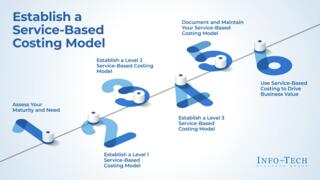 Establish a Service-Based Costing Model
 Implement an IT Chargeback System
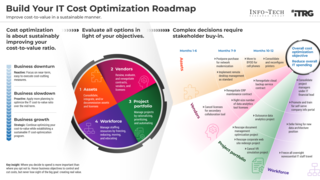 Build Your IT Cost Optimization Roadmap
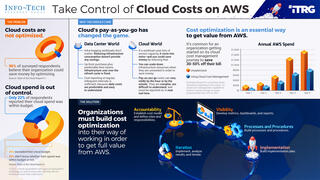 Take Control of Cloud Costs on AWS
 Take Control of Cloud Costs on Microsoft Azure
 Cost-Reduction Planning for IT Vendors
 Start Making Data-Driven People Decisions
 Maximize Your American Rescue Plan Funding
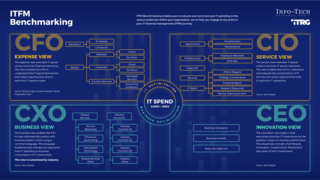 Achieve IT Spend & Staffing Transparency
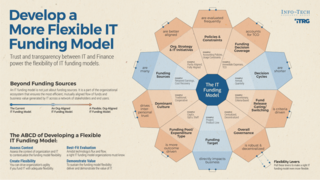 Develop a Flexible IT Funding Model
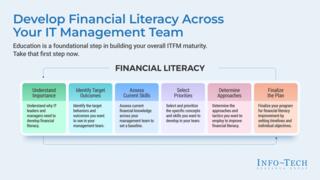 Develop Your IT Leadership Team’s Financial Literacy
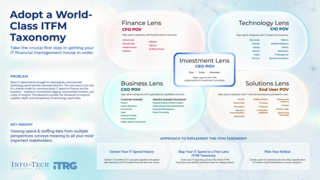 Adopt a World-Class ITFM Taxonomy
 Implement an Adaptive System for IT Financial Management
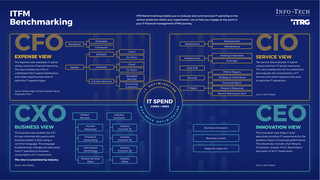 IT Spend and Staffing Benchmarking: Realign Resources for Success
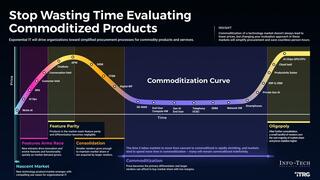 Stop Wasting Time Evaluating Commoditized Products and Services
 Build an ITFM Improvement Roadmap
 IT Spend and Staffing Benchmarking
 Adapt to Uncertainty: Optimize Your Top Areas of IT Spend
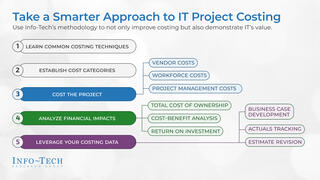 Invest in Realistic and Comprehensive Project Costing
 Demonstrate IT Value Through ITFM Reporting
 Establish End-to-End Visibility Over AI Spend
