
Invest in Realistic and Comprehensive Project Costing
Do the math now so that you can defend the spend later.
IT leaders are often held accountable for unexpected cost overruns despite routinely being excluded from project budgeting in the first place. The result? Initiatives that fail to deliver, strained relationships with finance, and an ongoing credibility gap. Our actionable research helps IT leaders get a seat at the budget table, adopt a more realistic project costing model, and clearly demonstrate IT’s value.
Inflation is pushing tech prices higher. Don’t let outdated, idealistic, and incomplete costing sink your IT investments. Embrace a data-supported but agile costing approach to build credibility and improve long-term planning.
1. Committing to exact numbers is foolish
A static budget with rigid figures doesn’t reflect shifts in tech pricing, especially in areas like cloud where costs can rise by 20 to 30% or more annually. Move to flexible, range-based costing models that account for uncertainty, inflation, and vendor volatility and revisit your costing model as you get closer to the spend date.
2. Stop overpromising and underestimating.
It’s a common scenario in many projects: the potential benefits are exaggerated while the costs and risks are underestimated. This leads to costs that are higher than expected and IT initiatives that deliver less value than anticipated.
3. Ignoring post-project costs is a costly mistake.
Don’t gloss over how much it will cost to maintain and support the outcomes of a project over the long term. Be sure to calculate your planned investment’s total cost of ownership in the early stages to avoid unpleasant surprises down the road.
Use this step-by-step blueprint to avoid costing problems from the very start.
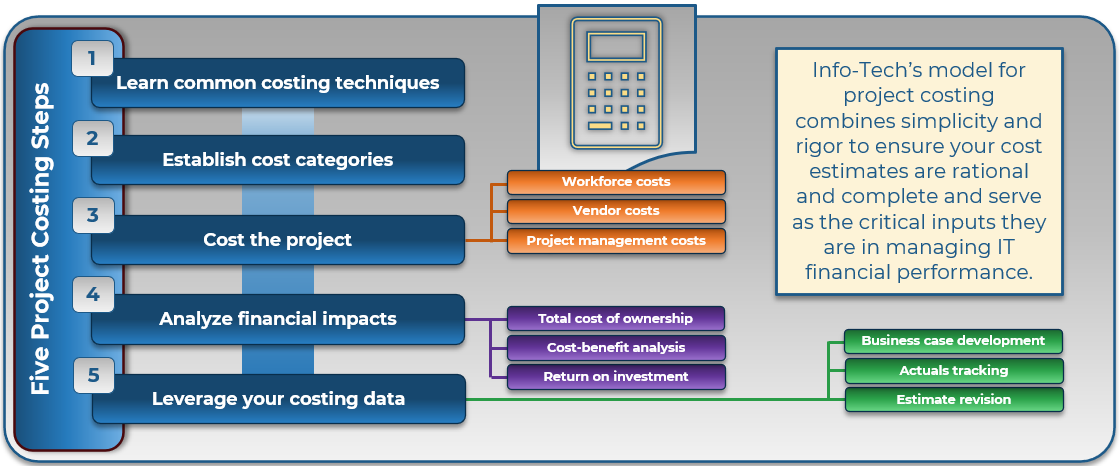
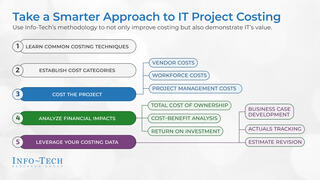
Our complete five-step costing strategy, complemented by four Excel-based financial workbooks and tools, helps IT leaders create credible, adaptable, and defensible project and investment cost estimates. Use this research to:
- Learn common project costing techniques and the pros and cons of each.
- Establish IT cost categories and organize your costing data to generate reports on your project’s progress and performance.
- Cost your project by documenting your working assumptions, identifying and quantifying benefits and risks, calculating workforce and vendor costs, and determining behind-the-scenes costs.
- Analyze financial impacts by determining how to measure your project’s long-term success.
- Leverage your costing data by communicating, tracking, reviewing, and revising it.
Invest in Realistic and Comprehensive Project Costing
Do the math now so that you can defend the spend later.
Analyst perspective
A project's costs are a key determinant of its success – or its failure.
All too often, IT leaders are asked why IT OpEx is so high and then struggle to answer the question. However, the answer is simple – we're spending what we're spending today because a decision was made in the past by our leadership to invest in technologies that bring operational efficiencies to the organization and support its growth. Almost all of today's OpEx is the direct result of yesterday's strategic and capital projects.
Yet evidential business cases and project planning documents that describe how and why the decision to invest was made in the first place are often inaccurate, incomplete, or missing entirely. The original "why" has simply vanished.
But it doesn't have to be this way. The first step in rationalizing today's spend is to develop full and realistic project cost estimates combined with total cost of ownership projections that demonstrate how much it will cost to manage and maintain the outcomes of that project. Only when this math has been done should an organization commit to any technology investment.
And with this math in hand, IT can prove why it's spending what it's spending today as well as prove the value it's delivering to the organization.

Jennifer Perrier
Principal Research Director, CIO Practice
Info-Tech Research Group
Executive summary
Your Challenge
Projects and finances go hand in hand, making project costing an essential skill for every IT department.
- Unfortunately, IT projects have become famous for their time and budget overruns.
- One of the major causes of these overruns is poor project estimation practices, particularly in the area of project costing.
- These poor practices are rampant, which virtually guarantees budget overruns and, too often, project failure.
Common Obstacles
Not applying financial management rigor to project intake and approval is the start of the problem, leading to:
- Overestimated benefits.
- Glossed-over risks and uncertainties.
- Underestimated costs.
- Unrevised cost forecasts in the face of change.
Many projects that should never have been approved in the first place are allowed to live on, gobbling up ever more precious funding.
Info-Tech's Approach
Practice sound project costing from the start:
- Learn common project costing techniques and set meaningful cost categories to support planning, tracking, and reporting.
- Estimate your project's workforce, vendor, and project management costs across best-case and worst-case scenarios to account for uncertainty.
- Give yourself the data to both analyze every technology investment's financial performance and prove the value of IT.
Info-Tech Insight
Given uncertainties about next month, let alone next year, committing to an exact project cost number is not only foolish but also dishonest. Instead, offer a projected cost range that can be narrowed as you get closer to the spend date and the state of variables that influence those costs become better known.
EXECUTIVE BRIEF
Projects and finances go hand in hand
All projects should pass the CFO's sniff test to gain approval.
Every project plan, big or small, seeks to answer a few fundamental questions:
- What capability do we want to build or foster in the organization?
- What tasks do we need to complete to bring that capability to life?
- How much do we need to spend to complete those tasks?
- What do we need to do to mitigate risks to the proposed capability's success?
- How much do we need to keep spending to sustain that capability over the long term?
- How will we know if, and when, our investments are paying off?
The fact is that finances – and specifically costs – are at the heart of every sound business case.
Understanding how to confidently and comprehensively forecast project costs and their potential returns is an essential skill for anyone in an IT leadership or management role.
Project costing is an essential skill
When stacked up against benefits and risks, cost becomes the key determinant of whether a project is (or should be) done.
What is project costing?
- Project costing is the identification, estimation, tracking, and management of the financial resources required to successfully complete a project.
- The result of this is that you must determine the resources required to do the project as well as the price and quantity of each of those resources.
The scale of a project's costs is determined or influenced by the project's requirements and characteristics, namely:
- Scope – features, scale, complexity
- Time – effort, duration, schedule, milestones/deadlines
- Materials – licenses, hardware, data, documentation
- Skills – specialization, availability
- Risks – likelihood, impact, uncertainty
- Quality – standards, testing, acceptance
- Communications – coordination, check-ins, updates
Poor costing contributes to massive overruns
The story of IT project cost overruns is an old one, and the ending doesn't appear to getting any happier.
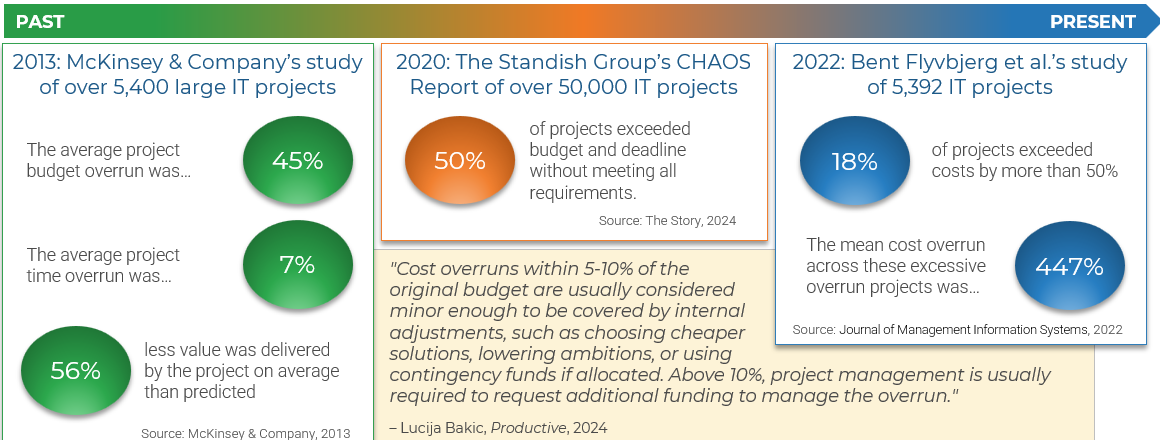
Rampant bad practices virtually guarantee overruns
If you want to ensure IT project cost overruns (and you most definitely don't), then do these things.
Bad practices: Perspective |
Bad practices: Experience |
Bad practices: Shortcutting |
|---|---|---|
|
|
|
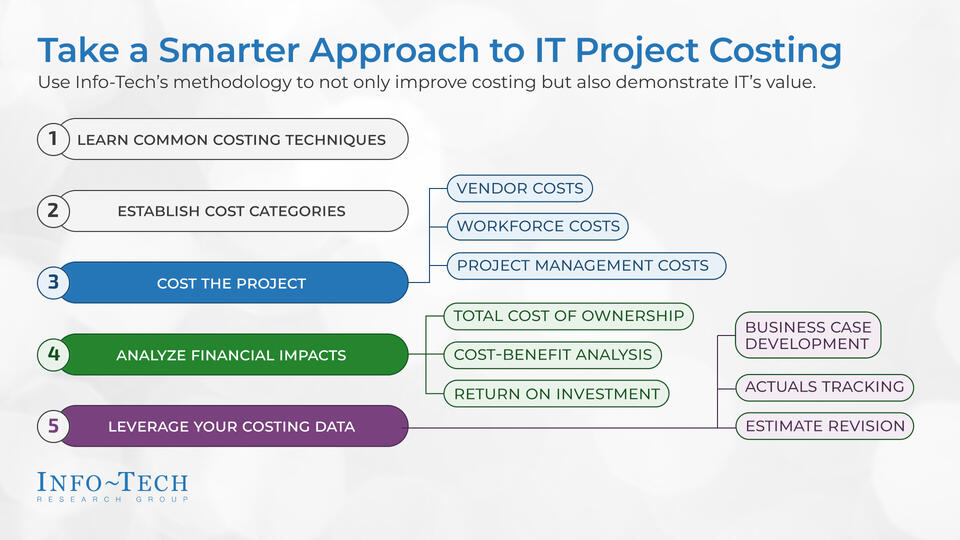
Take a smarter approach to IT project costing
Use Info-Tech's methodology to not only improve costing but demonstrate IT's value.
Blueprint deliverables
This blueprint is accompanied by supporting deliverables to help you accomplish your goals:
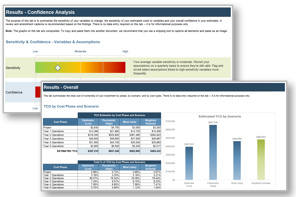
TCO Calculator
Estimate your proposed investment's total project costs plus the postproject operations and maintenance cost.
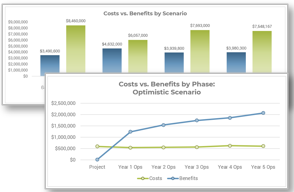
Cost-Benefit Analysis Tool
Perform this critical investment feasibility step by assessing both tangible and intangible costs and benefits.
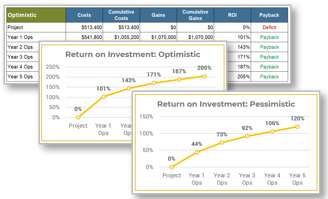
ROI Workbook
Estimate the financial costs versus gains of your investment and forecast when you can expect payback.
Key deliverable:
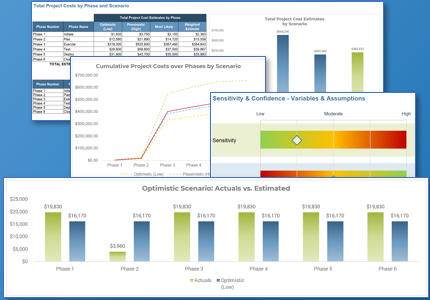
Project Costing Workbook
Use this Excel workbook to document optimistic, pessimistic, most likely, and weighted cost estimates for a proposed project.
Measure the value of this blueprint
The potential positive outcomes of improved project costing include:
- More accurate and realistic numbers.
- Improved sensitivity to risk and uncertainty.
- Better assessment of project feasibility.
- Enhanced financial transparency.
- Reduced cost overruns.
- Increased confidence.
- Fact-based information to prove the project's and IT's true value.
Use some or all of the metrics and recommended targets described in this table to track and assess the effectiveness of your project costing improvement efforts.
| Metric |
Recommended Targets |
Outcomes |
|---|---|---|
|
Improved feasibility assessment |
|
All approved projects realize intended benefits. |
|
Reduced project cost overruns |
|
All projects are at or below forecasted cost values. |
|
Increased confidence in IT |
|
Improved stakeholder satisfaction with project results. |
Insight summary
Overarching insight
Given uncertainties about next month, let alone next year, committing to an exact project cost number is not only foolish but also dishonest. Instead, offer a projected cost range that can be narrowed as you get closer to the spend date and the state of variables that influence those costs become better known.
Insight 1
Today's OpEx was born in yesterday's strategic capital projects. To provide a rationale for today's spend, you need to look at the rationale behind the project that caused that spend in the first place. This means revisiting the original business case.
Insight 2
One of the major determinants of a project's value is its cost. However, you can't prove a project's value if you don't set up the metrics that capture and prove that value prior to the project being approved. Project costing is one of these foundational metrics.
Insight 3
Too often, IT project benefits are exaggerated, the costs underestimated, and the assessment of true risk glossed over. All the above mistakes lead to cost overruns and the ultimate failure of many IT projects to deliver anticipated value.
Insight 4
An overlooked component of project approval is what it will cost to maintain and support the outcomes of that project over the long term. This means calculating both the project's cost and the planned investment's total cost of ownership at the start.
Insight 5
You can't do a thorough cost-benefit analysis without costing. You also can't forecast return on investment or any other profitability metric without it either. And with many things in life, the calculations are only as good as their inputs.
Guided Implementation
What does a typical GI on this topic look like?
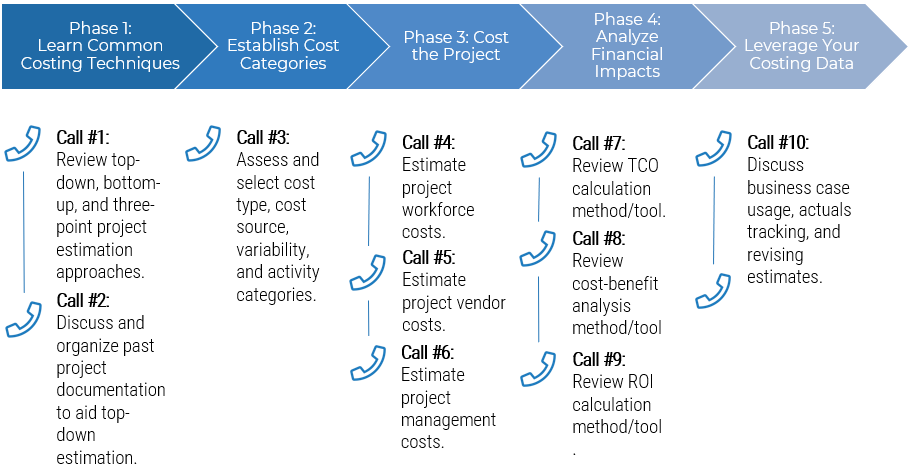
A Guided Implementation (GI) is a series of calls with an Info-Tech analyst to help implement our best practices in your organization.
A typical GI is 8 to 12 calls over the course of 3 to 5 months.
PHASE 1
LEARN COMMON COSTING TECHNIQUES
Learn common project costing techniques
There are many ways to cost a project, and no one way is perfect for every project.
In this phase, we'll review the most commonly used methods for costing projects and other tactics that will help better forecast and manage those costs. Specifically, this phase aims to help you:
- Understand that, given uncertainty, your project cost estimate is just that – an estimate – and not a promise.
- Learn the pros and cons of the leading cost estimation techniques – top-down, bottom-up, three-point, and parametric.
- Take a blended approach that uses several cost estimation techniques to ensure that you can leverage past lessons learned, ensure nothing is missed, and account for uncertainty.
- Consider how to scale the various costing techniques to suit not only your experience and expertise levels but also the proposed project's size, scale, and complexity.
"What happens in the planning phase often determines whether a project will succeed. At the core of this phase is cost estimation."
– Chris Hutchings, Galorath, 2024
About Info-Tech
Info-Tech Research Group is the world’s fastest-growing information technology research and advisory company, proudly serving over 30,000 IT professionals.
We produce unbiased and highly relevant research to help CIOs and IT leaders make strategic, timely, and well-informed decisions. We partner closely with IT teams to provide everything they need, from actionable tools to analyst guidance, ensuring they deliver measurable results for their organizations.
What Is a Blueprint?
A blueprint is designed to be a roadmap, containing a methodology and the tools and templates you need to solve your IT problems.
Each blueprint can be accompanied by a Guided Implementation that provides you access to our world-class analysts to help you get through the project.
Need Extra Help?
Speak With An Analyst
Get the help you need in this 5-phase advisory process. You'll receive multiple touchpoints with our researchers, all included in your membership.
Guided Implementation 1: Learn common costing techniques
- Call 1: Review top-down, bottom-up, and three-point project estimation approaches.
- Call 2: Discuss and organize past project documentation to aid top-down estimation.
Guided Implementation 2: Establish cost categories
- Call 1: Assess and select cost type, cost source, variability, and activity categories.
Guided Implementation 3: Cost the project
- Call 1: Estimate project workforce costs.
- Call 2: Estimate project vendor costs.
- Call 3: Estimate project management costs.
Guided Implementation 4: Analyze financial impacts
- Call 1: Review TCO calculation method/tool.
- Call 2: Review cost-benefit analysis method/tool.
- Call 3: Review ROI calculation method/tool.
Guided Implementation 5: Leverage your costing data
- Call 1: Discuss business case usage, actuals tracking, and revising estimates.
 Create a Transparent and Defensible IT Budget
 Take a Holistic Approach to IT Financial Management
 Increase Grant Application Success
 Manage an IT Budget
 Establish a Service-Based Costing Model
 Implement an IT Chargeback System
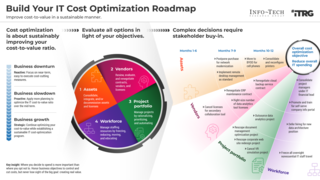 Build Your IT Cost Optimization Roadmap
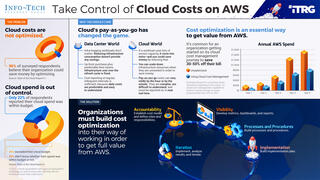 Take Control of Cloud Costs on AWS
 Take Control of Cloud Costs on Microsoft Azure
 Cost-Reduction Planning for IT Vendors
 Start Making Data-Driven People Decisions
 Maximize Your American Rescue Plan Funding
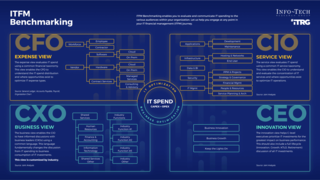 Achieve IT Spend & Staffing Transparency
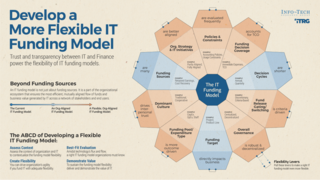 Develop a Flexible IT Funding Model
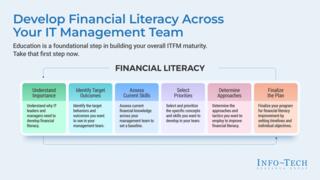 Develop Your IT Leadership Team’s Financial Literacy
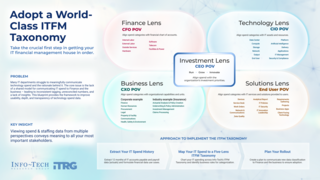 Adopt a World-Class ITFM Taxonomy
 Implement an Adaptive System for IT Financial Management
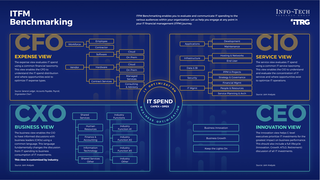 IT Spend and Staffing Benchmarking: Realign Resources for Success
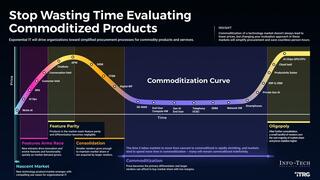 Stop Wasting Time Evaluating Commoditized Products and Services
 Build an ITFM Improvement Roadmap
 IT Spend and Staffing Benchmarking
 Adapt to Uncertainty: Optimize Your Top Areas of IT Spend
 Invest in Realistic and Comprehensive Project Costing
 Demonstrate IT Value Through ITFM Reporting
 Establish End-to-End Visibility Over AI Spend
