
Align CRM Selection to Your Higher Education Context
Transform CRM selection with self-knowledge and strategic assessment.
Assessment-driven selection transforms an overwhelming vendor landscape into manageable, strategic choices that address:
- Fragmented CRM vendor landscapes.
- Multiple stakeholders and poor institutional readiness.
- Technical and integration hurdles.
- Resource constraints.
Our Advice
Critical Insight
- CRM success depends more on institutional self-knowledge than vendor capabilities.
- Framework-driven selection reduces risk.
- Use the 12-factor assessment before engaging vendors.
Impact and Result
- Reduced CRM implementation failure rate.
- Improved timeline accuracy (target: 6 months).
- Enhanced stakeholder alignment.
- Strategic fit between selected CRM and institutional capacity.
Member Testimonials
After each Info-Tech experience, we ask our members to quantify the real-time savings, monetary impact, and project improvements our research helped them achieve. See our top member experiences for this blueprint and what our clients have to say.
8.0/10
Overall Impact
Client
Experience
Impact
$ Saved
Days Saved
University of Liverpool
Guided Implementation
8/10
N/A
N/A
A good open discussion, which gave us some valuable insights to take back to our stakeholders.
INFO~TECH RESEARCH GROUP
Align CRM Selection to Your Higher Education Context
Transform CRM selection with self-knowledge and strategic assessment.
Analyst Perspective
Transform CRM selection with self-knowledge and strategic assessment.
Unifying student lifecycle management through customer relationship management (CRM) is a top priority for higher education. The challenge extends beyond technology evaluation to fundamental questions of institutional capacity and strategic alignment.
Successful selection depends more on institutional self-knowledge than vendor capabilities. This research identifies a critical framework to distinguish between standardized education-specific solutions and customizable enterprise platforms.
By completing a comprehensive self-assessment before engaging vendors, CIOs can filter vendors and set realistic implementation expectations. This assessment-driven methodology reduces the documented 33% CRM project failure rate by identifying mismatched vendor-institution pairings before contracts are signed.
IT leaders in higher education must resist the temptation to prioritize vendor capabilities over institutional readiness. The standardized versus customizable platform distinction transforms CRM selection from a feature comparison exercise into a manageable strategic decision about organizational capacity and approach. Success requires acknowledging the complexity gap between CRM aspirations and implementation reality, then selecting solutions that align with actual institutional capacity rather than aspirational goals.

Mark Maby
Principal Research Director for Education,
Industry Practice
Info-Tech Research Group
Executive summary
Your Challenge
- Unify student lifecycle management from prospect to alumni.
- Empower data-driven decision-making across departments.
- Automate manual tasks for operational excellence.
- Strengthen brand and market position.
Common Obstacles
- The CRM vendor landscape is fragmented.
- Decision-making is complicated by the involvement of multiple stakeholders and assessing institutional readiness is difficult.
- Technical and integration hurdles further complicate CRM selection.
- Resource constraints are a major barrier.
Info-Tech’s Approach
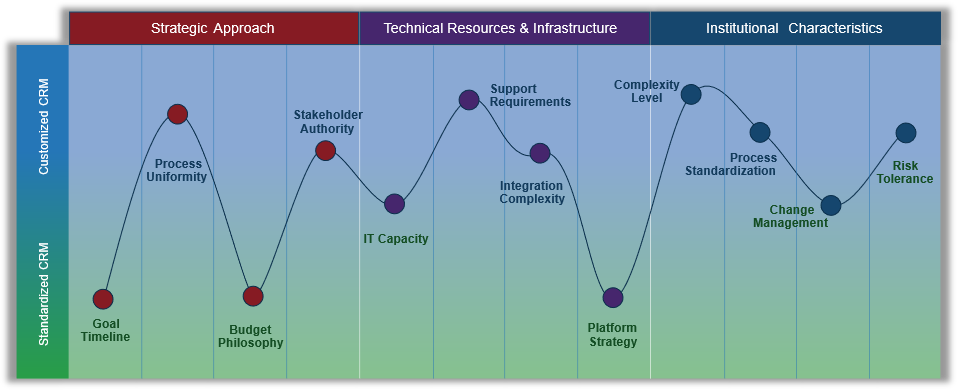
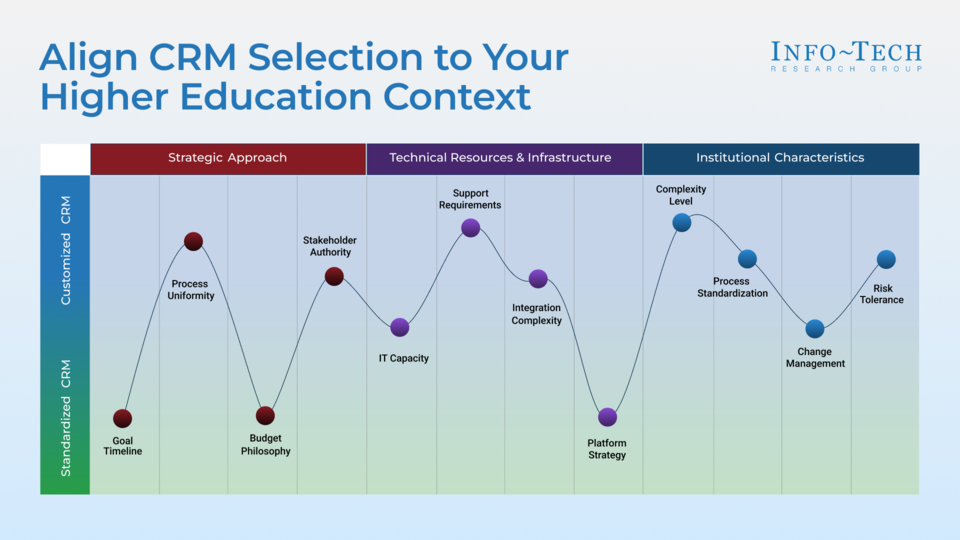
- Assess your strategic approach, technical resources, and institutional characteristics across 12 factors that determine the appropriate CRM category before vendor engagement.
- Use the assessment results to point toward either standardized higher education solutions or customizable enterprise platforms, reducing evaluation to three to five appropriate vendors within their determined category and eliminating mismatched options.
Info-Tech Insight
CRM selection success depends more on institutional self-knowledge than vendor capabilities. Assessment-driven selection transforms an overwhelming vendor landscape into manageable, strategic choices.
Your challenge
Leaders demand unified student engagement but underestimate the technical complexity posed by diverse departments.
- Unify student lifecycle management from prospect to alumni. A centralized system that offers a 360-degree view of student interactions across departments supports strategic enrollment efforts through a personalized student experience.
- Empower data-driven decision-making across departments. To drive performance and outcomes, CRMs must help improve recruitment yield, retention rates, and alumni engagement.
- Automate manual tasks for operational excellence. This requires integration with existing student information systems (SIS) and campus platforms, with analytics tools to guide institutional strategy and operations and ideally foster cross-departmental collaboration.
- Strengthen brand and market position. Institutions need tools for personalized communication at scale across all touchpoints, ensuring they remain competitive and responsive to evolving student needs.
Common obstacles
Vendor demonstrations without institutional assessment create a false sense of readiness.
- The CRM vendor landscape is fragmented, with providers offering overlapping features and conflicting marketing claims, making it difficult for institutions to distinguish between similar solutions and identify the best fit for their needs.
- Decision-making is complicated by the involvement of multiple stakeholders — admissions, IT, and advancement — each with competing priorities and influence.
- Technical and integration hurdles further complicate CRM selection. Institutions must navigate SIS integrations, legacy system dependencies, and unclear API capabilities. This adds layers of uncertainty to implementation planning.
- Resource constraints are a major barrier, with limited IT capacity to support complex deployments. Institutions often lack sufficient change management, and face pressure to meet aggressive timelines that don’t align with implementation realities.
- Assessing institutional readiness is difficult. Universities struggle to evaluate their capacity for customization, balance standardized processes with unique workflows, and gauge risk tolerance.
Info-Tech’s Solution
Assessment-driven CRM selection framework for higher education.
- Comprehensive institutional readiness assessment: Complete a structured 12-factor evaluation across strategic implementation approaches, technical resources and infrastructure, and institutional characteristics. This systematic self-assessment creates objective scoring that reveals whether your institution aligns with standardized solutions or requires customizable platforms, eliminating guesswork from CRM selection decisions.
- Interactive assessment tool application: Utilize the Excel-based assessment instrument to calculate weighted scores across all factors, generate automated recommendations for a CRM approach, and produce stakeholder-ready reports that translate technical evaluation into strategic guidance. This tool operationalizes the framework, providing concrete next steps for vendor shortlisting and RFP development.
- Framework-based vendor filtering: Apply the standardized versus customizable platform framework to narrow the vendor field based on institutional capacity and requirements. This approach eliminates mismatched solutions early in the process, focusing evaluation efforts only on vendors whose approach aligns with organizational reality and strategic goals.
Insight summary
Assess yourself before your vendors.
CRM selection success depends more on institutional self-knowledge than vendor capabilities. Assessment-driven selection transforms an overwhelming vendor landscape into manageable, strategic choices.
Leadership vision exceeds capacity.
Don’t underestimate the complexity gap between CRM aspirations and implementation reality. The challenge isn't finding capable technology — it's honestly assessing whether your context can support your ambitions.
Framework-driven selection reduces risk.
The standardized vs. customizable platform framework, operationalized through systematic assessment, eliminates unsuitable vendors early and sets realistic implementation expectations.
Use the 12-factor assessment first.
Complete institutional evaluation across strategic, technical, and organizational dimensions before any vendor engagement. This creates objective criteria for vendor filtering and stakeholder alignment.
Measure the benefits of assessment-driven CRM selection
A systematic assessment approach will have a measurable impact on CRM selection outcomes.
- Reduced implementation risk: The systematic assessment approach addresses the documented 33% CRM project failure rate (CIO Magazine, 2017) by identifying mismatched vendor-institution pairings before contracts are signed.
- Improved timeline accuracy: Assessment-driven selection helps address timeline delays. By narrowing your focus, you can confidently hit an implementation timeline of about six months (Dominic Systems, 2024).
- Enhanced stakeholder alignment: The structured assessment process creates objective criteria for decision-making, reducing the multi-stakeholder complexity that contributes to project delays and scope changes.
Align CRM selection to your higher education context
Overarching insight
CRM selection success depends more on institutional self-knowledge than vendor capabilities. Assessment-driven selection transforms an overwhelming vendor landscape into manageable, strategic choices.
Your Challenge
- Unify student lifecycle management.
- Empower data-driven decision-making across departments.
- Automate manual tasks for operational excellence.
- Strengthen brand and market position.
Common Obstacles
- Fragmented vendor landscape.
- Multiple stakeholders and poor institutional readiness.
- Technical and integration hurdles.
- Resource constraints.
Info-Tech’s Approach
- Assess your strategic approach, technical resources, and institutional characteristics across 12 factors that determine appropriate CRM category before vendor engagement.
- Use the assessment results to point toward either standardized higher education solutions or customizable enterprise platforms, reducing evaluation to three to five appropriate vendors within their determined category and eliminating mismatched options.
What is a CRM in Higher Education?
Key Characteristics:
- Relationship-Focused Data Management: Centralizes constituent information and interaction history to support personalized engagement, whether for a single department or across multiple functional areas.
- Process Automation: Streamlines department-specific workflows such as application processing, student interventions, or donor stewardship while maintaining compliance with educational regulations like FERPA.
- Communication Management: Coordinates multi-channel outreach including email campaigns, event management, and follow-up activities tailored to higher education communication patterns.
- Integration Capabilities: Connects with Student Information Systems (SIS), financial aid platforms, and other campus technologies to eliminate data silos within the CRM's scope of operation.
A CRM system for higher education is a technology platform that manages interactions and relationships with institutional stakeholders. CRMs can focus on specific lifecycle stages (like admissions only) or span the entire student journey from prospect to alumni.
Scope Variations
Higher education CRMs range from specialized solutions (admissions-only, advancement-only) to comprehensive platforms managing the complete lifecycle. The choice depends on institutional needs, resources, and integration requirements.
Evaluate institutional demands across three CRM domains
Knowing what integration complexity each department brings will help determine which CRM approach is most suitable – satisfying every departmental demand does not always equal successful implementation.
Recruitment & Admissions
Assess admissions workflow complexity, SIS integration requirements, multi-channel communication demands, and application processing customizations to understand if standardized solutions can accommodate your enrollment processes.Student Success & Retention
Evaluate advising case management needs, early alert system integration, cross-departmental intervention workflows, and academic data sharing requirements to determine platform flexibility demands.Alumni & Advancement
Examine fundraising process uniqueness, donor database migration complexity, campaign management requirements, and financial system integrations to understand advancement-specific customization needs.
Approach CRM selection from the perspective of solutions vs. platforms
The solution vs. platform distinction transforms CRM selection from an overwhelming feature comparison exercise into a manageable strategic decision about institutional capacity and approach.
Standardized Solutions
Specialized by lifecycle stage
Focus:
Single department excellence
- Admissions (Element451)
- Student Success (Navigate)
- Advancement (Blackbaud)
Benefits:
- Fast deployment
- Proven workflows
- Domain expertise
Limitation:
Requires integration for full lifecycle coverage
Customizable Platforms
Comprehensive lifecycle management
Focus:
Enterprise-wide flexibility
- Salesforce (with customization)
- Microsoft Dynamics 365
Benefits:
- Single system
- Unlimited adaptability
- Future-proof
Challenge:
Extensive configuration required; requires technical expertise
Hybrid Approach
Platform foundation + Higher ed modules
Examples:
- Salesforce Education Cloud
- Anthology suite built on Dynamics 365
Promise:
- Best of both worlds — specialized functionality on flexible platform
Reality:
Higher technical complexity and upfront cost than either pure approach
Info-Tech’s methodology to align CRM selection to your higher education context
1. Assemble the assessment team |
2. Complete strategic approach assessment |
3. Evaluate technical capacity and infrastructure |
4. Analyze institutional characteristics and culture |
5. Interpret results to filter your CRM selection |
|
Steps |
|
Assess the strategic approach factors:
|
Assess the technical capacity and infrastructure:
|
Assess the institutional characteristics and culture:
|
|
Activity 1: Assemble the assessment team
1-3 hours
Input: Organizational chart, List of CRM-impacted departments, Stakeholder contact information, Calendar availability
Output: Assembled assessment team with defined roles, Scheduled assessment sessions, Briefed participants ready for evaluation
Materials: CRM assessment tool (Excel file), Meeting scheduling tool, Assessment briefing materials
Participants: CIO or IT leadership, Admissions/enrollment director, Student services leadership, Advancement/alumni director, Senior institutional leadership
- Identify key stakeholders from each CRM-impacted department: admissions/enrollment, student services, advancement/alumni relations, and IT. Include decision-makers who can speak authoritatively about departmental processes and requirements.
- Schedule dedicated assessment sessions. Block sufficient time for thoughtful discussion rather than rushing through the evaluation.
- Brief participants on the CRM selection framework and assessment purpose. Share the standardized vs. customizable platform distinction and explain how honest self-assessment prevents costly vendor mismatches.
- Assign primary responsibility for each factor category: strategic factors to senior leadership, technical factors to IT leadership, and institutional factors to cross-departmental representatives. Ensure each participant understands their role in providing accurate assessment.
Download the CRM Assessment Tool for Higher Education
Activity 2: Complete strategic approach assessment
1-3 hours
Input: Institutional strategic plan, Budget parameters and constraints, Governance and decision-making authority, Timeline requirements and pressures
Output: Completed strategic factors (1-4) with scores, Documented rationale for strategic ratings, Identified strategic implementation approach
Materials: CRM assessment tool (Excel file), Institutional strategic planning documents, Budget guidelines, Governance structure documentation
Participants: Senior institutional leadership, CIO or IT leadership, Department heads with budget authority, Strategic planning representatives
- Work through Factor 1 (Goal Timeline Orientation) by honestly assessing institutional urgency and timeline expectations. Consider leadership pressure, enrollment challenges, and strategic planning cycles that may drive CRM timeline requirements.
- Evaluate Factor 2 (Implementation Scope Preference) by determining whether you want departmental focus or institution-wide coverage. Discuss trade-offs between targeted solutions and comprehensive platforms.
- Complete Factor 3 (Budget Investment Philosophy) by clarifying institutional approach to CRM investment. Consider total cost of ownership, funding sources, and ROI expectations across multiple budget cycles.
- Assess Factor 4 (Stakeholder Decision Authority) by mapping actual decision-making power and governance structure. Identify who has veto authority and how consensus will be achieved across departments.
- Review strategic category scores for internal consistency and discuss any significant disagreements before finalizing ratings.
Download the CRM Assessment Tool for Higher Education
Activity 3: Evaluate technical capacity and infrastructure
1.5 hours
Input: Current IT staffing and expertise inventory, Existing system architecture documentation, Integration requirements mapping, Technology ecosystem strategy
Output: Completed technical factors (5-8) with scores, Technical capacity assessment report, Integration complexity evaluation
Materials: CRM assessment tool (Excel file), IT organizational chart and skills inventory, System integration documentation, Technology architecture diagrams
Participants: CIO or IT leadership, Technical staff with integration experience, System administrators for key platforms, IT project management personnel
- Complete Factor 5 (IT Capacity and Expertise) through honest assessment of internal technical capabilities. Document current IT staffing, CRM experience, and availability for major implementation projects.
- Evaluate Factor 6 (Implementation Support Requirements) by determining your institution's need for external assistance. Consider vendor support, consulting requirements, and internal project management capacity.
- Assess Factor 7 (System Integration Complexity Needs) by mapping current systems requiring CRM integration. Document SIS, financial systems, and other platforms that must connect with new CRM.
- Complete Factor 8 (Technology Ecosystem Strategy) by clarifying institutional preferences for platform alignment. Consider existing technology investments and architectural standards.
- Validate technical scores with IT leadership to ensure accurate representation of institutional technical reality rather than aspirational goals.
Activity 4: Analyze institutional characteristics and culture
1.5 hours
Input: Organizational structure documentation, Process documentation from key departments, Change management history and capabilities, Risk tolerance guidelines
Output: Completed institutional factors (9-12) with scores, Institutional readiness assessment, Change management capacity evaluation
Materials: CRM assessment tool (Excel file), Organizational charts and reporting structures, Process documentation, Previous implementation case studies
Participants: Department heads from key functional areas, Change management specialists, Process owners from each CRM-impacted area, Institutional effectiveness representatives
- Complete Factor 9 (Organizational Complexity Level) by mapping institutional structure, campus locations, and organizational relationships. Consider multi-campus coordination and decentralized decision-making challenges.
- Evaluate Factor 10 (Process Standardization Preference) by assessing institutional willingness to adopt standard processes versus maintaining unique workflows. Discuss departmental attachment to current practices.
- Assess Factor 11 (Change Management Approach) by honestly evaluating institutional tolerance for process change and technology adoption. Consider past implementation experiences and organizational culture.
- Complete Factor 12 (Implementation Risk Tolerance) by determining acceptable levels of project complexity and potential failure risk. Balance innovation desires with practical implementation constraints.
- Confirm institutional scores reflect organizational reality through cross-departmental discussion and consensus-building on cultural assessments.
Activity 5: Interpret results to filter your CRM selection
1 hour
Input: Completed assessment scores (factors 1-12), Institutional priority weightings, Vendor landscape understanding, Implementation planning requirements
Output: Final assessment scores and interpretation, Recommended CRM approach (standardized/ platform/hybrid), Vendor filtering criteria and shortlist guidance, Implementation strategy and risk mitigation plan
Materials: CRM assessment tool (Excel file) with completed scores, Vendor landscape reference materials, Executive summary template, Presentation materials for stakeholder communication
Participants: Full assessment team, CIO or IT leadership, Senior institutional leadership, Project sponsors and decision-makers
- Calculate category averages and overall assessment scores using the Excel tool's automated formulas. Review the three category scores (Strategic, Technical, Institutional) for balance and implications.
- Apply custom weighting based on institutional priorities if needed. Use the weighting feature to emphasize factors most critical to your institution's CRM success.
- Review automated vendor approach recommendations generated by the tool. Understand whether your scores point toward standardized solutions, customizable platforms, or hybrid approaches.
- Identify potential implementation risks and mitigation strategies based on low-scoring factors. Plan how to address capacity gaps or institutional challenges revealed by the assessment.
- Document assessment rationale and recommendations for stakeholder communication. Prepare executive summary connecting assessment results to strategic CRM approach and vendor filtering criteria.
Review twelve higher education CRM providers
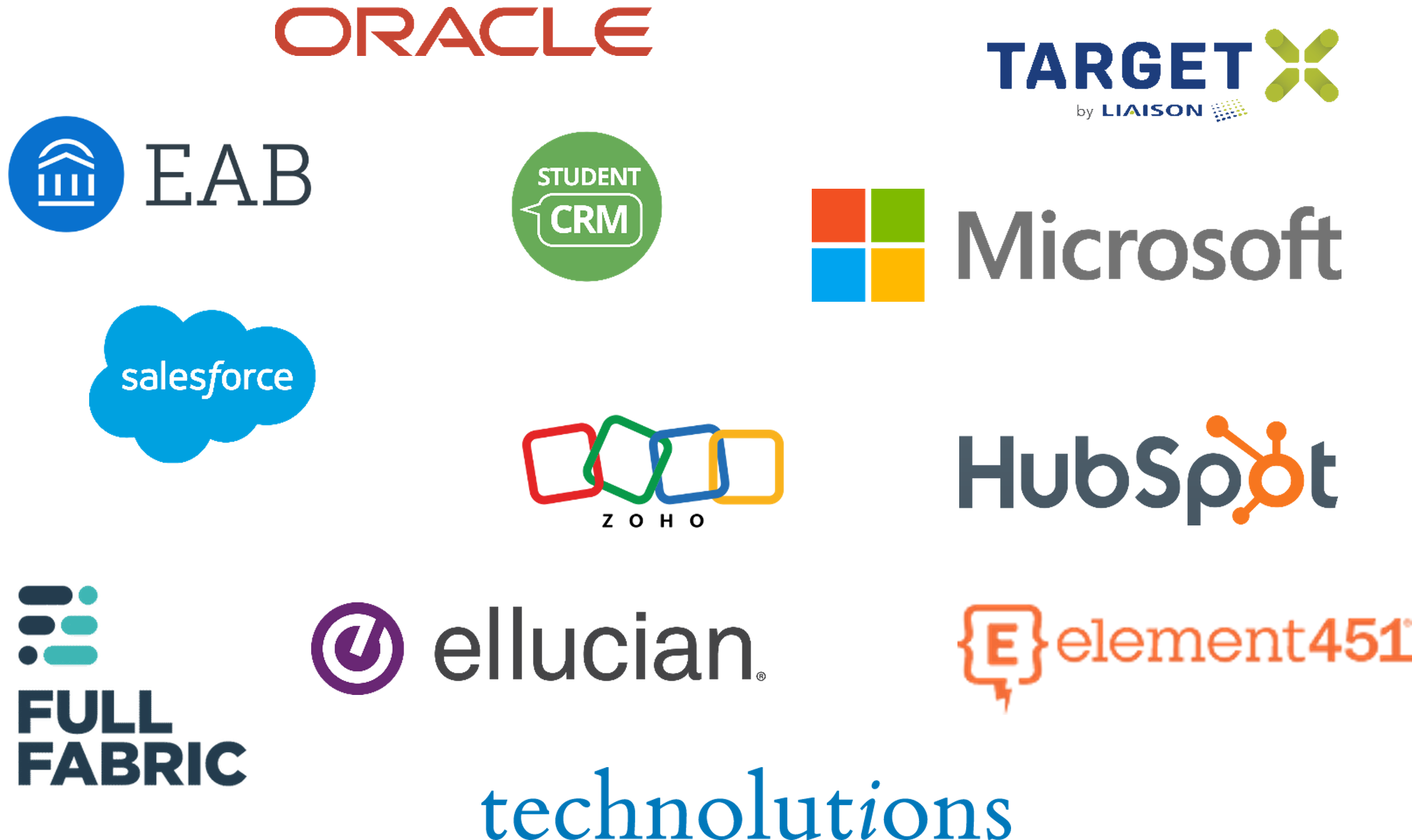
The following section contains an overview of twelve vendors and their CRM products.
This section ties in with Activity 5.
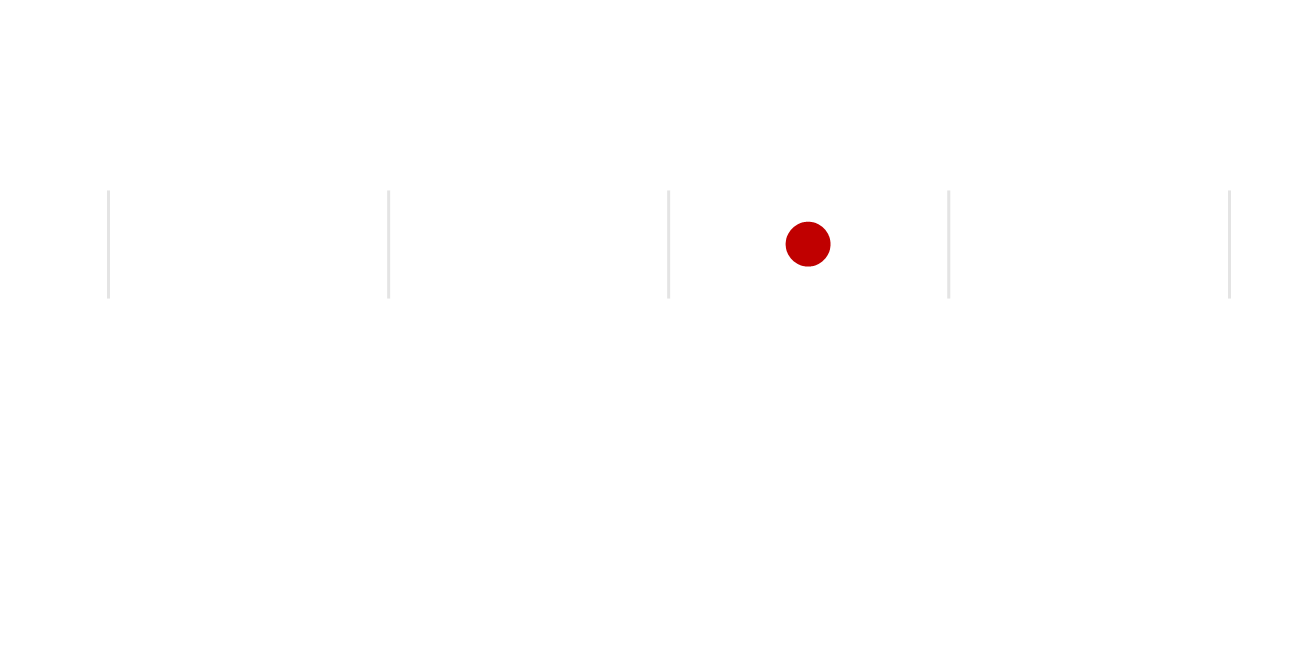
Each product includes a scale that indicates whether the product adheres to standardized processes or whether it requires customization. The scale doesn’t indicate quality.

Anthology was a comprehensive higher education technology company formed through strategic mergers, combining Campus Management, Campus Labs, iModules, and Blackboard to create an integrated ecosystem serving 3,500+ institutions globally. The company went bankrupt in early 2026 and its CRM solution was purchased by Encoura.
Anthology Reach
Anthology Reach is Anthology's flagship CRM solution built on Microsoft Dynamics 365, specifically designed for comprehensive student lifecycle management from recruitment through alumni engagement. The platform combines Microsoft's enterprise capabilities with pre-built higher education workflows and AI-powered features through Anthology Virtual Assistant. Reach excels at providing unified constituent management across the entire student journey with strong integration to Blackboard Learn and Microsoft ecosystem tools.
The solution benefits from Microsoft's innovation roadmap while offering education-focused functionality and structured implementation support. However, organizations must navigate dual licensing complexity with Microsoft and may experience steeper learning curves compared to specialized competitors. Additionally, the platform requires significant institutional commitment to realize ecosystem benefits. Anthology Reach is best suited for institutions seeking comprehensive lifecycle management with Microsoft platform alignment and who are comfortable with enterprise-level complexity and integrated ecosystem adoption. (Source: Encoura, n.d.)
Focus: Full Student Lifecycle
About Info-Tech
Info-Tech Research Group is the world’s fastest-growing information technology research and advisory company, proudly serving over 30,000 IT professionals.
We produce unbiased and highly relevant research to help CIOs and IT leaders make strategic, timely, and well-informed decisions. We partner closely with IT teams to provide everything they need, from actionable tools to analyst guidance, ensuring they deliver measurable results for their organizations.
What Is a Blueprint?
A blueprint is designed to be a roadmap, containing a methodology and the tools and templates you need to solve your IT problems.
Each blueprint can be accompanied by a Guided Implementation that provides you access to our world-class analysts to help you get through the project.
Talk to an Analyst
Our analyst calls are focused on helping our members use the research we produce, and our experts will guide you to successful project completion.
Book an Analyst Call on This Topic
You can start as early as tomorrow morning. Our analysts will explain the process during your first call.
Get Advice From a Subject Matter Expert
Each call will focus on explaining the material and helping you to plan your project, interpret and analyze the results of each project step, and set the direction for your next project step.
Unlock Sample ResearchContributors
70 higher education technology leaders from the roundtable “Transform CRM Selection With Self-Knowledge and Strategic Assessment” held on September 8, 2025.