Amazon Connect – A Significant Beneficiary to Product Announcements at AWS's re:Invent 2025
Connect inherits Nova, Bedrock, and AgentCore capabilities natively, creating an extensible CCaaS platform that is strongest when paired with AWS environments.
(Las Vegas, NV) December 1-5, 2025 – Amazon Connect emerged as a significant beneficiary to product announcements at AWS’s (NASDAQ:AMZN) re:Invent 2025 conference. Of note, the introduction of Amazon’s Nova models (especially the Sonic speech models) will directly impact Connect AI agents’ capabilities for transcription, human-natural pacing, tone, and multilingual comprehension.
Amazon Connect is becoming an increasingly important component within AWS’s broader portfolio. AWS reported during its Q3 2025 earnings call that Connect surpassed $1 billion annualized revenue run rate, positioning it among the fastest-growing CCaaS platforms globally. AWS is also extending Connect’s architectural and pricing model to adjacent services, such as Amazon Bedrock, AgentCore, and AWS Security Hub; this move indicates a deliberate strategy centered on delivering modular agentic capabilities through consumption-based economics. Because these services share a common design pattern and economic model, and because AWS continues to unify them under a coherent agentic framework, Connect’s growth trajectory has implications that reach beyond the contact center domain.
In this context, AWS’s release of 29 new agentic AI capabilities for Connect (including autonomous agents, Model Context Protocol support, real-time agent assistance, and expanded observability tools) represents a logical extension of this platform strategy. These features also align with a broader industry shift toward explainability and auditability in CX enterprise AI systems. Competitors in this market (such as Microsoft and Salesforce) are similarly investing in and announcing transparency mechanisms that allow organizations to trace model decisions, validate agent behaviors, and support governance requirements. Because explainability has become a baseline expectation for operational AI, and because major vendors are converging on comparable observability standards, these enhancements position Connect in alignment with competitive and regulatory norms.
Underlying these launches is Connect’s “all-you-can-eat” pricing model, rolled out in March 2025. Unlike traditional CCaaS vendors that rely on per-seat licensing and charge premiums for AI features, Connect remains fundamentally usage-based – sold by the minute rather than by the agent. (Connect does offer per-seat pricing options but the bulk of cost drivers – such as telephony, AI, orchestration, and data operations – remain usage-based.) AWS positions this consumption model as a catalyst for experimentation, allowing customers to toggle or expand AI capabilities without committing to new seat tiers. Centrica, a British multinational energy and services company, reported at re:Invent that a core driver for the speed of its Connect rollout was due to AWS’s pricing. An AWS example (albeit, extremely conservative) shows that a 75-agent operation with monthly volumes of 100,000 voice minutes, 50,000 chat messages, and 20,000 SMS messages, plus real-time agent assist and self-service chatbots, totals roughly $4,781 per month before taxes and fees.
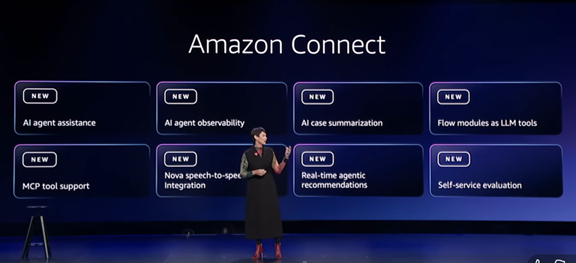
Amazon Connect updates at re:Invent 2025, delivered by Colleen Aubrey, SVP, Applied AI Solutions at AWS. Source: Thomas Randall, screenshot from re:Invent on demand video, YouTube:.
Our Take
Amazon Connect merits consideration as a credible CCaaS competitor, but its functional profile still straddles the line between CCaaS and CPaaS markets. Connect occupies this position because AWS has architected the solution as a service that exposes communication, orchestration, and AI capabilities through the broader AWS infrastructure rather than as a self-contained contact center suite. As a result, Connect inherits Nova, Bedrock, and AgentCore capabilities natively and can orchestrate agentic workflows with a degree of extensibility and tooling optionality not typically found in traditional CCaaS platforms.
This architectural design is a strength for organizations that treat the contact center as an extension of cloud architecture. Connect allows AI models, data pipelines, and orchestration logic to operate within a unified AWS environment, enabling deeper customization, tighter integration with enterprise systems, and more flexible automation patterns. For enterprises in cloud-first environments with strong engineering capacity, Connect’s CPaaS-like extensibility becomes a differentiator rather than a burden.
However, this architectural approach also limits Connect’s posturing within the CCaaS category. While Connect does not formally require a mature AWS environment to deploy, the solution does require AWS maturity to realize its differentiated value. Without expertise across Lambda, IAM, DynamoDB, EventBridge, CloudWatch, or adjacent services, Connect behaves more like a basic CCaaS system with fewer prescriptive capabilities. Because AWS prioritizes infrastructure and modularity, Connect by itself remains comparatively limited in areas that CCaaS incumbents consider foundational: advanced WEM, verticalized solution templates, prescriptive analytics, and turnkey CRM or case-management integrations. Vendors such as NiCE, Genesys, and Five9 lead in these domains precisely because they optimize for operational completeness rather than architectural flexibility. As a result, while Connect is marketed as CCaaS, its current maturity profile aligns more closely with a CPaaS-forward platform that can achieve CCaaS parity, but only when customers are willing to invest in AWS-centric engineering, configuration, and lifecycle management.
Another interesting market comparison is CCaaS vendors now emphasizing their role as CX orchestrators. For example, NiCE, Talkdesk, and Verint all argue that orchestration of customer information across front and back-office systems should occur within a unified CX operating layer that governs interactions, workflows, analytics, WEM, and AI behavior across the customer journey. Connect only partially aligns with this concept. Connect can function as an orchestration hub when an enterprise already relies on AWS for workflow automation, event routing, and AI execution; in these environments, Connect becomes the interface layer through which AWS-native orchestration (via Lambda, EventBridge, Bedrock, and AgentCore) is exposed to agents and customers. AWS is building an infrastructure-native orchestration layer that happens to include CX. However, Connect does not provide the prescriptive, CX-native orchestration capabilities that NiCE, Talkdesk, or Verint emphasize. For CIOs, the implication is that the more the enterprise treats CX as an extension of cloud architecture, the more Amazon Connect’s orchestration model becomes advantageous; conversely, organizations seeking a turnkey, CX-native system of record will continue to find traditional CCaaS platforms better suited.
Pricing is another distinction. Most established CCaaS providers continue to anchor their plans in per-agent licensing, adding AI features as premium tiers or bundles. This pricing model favors predictable revenue for vendors but constrains experimentation for buyers. AWS, by contrast, adopts a usage-based approach that assumes AI workloads will fluctuate and therefore monetizes interactions rather than licenses. This creates two contrasting implications. First, organizations experimenting with AI or facing variable demand patterns benefit from Connect because they avoid committing to seat tiers before value is proven – something Genesys, NiCE, and Verint still require through their licensing logic. Second, though, enterprises with large and stable volumes may find Connect less economical over time because consumption grows as AI takes on more tasks; the “all-you-can-eat” positioning makes experimentation cheap but scaled operations expensive. As such, AWS is playing a long game: revenue sources from metered AI activity (instead of predictable seats) will inevitably rise as agentic automation expands.
For CIOs, Connect is most suitable under three conditions. First, the enterprise should already operate within a mature AWS environment; without established governance, cost controls, and cloud engineering capabilities, Connect’s flexibility becomes a management burden. While Connect can be implemented without an AWS environment, Second, the organization should face variable interaction patterns or intend to iterate on AI agents over time, as Connect’s pricing and architecture reward elasticity. Third, AI must be treated as a core strategic capability, given Connect’s differentiation emerges only when enterprises embed automation deeply into customer journeys and back-office processes. Conversely, organizations seeking a turnkey, CCaaS deployment (with prescriptive workflows, robust WEM, industry-specific configurations, predictable per-seat pricing, and limited reliance on cloud engineering) may still find traditional CCaaS vendors a better fit.
