
ManageEngine Is Quietly Rebuilding the Enterprise IT Control Plane
Rajesh Ganeshan didn’t walk on stage at the recent ZohoDay (February 2026) to announce a new product or declare a category shift. He spent the time doing something more unusual in enterprise software: explaining why ManageEngine exists the way it does, and why that history suddenly matters again. Rajesh Ganesan is the CEO of ManageEngine, a division of Zoho Corp. and a leading provider of enterprise IT management solutions.
The subtext was clear early on. ManageEngine isn’t being repositioned because it’s struggling. It’s being repositioned because the environment around it has changed, and some of the assumptions CIOs made five or ten years ago no longer hold.
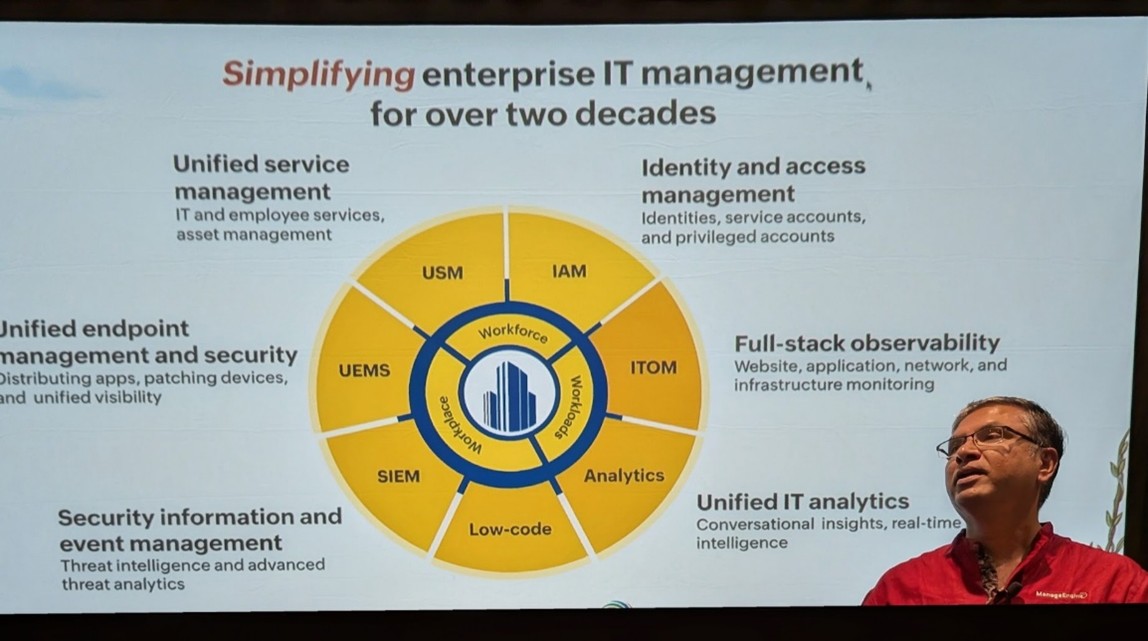
Ganeshan clarified ManageEngine’s goal is to become the operational backbone for digital enterprises – not just an assortment of tools. He declared that AIOps is no longer a differentiator for IT management but table stakes. This vision demands a platform approach, but rather than compel a big-bang whole suite adoption like its competitors, Zoho takes a modular approach of unification. So when the customer decides it's the right time to adopt another of the 60+ different products, they do so confident that architecture will be common, data can be shared, and overall business or semantic context will be retained.
Same company, same core technology stack, increasingly one operating model. The message wasn’t “new products.” It was “we’re done pretending these are separate things.” And as an understated bonus, Zoho keeps its licensing incredibly simple, prioritizing long-term customer value over quarterly sales expectations.
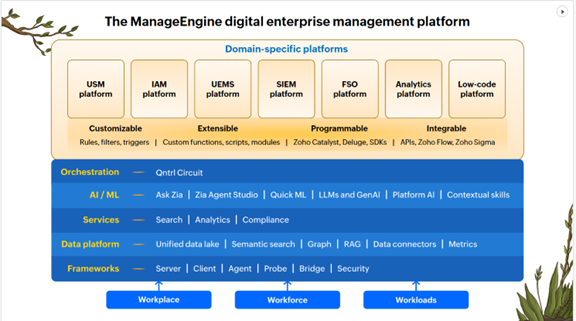
ManageEngine laid out a clearer platform story tying together service management, endpoint management, identity, security operations, and observability under a single architectural direction shared with Zoho. Same company, same core technology stack, increasingly one operating model.
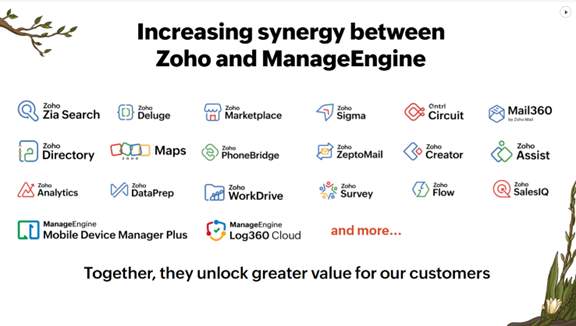
Most important to us was the emphasis on the ever-evolving models and capabilities that Zoho has committed to. It engineers its own AI technology and applies what is appropriate where it is appropriate across its entire stack. Large language models, small language models, specialized graph, columnar and time-series databases. All of this in service of a promise: faster insights, privacy without compromise, and reliable scalability.You know that if Zoho considers something a priority like soverienty, it’s more than capable of building that in from the ground up. No awkward bolt-ons or afterthoughts.
This matters because fragmentation is now the default state of enterprise IT, and most vendors quietly benefit from it. ManageEngine is arguing the opposite.
For organizations drowning in overlapping tools, the promise here is fewer control planes, fewer agents, fewer contracts, and fewer “we think this system owns that problem” moments during audits or incidents. That’s not sexy, but it’s real.
There’s also a cost story that practitioners will recognize immediately. Several customer examples are centered on replacing premium‑priced incumbents where licensing costs scale faster than value. SIEM and endpoint management came up repeatedly. Not because those tools were bad, but because the economics stopped making sense.
ManageEngine’s strongest value proposition, according to Ganeshan, is that it lets IT leaders rebalance spending away from logo‑driven purchasing and back toward coverage and evidence. Especially in regulated environments.
For competition, the obvious comparisons are Microsoft, ServiceNow, IBM, and Palo Alto Networks, depending on which slice you’re looking at.
Microsoft competes by gravity and bundling. ServiceNow competes by workflow dominance. Palo Alto competes by security breadth. IBM competes by existing footprint and inertia.
ManageEngine competes by coverage density and price discipline.
Zoho and ManageEngine are coordinating their enterprise push by aligning historically separate domains: business applications on the Zoho side and IT operations on the ManageEngine side, a shared architectural foundation often referred to internally as an App OS. Rather than forcing enterprises to choose between stability and speed, the model separates responsibilities cleanly: ManageEngine anchors the reliability layer (identity, endpoints, monitoring, security, service management) while Zoho drives the differentiation layer (CRM, finance, HR, collaboration, and custom apps). The shared platform underneath standardizes identity, data models, workflows, analytics, and extensibility so these layers can interact without brittle integrations or duplicated controls.
The practical effect is reduced friction between IT and the business. Infrastructure teams retain control and auditability, while application teams move faster without bypassing governance. This isn’t a suite merger or a rip‑and‑replace strategy; it’s an attempt to let enterprises consolidate incrementally, using a common platform layer to connect operational stability with business agility instead of trading one off against the other.
Customer Case Studies
Across the sessions, ManageEngine grounded its platform narrative with examples that emphasized operational risk, not feature breadth.
In global banking, the challenge wasn’t tooling gaps so much as systemic fragility. One large bank described running more than 20 critical applications with fragmented monitoring. The risk wasn’t inconvenience; it was national‑scale economic exposure if core systems went dark. Moving to a unified monitoring and operations platform reduced gaps and helped prevent outages that simply weren’t acceptable at that scale.
In public events and large venues, the problem was complexity at speed. Thousands of endpoints had to be reconfigured depending on whether the venue was hosting a sporting event, a concert, or another large gathering. Endpoint management allowed IT teams to rapidly shift configurations without disrupting operations or visibility, even as the environment changed day to day.
In the public sector, cost and compliance pressure dominated. A state agency faced seven-year log retention requirements, but the economics of traditional SIEM platforms made full compliance prohibitively expensive. By adopting a more cost-effective SIEM and remote management approach, the agency was able to meet retention mandates while eliminating the need for staff to rely on VPN access for day-to-day support.
At the event, we heard directly from two customers whose comments cut through the marketing layer.
A state Department of Justice IT operations manager described why they began looking beyond their existing stack:
“We were very much a Microsoft shop […]. The problem we found over time is Microsoft has a great suite of products, but there are a lot of gaps […]. ManageEngine didn’t just do everything we were doing before – it gave us visibility into things we didn’t even know were problems.”
That visibility, he emphasized, changed how his team thought about security and operations, not just how they ran tools.
A credit union executive highlighted a very different starting point but a similar outcome:
“We came across ServiceDesk Plus. Before that we were logging help desk calls in a spiral notebook […]. Capturing that tribal knowledge was super important.”
They started small, solving one immediate operational problem, and expanded over time as confidence grew. The value wasn’t in a big‑bang replacement but in gradual consolidation that reduced friction and institutional risk.
Together, the customer stories reinforced a consistent theme: ManageEngine wasn’t brought in because it was new or flashy. It was brought in because it addressed operational realities that existing platforms either priced out of reach or left partially solved.
Our Take
ManageEngine is making a mature move at a moment when a lot of the market is chasing novelty. This isn’t a moonshot; it’s an attempt to own the reliability layer that everyone depends on and no one loves.
The differentiation is not AI. Zia is competent, sometimes useful, and mostly conservative in how it’s applied. That’s fine. Over‑automation in infrastructure is still a good way to lose your job.
The differentiation is that ManageEngine still treats on‑prem, hybrid, and sovereign environments as first‑class citizens. Not legacy exceptions. That’s increasingly rare.
Another differentiator is cultural, not technical. This organization is comfortable playing a long game. Endpoint Central took years to mature. It paid off because they didn’t abandon it when it was hard (most vendors do).
We are optimistic about the direction, cautious about the integration timeline, and unconvinced that the market fully understands what this portfolio can replace yet. If ManageEngine can prove customers are shrinking their vendor lists, not just reshuffling them, this becomes a serious enterprise contender.
ManageEngine is often described as the "affordable enterprise stack." While it may lack some of the high-end "AI-first" orchestration of platforms like ServiceNow, it is highly rated for "ease of deployment" and "value for money" in mid-to-large enterprise environments.
There is an old truism in IT – no one ever got fired for buying IBM. And while that may or may not have ever been true, I&O folks are risk-averse by nature and have a tendency to prioritize incumbency. But that’s not a responsible way to lead IT in this day and age. Price is a poor proxy for quality. The responsible leader should be asking their team why they didn’t consider ManageEngine. And challenging the answers they give to see if they are doing what is easiest for them or what is best for the enterprise they serve.