
IT Talent Trends 2026
The human edge in an AI world.
CIOs face an inflection point in the IT talent landscape.
The year 2025 brought unprecedented rapid change, from surging skills gaps to the rise of embedded AI. In 2026, CIOs must address these seismic shifts head-on by acknowledging that the old normal in IT workforce management has ended. It’s time to build a new normal with future-ready talent strategies that continuously realign, adapt to constant change, and leverage the value of uniquely human capabilities.
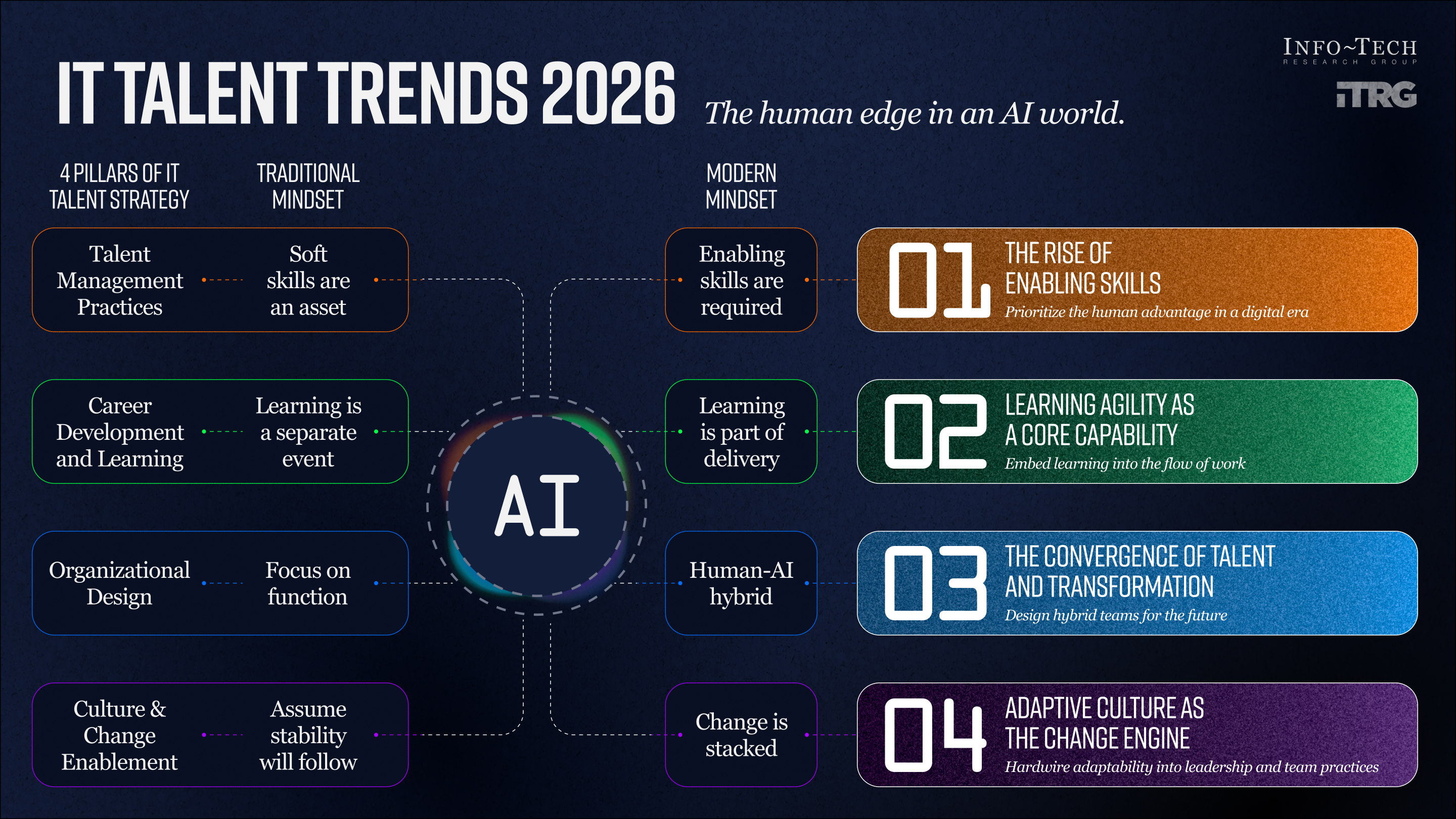
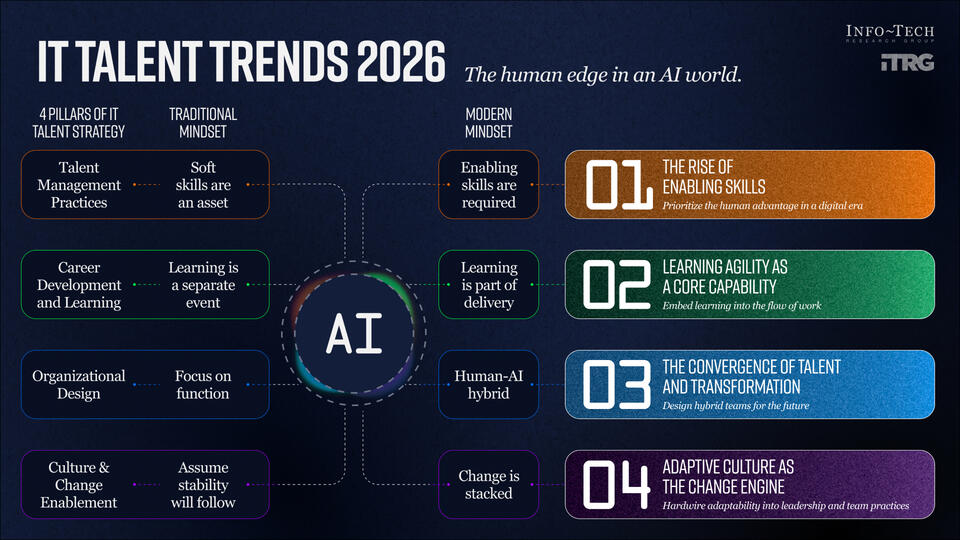
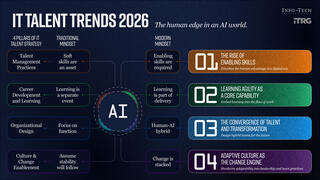
IT Talent Trends 2026 is designed to help CIOs cut through all the noise around how to attract, develop, and retain talent in the age of AI. The report explores four key talent trends for IT leaders to focus on in the year ahead, plus the critical insights they need to craft a more adaptive, resilient talent strategy for 2026 and beyond.
Four key trends shaping IT talent strategy
Our annual report examines four trends that will have the most impact on IT’s ability to effectively navigate the shifting talent environment in the year ahead.
1. The Rise of Enabling Skills
The human advantage in a digital era.
In the AI era, technical expertise no longer distinguishes IT professionals. Instead, uniquely human abilities that can’t be mimicked by technology are the true differentiators: critical thinking, creative problem-solving, emotional intelligence, adaptability, and business acumen.
2. Learning Agility as a Core Capability
Embed learning into the flow of work.
The old model of ad hoc, episodic training is too slow and inconsistent to keep pace with today’s constant technological evolution. Build a culture of ongoing learning where learning opportunities are embedded into daily, weekly, monthly, and annual routines.
3. The Convergence of Talent and Transformation
Design hybrid teams for the future.
Merely adding new AI tools doesn’t lead to successful transformation. Intentionally design human-AI hybrid teams by redefining roles and workflows, building complementary actions between people, automation, and agents.
4. Adaptive Culture as the Change Engine
Hardwire adaptability into leadership and team practices.
Treat change as continuous and perpetual, not a one-off project where things eventually stabilize back to a steady state. Fostering an adaptive, resilient, psychologically safe culture bolsters IT’s ability to sustain performance amid constant change.
IT TALENT TRENDS 2026
The Human Edge in an AI World
CIOs face an inflection point in the IT talent landscape
The year 2025 brought unprecedented rapid change, from surging skills gaps to the rise of embedded AI, forcing a reevaluation of how IT organizations attract, develop, and retain talent:
42% of IT professionals were actively or passively job seeking.
76% of IT managers had moderate or increasing stress levels.
89% of IT leaders were anticipating restructuring their IT organization.
95% of IT professionals acknowledged that major skill changes will be required to keep pace with technology by 2030.
Source: Future of IT Survey, 2025; n=404
It was a tipping point for IT talent. Converging factors made it clear that the old normal in IT workforce management has ended. The challenges faced by IT in 2025 highlighted that continuing business as usual in IT talent strategy would be riddled with risk.
In 2026, IT leaders need future-ready talent strategies that address these shifts head-on. CIOs must continuously scan the horizon and realign IT talent strategies as conditions change.
This trends report will walk you through emerging themes in four areas:
01 The Rise of Enabling Skills: Prioritize the Human Advantage in a Digital Era
02 Learning Agility as a Core Capability: Embed Learning Into the Flow of Work
03 The Convergence of Talent and Transformation: Design Hybrid Teams for the Future
04 Adaptive Culture as the Change Engine: Hardwire Adaptability Into Leadership and Team Practices

Heather Leier-Murray
Research Director
CIO, People & Leadership
Info-Tech Research Group
Disruption and uncertainty will continue in 2026
In 2026, CIOs are leading in an environment where uncertainty and disruption are ongoing, not episodic. Rapid changes in AI and emerging technologies, shifting regulations, talent shortages, and cyber risks continue to reshape how IT work gets done. While this creates pressure, it also creates opportunity. IT leaders have a chance to rethink how teams work, strengthen leadership, and help people build skills to adapt faster. By focusing on learning, trust, and teamwork, CIOs can turn uncertainty into a source of momentum.
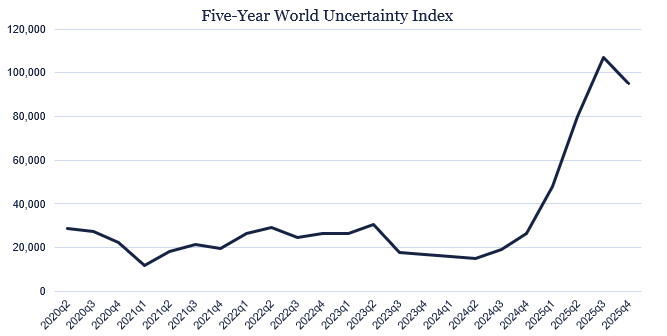
Source: World Uncertainty Index, 2026
2026 will be disruptive
Respondents identified the top factors that are likely or highly likely to disrupt business in the next 12 months:
- Government-enacted regulatory changes
- Talent shortage
- AI and emerging technologies
- Industry-enacted standards or regulation changes
- Cybersecurity incidents
Source: Tech Trends 2026, Info-Tech Research Group; n=525
Skills gaps and business expectations underscore the need for a new approach
IT is being challenged to find efficiency, while also leading technology innovation for their organization, with minimal headcount increases.
CIOs and CxOs agree that, in the future, IT should drive innovation and transform their organizations to create new business models and lines of revenue. CIOs and CxOs also agree that IT is currently at the support level, focused on keeping costs low and keeping the business happy with minimal downtime and quick response to tickets.
The challenge to CIOs is clear: Find ways to improve efficiency in existing budgets and headcount so cost savings can be reinvested into the innovation initiatives that the business demands.
Perspectives on the role of IT:
Now and in the future
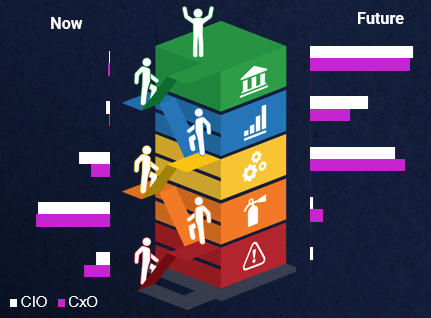
Source: CEO-CIO Alignment benchmark, 1 Aug 2024-31 July 2025; n=94
CIO: Large headcount increase (more than 16%)
26%
CxO: Large headcount increase (more than 16%)
16%
The talent debate: Four trends, many perspectives
Before exploring the four defining IT talent trends for 2026, it's worth acknowledging a truth: not everyone sees the future the same way. There are strong, and sometimes polarizing, perspectives on what matters most, what's changing, and what's hype. Below, we've captured the spectrum of thinking we've encountered in our research. Most organizations sit somewhere in the middle, aware of the need for change but still navigating the complexity of execution, and the current state of uncertainty complicates this. Some are leaning into more radical reinvention. As you read this report, consider: Where do you sit today? And where do you need or want to be?
Which best reflects your leadership team's mindset?
| Human Skills | AI will replace most human roles; soft skills won't matter much. | Human skills are the new "hard" skills. Emotional intelligence will be more valuable than coding. |
| Learning Agility | We'll hire or contract for new skills; training is too slow and expensive. | Learning is the job. Static roles will disappear, and adaptability will be the top hiring criterion. |
| Talent & AI Collaboration | AI is overhyped. It's a bubble that will burst like other tech fads. | AI is a teammate. Every IT team will include digital agents with defined roles and performance metrics. |
| Culture & Change | We just need to get through this wave of change and return to normal. | Culture will be engineered. Psychological safety, adaptability, and trust will be designed, measured, and iterated. |
Where do you stand in the talent debate?
Are soft skills becoming obsolete, or are they the most critical?
Perspectives on the role of human skills in IT are shifting. While some still see them as secondary to technical expertise, others are reimagining them as the core of future-ready IT roles.
"It's likely that jobs you do on a computer... computer-related jobs will go. And as robots are developed, physical jobs will go as well."
- Roman Yampolskiy, Associate Professor, University of Louisville1
"...Learn to collaborate and create, because these are things that you'll still need to do no matter how many of our jobs the robots take away."
- Dr. Anne-Marie Imafidon, CEO at Stemettes, Author, Speaker, and Presenter2
AI will replace most human roles; soft skills won't matter much.
Human skills are the new "hard" skills. Emotional intelligence will be more valuable than coding.
INFO-TECH INSIGHT
Enabling skills have shifted from being a nice-to-have to being a fundamental strategic focus within IT. As technology advances, technical expertise no longer distinguishes IT professionals. Instead, it is the uniquely human abilities that technology cannot mimic that make the difference.
Sources:
1 - "Superintelligent AI," Digital Disruption, 2025
2 - "Is AI Eroding Identity?" Digital Disruption, 2025
Why enabling skills matter more than ever
Automation will continue to rebalance what work humans versus machines do in IT. As certain tasks become automated, the demand for employee skills changes. Employees are needed for the tasks that demand higher-order thinking and creativity.
Organizations are recognizing a need for a shift in the skills required to successfully carry out many IT roles, breaking from the legacy model that rewards static technical expertise with a short shelf life and embracing the increased importance of various business, leadership, and human skills.
IT ROLES ARE EVOLVING; SKILLS SHOULD TOO
IT roles are evolving from isolated technical execution to business-aligned advisory roles, requiring interpersonal and cognitive capabilities such as problem framing, communication, negotiation, and systems thinking. IT employees who historically worked in isolation will increasingly need to seek out requirements from the business and help them problem-solve using technology.
The "human edge" is the primary differentiator of high-performing IT organizations. Forward-looking CIOs are designing talent strategies around cultivating enabling skills, not as nice-to-haves, but as critical infrastructure for navigating emerging technological change, especially AI-driven change. Organizations that understand this and invest in building human-centric enabling skills will access the talent advantage in the digital transformation of work and outperform competitors in 2026.
Employers are moving away from hiring purely for technical knowledge
82% of organizations are prioritizing "human-intrinsic" traits over technical skills when hiring.
Source: SightsIn Plus, 2026
AI amplifies the importance of enabling skills
We are far from rendering people obsolete, but the rise of AI is making enabling skills (e.g. communication, problem framing, business understanding, change leadership) more essential. Forward-looking IT leaders recognize that they need to redeploy people toward high-value business problem-solving.
AI IS SCALING QUICKLY
94% of respondents expect AI to have a positive organizational impact.
Source: Info-Tech Future of IT Survey, 2026; n=472
87% plan to adopt, continue to use, or increase use of AI through 2026.
Source: Info-Tech Future of IT Survey, 2026; n=525
When AI scales
- Automation handles execution.
- Complexity and ambiguity increase.
- Value shifts to human judgment, context, and communication.
AI SUCCESS DEPENDS AS MUCH ON PEOPLE SKILLS AS ON TECHNOLOGY SKILLS.
- Strong communication and understanding of needs are highly correlated with business satisfaction with IT (0.91 and 0.90 respectively).
- IT leaders continue to invest in AI, but value is realized through how people apply it.
- Technical skills remain essential but are no longer sufficient for IT professionals to thrive.
Source: Info-Tech CIO Business Vision diagnostic, 2020 to 2026; n=1,061
The important next step is to ensure your team's success by supporting their development of enabling skills.
About Info-Tech
Info-Tech Research Group is the world’s fastest-growing information technology research and advisory company, proudly serving over 30,000 IT professionals.
We produce unbiased and highly relevant research to help CIOs and IT leaders make strategic, timely, and well-informed decisions. We partner closely with IT teams to provide everything they need, from actionable tools to analyst guidance, ensuring they deliver measurable results for their organizations.
What Is a Blueprint?
A blueprint is designed to be a roadmap, containing a methodology and the tools and templates you need to solve your IT problems.
Each blueprint can be accompanied by a Guided Implementation that provides you access to our world-class analysts to help you get through the project.
You get:
- IT Talent Trends 2026 Report
Talk to an Analyst
Our analyst calls are focused on helping our members use the research we produce, and our experts will guide you to successful project completion.
Book an Analyst Call on This Topic
You can start as early as tomorrow morning. Our analysts will explain the process during your first call.
Get Advice From a Subject Matter Expert
Each call will focus on explaining the material and helping you to plan your project, interpret and analyze the results of each project step, and set the direction for your next project step.
Unlock Sample ResearchContributors
- Brian Bagwell, Vice President Information Technology, AFC Industries, Inc.
- Alex Bazin, COO and CTO, Lewis Silkin LLP
- Jesse Cheetham, Director of HR at a Canadian Managed Service Provider
- Mike Conley, Vice President of IT, East Pennsylvania Manufacturing Co.
- William Howard, Practice Lead, HR Trends & AI, McLean & Company
- Jessie Karches, Associate Director of Internal Talent & Leadership Development, Erie 1 Board of Co-Op Education Services
- Steve Maniscalco, Chief Information Officer, SUNY Oneonta
- Fallan Mitchell, HR Research & Advisory Services Manager, McLean & Company
- Karen Poulter, Chief Information Officer, Suez R&R UK Ltd.
- Sam Schrecengost, Supervisor, Data Warehouse & Test Scoring, Erie 1 Board of Co-Op Education Services
- Suresh Shaddarsanam, Vice President – Enterprise Applications & IT Services, Peabody Investments Corp.
- Paula Wagner, Chief Information Officer, Mansfield Oil Company
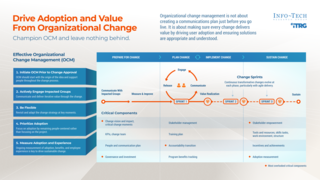 Drive Adoption and Sustain Transformational Change
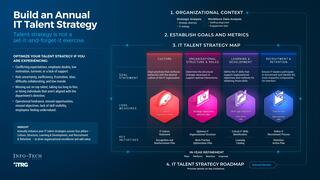 Build an Annual IT Talent Strategy
 Lead Staff through Change
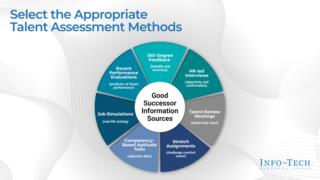 Build an IT Succession Plan
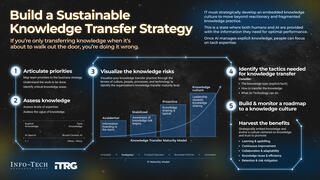 Build a Sustainable Knowledge Transfer Strategy
 2020 IT Talent Trend Report
 Pandemic Preparation – The People Playbook
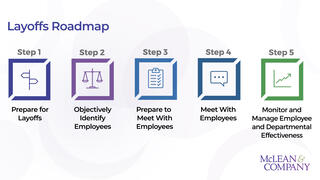 The Complete Manual for Layoffs
 Streamline Your Workforce During a Pandemic
 2021 IT Talent Trend Report
 IT Diversity & Inclusion Tactics
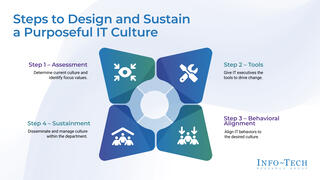 Design and Sustain a Purposeful IT Culture
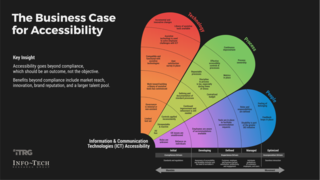 The Accessibility Business Case for IT
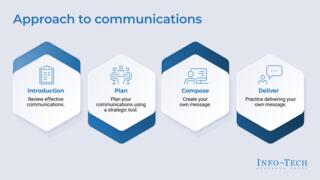 Communicate Any IT Initiative
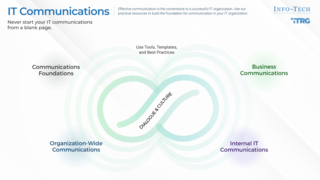 Effective IT Communications
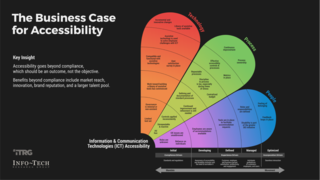 Initiate Digital Accessibility for IT
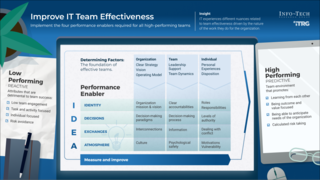 Improve IT Team Effectiveness
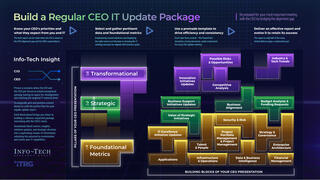 Build a Regular CEO IT Update Package
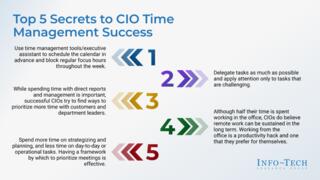 CIO Time Study
 IT Talent Trends 2024
 Crack the Code to Successful Transformation Management
 Chart Your Path: From Enterprise Architect to the Next CIO
 Reputation Equals Revenue: Why Reputation Matters to IT as a Professional Service
 Strengthening the CIO Brand: From Perception to Reality
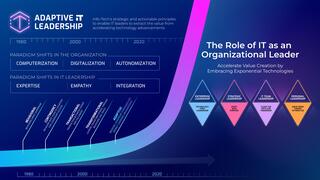 Adaptive IT Leadership
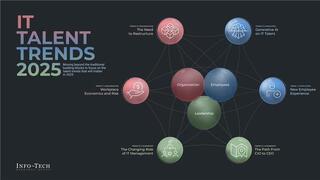 IT Talent Trends 2025
 Adaptive IT Leadership Keynote
 Leading People Change in the Face of Disruptive Technology
 The Race to Develop Talent
 IT Talent Trends 2026