



Modernize core platforms and architecture
The Challenge
Aging core systems block every ambition.
Many carriers still run policy administration, billing, and claims on aging platforms that are costly to change and hard to integrate. Layered on top are years of cloud projects and overlapping applications that inflate cost and slow every new product launch. The estate has grown faster than the carrier's ability to simplify it, and that drag now blocks AI, data, and customer ambitions alike.
Why It Matters
Systems set the ceiling on AI and data.
Modernization is no longer just an IT project but the foundation every other priority depends on, since AI and analytics cannot outperform the systems beneath them. As carriers move AI from experiment to production, leaders point to data readiness and robust technology architecture as the prerequisites for scale, making disciplined platform and cloud modernization the work of the year ("Global Insurance Outlook," Deloitte, 2025).
The Solution
Set a core platform modernization roadmap.
Sequence policy, billing, and claims modernization around business value and risk rather than replacing everything at once.
Rationalize the application and cloud portfolio.
Retire overlapping systems and standardize cloud patterns to cut cost and shrink the integration burden.
Adopt a target architecture and API standards.
Define reference architecture and integration standards so new products and AI services plug in cleanly instead of adding technical debt.





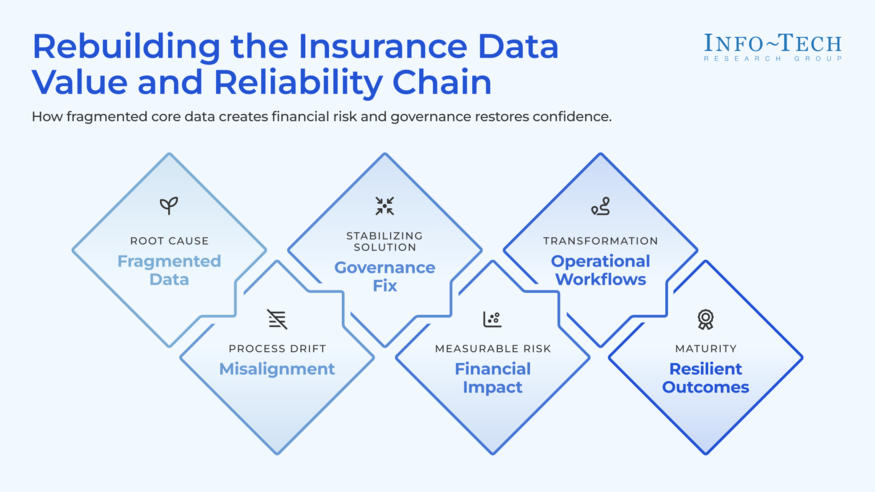
Govern insurance data as a trusted asset
The Challenge
Carriers work from conflicting versions of the data.
Underwriting, policy, claims, and customer data sit in many systems with inconsistent definitions and uneven quality. Actuaries, underwriters, and AI models often work from conflicting versions of the truth, and no single owner is accountable for fixing it. Until data is governed, it cannot drive pricing, risk, or AI decisions the business can defend.
Why It Matters
Trusted data is the prerequisite for AI.
Every AI and analytics ambition rests on data the carrier can trust, which is why governance has moved from back-office cleanup to a board-level prerequisite. Industry leaders are explicit that AI success depends on quality data, modernization, and security, making clear ownership and data quality the foundation that has to come first ("Global Insurance Outlook," Deloitte, 2025).
The Solution
Assign data owners and stewards by domain.
Name accountable owners for underwriting, policy, claims, and customer data so each critical data set has clear responsibility for quality.
Establish common definitions and a data dictionary.
Agree shared definitions and quality rules for core metrics so pricing, reserving, and reporting reconcile across functions.
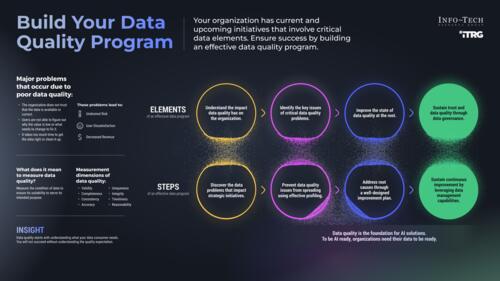
Build data quality into the AI pipeline.
Validate and monitor the data feeding models so analytics and AI rest on accurate, consistent inputs.


Scale AI from pilots to governed value
The Challenge
Many AI pilots, little scaled value.
Carriers are running many AI and generative AI pilots across underwriting, claims, and service, but few have scaled into measured business value. Promising proofs of concept stall because data, controls, and ownership were not set up to move them into production. Without a path from pilot to production, AI spending becomes a portfolio of demos rather than real capability.
Why It Matters
Value, not pilot count, separates leaders.
The advantage is shifting from running pilots to industrializing the few that pay off, and carriers that measure value will pull ahead. With about 76% of insurers reporting generative AI in at least one function but most still stuck in proof of concept, this is the year to convert experiments into governed, production-grade value ("Global Insurance Outlook," Deloitte, 2025).
The Solution
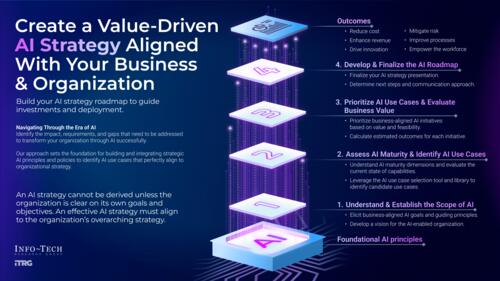
Prioritize use cases by value and feasibility.
Focus investment on high-return areas like underwriting triage, claims automation, and customer service, not novelty pilots.
Set value metrics and owners before each pilot.
Define the baseline, target, and accountable owner so impact on loss ratio, cost, or cycle time can be proven.
Build a governed path to production.
Agree in advance on the data, model risk, and security gates a pilot must clear so winners scale quickly and safely.



Strengthen cyber resilience across the ecosystem
The Challenge
Carriers are high-value, interconnected targets.
Carriers hold vast amounts of personal, health, and financial data and depend on a web of third-party platforms, making them high-value, interconnected targets. Attackers increasingly exploit vendors, stolen credentials, and AI-enabled social engineering, so a single partner failure can halt operations and expose millions of records. Defending the carrier means defending its whole ecosystem, not just its own perimeter.
Why It Matters
Attacks outpace defenses across the ecosystem.
Cyber risk has become an existential, board-level exposure as attacks grow more frequent and AI-assisted. With 87% of executives in a global survey judging their own cyber protection inadequate, closing the gap across the carrier and its vendors is urgent rather than optional ("Cyber Insurance: Risks and Trends," Munich Re, 2025).
The Solution
Anchor the program in a recognized framework and expand multifactor authentication.
Build on the NIST Cybersecurity Framework and enforce multifactor authentication to close the most exploited entry point.
Run a third-party and vendor risk program.
Require security standards, audit rights, and breach-notification terms so vendor failures do not become carrier breaches.
Test incident response and recovery regularly.
Rehearse ransomware and outage scenarios so the carrier can detect, contain, and recover quickly.


Deliver a connected customer and advisor experience
The Challenge
Buying and service are fragmented across channels.
Customers, agents, and advisors expect seamless, digital-first buying and servicing, but carriers still deliver it through disjointed portals, channels, and systems. Direct, agent, and broker journeys run on different platforms with inconsistent data, so quotes are slow, service varies by channel, and people repeat themselves. Fragmented experience now costs carriers growth and loyalty as buyers compare options instantly.
Why It Matters
Buyers judge insurers against every app they use.
Experience has become a primary battleground for growth and retention, as buyers judge insurers against the best digital journeys they encounter anywhere. The most digitally mature carriers pair strong self-service with personalized human advice, and those that connect the customer and advisor experience across channels will win and keep more business ("Digital Insurance Maturity," Deloitte, 2025).
The Solution
Unify the quote-to-service journey across channels.
Connect direct, agent, and broker experiences to shared data so customers and producers get consistent, fast service.
Blend self-service with human advice.
Let customers self-serve routine tasks and move to an advisor without losing context, supported by a single customer view.
Equip agents and advisors with modern, data-rich tools.
Give producers streamlined workflows and a full client view so they sell and serve efficiently.

Transform claims into a moment of trust
The Challenge
Claims still runs slow and manual.
Claims is the moment that defines customer loyalty, yet many carriers still run it through manual handoffs, slow cycle times, and limited visibility. Fraud, leakage, and inconsistent decisions add cost while frustrating policyholders at their most vulnerable. Done poorly, claims erodes the very trust the policy was bought to provide.
Why It Matters
AI makes faster, fairer claims achievable.
Claims is where carriers either earn lasting loyalty or lose it, and AI now makes faster, fairer claims achievable at scale. As insurers begin integrating generative AI into prioritized areas like claims and service, the carriers that modernize claims will cut cost and strengthen trust at the same time ("Global Insurance Outlook," Deloitte, 2024).
The Solution
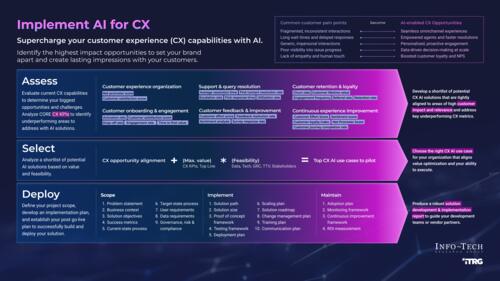
Automate intake and straight-through processing.
Use digital first notice of loss and rules-based automation to fast-track simple claims and free adjusters for complex ones.
Apply AI to fraud detection and triage.
Use models to flag suspicious claims and route work by complexity so leakage falls and decisions stay consistent.
Give policyholders transparent claim tracking.
Provide clear status and proactive communication so customers stay informed throughout the claim.

Embed climate and catastrophe risk into pricing
The Challenge
Catastrophe losses are outpacing old models.
Climate-driven catastrophes such as wildfires, floods, and severe storms are growing more frequent and severe, straining pricing models built on historical averages. Carriers face rising loss volatility, reinsurance cost spikes, and pressure to keep coverage available and affordable in high-risk regions. Pricing the future from the rear-view mirror is no longer viable.
Why It Matters
Pricing must look forward, not back.
Catastrophe exposure has moved to the center of underwriting strategy as losses mount and coverage gaps widen. With global natural-disaster losses reaching roughly $224 billion in 2025 and only about half of them insured, carriers that rebuild pricing and portfolio management around forward-looking climate risk will protect both solvency and their ability to keep writing business ("Climate Change Presses On," Munich Re, 2026).
The Solution
Modernize catastrophe and climate risk models.
Incorporate forward-looking climate data and analytics into pricing rather than relying on historical loss averages alone.
Manage portfolio concentration and reinsurance.
Monitor aggregate exposure by peril and geography and align reinsurance and capital to the changing risk.
Balance risk selection with availability.
Pair risk-based pricing with mitigation incentives and product design so coverage stays available and affordable in exposed markets.
Operationalize risk and model controls
The Challenge
Model governance is informal and scattered.
Carriers now rely on models and AI across underwriting, pricing, claims, and fraud, but governance of those models is often informal and scattered. Without documented controls, validation, and clear ownership, model errors and bias can drive unfair or noncompliant decisions before anyone notices. Risk that lives in spreadsheets and individual judgment cannot scale with the carrier's use of AI.
Why It Matters
Unmanaged models invite unfair decisions.
Despite widespread adoption of AI governance frameworks, only 22% of organizations report that their AI governance systems operate effectively in practice ("Most Organizations Have AI Governance; Few Say It Works in Practice," American Arbitration Association, 2026). Regulators and boards now expect insurers to run AI and models with the same discipline as financial and solvency risk, not as a side activity.
The Solution
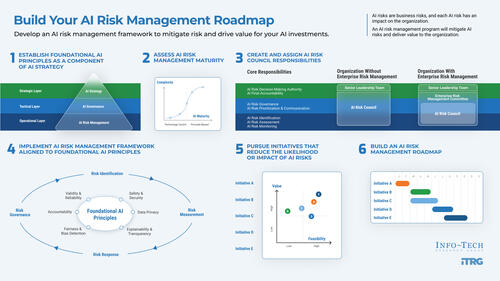
Stand up a model risk management lifecycle.
Document, validate, and periodically retest models so errors, drift, and bias are caught before they reach customers.
Embed controls and audit trails into delivery.
Build approval gates, monitoring, and evidence into model deployment so controls are routine, not retrofitted.
Govern third-party models and data.
Require validation, documentation, and audit rights from vendors so outsourced models meet the same standard as internal ones.
Optimize technology spend to fund growth
The Challenge
Tech spend is opaque as margins tighten.
Carriers must fund modernization, AI, and cyber while underwriting margins tighten and costs climb. Technology spend is often spread opaquely across lines and functions, so leaders cannot see what a system truly costs or returns, and blunt cuts risk hitting the wrong capabilities. Without cost transparency, modernization competes with run-the-business spend and usually loses.
Why It Matters
Margin pressure leaves no room for new budget.
Self-funding is now the realistic way to pay for transformation, because margin pressure leaves little room for new budget. With the US property and casualty combined ratio expected to worsen from 97.2% in 2024 toward 99%, the discipline to show and reallocate technology spend is what frees the dollars for modernization and AI ("Global Insurance Outlook," Deloitte, 2025).
The Solution
Make technology cost transparent by capability.
Show spend by system and business capability so leaders weigh value, not just line items.
Reclaim savings from rationalization and cloud.
Redirect dollars freed by retiring legacy systems and right-sizing cloud into modernization and AI.
Tie spending to business outcomes.
Review major technology investments against measurable impact on growth, loss ratio, and expense ratio.

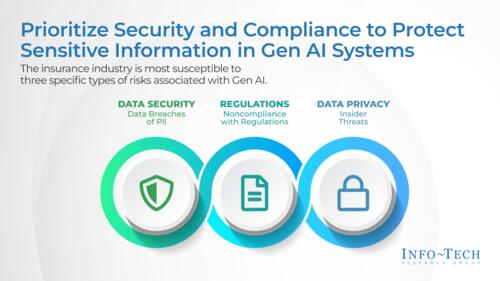
Meet emerging AI and data regulation
The Challenge
AI regulation is becoming a state-by-state reality for insurers.
Insurers are increasingly embedding AI into underwriting, pricing, claims, fraud detection, and customer service. At the same time, regulators are introducing new expectations governing how AI models are developed, validated, monitored, and used in decision-making. As states adopt AI-specific guidance and expand oversight of algorithmic decision-making, insurers must navigate a growing patchwork of requirements while ensuring compliance across their operations. What was once a future compliance concern is becoming an active examination and governance challenge.
Why It Matters
Delayed governance creates immediate regulatory and financial exposure.
AI adoption is accelerating across the insurance industry, with 88% of auto insurers and 70% of home insurers reporting current or planned AI use ("2024 Industry Trends Report," Earnix, 2024). At the same time, regulators are expanding oversight of AI-driven underwriting, pricing, claims, and fraud detection, with more than 20 states adopting the NAIC AI Model Bulletin or substantially similar guidance ("Tracking the Evolution of AI Insurance Regulation," Fenwick, 2025). As AI becomes increasingly embedded in core insurance operations, carriers are expected to demonstrate that models are governed, tested for discrimination, and supported by clear documentation. Insurers that cannot provide this evidence may face heightened regulatory scrutiny, market conduct examination findings, and reputational risk.
The Solution
Monitor the evolving AI regulatory landscape.
Maintain a current view of NAIC guidance, state insurance department requirements, and emerging AI regulations to ensure compliance keeps pace with where the insurer operates.
Embed model governance, fairness, and bias testing.
Establish consistent validation, monitoring, and testing practices for underwriting, pricing, claims, and fraud models to identify and mitigate unfair discrimination risks.
Maintain regulator-ready documentation.
Centralize model inventories, validation results, governance controls, vendor oversight records, and audit trails so the organization can quickly respond to regulatory inquiries and market conduct examinations.