
Align Your P&C PAS With the Right Modernization Pathway
Align your PAS choice with the right modernization pathway to maximize agility, compliance, and customer value.
- Insurers operate fragmented, heavily customized legacy policy administration systems (PAS) platforms that are hard to scale, integrate, and support real-time data or digital experiences.
- Determining the right modernization path (upgrade, re-platform, replace, or maintain) is critical to long-term business alignment.
- Rising claims costs, regulations, and customer demands add urgency to PAS decisions.
- Competitive pressures demand faster, more flexible systems than legacy PAS can provide.
Our Advice
Critical Insight
- Carriers do not compete on policies alone; they compete on the strength of their PAS.
- The right PAS unites operations, embeds compliance, and powers agility to capture growth in volatile markets.
- Aligning PAS modernization with business strategy reduces risk, accelerates value delivery, and drives sustainable growth.
Impact and Result
- This buyers guide gives P&C insurers a clear process for PAS modernization, starting with an analysis of market capabilities and innovations to align technology choices with strategic goals.
- It includes assessing organizational readiness and technical fit, then comparing pathways to select the best option.
- The Vendor Evaluation Tool maps capabilities, scores vendors, and ensures alignment with business and technology needs, helping reduce risk, speed value delivery, and enable sustainable growth.
Align Your P&C PAS With the Right Modernization Pathway
Maximize agility, compliance, and customer value through the right PAS modernization strategy.
Analyst Perspective
Modernize strategically with the right PAS to drive agility, compliance, and customer value.
In the property & casualty insurance sector, many organizations continue to rely on legacy policy administration systems (PAS) that are fragmented, heavily customized, and difficult to scale. These systems often fall short in supporting real-time data exchange, enabling advanced analytics, and delivering seamless customer experiences. In a competitive and highly regulated market, selecting the right PAS should be viewed as a strategic transformation that aligns technology investments with long-term business goals.
An effective PAS can unify policy, billing, and claims data, streamline core workflows, and integrate with emerging capabilities such as embedded insurance and AI-driven insights. These capabilities strengthen organizational agility, improve compliance readiness, and enhance the overall customer experience.
This buyers guide provides a structured framework and a vendor evaluation tool to help insurers assess modernization readiness, determine the most suitable modernization pathway, and evaluate vendors for strategic fit. The approach is designed to reduce risk, accelerate time-to-value, and establish a PAS foundation that supports sustainable growth in an increasingly digital insurance landscape.

Vidhi Trivedi
Research Analyst, Insurance
Info-Tech Research Group
Executive summary
Your Challenge
Property & casualty (P&C) insurers face mounting pressure to modernize policy administration systems (PAS) to meet regulatory demands, rising customer expectations, and competitive pressures.
Many still operate fragmented, heavily customized legacy platforms that are hard to scale, slow to integrate, and unable to fully support real-time data, analytics, or digital experiences.
The key challenge is not only choosing a vendor, but determining the right modernization path: upgrade, replatform, replace, or maintain to align with long-term business goals.
Common Obstacles
Insurers often lack the change management capacity to successfully initiate and sustain PAS modernization, slowing adoption and creating risk during transitions.
Legacy PAS environments are heavily customized and fragmented, leading to data silos, incompatibility, and difficulty integrating or transferring critical information.
Competing departmental priorities and limited executive alignment make it challenging for IT leaders to secure buy-in for enterprise-wide transformation initiatives.
Info-Tech's Approach
This buyers guide gives P&C insurers a clear process for PAS modernization, starting with an analysis of market capabilities and innovations to align technology choices with strategic goals.
It includes assessing organizational readiness and technical fit, then comparing pathways to select the best option.
The Vendor Evaluation Tool maps capabilities, scores vendors, and ensures alignment with business and technology needs, helping reduce risk, speed value delivery, and enable sustainable growth.
Info-Tech Insight
Carriers do not compete on policies alone; they compete on the strength of their PAS. The right platform unites operations, embeds compliance, and powers the agility needed to capture growth in a volatile market.
Unlock how a PAS impacts your organization
PAS: The Foundation of Insurance Operations
A policy administration system (PAS) is the core system that manages every part of an insurance policy's lifecycle. It is the system of record for transactions like quoting, rating, underwriting, policy issuance, endorsements, cancellations, renewals, billing, and even claims servicing. Every action on a policy is recorded, processed, and stored, ensuring accuracy and consistency across the insurance business.
The Business Value of PAS
A PAS is more than just a processing tool. It is the engine of an insurance company's operations:
- It enables insurers to launch products faster and respond to market changes.
- It automates manual tasks, cutting costs and improving efficiency.
- It ensures regulatory compliance by maintaining accurate and auditable records.
- It delivers digital experiences for agents, brokers, and policyholders through portals, APIs, and self-service options.
How a PAS Powers the Policy Lifecycle
- Quoting: Collects applicant information, analyzes risk factors, and generates personalized quotes using predefined rules and calculations.
- Underwriting: Evaluates risk using applicant data (e.g. history, lifestyle, IoT inputs) and applies rules to speed decision-making.
- Issuance: Produces accurate policy documents, contracts, and disclosures once coverage is approved, and delivers them to the policyholder.
- Endorsements: Automates mid-term changes (e.g. coverage updates), generates documents, adjusts premiums, and updates records.
- Billing: Creates invoices, reminders, and statements, manages multiple payment options, and reconciles payments with policy records.
- Claims: Captures claim details, validates coverage, adjudicates according to policy terms, and coordinates communication with all parties.
- Reporting & Analytics: Collects and analyzes policy, underwriting, and claims data to produce dashboards and reports for better decisions.
Info-Tech Insight
The value of a modern PAS lies in its ability to transform routine policy transactions into business outcomes, from faster speed-to-market to improved compliance and customer satisfaction.
Transform P&C insurance operations with PAS
Protecting Against Property Damage and Liability Risks
P&C insurance protects individuals and businesses against financial loss from damage to property (such as homes, vehicles, and commercial buildings) and from liability risks (such as accidents, injuries, or lawsuits). It covers everyday products like auto insurance, homeowners' insurance, renters' insurance, and commercial liability policies. P&C insurance is complex because policies must adapt to a wide range of risks, frequent regulatory updates, and high customer expectations for fast, reliable service.
Policy Administration System (PAS)
The central nervous system of P&C insurance
Product Agility
Design and launch new products quickly for emerging risks.
Customer Experience
Deliver seamless digital experiences such as quotes, endorsements, and self-service portals.
Regulatory Compliance
Ensure filings, audit trails, and reporting obligations are met consistently.
Operational Efficiency
Automate underwriting, billing, and claims to cut costs and improve accuracy.
The PAS Advantage in P&C Insurance
P&C insurance depends on timely, accurate, and compliant management of policies. The PAS is the central nervous system that makes this possible, tying together every transaction, policyholder interaction, and regulatory obligation. Without a modern PAS, carriers risk falling behind in innovation, compliance, and customer satisfaction.
Info-Tech Insight
For P&C carriers, a PAS is the foundation for driving growth, ensuring compliance, and building customer trust in a fast-changing market.
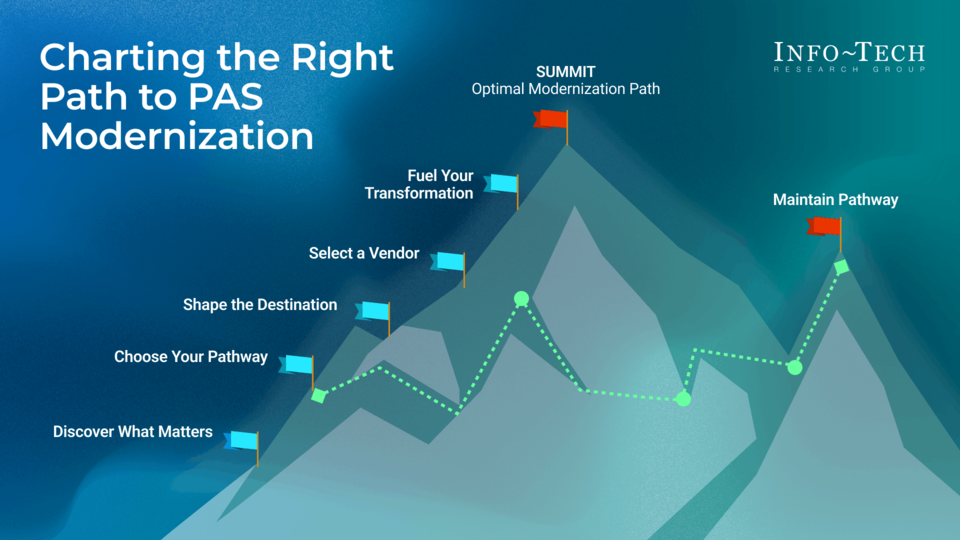
Charting the Right Path to PAS Modernization
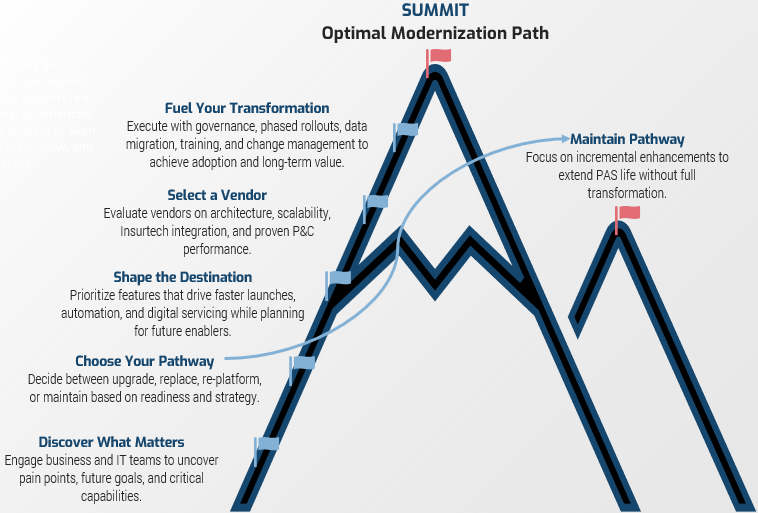
SUMMIT
Optimal Modernization Path
Fuel Your Transformation
Execute with governance, phased rollouts, data migration, training, and change management to achieve adoption and long-term value.
Select a Vendor
Evaluate vendors on architecture, scalability, Insurtech integration, and proven P&C performance.
Shape the Destination
Prioritize features that drive faster launches, automation, and digital servicing while planning for future enablers.
Choose Your Pathway
Decide between upgrade, replace, re-platform, or maintain based on readiness and strategy.
Maintain Pathway
Focus on incremental enhancements to extend PAS life without full transformation.
Discover What Matters
Engage business and IT teams to uncover pain points, future goals, and critical capabilities.
The Challenge
Legacy PAS platforms are fragmented, monolithic, and heavily customized. They cannot support real-time data, omni-channel experiences, or predictive analytics, leading to even small updates being costly, slow, and difficult to scale.
The Obstacles
The decision is no longer "Which vendor?" but "How much change do we need?" Carriers must weigh upgrade, re-platform, replace, or maintain options while avoiding misaligned technology choices.
The Solution
This buyers guide offers a structured, insurance-specific framework to evaluate modernization options, align PAS with business goals, and minimize the risks, costs, and uncertainties of transformation.
The Strategic Value
By right-sizing modernization, insurers unlock agility to adapt to regulation, scale digital capabilities, and improve time-to-market while avoiding costly missteps and ensuring PAS investments deliver sustainable business impact.
Blueprint deliverables
Each step of this blueprint is accompanied by supporting deliverables to help you accomplish your goals:
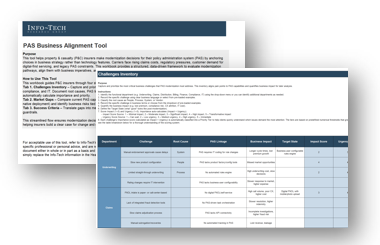
Aligns PAS modernization with business strategy by identifying key challenges, market gaps, and success criteria to guide vendor selection and prioritize modernization efforts.
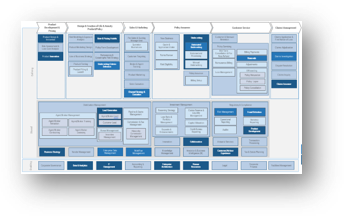
PAS Readiness & Capability Map
Maps core insurance capabilities to show where PAS modernization drives efficiency, cost advantage, and customer differentiation.
Key deliverable:
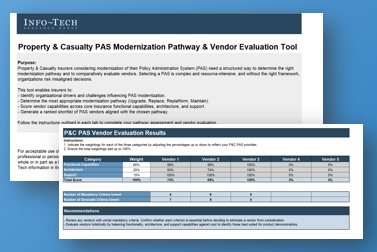
Modernization Pathway & Vendor Evaluation Tool
Evaluate P&C vendors to narrow your search and find the vendor most suitable for your organization.
Info-Tech offers various levels of support to best suit your needs
| DIY Toolkit | Guided Implementation | Workshop | Consulting |
|---|---|---|---|
| "Our team has already made this critical project a priority, and we have the time and capability, but some guidance along the way would be helpful." | "Our team knows that we need to fix a process, but we need assistance to determine where to focus. Some check-ins along the way would help keep us on track." | "We need to hit the ground running and get this project kicked off immediately. Our team has the ability to take this over once we get a framework and strategy in place." | "Our team does not have the time or the knowledge to take this project on. We need assistance through the entirety of this project." |
Diagnostics and consistent frameworks are used throughout all four options.
Guided Implementation
What does a typical GI on this topic look like?
| Phase 1 | Phase 2 | Phase 3 | Phase 4 |
|---|---|---|---|
|
Call #1: Scope PAS objectives and challenges. Call #2: Map to enterprise goals and success criteria. |
Call #3: Assess PAS maturity, data, and workflows. Call #3: Gauge readiness and categorize features. |
Call #4: Explore modernization options and trade-offs. Call #5: Build shortlist and evaluation criteria while scoring vendors and identifying best fit. |
Call #6: Follow next steps for your transformation journey. |
A Guided Implementation (GI) is a series of calls with an Info-Tech analyst to help implement our best practices in your organization.
A typical GI is 6-8 calls over the course of 4 to 6 months.
Workshop overview
| Day 1 | Day 2 | Day 3 | Next Steps | |
| Activities | Anchor PAS Modernization in Business Strategy | Align PAS Requirements to Business Priorities | Define Modernization Pathways & Evaluate Vendor Landscape | Orchestrate the Transformation Process (Optional) |
|
1.1 Identify top P&C insurance challenges 1.2 Evaluate PAS market evolution and current gaps 1.3 Define success criteria for PAS modernization |
2.1 Map critical capabilities to strategic goals 2.2 Evaluate data readiness for core insurance functions 2.3 Evaluate PAS alignment to business processes 2.4 Define priority PAS features to drive modernization |
3.1 Define modernization pathway drivers 3.2 Score core insurance capabilities 3.3 Evaluate platform architecture 3.4 Assess delivery and support strength 3.5 Compare vendors and build shortlist |
Complete the Elevate Your Service Capabilities to Drive Enterprise Value blueprint and associated tools and templates. | |
| Deliverable |
|
|
|
|
| Outcomes |
|
|
|
|
Contact your account representative for more information.
workshops@infotech.com 1-888-670-8889
About Info-Tech
Info-Tech Research Group is the world’s fastest-growing information technology research and advisory company, proudly serving over 30,000 IT professionals.
We produce unbiased and highly relevant research to help CIOs and IT leaders make strategic, timely, and well-informed decisions. We partner closely with IT teams to provide everything they need, from actionable tools to analyst guidance, ensuring they deliver measurable results for their organizations.
What Is a Blueprint?
A blueprint is designed to be a roadmap, containing a methodology and the tools and templates you need to solve your IT problems.
Each blueprint can be accompanied by a Guided Implementation that provides you access to our world-class analysts to help you get through the project.
Need Extra Help?
Speak With An Analyst
Get the help you need in this 3-phase advisory process. You'll receive multiple touchpoints with our researchers, all included in your membership.
Guided Implementation 1: Anchor PAS Modernization in Business Strategy
- Call 1: Scope PAS objectives and challenges.
- Call 2: Map to enterprise goals and success criteria.
Guided Implementation 2: Align PAS Requirements to Business Priorities
- Call 1: Assess PAS maturity, data, and workflows.
- Call 2: Gauge readiness and categorize features.
Guided Implementation 3: Define Modernization Pathways and Evaluate Vendor Landscape
- Call 1: Explore modernization options and trade-offs.
- Call 2: Build shortlist and evaluation criteria while scoring vendors and identifying best fit.
- Call 3: Follow next steps for your transformation journey.
Contributors
- Peter Li, Executive Vice President, Operations & Technology, BridgePoint Financial
- Elizabeth Smith, Executive Counselor, Info-Tech Research Group
- Jody Gunderman, Executive Counselor, Info-Tech Research Group
- Chris Kenyon, Executive Counselor, Info-Tech Research Group
