Rise above firefighter mode with structured incident management to enable effective problem management.
IT infrastructure managers have conflicting accountabilities. It can be difficult to fight fires as they appear while engaging in systematic fire prevention.
Repetitive interruptions erode faith in IT. If incidents recur consistently, why should the business trust IT to resolve them?
Our Advice
Critical Insight
Don’t risk muddling the chain of command during a crisis. Streamline the process. When senior technical staff are working on incidents, they report to the service desk manager.
Incidents defy planning, but problem management is schedulable. Schedule problem management; reduce unplanned work.
Just because a problem has not caused an incident doesn’t mean it never will. Get out in front of problems. Maximize uptime.
Impact and Result
Define the roles and responsibilities of the incident manager and the problem manager.
Develop a critical incident management workflow that will save money by streamlining escalation.
Create a problem management standard operating procedure that will reduce incident volume, save money, and allow upper tier support staff to engage in planned work as opposed to firefighting.
Research & Tools
1. Improve Incident and Problem Management: Our Methodology
Step-by-step methodology to identify existing
challenges, clarify process and role expectations, and create concise effective
process documentation to drive improvement. Review the executive brief at the
start of the slide deck for an overview of the methodology and the value it
can provide your organization.
2. Incident Management and Service Desk SOP
Document process and role expectations to drive consistent
and effective incident response.
3. Incident Management and Service Desk Workflows
Create incident response workflows to clarify
steps and identify opportunities to improve.
4. Incident KB Article Examples
Use these examples to guide your KB article
templates and to clarify appropriate level of detail.
5. Incident Status Updates and Incident Report Templates
Modify these examples to suit your requirements
and expedite incident status communications.
6. Problem Management SOP
Define your problem management process, roles,
and techniques.
7. Problem Management Workflow
Clarify problem intake and action steps in a
workflow format that is easier for stakeholders to consume.
8. Problem Ticket Template
Use this example as a guide to create a problem
ticket template in your ITSM tool.
9. Communication Initiatives Template
Capture initiatives to educate staff and drive
buy-in from senior leadership on improvements to your incident and problem
management processes.
10. Incident and Problem Management Project Roadmap Tool
Translate ideas into specific initiatives to improve
your incident and problem management processes.
Member Testimonials
After each Info-Tech experience, we ask our members to quantify the real-time savings, monetary impact, and project improvements our research helped them achieve. See our top member experiences for this blueprint and what our clients have to say.
8.4/10
Overall Impact
$119,009
Average $ Saved
35
Average Days Saved
Member Testimonials
Client
WA Department of Transport and Major Infrastructure
Experience
Guided Implementation
Impact
10/10
$ Saved
$294K
Days Saved
110
Testimonial
The ability to find a pragmatic approach to complex problem solving by distilling a multi-dimensional view of the organisational context, technical...
The ability to find a pragmatic approach to complex problem solving by distilling a multi-dimensional view of the organisational context, technical research, analysis, and supporting evidence, into consumable messaging across stakeholders.
Member Testimonials
Client
Institute for Health Metrics and Evaluation - University of Washington
Experience
Guided Implementation
Impact
9/10
$ Saved
$11,039
Days Saved
6
Testimonial
Member Testimonials
Client
Member Organization
Experience
Guided Implementation
Impact
4/10
$ Saved
N/A
Days Saved
N/A
Testimonial
Ben is very knowledgeable. The topic was just not what we were looking for right now. Thank you Ben!
Ben is very knowledgeable. The topic was just not what we were looking for right now. Thank you Ben!
Member Testimonials
Client
Member Organization
Experience
Guided Implementation
Impact
10/10
$ Saved
N/A
Days Saved
1
Testimonial
We're still gathering a data set to determine this information as to impact and cost. However, the ability to validate our framework, methodology, ...
We're still gathering a data set to determine this information as to impact and cost. However, the ability to validate our framework, methodology, process.
Member Testimonials
Client
Member Organization
Experience
Guided Implementation
Impact
8/10
$ Saved
N/A
Days Saved
10
Testimonial
Frank's insight is always valuable in our project. Once again he offered validation and confidence in the project we were working on.
Frank's insight is always valuable in our project. Once again he offered validation and confidence in the project we were working on.
Member Testimonials
Client
Member Organization
Experience
Guided Implementation
Impact
10/10
$ Saved
N/A
Days Saved
55
Testimonial
Best - very friendly, knowledgeable, and ready to help. Worst - N/A.
Best - very friendly, knowledgeable, and ready to help. Worst - N/A.
Member Testimonials
Client
Member Organization
Experience
Guided Implementation
Impact
10/10
$ Saved
$136K
Days Saved
44
Testimonial
Member Testimonials
Client
Member Organization
Experience
Guided Implementation
Impact
10/10
$ Saved
N/A
Days Saved
N/A
Testimonial
It is too early on to estimate time and $ savings however the advice is definitely assisting with breaking through long established practices that ...
It is too early on to estimate time and $ savings however the advice is definitely assisting with breaking through long established practices that have not evolved from 20 years ago.
Member Testimonials
Client
Member Organization
Experience
Guided Implementation
Impact
10/10
$ Saved
$35,000
Days Saved
20
Testimonial
The standardized approach with the ability to tailor the outcomes to the local organization was really appreciated. The support from Ben was fabul...
The standardized approach with the ability to tailor the outcomes to the local organization was really appreciated. The support from Ben was fabulous and his insight allowed us to understand how we could really complete this organizational change and get buy in from our hospital. This work will increase the ability of our service desk to respond to incidents more efficiently and effectively and it will allow us to focus on our knowledge management.
Member Testimonials
Client
Member Organization
Experience
Guided Implementation
Impact
9/10
$ Saved
N/A
Days Saved
N/A
Testimonial
Assistance in relating process to required capabilities and competencies. The valued role of a referential third part in overcoming opposing positi...
Assistance in relating process to required capabilities and competencies. The valued role of a referential third part in overcoming opposing position and blockers.
Member Testimonials
Client
Member Organization
Experience
Guided Implementation
Impact
2/10
$ Saved
N/A
Days Saved
N/A
Testimonial
there isn't a best. The analyst "disappeared" (not further contact) after 3 or 4 calls and did not respond after that.
there isn't a best. The analyst "disappeared" (not further contact) after 3 or 4 calls and did not respond after that.
Member Testimonials
Client
Member Organization
Experience
Guided Implementation
Impact
10/10
$ Saved
$2,000
Days Saved
5
Testimonial
Ben was super helpful, made many practical suggestions, and was very valuable in helping us to tailor the templates to meet our specific needs.
Th...
Ben was super helpful, made many practical suggestions, and was very valuable in helping us to tailor the templates to meet our specific needs.
The only downside is that is was sometimes difficult finding time in our own team to work on this new process.
Member Testimonials
Client
Member Organization
Experience
Guided Implementation
Impact
9/10
$ Saved
N/A
Days Saved
5
Testimonial
Member Testimonials
Client
Member Organization
Experience
Guided Implementation
Impact
10/10
$ Saved
$73,999
Days Saved
5
Testimonial
the informtation was informative and easy to understand and more on the site for me to look at. If i also have any questions Frank is available for...
the informtation was informative and easy to understand and more on the site for me to look at. If i also have any questions Frank is available for me, very helpful
Member Testimonials
Client
Member Organization
Experience
Workshop
Impact
10/10
$ Saved
N/A
Days Saved
N/A
Testimonial
The sessions were very informative, and material provided will help us improve our processes further. We've not done any RoI so I wont be able to p...
The sessions were very informative, and material provided will help us improve our processes further. We've not done any RoI so I wont be able to provide the metrics above.
Member Testimonials
Client
Member Organization
Experience
Workshop
Impact
10/10
$ Saved
$274K
Days Saved
120
Testimonial
The workshop was exceptional. Jeremy is extremely knowledgeable. He gives relatable examples, talks specifics where applicable, and keeps things mo...
The workshop was exceptional. Jeremy is extremely knowledgeable. He gives relatable examples, talks specifics where applicable, and keeps things moving along. We were all very impressed. We plan to implement all of our proposed changes, and I am sure I will have some follow up questions!
Member Testimonials
Client
Member Organization
Experience
Guided Implementation
Impact
10/10
$ Saved
$2,740
Days Saved
20
Testimonial
Member Testimonials
Client
Member Organization
Experience
Guided Implementation
Impact
9/10
$ Saved
N/A
Days Saved
N/A
Testimonial
clear explanations from Franck for Problem Management and outcome of calls very interesting, thanks. We will certainly contact Franck for Crisis Ma...
clear explanations from Franck for Problem Management and outcome of calls very interesting, thanks. We will certainly contact Franck for Crisis Management
Member Testimonials
Client
Member Organization
Experience
Workshop
Impact
9/10
$ Saved
N/A
Days Saved
N/A
Testimonial
The best and the worst are the same. We were given a great deal of knowledge in these sessions. That is very good. Finding the time to make the cha...
The best and the worst are the same. We were given a great deal of knowledge in these sessions. That is very good. Finding the time to make the changes.is the worst.
Member Testimonials
Client
Member Organization
Experience
Guided Implementation
Impact
10/10
$ Saved
$1,820
Days Saved
10
Testimonial
Member Testimonials
Client
Member Organization
Experience
Guided Implementation
Impact
9/10
$ Saved
$6,000
Days Saved
14
Testimonial
Member Testimonials
Client
Member Organization
Experience
Guided Implementation
Impact
9/10
$ Saved
$64,999
Days Saved
10
Testimonial
Best: Validated our approach and our current path. Analyst was very knowledgable.
Worse: Was about structure - yes, the uber topic is Inciden...
Best: Validated our approach and our current path. Analyst was very knowledgable.
Worse: Was about structure - yes, the uber topic is Incident / Problem Management but the specific topic was Closing values. This survey is an example as to why the focus area (specific topic) needs to be flagged. This is the same with the meeting invite. The subject was Incident / Problem not Resolution Values. It should have been Resolution Values are something similar.
Member Testimonials
Client
Member Organization
Experience
Guided Implementation
Impact
10/10
$ Saved
N/A
Days Saved
N/A
Testimonial
It was a pleasure to meet with Sandi.
She took the time to understand my needs and then directed me to the best resource and materials.
San...
It was a pleasure to meet with Sandi.
She took the time to understand my needs and then directed me to the best resource and materials.
Sandi's guidance was exactly what I was after, and I will be reviewing the materials she has provided at a future date.
Sandi was also able to provide me with extra advice on processes we are currently doing and how the materials provided can help improve those, which I will also find the time to review.
Overall, I felt that Sandi did an excellent job providing me with what I needed without going into too much detail.
I look forward to working with Sandi in the future as she is very knowledgeable on the subject and personable, and easy to talk with.
Member Testimonials
Client
Member Organization
Experience
Workshop
Impact
10/10
$ Saved
N/A
Days Saved
20
Testimonial
The best part of the workshop was how the leaders skillfully walked us through the material and lead us towards a better understanding of how our o...
The best part of the workshop was how the leaders skillfully walked us through the material and lead us towards a better understanding of how our organization operates. Our IT support model is not a traditional tiered system and although we understand that, we have had a hard time articulating how we operate, where we excel, and where we are deficient. The workshop brought clarity and words around those. We left with clear takeaway tasks and the foundation of a tailored SOP.
The worst part is not having enough time to dive deeper. For us, because of our federated/distributed support model, we had a lot of work to do to define and agree on our current state. That legitimately took time to do. We have kicked off an internal workgroup to build on the delivered SOP and plan to reevaluate our state in 12 months.
This was an extremely valuable workshop and John, Frank, and the whole Info-Tech team was amazing!
Member Testimonials
Client
Member Organization
Experience
Workshop
Impact
9/10
$ Saved
$27,880
Days Saved
20
Testimonial
The communication that the workshop engendered within our team was helpful. We had worked a lot out prior to the workshop but this helped us to ref...
The communication that the workshop engendered within our team was helpful. We had worked a lot out prior to the workshop but this helped us to refine that work and also to verify the value of it. It also helped our team to commit to the project.
Member Testimonials
Client
Member Organization
Experience
Guided Implementation
Impact
10/10
$ Saved
$2,519
Days Saved
N/A
Testimonial
Member Testimonials
Client
Member Organization
Experience
Workshop
Impact
9/10
$ Saved
$34,000
Days Saved
5
Testimonial
Member Testimonials
Client
Member Organization
Experience
Guided Implementation
Impact
8/10
$ Saved
$74,800
Days Saved
120
Testimonial
Member Testimonials
Client
Member Organization
Experience
Guided Implementation
Impact
10/10
$ Saved
$2,720
Days Saved
5
Testimonial
I really appreciated the follow-up notes after each meeting. Especially additional resources to review and get more information from. I also enjoye...
I really appreciated the follow-up notes after each meeting. Especially additional resources to review and get more information from. I also enjoyed working with Derek, he was very clear in explaining and addressing my questions. He knows what he is talking about and was able to further clarify anytime things were not clear. Great working with Derek and InfoTech!
Member Testimonials
Client
Member Organization
Experience
Guided Implementation
Impact
10/10
$ Saved
$100K
Days Saved
20
Testimonial
The presentation was concise and well presented. The presentation gave me food for thought as to how to rethink problem management. Thank you.
The presentation was concise and well presented. The presentation gave me food for thought as to how to rethink problem management. Thank you.
Member Testimonials
Client
Experience
Impact
$ Saved
Days Saved
Testimonial
WA Department of Transport and Major Infrastructure
Guided Implementation
10/10
$294K
110
The ability to find a pragmatic approach to complex problem solving by distilling a multi-dimensional view of the organisational context, technical...
The ability to find a pragmatic approach to complex problem solving by distilling a multi-dimensional view of the organisational context, technical research, analysis, and supporting evidence, into consumable messaging across stakeholders.
Institute for Health Metrics and Evaluation - University of Washington
Guided Implementation
9/10
$11,039
6
Member Organization
Guided Implementation
4/10
N/A
N/A
Ben is very knowledgeable. The topic was just not what we were looking for right now. Thank you Ben!
Ben is very knowledgeable. The topic was just not what we were looking for right now. Thank you Ben!
Member Organization
Guided Implementation
10/10
N/A
1
We're still gathering a data set to determine this information as to impact and cost. However, the ability to validate our framework, methodology, ...
We're still gathering a data set to determine this information as to impact and cost. However, the ability to validate our framework, methodology, process.
Member Organization
Guided Implementation
8/10
N/A
10
Frank's insight is always valuable in our project. Once again he offered validation and confidence in the project we were working on.
Frank's insight is always valuable in our project. Once again he offered validation and confidence in the project we were working on.
Member Organization
Guided Implementation
10/10
N/A
55
Best - very friendly, knowledgeable, and ready to help. Worst - N/A.
Best - very friendly, knowledgeable, and ready to help. Worst - N/A.
Member Organization
Guided Implementation
10/10
$136K
44
Member Organization
Guided Implementation
10/10
N/A
N/A
It is too early on to estimate time and $ savings however the advice is definitely assisting with breaking through long established practices that ...
It is too early on to estimate time and $ savings however the advice is definitely assisting with breaking through long established practices that have not evolved from 20 years ago.
Member Organization
Guided Implementation
10/10
$35,000
20
The standardized approach with the ability to tailor the outcomes to the local organization was really appreciated. The support from Ben was fabul...
The standardized approach with the ability to tailor the outcomes to the local organization was really appreciated. The support from Ben was fabulous and his insight allowed us to understand how we could really complete this organizational change and get buy in from our hospital. This work will increase the ability of our service desk to respond to incidents more efficiently and effectively and it will allow us to focus on our knowledge management.
Member Organization
Guided Implementation
9/10
N/A
N/A
Assistance in relating process to required capabilities and competencies. The valued role of a referential third part in overcoming opposing positi...
Assistance in relating process to required capabilities and competencies. The valued role of a referential third part in overcoming opposing position and blockers.
Member Organization
Guided Implementation
2/10
N/A
N/A
there isn't a best. The analyst "disappeared" (not further contact) after 3 or 4 calls and did not respond after that.
there isn't a best. The analyst "disappeared" (not further contact) after 3 or 4 calls and did not respond after that.
Member Organization
Guided Implementation
10/10
$2,000
5
Ben was super helpful, made many practical suggestions, and was very valuable in helping us to tailor the templates to meet our specific needs.
Th...
Ben was super helpful, made many practical suggestions, and was very valuable in helping us to tailor the templates to meet our specific needs.
The only downside is that is was sometimes difficult finding time in our own team to work on this new process.
Member Organization
Guided Implementation
9/10
N/A
5
Member Organization
Guided Implementation
10/10
$73,999
5
the informtation was informative and easy to understand and more on the site for me to look at. If i also have any questions Frank is available for...
the informtation was informative and easy to understand and more on the site for me to look at. If i also have any questions Frank is available for me, very helpful
Member Organization
Workshop
10/10
N/A
N/A
The sessions were very informative, and material provided will help us improve our processes further. We've not done any RoI so I wont be able to p...
The sessions were very informative, and material provided will help us improve our processes further. We've not done any RoI so I wont be able to provide the metrics above.
Member Organization
Workshop
10/10
$274K
120
The workshop was exceptional. Jeremy is extremely knowledgeable. He gives relatable examples, talks specifics where applicable, and keeps things mo...
The workshop was exceptional. Jeremy is extremely knowledgeable. He gives relatable examples, talks specifics where applicable, and keeps things moving along. We were all very impressed. We plan to implement all of our proposed changes, and I am sure I will have some follow up questions!
Member Organization
Guided Implementation
10/10
$2,740
20
Member Organization
Guided Implementation
9/10
N/A
N/A
clear explanations from Franck for Problem Management and outcome of calls very interesting, thanks. We will certainly contact Franck for Crisis Ma...
clear explanations from Franck for Problem Management and outcome of calls very interesting, thanks. We will certainly contact Franck for Crisis Management
Member Organization
Workshop
9/10
N/A
N/A
The best and the worst are the same. We were given a great deal of knowledge in these sessions. That is very good. Finding the time to make the cha...
The best and the worst are the same. We were given a great deal of knowledge in these sessions. That is very good. Finding the time to make the changes.is the worst.
Member Organization
Guided Implementation
10/10
$1,820
10
Member Organization
Guided Implementation
9/10
$6,000
14
Member Organization
Guided Implementation
9/10
$64,999
10
Best: Validated our approach and our current path. Analyst was very knowledgable.
Worse: Was about structure - yes, the uber topic is Inciden...
Best: Validated our approach and our current path. Analyst was very knowledgable.
Worse: Was about structure - yes, the uber topic is Incident / Problem Management but the specific topic was Closing values. This survey is an example as to why the focus area (specific topic) needs to be flagged. This is the same with the meeting invite. The subject was Incident / Problem not Resolution Values. It should have been Resolution Values are something similar.
Member Organization
Guided Implementation
10/10
N/A
N/A
It was a pleasure to meet with Sandi.
She took the time to understand my needs and then directed me to the best resource and materials.
San...
It was a pleasure to meet with Sandi.
She took the time to understand my needs and then directed me to the best resource and materials.
Sandi's guidance was exactly what I was after, and I will be reviewing the materials she has provided at a future date.
Sandi was also able to provide me with extra advice on processes we are currently doing and how the materials provided can help improve those, which I will also find the time to review.
Overall, I felt that Sandi did an excellent job providing me with what I needed without going into too much detail.
I look forward to working with Sandi in the future as she is very knowledgeable on the subject and personable, and easy to talk with.
Member Organization
Workshop
10/10
N/A
20
The best part of the workshop was how the leaders skillfully walked us through the material and lead us towards a better understanding of how our o...
The best part of the workshop was how the leaders skillfully walked us through the material and lead us towards a better understanding of how our organization operates. Our IT support model is not a traditional tiered system and although we understand that, we have had a hard time articulating how we operate, where we excel, and where we are deficient. The workshop brought clarity and words around those. We left with clear takeaway tasks and the foundation of a tailored SOP.
The worst part is not having enough time to dive deeper. For us, because of our federated/distributed support model, we had a lot of work to do to define and agree on our current state. That legitimately took time to do. We have kicked off an internal workgroup to build on the delivered SOP and plan to reevaluate our state in 12 months.
This was an extremely valuable workshop and John, Frank, and the whole Info-Tech team was amazing!
Member Organization
Workshop
9/10
$27,880
20
The communication that the workshop engendered within our team was helpful. We had worked a lot out prior to the workshop but this helped us to ref...
The communication that the workshop engendered within our team was helpful. We had worked a lot out prior to the workshop but this helped us to refine that work and also to verify the value of it. It also helped our team to commit to the project.
Member Organization
Guided Implementation
10/10
$2,519
N/A
Member Organization
Workshop
9/10
$34,000
5
Member Organization
Guided Implementation
8/10
$74,800
120
Member Organization
Guided Implementation
10/10
$2,720
5
I really appreciated the follow-up notes after each meeting. Especially additional resources to review and get more information from. I also enjoye...
I really appreciated the follow-up notes after each meeting. Especially additional resources to review and get more information from. I also enjoyed working with Derek, he was very clear in explaining and addressing my questions. He knows what he is talking about and was able to further clarify anytime things were not clear. Great working with Derek and InfoTech!
Member Organization
Guided Implementation
10/10
$100K
20
The presentation was concise and well presented. The presentation gave me food for thought as to how to rethink problem management. Thank you.
The presentation was concise and well presented. The presentation gave me food for thought as to how to rethink problem management. Thank you.
Info-Tech Academy
Incident and Problem Management
Resolve service issues faster and eliminate recurring incidents. This course makes up part of the Infrastructure & Operations Certificate.
Number of Course Modules:
4
Estimated Completion Time:
2-2.5 hours
An active membership is required to access Info-Tech Academy.
Workshop
Improve Incident and Problem Management Workshop
Work with our analysts to accelerate this project using Info-Tech's proven workshop approach.
Module 1: Incident ticket intake and routing
The Purpose
Improve how tickets logged, categorized, and prioritized.
Key Benefits Achieved
Efficient ticket processing and consistent treatment of tickets based on severity.
Activities
Outputs
1.1
Review incident lifecycle and current challenges.
Outputs
1.2
Roles and responsibilities for service desk.
Outputs
1.3
Review ticket categorization.
Outputs
1.4
Prioritization schema.
Outputs
1.5
Drive more efficient intake.
Outputs
Incident management SOP
Module 2: Incident response
The Purpose
Clarify incident management steps, roles, and responsibilities.
Key Benefits Achieved
Incident Management SOP and Workflows documented to drive consistent and effective incident response.
Activities
Outputs
2.1
Incident management workflow.
Outputs
2.2
Critical incident management workflow.
Outputs
2.3
Define SLOs and escalation rules.
Outputs
Incident management SOP (cont.)
Incident management workflows
Module 3: Shift-left and problem management
The Purpose
Outline a standard process for resolving problems.
Key Benefits Achieved
Efficient and effective problem management, reducing incident recurrence and impact.
Module 4: Proactive problem management and roadmap
The Purpose
Plan how you will implement improvements.
Key Benefits Achieved
Translate ideas into action, with specific steps to implement tangible improvements in the areas of people (training), process, and technology.
Activities
Outputs
4.1
Establish appropriate problem management governance.
Outputs
4.2
Create a plan to communicate process changes.
Outputs
4.3
Create a project roadmap to implement improvements.
Outputs
4.4
Review workshop results.
Outputs
Communication initiatives list (to educate stakeholders on process changes)
Roadmap to close gaps (for incident and problem management)
Workshop results summary
Improve Incident and Problem Management
Rise above firefighter mode with structured incident management to enable effective problem management
EXECUTIVE BRIEF
Analyst Perspective
Keep it simple. Good data and consistent processes will help you break out of firefighter mode.
Incident management teams often find themselves too busy to create the knowledgebase (KB) articles or track the incident data that will save them time in the future. It becomes a vicious cycle that keeps them constantly in firefighter mode.
The key to breaking this cycle is to keep it simple as you seek to implement better structure and processes and right-size your approach. For example, avoid complex categorization schemes, and start with KB articles for known recurring incidents. Don’t jump to automation before you have the processes and resources to support it.
Similarly, when it comes to problem management, keep it simple by starting with Sev 1 tickets and recurring incidents that are obvious candidates for problem management. Support problem management with a consistent, structured approach that enables you to prioritize your limited resources.
As you build momentum with quick wins and better structure, improved incident management will drive more effective problem management and reduce future incidents as the incident-problem lifecycle comes full circle.
Frank Trovato
Research Director, Infrastructure and Operations
Info-Tech Research Group
Executive Summary
Your Challenge
Establish a consistent incident management process to better categorize, prioritize, and resolve incidents.
Enable faster resolution time through well-defined escalation protocols.
Prevent incidents from happening in the first place by identifying and resolving the underlying root cause via problem management.
Leverage event management to predict problems before potential incidents occur.
Common Obstacles
IT managers have conflicting accountabilities. It can be difficult to set aside time for preventing incidents (i.e., problem management) when staff are already busy resolving existing incidents and working on projects.
Resolving incidents quickly boosts confidence in IT, but recurring incidents erodes confidence, as does the need to use cumbersome workarounds.
Info-Tech’s Approach
Implement structured incident management to drive efficiency (e.g., effective use of categorization to drive appropriate ticket routing), and build out a knowledgebase to expedite future incident response.
On the problem management side, acknowledge that you have limited time for this, so start with obvious problems (e.g., recurring incidents) and then expand from there as problem management starts to reduce incident volume.
Info-Tech Insight
Effective problem management drives business value by preventing incidents, but it starts with good incident management that produces the data needed to identify problems that are driving recurring and related incidents. Specifically, logical categorization and resolution codes drive effective trend analysis to identify problems, and documenting troubleshooting, resolution details, and known errors provides a solid starting point for root cause analysis via problem management.
Common challenges to incident management success
Organizations that struggle with incident management (IM) are typically faced with these barriers:
Unresolved issues
Tickets are not created for all incidents.
Tickets are lost or escalated to the wrong technicians.
Poor data impedes root-cause analysis of incidents.
Low productivity
Lack of cross-training and knowledge sharing.
Time is wasted troubleshooting recurring issues.
Reports unavailable due to lack of data and poor categorization.
Poor planning
Lack of data for effective trend analysis leads to poor demand planning.
Lack of data leads to lost opportunities for templating and automation.
Expedite incident resolution with better data and focused documentation
ITIL Incident Mgmt. Lifecycle
Key data and documentation to improve incident management
1. Detection (identify, triage)
Improve ticket intake methods and triage to gather better data upfront (e.g., a web portal that can make required data mandatory).
2. Registration (log ticket)
Capture as much detail as you can (e.g., context, affected system) to expedite troubleshooting, post-incident review, & problem management.
3. Classification (categorize, prioritize)
Define a categorization scheme that drives appropriate ticket routing and identifying recurring incidents, but keep it simple — 3 layers max.
4. Diagnosis (investigate)
Document known errors and KB articles for common incidents to increase first-call resolution and expedite troubleshooting.
5. Resolution (solve, validate)
*Record solution details, update the category if necessary, and assign a resolution code to ensure more-accurate trends reporting.
6. Closure (final updates)
Determine if a KB would expedite future troubleshooting or incident resolution. Don’t let lessons learned float away into the ether.
*Category and resolution can also be updated at Closure if needed.
The Info-Tech difference:
Start by analyzing your existing tickets. This translates theoretical goals and challenges into your reality.
Identify specific issues that get in the way of better incident data and processes. Are there quick wins available?
Define action items with a realistic time frame — short, medium, and long-term — to improve processes right-sized for your organization.
Leverage improved incident data to move from reactive to proactive mode with improved problem management
The Info-Tech difference:
Problem management is a planned activity but with limited resources, so prioritizing your efforts is crucial.
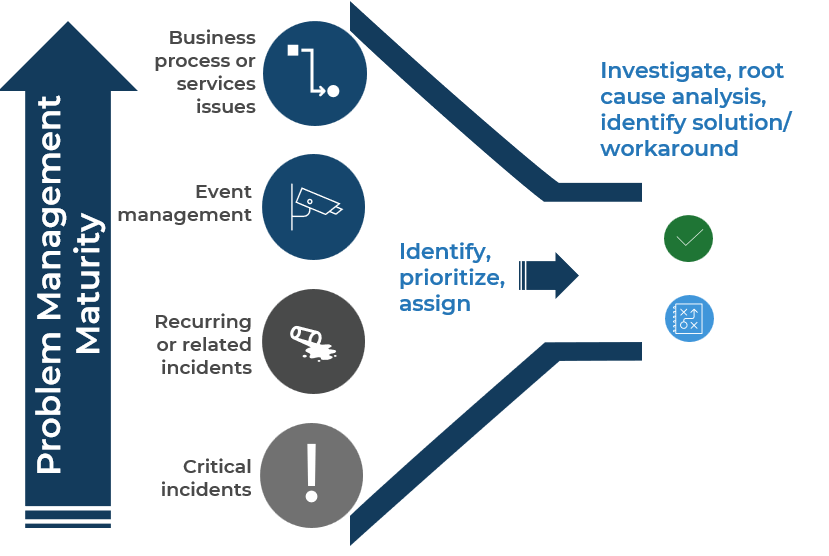
Start with known issues – critical incidents and recurring incidents identified through effective incident classification. This drives tangible business benefits that justify time spent on problem management.
Not every problem has a viable or practical permanent resolution. A workaround that expedites resolving future occurrences of the incident can make more business sense, depending on the time and money needed for a permanent resolution.
STOP: Ensure you have foundational Service Desk operations before continuing
This blueprint will help you improve existing incident management processes, and then build on that foundation to implement or improve problem management.
If you need more foundational improvements to your Service Desk operations, we recommend starting with the blueprint Standardize the Service Desk.
Specifically, the following are pre-requisites for this blueprint:
There is a formal process for submitting tickets or reporting issues (e.g., Service Desk email address, phone number, or portal).
Ticket intake process separates incidents from service requests.
Tier 1 roles are defined that manage ticket intake and provide first-call resolutions for low-complexity issues (e.g., forgot my password).
Info-Tech’s methodology to improve incident and problem management
1. Optimize Ticket Intake and Routing
2. Standardize and Streamline Incident Response
3. Establish Effective Problem Management
4. Implement Improvements
Phase Steps
Review the incident lifecycle and your current challenges.
Improve how you identify, log, and categorize incidents.
Define a ticket prioritization scheme.
Drive more efficient ticket intake.
Document your target-state Incident Management Workflow.
Document your target-state Critical Incident Response Workflow.
Define SLOs and escalation rules.
Create knowledgebase articles and communication templates to expedite incident response.
Improve efficiency with shift-left and automation.
Define problem management.
Standardize your problem intake process.
Standardize your problem action process (investigate, root cause analysis, resolve).
Establish appropriate problem management governance.
Create a plan to communicate process changes.
Create a project roadmap to implement improvements.
Phase Deliverables
Incident Management and Service Desk SOP and Workflows
Incident KB Article Examples
Incident Status Updates and Incident Report Templates
Problem Management SOP and Workflows
Problem Ticket Template
Communication Initiatives
Project Roadmap
Insight summary
Shift-left starts with a good knowledge base
A good knowledge base expedites incident resolution and supports “shift-left” (e.g., enabling Tier 1 to solve incidents that would otherwise escalate to Tier 2 or 3).
Every incident is potentially an opportunity to document a solution, troubleshoot steps, or establish relevant operational documentation needed solve the incident.
If you capture this information only in the ticket or your own personal repository, you limit the ability to shift left and expedite future incident resolution.
Don’t reinvent your processes because of a critical incident
All hands on deck doesn’t mean abandoning processes. Instead, supplement your existing incident management processes to maintain structure to your response. For example:
Alert senior IT leads in case they’re needed but follow existing processes to triage and assign the incident to the right SMEs.
Notify affected users as usual but add appropriate updates to senior leadership.
Leverage existing incident response collaboration methods – e.g., use the same MS Teams channel you normally use to collaborate on incidents; if necessary, set up a separate channel for leadership updates.
Apply structure to problem management to find value
Time must be allocated to problem management to get the long-term benefits. It’s not going to be driven by the urgency of an outage, but rather the foresight to predict and prevent future incidents.
Effective problem management follows a structured process to get the most out of the time allocated to this proactive effort. This includes appropriate prioritization, a root cause analysis methodology, and a decision point on whether to adopt a workaround or continue to pursue a permanent solution.
If problem management is ad-hoc or “when I have time,” something else will always take precedence.
Blueprint deliverables
Each step of this blueprint is accompanied by supporting deliverables to help you accomplish your goals:
Incident Knowledgebase Article Examples
Use the examples as a guide for your KB article templates.
Incident, Critical Incident, and Problem Workflows
Workflows are critical to communication process expectations and driving consistent execution.
Incident Status Updates and Incident Report Templates
Modify our examples to suit your requirements.
Incident and Problem Management Project Roadmap
Identify, prioritize, and present initiatives to improve incident and problem management.
Key deliverable:
SOPs for Incident Management and Problem Management
Clarify process and role expectations to improve consistency, efficiency, and effectiveness.
Blueprint benefits
IT Benefits
Documented incident management processes clarify expectations for Tier 1, 2, and 3 roles and drive consistent process execution.
Capturing good incident data makes it easier to identify and resolve problems.
Similarly, promoting knowledgebase development as part of your core process (e.g., identifying KB opportunities as part of resolving a ticket) not only expedites future incident resolution but also provides input to problem management to resolve the underlying root cause.
Business Benefits
Quicker incident resolution through better process (e.g., routing tickets to the correct SMEs) and leveraging KB articles.
Preventing recurring incidents by resolving the root cause.
Predicting and preventing future incidents through proactive problem management.
Info-Tech offers various levels of support to best suit your needs
DIY Toolkit
“Our team has already made this critical project a priority, and we have the time and capability, but some guidance along the way would be helpful.”
Guided Implementation
“Our team knows that we need to fix a process, but we need assistance to determine where to focus. Some check-ins along the way would help keep us on track.”
Workshop
“We need to hit the ground running and get this project kicked off immediately. Our team has the ability to take this over once we get a framework and strategy in place.”
Consulting
“Our team does not have the time or the knowledge to take this project on. We need assistance through the entirety of this project.”
Diagnostics and consistent frameworks used throughout all four options
Guided Implementation
What does a typical GI on this topic look like?
A Guided Implementation (GI) is a series
of calls with an Info-Tech analyst to help implement our best practices in your organization.
A typical GI is between eight and 12 calls over the course of four to six months.
Phase 1
Phase 2
Phase 3
Phase 4
Call #1: Scope requirements, objectives, and your specific challenges.
Call #3: Incident Management Workflows.
Call #6: Problem ticket sources.
Call #9: Plan how you will communicate changes.
Call #2: Incident ticket intake and routing.
Call #4: Critical Incident Workflows.
Call #7: Problem management workflows.
Call #10: Create a project roadmap to implement improvements.
Call #5: Complete the Incident Management SOP
Call #8: Complete the Problem Management SOP
Phase 1: Optimize Ticket Intake and Routing
Phase 1
Optimize Ticket Intake and Routing
Phase 2
Standardize and Streamline Incident Response
Phase 3
Establish Effective Problem Management
Phase 4
Implement Improvements
This phase will walk you through the following steps:
Review the incident lifecycle and your current challenges.
Improve how you identify, log, and categorize incidents.
Define a ticket prioritization scheme.
Drive more efficient ticket intake.
Improve Incident and Problem Management
Step 1.1
Review the incident lifecycle and your current challenges
Activities
1.1.1 Identify challenges with your existing incident management processes
This step will guide you through the following content and activities:
Establish a common understanding of the incident lifecycle.
Identify challenges with your existing incident management processes.
This step involves the following participants:
Incident Management Team (e.g., Tier 1 and 2 roles and the Incident Manager)
Tier 3 reps from relevant IT teams (e.g., network, servers, security, apps, etc.)
Outcomes of this step
Level-setting across the team regarding incident lifecycle stages, based on ITIL.
High-level challenges identified with your existing incident management processes.
Blueprint pre-step: Gather your data to relate this blueprint to your reality
Before you begin this project, gather the data from your existing ticketing system.
You will use this data as you work through this blueprint to help you make decisions on what the target state of your incident management program looks like.
You will need:
An export of your existing ticket categorization scheme; raw data is better so you can easily manipulate the data as you are analyzing it.
Each person on the project team will pull ten tickets from each priority level you are currently using (10 sev1, 10 sev2, 10 sev3).
A snapshot of the incident ticket interface to be able to quickly reference existing fields and functionality.
This image will help remind you to search through your own ticket data to help guide your decisions during the design phase of incident management.
Establish a common understanding of the incident lifecycle
1) Detection: User reporting an issue, event triggering an alert, and so on. Conduct initial triage/discovery. Confirm it’s an incident (for service requests, follow a separate process).
2) Registration: Create/update the ticket based on initial triage (e.g., incident details) or monitoring system that generated the alert (e.g., relevant system).
3) Classification: Categorize, prioritize, and conduct initial investigation (e.g., check KB for known errors). Escalate or re-assign if necessary.
4) Diagnosis: Additional investigation if solution not already identified. Peer discussion, check KB, and/or consult vendor. Escalate or re-assign if necessary.
5) Resolution: Apply solution (permanent fix or workaround) to restore service. If applicable, submit a change request to move the fix into production.
6) Closure: Finalize ticket details, including status (Closed). Provide final update to affected users. Identify if a KB is needed to expedite future troubleshooting or incident resolution.
Note: Ideally, steps 1 to 3 are executed by Tier 1 staff so that Tier 2 and 3 are included only when an issue needs to be escalated. This drives lower-cost resolution and frees time for Tier 2 and 3 to focus on project work, more-complex incidents, and problem management. Ticket updates occur throughout and are finalized as needed at Closure.
1.1.1 Identify challenges with your existing incident management processes
1-3 hours
Materials
Whiteboard or flip chart
Participants
Incident Management Team (e.g., Tier 1 and 2 roles and the Incident Manager)
Tier 3 reps from relevant IT teams (e.g., network, servers, security, apps, etc.)
As a group, outline the challenges or weaknesses you have in each step of the incident lifecycle. Separate the challenges into people, process, and technology for a wholistic view.
Record those challenges for reference purposes. Phase 4 will include creating a project roadmap to address gaps and improve processes.
Below are examples of common challenges to consider:
Are incidents resolved at the appropriate Tier? Are Tier 2 and 3 resolving incidents that could be solved at a lower Tier?
Any challenges with identifying ticket type, category, or severity level? Is it clear where to route tickets (e.g., based on category)?
Is it clear when to escalate tickets? Is Tier 1 gathering enough information before escalating?
Is ticket data updated appropriately by Tier 2 or 3 staff?
Is there appropriate documentation available to support ticket troubleshooting (e.g., system information, relevant KB articles, etc.)?
Any common complaints from users or executives (e.g., slow response, ticket status is unclear)?
Step 1.2
Improve how you identify, log, and categorize incidents
Activities
1.2.1 Review and update your categorization scheme
1.2.2 Define resolution codes to further improve reporting
This step will guide you through the following content and activities:
Separate incidents from service requests
Understand categorization best practices
Review/update categorization scheme
Define resolution codes to further improve reporting
This step involves the following participants:
Incident Management Team (e.g., Tier 1 and 2 roles and the Incident Manager)
Tier 3 reps from relevant IT teams (e.g., network, servers, security, apps, etc.)
Outcomes of this step
Improved ticket categorization scheme and resolution codes.
Knowledge sharing between teams regarding proper use of categories and resolution codes.
This content is exclusive to members.
Sign up to continue reading the full blueprint, or sign in if you already have an account.
Our systems detected an issue with your IP. If you think this is an error please submit your concerns via our contact form.