
Discover the Enterprise AI Technology Stack
Make the right vendor choices to sustainably, safely, and dynamically scale your enterprise AI capabilities.
Many organizations have moved past chatbot pilots and are adopting autonomous systems that trigger workflows, access sensitive data, and make operational decisions across the enterprise. As agentic AI embeds itself into core workflows and critical systems, the piecemeal stack assembled for quick wins exposes organizations to challenges unseen in earlier AI pilots. This expansive research maps the six layers of the enterprise AI technology stack to help IT leaders understand how the pieces fit together, learn the vendors shaping each layer, and prepare for vendor evaluation.
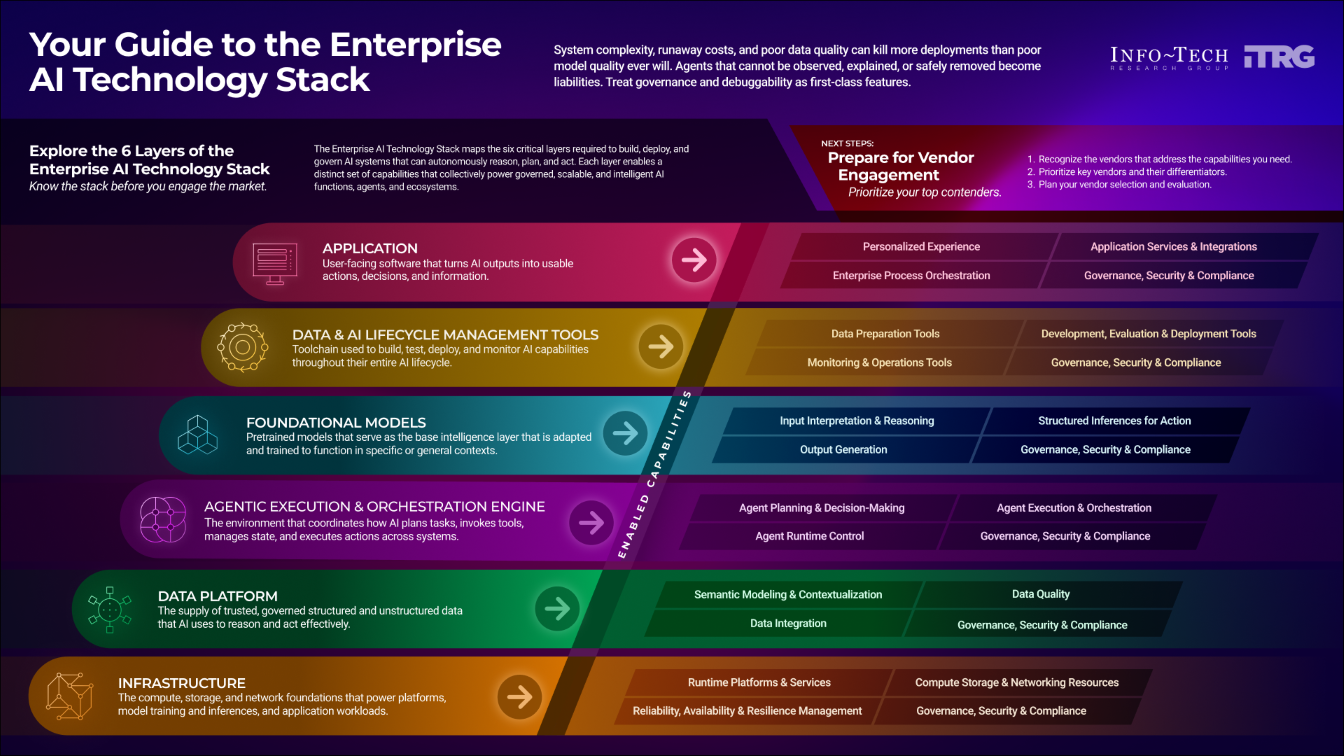
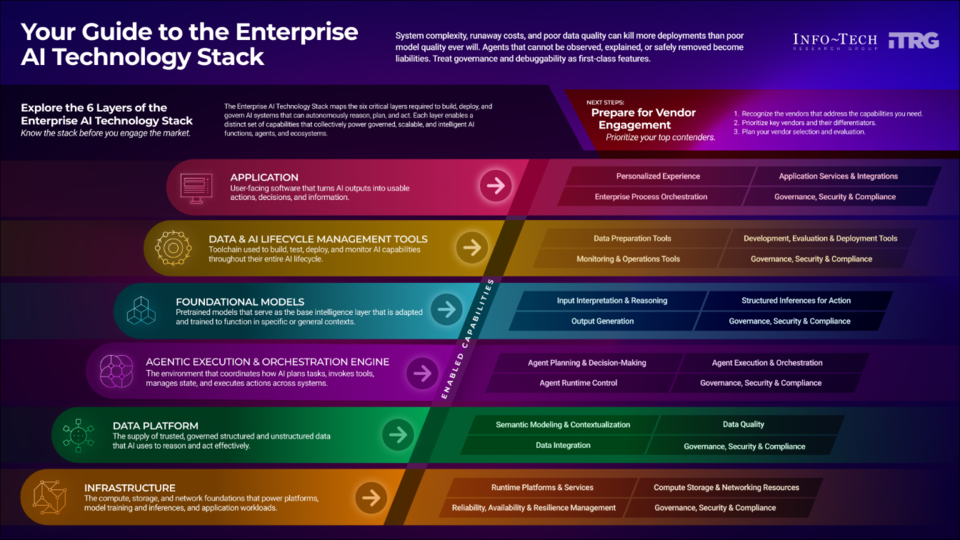
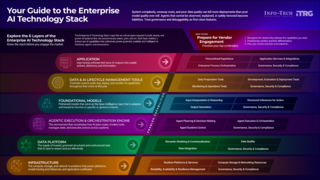
What worked for early AI pilots will not hold up at enterprise scale. Before making long-term decisions, IT leaders, enterprise architects, and AI product owners need a clear view of all the layers of the enterprise AI technology stack: Application, Data & AI Lifecycle Management Tools, Foundational Models, Agentic Execution & Orchestration Engine, Data Platform, and Infrastructure.
1. Application: Turn user intent into autonomous workflows.
Agentic applications that respond only to prompts leave most of their value on the table. Without application integration, memory retention, and tooling execution working together, teams stall at chatbot-style use cases and never reach real autonomy. Configure or build applications so user intent flows into autonomous multistep tasks that act, recall context, and complete work end to end.
2. Data & AI Lifecycle Management: Streamline the path from prototype to production.
Manual and fragmented AI delivery pipelines struggle to meet enterprise demands for AI customization, reusability, testing, and monitoring. Without reusable lifecycle components, every new agent restarts the engineering work and lengthens time to value. Prioritize lifecycle tools with reusable parts for prompt chaining, function calling, and agent evaluation so prototypes are safely promoted to production.
3. Foundational Models: Pick the smallest viable model.
Defaulting to the largest generative AI model inflates cost and latency without lifting outcomes. Oversized foundational models drain budgets and slow agents in the workflows where speed and unit economics matter most. Identify the smallest viable model that meets each agent's functional and nonfunctional requirements, and use fit-for-purpose or mid-tier models for unique use cases.
4. Agentic Execution & Orchestration: Engineer the runtime for coordination and control.
Agents that act in isolation cannot deliver on cross-system workflows or composite decisions. A weak agent orchestration layer fragments execution, leaves agent behavior hidden, and lets strategic and operational goals go unenforced. Architect a runtime that coordinates agents across systems, synthesizes multimodal results, and embeds observability and AI governance into every decision and action.
5. Data Platform: Feed agents trusted, real-time data.
Agents are only as intelligent as the data they can reach. Stale, siloed, or ungoverned data produces unreliable outputs that erode trust in agentic systems. Build a data platform that delivers real-time access to structured and unstructured data and scales as adoption accelerates across the organization.
6. Infrastructure: Tune infrastructure for inference, not training.
Infrastructure built for batch machine learning training cannot absorb the sequential reasoning steps and tool calls agentic workloads demand. Without inference-optimized accelerators, response latency climbs and agent performance degrades under real operating conditions. Validate that accelerators, compute resources, and networks are tuned for low-latency inference at the scale your agentic workloads require.
Use this step-by-step research to map the enterprise AI stack and its vendors
This comprehensive research includes a high-level capstone report accompanied by six companion reports, each focused on a different layer of the enterprise AI technology stack along with vendors that shape them. Together, they guide teams from a piecemeal pilot architecture to a coordinated, enterprise AI-ready foundation for scaling agentic systems.
- Learn the agentic AI technology stack. Develop a working understanding of each layer and how they connect to power intelligent, autonomous systems.
- Recognize the vendors in the marketplace. Identify commonly referenced vendors shaping each layer of the stack.
- Prepare for vendor selection. Equip teams with structured criteria, trade-offs, and key questions to ask before entering formal evaluation.
Discover the Enterprise AI Technology Stack
Make the right vendor choices to sustainably, safely, and dynamically scale your agentic AI capabilities.
Analyst perspective
Agentic AI is a living system that must flex, adapt, and evolve.
As AI continues to transform organizations, the supporting ecosystem must evolve to sustainably and safely enable, adapt, and orchestrate agentic AI agents and capabilities. A successful technology stack extends beyond traditional components to include:
- Applications: Agentic AI-enhanced applications with autonomous capabilities that orchestrate, manage, and govern multiple AI agents.
- Data and AI Lifecycle Management Tools: Development tools purpose-built to streamline agentic workflows from prototype to production-ready autonomous systems.
- Foundation Models: Models selected to perform multistep reasoning, context retention, tool use, and autonomous error recovery in specific contexts.
- Data and AI Platforms: An underlying platform architected for real-time knowledge access, tool and action logging, and governance enforcement.
- Infrastructure: Hardware optimized to maximize inference performance and throughput while minimizing response latency for agentic workloads.
Unfortunately, the AI landscape shifts faster than any roadmap can predict. The most critical architectural decision an IT leader can make is building a technology stack designed not for today’s answers, but for tomorrow’s unknowns.

Bill Wong
AI Research Fellow, Research Development
Info-Tech Research Group

Andrew Kum-Seun
Research Director, Applications Research Development
Info-Tech Research Group
Executive summary
Your Challenge
- Organizations are rapidly moving from AI assistants that advise (e.g. chatbots) to autonomous agents that contextualize systems, trigger workflows, and make operational decisions. They are beyond task-based pilots.
- Early AI deployments are often assembled quickly with a mixture of models, tools, and technologies. Early and quick wins are traded off for architectural discipline and scalability.
- As agentic AI becomes more embedded in core processes and systems, it must meet enterprise expectations for reliability, security, governance, cost control, and vendor sustainability.
Common Obstacles
- Scaled agentic AI introduces new risks, such as integration brittleness, runaway costs, untrusted and stale data that organizations may not be capable of addressing.
- The agentic AI marketplace spans across a broad and expanding range of layers in the technology stack (from application to infrastructure) making it increasingly difficult to keep up-to-date and complex to assemble.
- Without a clear AI vision and architecture discipline, AI teams over-invest in the wrong places while under-investing in what enables scale (e.g. observability and integration reliability).
Info-Tech’s Approach
- Get familiar with the enterprise AI technology stack. Develop a foundational understanding of each layer in the stack and how they work together to enable intelligent and autonomous systems.
- Recognize the vendors in the marketplace. Learn the notable and commonly referenced vendors to discover what and who is shaping the marketplace.
- Prepare for vendor selection. Equip your teams with a structured way to evaluate and prioritize vendors and products by identifying key considerations, trade-offs, and questions to ask before moving into formal selection.
Info-Tech Insight
Agent demonstrations look alike, but operational realities do not. Sustainable, understandable, and trustworthy operations beat smarter models every time. The vendors worth betting on are the ones that make agents easy to observe, explain, debug, govern, and remove safely.
Organizations are beyond small-scale pilots
From prototypes to production-grade agentic AI
Organizations are rapidly shifting from chat-based assistants to autonomous agents that take actions and make decisions across enterprise systems. Early pilot successes are often achieved by quickly assembling task-based solutions using a mix of models, tools, and techniques. As agentic AI scales and spreads into and across critical workflows, it is expected to operate reliably, in compliance with regulations, be cost efficient, and have clear accountability.
- Early AI deployments are piecemeal and siloed, prioritizing speed to value over long-term viability.
- Enterprise-grade reliability, governance, and quality requirements become critical success factors that were not priorities in early pilots.
See our Design Your Agentic AI Prototype to learn more on agentic AI prototyping.
Scale makes the technology stack taxing
Architectural and vendor decisions that worked well in pilots begin to expose significant risks as agentic AI scales. Specific failure modes become more probable and impactful, such as unsafe actions, unauthorized access to sensitive data, brittle integrations, and runaway costs. Without robust controls and clear governance, organizations will struggle to manage agents as sustainable and secured systems.
- Runtime controls, durable and robust integrations and understandable agent explanations are required to reveal and proactively address risks across systems and teams.
- Overlapping and uncoordinated stacks lead to redundant capabilities, gaps in control, unnecessary vendor lock-in, and incomplete visibility of agent behavior and impact.
AI is a strategic priority
84% of organizations say they are looking to add more AI capabilities over the next three years. (Source: “State of Process Orchestration & Automation 2025.” Camunda, 2025; n=800)
Automations do not get easier as you scale
78% of organizations say complex workflow patterns and/or long-running processes are increasing the difficulty in automation. (Source: “State of Process Orchestration & Automation 2025.” Camunda, 2025; n=800)
Successful AI adoptions are aligned to strategic priorities and architectures
Understanding the business context is a must for all AI initiatives, especially when scaling. Map your initiatives to your strategic priorities to gain the stakeholder buy-in you need. Then, use these targets to design the architectures that maximize the value you are committed to delivering while minimizing organizational risks.
Capture your business priorities in your AI strategy and your technology vision with an AI architecture
AI Strategy
An AI strategy ties business needs with the AI capabilities and tools required to support them. Key components of the AI strategy include AI governance, data management, people, processes, and technology.
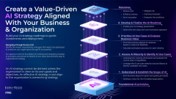
See Info-Tech’s Build Your AI Strategy and Roadmap for more information.
AI Architecture
An AI architecture is the structured framework that encompasses the components and processes necessary to develop, deploy, and manage AI systems. It aims to ensure compliance, interoperability, reliability, strategic alignment, and sustained value from AI investments.
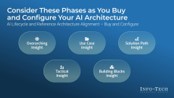
See Info-Tech’s Define the Components of Your AI Architecture for more information.
Info-Tech Insights
Keep these points in mind as you explore and design your agentic AI technology stack:
Application
Configure or build your agentic AI applications so that they do more than just respond. They must translate user intent into autonomous, multistep workflows where planning, memory, and tool execution converge.Data & AI Lifecycle Management
Prioritize the tools that streamline agent delivery through reusable components for prompt chaining, function calling, and agent evaluation. Your delivery toolchain should accelerate the transition from prototype to production-ready autonomous systems.Foundational Models
Identify the smallest viable model capable of meeting your agent’s functional and nonfunctional requirements. Consider fit-for-purpose and mid-tier models to execute unique use cases and to optimize costs and performance.Agentic Execution & Orchestration Engine
Architect your runtime engine so that it coordinates AI agents across different systems and technology stacks, synthesizes multimodal results, and continuously optimizes decision-making and workflow executions in real time. Observability and governance are central to ensuring agent alignment to broader strategic and operational goals.Data Platform
Agents are only as intelligent as the data they can access. Ensure your data platform delivers real-time access to both structured and unstructured data and is architected to scale as agentic AI adoption accelerates across the organization.Infrastructure
Ensure that your AI accelerators are inference optimized and your infrastructure can deliver low-latency, sequential reasoning steps and tool calls at scale and in various operational conditions.
Learn the capabilities, table-stake features, and vendors of each layer
Application
User-facing software that turns AI outputs into usable actions, decisions, and information.Data & AI Lifecycle Management Tools
Toolchain used to build, test, deploy, and monitor AI capabilities throughout their entire AI lifecycle.Foundational Models
Pre-trained models that serve as the base intelligence layer that is adapted and trained to function in specific or general contexts.Agentic Execution & Orchestration Engine
The environment that coordinates how AI plans tasks, invokes tools, manages state, and executes actions across systems.Data Platform
The supply of trusted, governed, structured, and unstructured data that AI uses to reason and act effectively.Infrastructure
The compute, storage, and network foundations that power platforms, model training and inferences, and application workloads.
Make the right vendor and product decisions
Create vendor selection criteria that best enables you to deliver your current and future high-value AI use cases.
Selection Criteria Considerations
- Functional Use Cases – AI capabilities that support your high-priority business capabilities, processes, and tasks.
- Operability & Production Reliability – The ability to reliably deploy, run, monitor, recover, and evolve the technology stack to reflect real enterprise scenarios.
- Deployment Compatibility & Flexibility – The fit of the product with the organization’s deployment models (e.g. cloud) and regulatory requirements without architectural, functional, or technical compromises.
- Governance, Security & Compliance – The extent to which the product enforces budget caps, permissions, policies, oversight, and transparency controls so that agent actions are safe, sustainable, compliant, explainable, and visible.
- Integration & Ecosystem Fit – The robust and flexible connections of the product with new and existing platforms, data sources, tools, and standards, minimizing any regressions in agent and system performance.
- Implementation & Operational Costs – The initial and ongoing expenses required to run, monitor, scale, and maintain the product in production.
Info-Tech’s Research
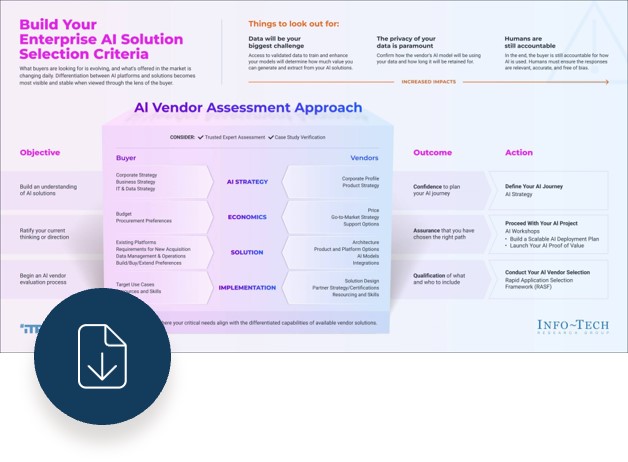
FEATURED RESEARCH:
Build Your AI Solution Selection Criteria
FEATURED RESEARCH:
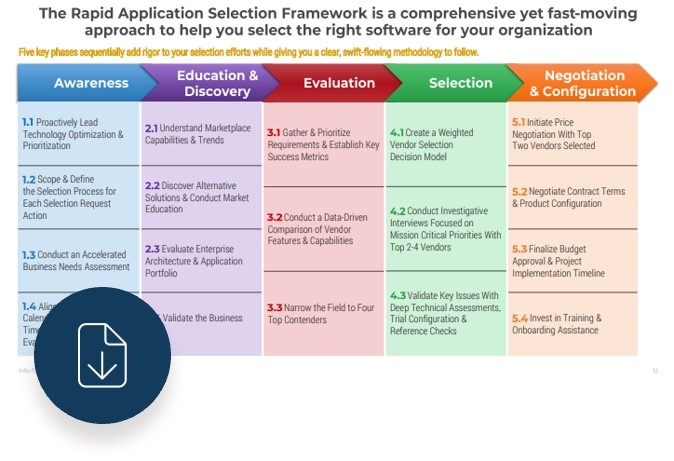
The Rapid Application Selection Framework
Follow Info-Tech’s AI Journey
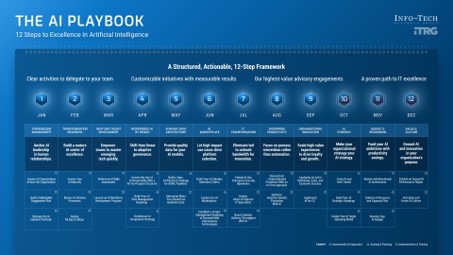
Info-Tech has compiled a thorough and proven library of research products aligned to the 12 steps in the AI Playbook.
Under each of the 12 steps in our AI Playbook framework is a series of research products with associated deliverables that will help you achieve excellence in that area. There are 32 research experiences in total.
The Info-Tech difference:
- A structured, actionable, 12-step playbook
- Our highest-value advisory engagements
- Clear activities to delegate to your team
- Customizable initiatives with measurable results
- A proven path to AI excellence
Related Info-Tech Research
Artificial Intelligence Research Center
Identify, prioritize, implement, govern, and scale AI initiatives across business processes with Info-Tech’s tools, curated research, guidance, and expert support.
AI Marketplace
Discover, learn, and evaluate AI vendors and solutions tailored to specific use cases, industry needs, and desired business outcomes through case studies and Info-Tech interviews.
Info-Tech AI Insights
Read Info-Tech’s monthly AI Insights newsletter to educate your team on important AI news, analysis, research, and vendor updates in one brief, easy-to-digest newsletter.
About Info-Tech
Info-Tech Research Group is the world’s fastest-growing information technology research and advisory company, proudly serving over 30,000 IT professionals.
We produce unbiased and highly relevant research to help CIOs and IT leaders make strategic, timely, and well-informed decisions. We partner closely with IT teams to provide everything they need, from actionable tools to analyst guidance, ensuring they deliver measurable results for their organizations.
What Is a Blueprint?
A blueprint is designed to be a roadmap, containing a methodology and the tools and templates you need to solve your IT problems.
Each blueprint can be accompanied by a Guided Implementation that provides you access to our world-class analysts to help you get through the project.
Talk to an Analyst
Our analyst calls are focused on helping our members use the research we produce, and our experts will guide you to successful project completion.
Book an Analyst Call on This Topic
You can start as early as tomorrow morning. Our analysts will explain the process during your first call.
Get Advice From a Subject Matter Expert
Each call will focus on explaining the material and helping you to plan your project, interpret and analyze the results of each project step, and set the direction for your next project step.
Unlock Sample ResearchContributors
- Danny Buie – Vice President, IT Strategy & Data, Tyler Technologies, Inc.
- Deepti Bahel – Senior Data Engineer, AI Builder, Founder, MediMate Foundation
- James Galvin –AI and Emerging Technology Manager, Washington Technology Solutions
- Chaney Curry – Enterprise AI Business Architect, Washington Technology Solutions
- 3 anonymous contributors
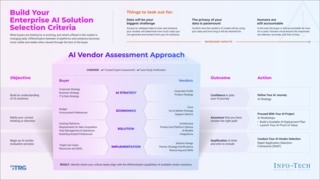 Build Your AI Solution Selection Criteria
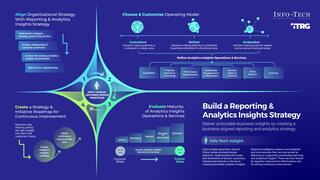 Build a Reporting and Analytical Insights Strategy
 Activate Data Governance
 Business Intelligence and Analytics Platform Selection Guide
 Mitigate Machine Bias
 Get Started With Artificial Intelligence
 Define the Components of Your AI Architecture
 Drive Business Value With Off-the-Shelf AI
 AI Trends 2023
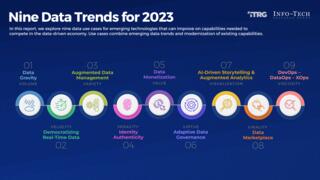 Data and Analytics Trends 2023
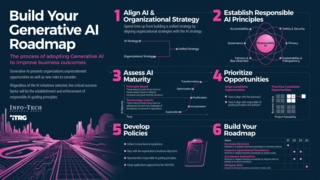 Build Your Generative AI Roadmap
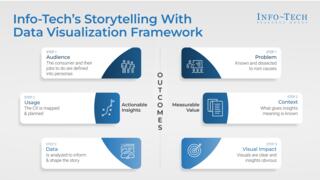 Tell Your Story With Data Visualization
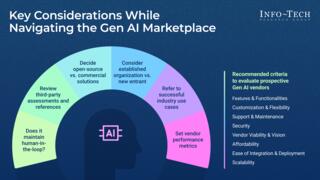 Select Your Generative AI Vendor
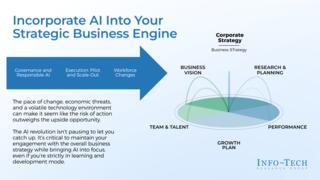 An AI Primer for Business Leaders
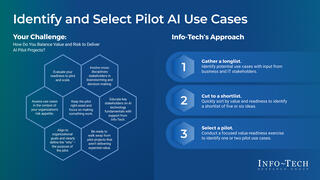 Identify and Select Pilot AI Use Cases
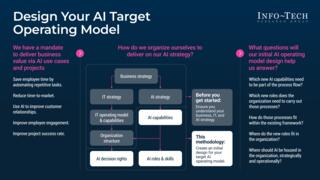 Design Your AI Target Operating Model
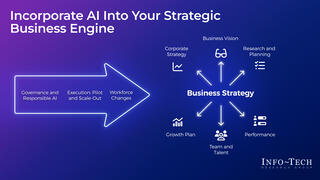 Plan Your Early AI Moves: Training for Business Leaders
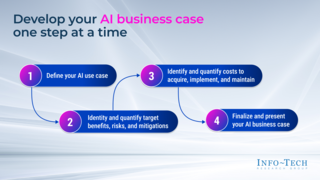 Build Your AI Business Case
 Run IT By the Numbers
 Transform IT, Transform Everything
 The Race to Develop Talent
 Assessing the AI Ecosystem
 Sync or Sink: Aligning IT and HR for the Future of Work
 Bring AI Out of the Shadows
 The AI Vendor Landscape in IT
 IT Spend and Staffing Benchmarking
 The Data Playbook
 Assess Your Data Science and Machine Learning Capabilities
 Discover the Enterprise AI Technology Stack
 AI in Seven Charts
 Emerging AI Trends and Predictions From Our Global Technical Counselor Team
 People Change in the Face of Disruptive Technology
 Optimize Cloud & AI Spend With Agentic FinOps
 The Challenge of Ethics in the Use of AI
 Introducing the Info-Tech Speakers Bureau
 Inside the Agentic Enterprise
 Agents 2.0: From Autonomy to Architecture
 Agentic IT: From Hype to Value
 Tech Trends 2027 Keynote
 Become an Exponential CIO
 Beyond the Agent: The Leadership Ecosystem for an AI-Enabled World
 Five Key Takeaways From Info-Tech LIVE 2026
 From Data as a Product to the Data Value Chain