Our systems detected an issue with your IP. If you think this is an error please submit your concerns via our contact form.
Build the Semantic Layer Behind LLM-Powered Analytics
Vibe dashboarding: Turn your dashboard portfolio into trusted AI answers.
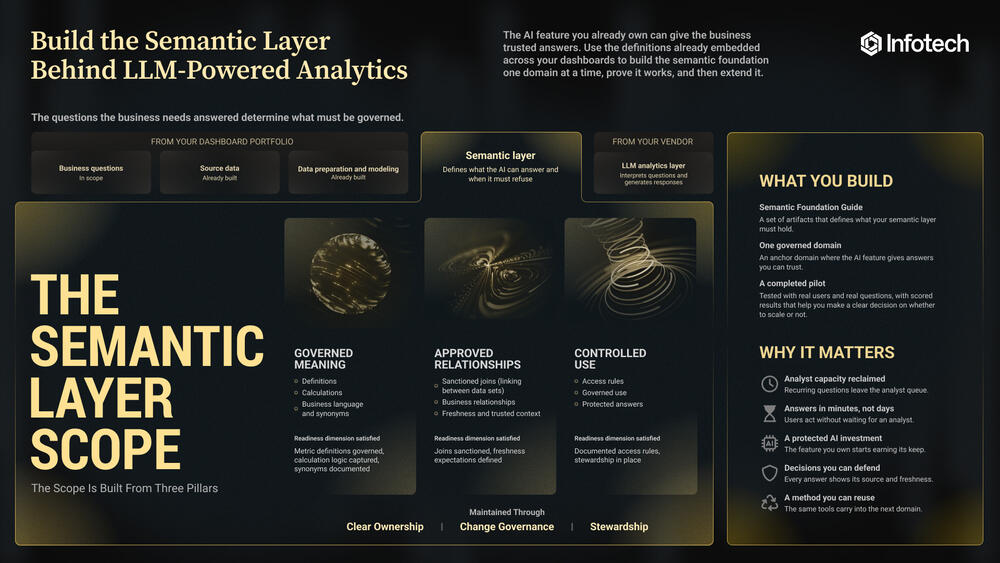
The AI capabilities included in today’s business intelligence (BI) platforms enable users to ask questions in their own words. But for many organizations, this conversational AI feature produces answers that BI users do not trust. That’s because the quality of the answers depends on the business meaning underneath the technology. Use our four-phase framework to build the semantic foundation in one key domain, prove it works, and use the evidence to decide whether to extend it across the portfolio to realize the full value of AI in your existing enterprise analytics investments.
Your semantic foundation was built for dashboards, not for AI. To produce trustworthy AI answers, it requires definitions, joins, access rules, and ownership structures that are both governed and consistent. Instead of focusing on the AI feature, improve the part you can control: the foundational layer beneath the dashboards.
1. The dashboard portfolio is the scope boundary.
Don’t rationalize dashboards; it’s better to mine them instead. The questions they already answer define what the layer must support, grounded in real demand.
2. Trust is proven rather than assumed.
Validate answers against known-good answers, treat appropriate refusal as a feature, and turn the evidence into a defensible go/wait/no-go call. The pilot proves the reusable method.
3. Refusal is a feature.
A working foundation lets the AI refuse what it can’t answer reliably. Refusal is the layer doing its job – punishing it only trains the AI to fabricate.
Use this blueprint to build a trusted, governed semantic layer that prevents false answers.
Our practical framework equips BI leaders with a platform-agnostic methodology to build a proven pilot in one domain that can then be reused in others. Use this step-by-step approach to:
- Fix the foundation instead of the feature. Rather than ripping out the AI or buying an entirely new tool, build the governed semantic layer beneath the dashboard that every vendor says their AI feature requires.
- Scope to one domain vs. the whole enterprise. Instead of a multiyear modernization, prove the method on a single slice of your dashboard portfolio with an approach that is defensible, bounded, and grounded in real demand.
- Prove trust with evidence rather than enthusiasm. Check every answer against a known-good result and a trust contract, making a go/wait/no-go scaling decision based on measured accuracy, refusal, and provenance.
Research & Tools
1. Build the Semantic Layer Behind LLM-Powered Analytics Storyboard – A comprehensive PowerPoint deck to guide you through the four-phase methodology for building and validating the semantic foundation required for trusted AI-powered analytics.
Use this storyboard to:
- Define the demand boundary. Extract semantic requirements from the dashboard portfolio, then select the anchor domain.
- Build the semantic foundation. Assess semantic layer readiness first, then build the minimum viable semantic layer.
- Establish governance and stewardship. Diagnose stewardship conditions and define the stewardship operating model.
- Pilot and decide. Pilot the foundation against the BI tool’s AI feature before deciding whether to extend.
2. LLM-Powered Analytics Semantic Foundation Guide – A guide containing nine templates and decision tools, including a Semantic-Layer Readiness Scorecard, Metric Definition Template, Trust Contract, Pilot Validation Log, and Go/Wait/No-Go Scale Decision.
This guide helps you:
- Build a trusted semantic layer for AI within your BI tool.
- Know what to govern.
- Define and validate key business meanings.
- Ensure AI delivers trusted answers so you can scale with confidence.