
Design the IT Infrastructure & Operations Organization of the Future
Review your strategy, structure, skills, and staffing.
Technology’s lightning-speed advancements require new skills and new ways of working. Against that shifting backdrop, IT infrastructure & operations teams must balance meeting everyday demands with planning for the future. But I&O’s plate is already overloaded with day-to-day tickets, last-minute projects, and fires that urgently need putting out. Use our practical research framework to build an I&O operating model that addresses the needs of both today and tomorrow.
Your enterprise’s ability to adapt to technological change can be sabotaged by widening skills gaps, static staffing levels, and misalignment between I&O and strategic goals. Assess your organization’s strategy, structure, and critical skills gaps to embrace a holistic I&O approach that’s responsive to daily realities yet also future-ready.
1. I&O’s culture can stifle much-needed change.
I&O is built on stability, standardization, reliability, availability, and cost control – qualities essential for keeping the lights on, but not for driving innovation, experimentation, and learning. Some I&O leaders may have to consciously shift their team’s culture to be more open to change.
2. The skills gap is just the tip of the iceberg.
Addressing the skills gaps in your organization is only one piece of the I&O puzzle; upskilling and training are not enough anymore. Analyze your organization’s structure and staffing, as well, to make sure work flows smoothly, accountability is well defined, and capacity is sufficient to maximize the value of the change you’re enabling.
3. Short-term skills patching isn’t a plan for the future.
Some projects demand skills your organization lacks right now. But rushing to contract, hire, and train your way out of a skills shortfall is ultimately shortsighted. Problem solved for now – but what about tomorrow? A more strategic, forward-looking approach puts I&O on steadier footing than just patching the most immediate skills gaps facing your organization today.
Use this step-by-step guide to build an I&O organization that’s aligned, agile, and adaptable
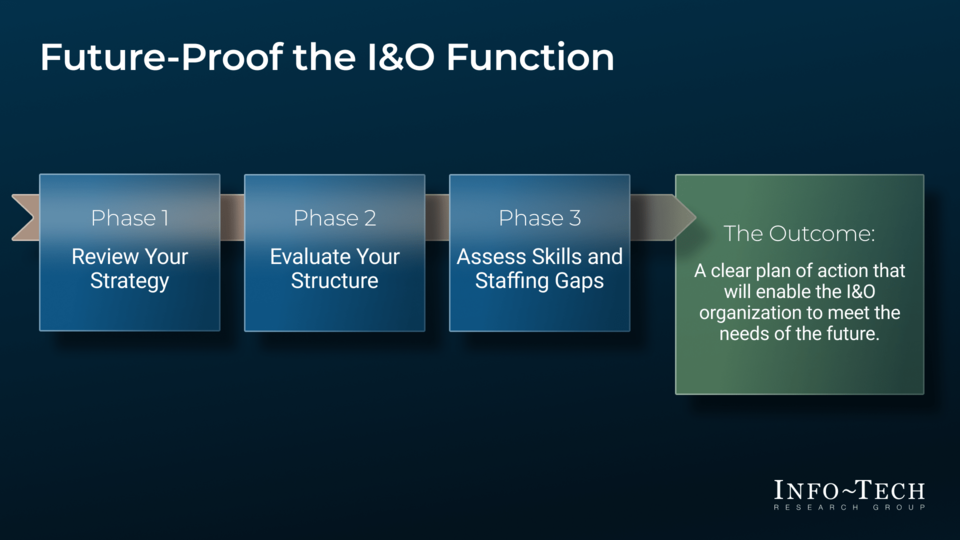
Our research offers a comprehensive storyboard combined with three other tools: a design sketchbook, a skills analysis template, and a staffing calculator. Use our detailed, actionable methodology to craft a multiyear I&O strategy that’s made for this current moment yet flexible enough for the future.
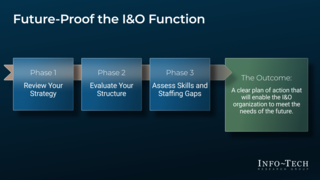
- Review your strategy and technology plans to identify key drivers and stakeholders for change, pinpoint roadblocks and risks, and decide how to handle them.
- Evaluate your structure by documenting inputs, outputs, work, and interactions to assess the current and future state of your organization. Then, identify action items to address any gaps.
- Assess skills and staffing gaps by conducting a data-driven analysis and create a multiyear roadmap out of action items you’ve identified.
Design the IT Infrastructure & Operations Organization of the Future
Review your strategy, structure, skills and staffing.
EXECUTIVE BRIEF
Analyst perspective
Start with the end in mind.

IT Infrastructure & Operations leaders are facing more change today than we’ve seen in years. Technologies are changing exponentially, bringing with them a need for new skills, sometimes new roles, and new ways of working.
Adapting to the change can feel impossible when I&O teams are already underwater, struggling to keep pace with day-to-day break-fix, last-minute projects, and operational work. It’s hard to build a strategic approach that addresses the needs of today and the needs of tomorrow, too.
The right-sized, practical tool kit you’ll find in this methodology will help you build a forward-looking organizational structure, skills sourcing plan, and staffing gap analysis to prepare your team and organization to adapt to change.
Andrew Sharp
Research Director,
Infrastructure & Operations
Info-Tech Research Group
Executive summary
Your Challenge
Your business’ appetite for new technology is outpacing the Infrastructure & Operations team’s ability to deliver:
- Current skill sets haven’t kept up with the latest technologies or organizational mandates.
- Staffing levels aren’t allowing you to meet organizational needs.
- I&O isn’t well aligned with the business or the other areas of IT.
Common Obstacles
You’re not sure where to start:
- Making changes to one part of your team or function can have cascading effects in other parts of I&O, IT, or the organization.
- Trying to force the organization to operate the wrong way can do lasting damage to engagement, retention, SLAs, and business value.
- Existing theories for team and organizational design don’t always feel like a good fit for the Infrastructure & Operations team.
Info-Tech’s Approach
Use our methodology to:
- Document, evaluate, and redesign your operating model to help you achieve your documented strategy and goals.
- Evaluate current skill sets and staffing levels and identify gaps as you move forward to implement changes.
- Leverage other Info-Tech research and products to support cultural change, skills training, benchmarking, and more.
Info-Tech Insight
It’s not just the skills gap holding you back. Pair your skills upgrade with a fresh look at your structure and staffing to ensure work flows smoothly, accountability is well defined, and capacity is sufficient to maximize the value of the change.
Everyone has a skills gap
Your business’ appetite for new technology is outpacing your team’s ability to acquire needed skills
- Most organizations are getting out of the business of running their own data center, unless they have a compelling reason to do so.
- Technology is changing very quickly, and unless you can abstract underlying layers it becomes very difficult to adopt those changes in your organization rapidly, responsibly, and securely.
- Across every major survey, a major obstacle to transformation is a lack of qualified skills and resources to support the design, implementation, and management of a new technology stack.
“A common theme across every Infrastructure & Operations leader I work with is the skills gap in their organization that’s preventing them from taking action on their cloud strategy.”
– Justin St-Maurice, Technical Counselor, Info-Tech Research Group
30% of respondents said talent and skills remain a key barrier to cloud adoption.
Source: Foundry, 2024
75% of survey respondents said a lack of resources or expertise was a challenge for cloud management.
Source: Flexera, 2025
A lack of needed skills was the most commonly cited contributing factor to avoidable and wasteful cloud spend, with 41% of all organizations citing a skills gap as a problem.
Source: HashiCorp, 2024
38% of organizations said a lack of training was an obstacle to container use, up from 28% in 2023.
Source: “Cloud Native 2024,” CNCF, 2025
You need to address more than the skills gap
If the problem is a lack of skills and resources, why not just train, contract, and hire to address the gaps you have now?
- A skills acquisition plan is necessary, but you need to be more forward-looking than just patching skills gaps you have today.
- Internal teams have to make time and secure funding to pursue training. Your skilled resources have to be motivated to learn new skills in the first place, or no amount of training budget will help.
- Even if you have budget for it, new hires and contractors don’t know your organization or technology stack as well as seasoned resources do and typically will have a longer ramp time to get to value.
- If you acquire new skills, they need to be in the right place to deliver value: you need to align key skills with accountabilities and work.
- Technologies like IaaS, containers, and automation platforms require new ways of working to maximize the value they deliver. There may be work you’re doing now that you really don’t need to do anymore.
Info-Tech’s approach to future-proof the I&O function
The Challenge:
As the IT Infrastructure & Operations leader, you need to prepare the people who report to you to meet the needs of future technology and organizational demands.
Phase 1: Review Your Strategy
- Drivers for Change and Expected Outcomes
- Risks and Blockers
- Key Stakeholder Map and Engagement Plan
Phase 2: Evaluate Your Structure
- Current and Target-State Organization Diagrams
Phase 3: Assess Skills and Staffing Gaps
- Skills Gaps & Sourcing Plans
- Current and Future-State Staffing Gaps
- Roadmap and Action Plan
The Outcome:
A clear plan of action that addresses quantified gaps and will enable the I&O organization to meet the needs of the future.
Key Insight
It’s not just the skills gap holding you back. Pair your skills upgrade with a fresh look at your structure and staffing to ensure work flows smoothly, accountability is well defined, and capacity is sufficient to maximize the value of the change.
Qualify and track project benefits
Benefits for IT & example metrics
-
Deliver on key initiatives that require significant I&O support.
- Project success rate: Percent of top projects with significant I&O involvement that are on time, on budget, and in scope.
-
Align key processes and accountabilities for better ownership and ultimately better execution across I&O.
- Accountability coverage: Percent of key processes with an identified owner
- Process effectiveness: Effectiveness score for all key I&O processes (e.g. out of five, as rated by the CIO)
-
Avoid unnecessary rework by following this structured, best-practice methodology.
- Person-hours saved: Estimate time saved through not needing to build templates, define methodology, etc.
- Decision-making time reduction: Poll key stakeholders post-project to gather feedback on whether the decision-making process went faster.
Benefits for the business & example metrics
-
Realize the technology transformation with an I&O organization that is ready to deliver on key transformation projects rather than an afterthought that blocks business value.
-
Expected return on transformation investment: ROTI = (Ve – IT)/IT
where Ve is the expected organizational value of transformation and IT is the investment in transformation
-
Expected return on transformation investment: ROTI = (Ve – IT)/IT
-
Quality, throughput, or cost improvements enabled by organizational restructuring, upskilling, or staffing gaps addressed:
- Increased deployment frequency: Number of production releases per week
- Decreased change failure rate: [Failures / Total Deployments] * 100%
- Decreased infrastructure spend per user: Infrastructure Costs / Users
Info-Tech’s methodology for I&O design
Phase 1: Review Your Strategy |
Phase 2: Evaluate Your Structure |
Phase 3: Assess Skills and Staffing Gaps |
|
Phase Steps |
|
|
|
Phase Outcomes |
Identify drivers for change and the key stakeholders to change. Pinpoint any critical risks or blockers and what to do about them. | Create multilayered diagrams of your current and future-state organization. Identify action items to address identified gaps. | Conduct a data-driven analysis of skills and staffing gaps. Create a multiyear roadmap to address identified action items. |
Insight summary
It’s not just the skills gap.
Pair your skills upgrade with a fresh look at your structure and staffing to ensure work flows smoothly, accountability is well defined, and capacity is sufficient to maximize the value of the change.
Start with the end in mind.
You need to identify the destination before you can map the best route to get there.
Prioritize impact.
Focus on areas of the organization where change will have the most significant impact, rather than the areas that may change the most. Concentrate your effort in the areas where you can have the most benefit.
Staff for change.
You’ll likely be straddling the old environment and the new for some time. Ensure your capacity plan accounts for the disruption and added work that the team will have to support while they’re stuck in the middle of the change from old to new.
A picture’s worth a thousand words.
Avoid lengthy prose-heavy documents to describe required organizational changes. Instead, use diagrams that are easier to create and more likely to be read.
Good data paints the right picture.
Support your vision of the future-state organization with data on needed skills and staffing.
Phase 1
Review Your Strategy
Phase 1
1.1 Strategy drivers
1.2 Other drivers
1.3 Alternative tactics
1.4 Key stakeholders
1.5 Pre-mortem
Phase Outcomes
- Identify drivers for change and the key stakeholders to change.
- Pinpoint any critical risks or blockers and what to do about them.
Transformation is in demand and I&O can’t keep up
It’s not just the skills gap
- Surveys show that a lack of skills on new systems is a barrier to adopting new technologies.
- At the same time, an inability to get off legacy technologies is seen by the vast majority of executives as a drag on business agility.
- Skills are a key gap, but not the only one.
- Most organizations change themselves – often adding new roles or functions – during or after a major technology transformation.
- You need a holistic approach that aligns structure, skills, and staffing to your strategic roadmap.
30%
30% of respondents said talent and skills remain a key barrier to cloud adoption.
Source: Foundry, 2024
94%
94% of executives believe legacy infrastructure is greatly hindering their business’ agility.
Source: NTT Data, 2024
81%
81% of organizations have added new roles and functions as a result of their cloud investments.
Source: Foundry, 2024
Prepare yourself with a bold vision of the future
The following research will help you conduct a deep dive into your expected future state:
- Speak to current and emerging technology trends and identify which trends are a priority for your organization:
- Describe the business-aligned strategy for IT, Infrastructure, and Operations:
1.1 Summarize your strategy and technology plans
1.5 hours
Outline the future state of your organization and IT department in a facilitated discussion before you start to work on design activities.
We strongly recommend you document key points from these discussions. They’re a key reference as you work through the rest of the exercise.
- Summarize the wider organization’s strategy and direction. If possible, have a senior executive present this direction to the working group.
- Summarize IT’s and I&O’s role in supporting the business strategy.
- Identify key technology changes you expect in the next few years. List key projects and initiatives that are happening within or will impact the I&O organization.
- Create a shortlist of the ways your strategy and technology roadmap are driving change in the I&O organization.
Input
|
Output
|
Materials
|
Participants
|
1.1 Example: Strategy-Based Drivers for Change
Strategy-Based Drivers for Change
- Business Strategy: Drive digital-first banking; double SMB lending; implement repeatable, data-driven compliance; and cut cost-to-income to 55% by 2028.
- IT’s and I&O’s Role: Deliver 99.99% uptime on critical user-facing systems; support pipelines for real-time data and decisioning; support API-ready core services; develop self-service and auto-remediation.
- Technology Horizon: Open-banking APIs; real-time payments infrastructure; AI underwriting; cloud services; AIOps.
- Major Initiatives and Roadmap: Core replatform; CCaaS rollout; Databricks lakehouse; SD-WAN for 120 branches.
Required Organizational Changes to Respond to Drivers
- Build skill sets and capacity to move and support workloads on SaaS or a secure and scalable cloud platform.
- Build skills, knowledge, and tool sets that support secure development practices.
- Work more closely with the data, analytics, and BI teams to support effective data pipelines.
- Redirect resources toward automation and self-service.
- Review accountabilities for cloud spend to enable FinOps best practices for cloud optimization.
1.2 Identify other drivers for change
30 minutes
Strategy aside, are there other reasons you need to make changes to your I&O organization? See the next slide for an example.
-
List the challenges I&O is facing today. For example:
- High turnover, challenges recruiting qualified staff
- Challenges with upskilling and training
- Cultural or management challenges
-
List the opportunities you think could be unlocked by investing in the I&O organization today. For example:
- Acquiring talent with key skills would enable us to deliver service at the levels required by the business.
- Identifying accountability for key tasks (e.g. DR, change control, request management) in the changing technology environment can clarify roles, reduce rework and friction, and ultimately drive better outcomes.
- How could or should the organization change to address challenges and seize opportunities? List key ideas.
Input
| Output
|
Materials
| Participants
|
1.2 Example: Current Drivers for Change
Current Drivers for Change (Current Challenges and Opportunities)
- Rapid year-over-year growth: The company, customer count, and employee count have all grown, resulting in increased demand on technology resources and service support.
- High levels of disengagement: We believe low engagement is resulting in lower productivity and employee turnover.
- Skills gap: We believe we are lacking key skills and headcount to deliver appropriate service.
- Unclear accountability: It’s unclear who’s accountable for certain key tasks.
- New technology appetite: There is a high demand for new technologies to support productivity and user experience.
Required Organizational Changes to Respond to Drivers
- Identify where and how the I&O organization needs to grow to support growing demand.
- Improve engagement tracking and employee recognition programs.
- Identify and assign key accountabilities, and ensure the accountable party is able to deliver on those accountabilities.
1.3 Identify alternate or complementary tactics
30 minutes
Discuss where organizational changes need to be complemented by other changes.
- List other ways to address the drivers you’ve identified in the previous two activities.
- List any complementary tactics that would help support organizational changes.
- Identify any change drivers that can’t be addressed by changes to structure, skills and/or staffing and any other tactics that can help move the organization to its desired state.
Input
| Output
|
Materials
| Participants
|
Leverage other Info-Tech research to support organizational change
- Enable a culture that embraces and celebrates innovation and acknowledges the need for change:
- Use our world-class training programs to develop your leaders of tomorrow:
- Work with your HR team or PMO to support organizational change management as you roll out changes to the organization. If this capability doesn’t exist in your organization, use the best practices from this research:
- Our benchmarking data offers insights into staff and spending at other firms in the industry to inform your staffing and investment decisions.
1.4 Identify your key stakeholders
30 minutes
Identify your key stakeholders and decide how to engage them before you start design work.
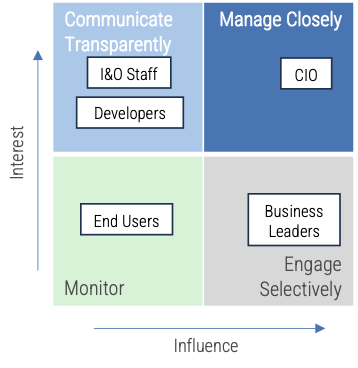
- List the project’s key stakeholders (typically by role). This might include members of your organization, the CIO, other IT leaders, end users, developers, and other business leaders.
- Evaluate their interest in the project and their influence over the project. Plot each group on a 2x2 matrix. (See example at right.)
- Identify when and how you’ll engage, particularly with groups in the top two boxes. Consider whether to include members of these groups in the subsequent design exercises.
- Revisit this list if you make decisions that could change the level of interest or influence of any of these groups.
Input
| Output
|
Materials
| Participants
|
About Info-Tech
Info-Tech Research Group is the world’s fastest-growing information technology research and advisory company, proudly serving over 30,000 IT professionals.
We produce unbiased and highly relevant research to help CIOs and IT leaders make strategic, timely, and well-informed decisions. We partner closely with IT teams to provide everything they need, from actionable tools to analyst guidance, ensuring they deliver measurable results for their organizations.
What Is a Blueprint?
A blueprint is designed to be a roadmap, containing a methodology and the tools and templates you need to solve your IT problems.
Each blueprint can be accompanied by a Guided Implementation that provides you access to our world-class analysts to help you get through the project.
You get:
- Design the IT Infrastructure & Operations Organization of the Future Storyboard
- Infrastructure & Operations Design Sketchbook
- Infrastructure & Operations Skills Inventory and Gap Analysis
- Infrastructure & Operations Staffing Calculator
Talk to an Analyst
Our analyst calls are focused on helping our members use the research we produce, and our experts will guide you to successful project completion.
Book an Analyst Call on This Topic
You can start as early as tomorrow morning. Our analysts will explain the process during your first call.
Get Advice From a Subject Matter Expert
Each call will focus on explaining the material and helping you to plan your project, interpret and analyze the results of each project step, and set the direction for your next project step.
Unlock Sample ResearchContributors
- 3 anonymous contributors
 Assess Infrastructure Readiness for Digital Transformation
 Build a Strategic Infrastructure Roadmap
 Map Technical Skills for a Changing Infrastructure & Operations Organization
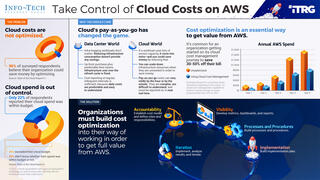 Take Control of Cloud Costs on AWS
 Take Control of Cloud Costs on Microsoft Azure
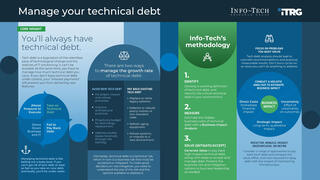 Manage Your Technical Debt
 Choose a Right-Sized Contact Center Solution
 Prepare for Cognitive Service Management
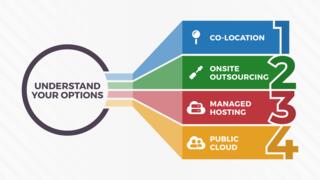 IBM i Migration Considerations
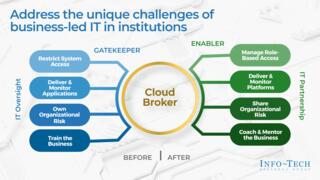 Adding the Right Value: Building Cloud Brokerages That Enable
 Drive Technology Adoption
 Transform Your Field Technical Support Services
 Domino – Maintain, Commit to, or Vacate?
 z/Series Modernization and Migration
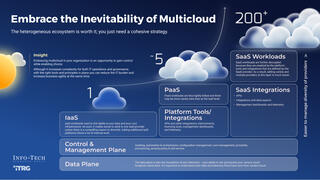 Embrace the Inevitability of Multicloud
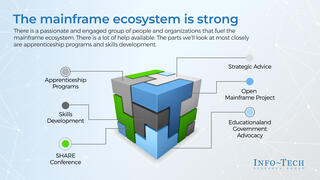 Skills Development on the Mainframe Platform
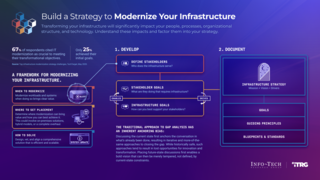 Build a Strategy to Modernize Your Infrastructure
 Run IT By the Numbers
 Transform IT, Transform Everything
 Sync or Sink: Aligning IT and HR for the Future of Work
 The AI Vendor Landscape in IT
 The Infrastructure and Operations Playbook
 Design the IT Infrastructure & Operations Organization of the Future
 Define Your Target AI Infrastructure