ServiceNow Makes Its Bid to Own Enterprise AI Execution
ServiceNow introduced three intertwined capabilities:
- Autonomous Workforce – AI specialists that execute end‑to‑end tasks (not just recommend actions), starting with an L1 Service Desk AI Specialist that diagnoses, fixes, and closes common IT incidents.
- Employee Works – A unified conversational front door combining Moveworks’ interface with ServiceNow’s workflow engine to turn employee requests into real execution.
- AI Control Tower – A policy, governance, and orchestration layer unifying all human, digital and AI work on the platform.
ServiceNow’s customer case studies demonstrate that Autonomous Workforce and Employee Works are already delivering measurable results in large, complex organizations. Examples such as CVS Health, the City of Raleigh, Siemens Healthineers, and UKG show these solutions are operating at scale, improving compliance, efficiency, and employee experience. These cases provide tangible evidence for CIOs that ServiceNow’s AI offerings are moving beyond experimentation to effective, real-world operations.
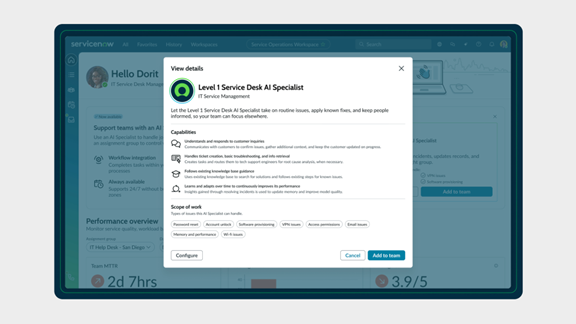
Image Source: ServiceNow Press Room
Customer case studies provided by ServiceNow to validate the success of outcomes. In all these cases governance is not an after-the-fact compliance exercises. It is embedded before AI is allowed to operate at scale.
The pattern of similarities in these customer validated use cases are:
- AI operates only inside clearly defined roles, scopes, and permissions.
- Policies for access, escalation, auditability, and accountability already existed and were extended to AI.
- Governance is continuous and lifecycle‑based, not a one‑time review.
CVS Health
- Supporting 300,000 colleagues across IT, HR, and procurement.
- Focused on automating repetitive, high‑volume tasks so people can spend more time with patients and members.
- Serves 185 million customers; requires AI that maintains healthcare‑grade compliance and security.
- Quote from CISO Alan Rosa underscores the need for operational AI, not novelty AI.
City of Raleigh
- Using ServiceNow and Moveworks to power a “smart city” operating model.
- Now Assist is already resolving 98 percent of initial touchpoints through intelligent routing.
- Goal is to shift employees from routine triage to higher‑value work and improved constituent services.
- Strong signal that government – traditionally cautious – sees ServiceNow as a responsible AI platform.
Siemens Healthineers
- 74,000 employees relying on AI for global workflows.
- Their Moveworks‑based AI assistant “Ada” saves 5,000 hours every month with 91 percent employee satisfaction.
- ServiceNow EmployeeWorks expected to extend this impact by automating end‑to‑end tasks, not just responses.
- A powerful proof point that ServiceNow can operate in regulated, safety‑critical, multinational healthcare environments.
UKG
- Consolidated and modernized IT operations on the ServiceNow AI Platform.
- Moveworks extends AI execution reach to 15,000 employees, with dozens of agentic use cases in production.
- Moving from reactive to predictive operations through data unification and AI‑driven workflows.
- Clear example of ServiceNow reducing system complexity and elevating operational resilience.
ServiceNow as Customer Zero
- Internal Autonomous Workforce handles more than 90 percent of employee IT requests.
- L1 Service Desk AI Specialist resolves incidents 99 percent faster than human agents.
- Used in production today, not just pilots.
ServiceNow’s focus on hard outcomes, not productivity theater is refreshing: reduced MTTR, fewer escalations, elimination of repetitive L1 work, and full process automation across IT, HR, security, finance, and operations. Early customers claim 90 percent+ autonomous resolutions for common IT requests and dramatic reductions in major incidents. The bigger promise is durable ROI that persists even when employees churn because the automation lives in the platform, not in personal productivity tools. Through member calls, many of the IT leaders are looking for solutions to achieve these outcomes.
Microsoft Copilot for Service, Salesforce Einstein, Google’s Gemini agents, AWS Q for Business, and a wave of agent‑platform startups – Moveworks itself was a competitor until now. Others offer strong conversational UX or powerful foundation models, but few have deep integration into enterprise workflow engines or governance controls. The real battle is between “assistants that talk” and “assistants that act.”
Our Take
This is the most aggressive and credible push yet from a major enterprise vendor to move AI from insights to execution. ServiceNow understands that the future isn’t about better answers; it’s about fewer handoffs and more closed loops. The combination of Moveworks’ conversational intelligence with ServiceNow’s workflow engine is strategically smart and puts pressure on every assistant‑first vendor that can’t execute actions. But the autonomy story will only hold if customers trust the control tower model and see real operational gains, not scripted demos. If ServiceNow can consistently deliver measurable bottom‑line impact, not just faster ticket triage, this will redefine enterprise AI implementation patterns for the next decade.
The prevailing executive hesitation toward agentic AI, often framed as a concern for employee apprehension and predictable cost modeling frequently masks a deeper, unaddressed issue: AI Infrastructure Debt. For organizations currently navigating the friction of disconnected software instances and post-acquisition fragmentation, the status quo is not a neutral position; it is a compounding financial tax. While ServiceNow promotes a high speed-to-value through its unified operating backbone, leadership must recognize that an AI agent is only as effective as the data layer it inhabits. If the underlying enterprise architecture is siloed, any autonomous specialist will suffer from "data starvation," leading to the very unpredictable costs and performance variances that CIOs fear. To move toward fiscal maturity, CTOs must prioritize architectural rationalization, resolving multiple instances and legacy gaps to ensure the platform functions as an accelerator rather than a patch. In a landscape where first movers in autonomous execution are realizing exponential improvement, the "predictable" cost of waiting is increasingly eclipsed by the lost opportunity of resolution velocity.
Want to Know More?
ServiceNow Q4 Results Reinforce Enterprise AI Driving Business Impact
Sense, Decide, Act, Govern: ServiceNow’s Four‑Pillar Blueprint for Enterprise AI
