
Assess and Prioritize Agentic AI Use Cases in Oil and Gas
Align autonomy with value, risk tolerance, and viable domain to maximize impact.
Agentic AI has the potential to yield cost and efficiency improvements in the oil and gas industry but is difficult to implement amid structural boundaries. As AI use cases get closer to operational environments, risk tolerance decreases and the value and viability must increase to counterbalance. Determining the optimal level of agentic AI autonomy, based on your organization’s needs and maturity, further complicates the decision process.
Our Advice
Critical Insight
Oil and gas organizations should prioritize agentic AI to strengthen production, operational efficiency, and commercial performance while establishing boundaries to maintain auditability and alignment with safety, OT, and regulatory constraints.
Impact and Result
- A clear, defensible shortlist of agentic AI use cases aligned to strategic business goals.
- Time savings through the evaluation process and a seamless input into AI strategy and piloting initiatives that follow.
- Established autonomy ceilings and agentic role fit for each capability domain, identifying where regulatory operational constraints limit defensible autonomous decision-making and what activities are most readily supported by AI.
- Evaluated use cases using a structured value-vs.-viability framework, allowing organizations to prioritize initiatives where agent behavior is both operationally useful and risk-appropriate.
Assess and Prioritize Agentic AI Use Cases in Oil and Gas
Align autonomy with value, risk tolerance, and viable domain to maximize impact.
Analyst perspective
The industry won’t wait – it’s time to get involved.
Agentic AI is a rapidly expanding frontier within the broader landscape of AI development. As AI competencies become more advanced, mature organizations can deploy increasingly robust multi-agent systems that perform not just individual tasks, but entire workflows of related activities with minimal human guidance. Oil and Gas leaders can no doubt appreciate the potential for efficiency and productivity gains such systems provide but are right to be cautious about the suitability of highly autonomous systems within their technology environment. Some capabilities are too operationally complicated, require too much regulatory oversight, and have a risk tolerance too low for easy AI implementation.
This is not, however, a strong enough reason to remain in a holding pattern. The longer you operate in catch-up mode to industry peers, the bigger the gap will become in business outcomes. With the correct framework for understanding both the needs of your organization and the landscape of agentic AI use cases, it is possible to find a fit that will yield tangible results without overstepping your capabilities or tolerance. Starting tomorrow might be comfortable, but starting today is practical.

Evan Garland
Senior Research Analyst, Industry Practice
Info-Tech Research Group
Executive summary
Your Challenge
- Agentic AI has the potential to yield cost and efficiency improvements in the oil and gas industry but is difficult to implement amid structural boundaries.
- As AI use cases get closer to operational environments, risk tolerance decreases, and the value and viability must increase to counterbalance.
- Determining the optimal level of agentic AI autonomy, based on your organization’s needs and maturity, further complicates the decision process.
Common Obstacles
- Cost-center domains where technology has the highest potential value are often tightly coupled with OT, creating ceilings for automation potential.
- Data and process fragmentation across OT, engineering, and enterprise systems makes explainability and auditability difficult to achieve.
- Realizing the full benefits of agentic AI often requires complex multi-agent architectures with persistent memory and learning loops, raising technical and governance barriers to early deployment.
Info-Tech’s Approach
- Align agentic AI evaluation with organizational business drivers and key operational capabilities to the visibility and magnitude of benefits realized.
- Establish autonomy ceilings and agentic role fit for each capability domain, identifying where regulatory operational constraints limit defensible autonomous decision-making, and what activities are most readily supported by AI.
- Evaluate use cases using a structured value-vs.-viability framework, allowing organizations to prioritize initiatives where agent behavior is both operationally useful and risk-appropriate.
Info-Tech Insight
Oil and gas organizations should prioritize agentic AI to strengthen production, operational efficiency, and commercial performance, while establishing boundaries to maintain auditability and alignment with safety, OT, and regulatory constraints.
Your challenge
Implement agentic AI through initiatives that strengthen operational performance without compromising safety or control.
- Finding the right starting point is difficult. Agentic AI can improve efficiency across the oil and gas value chain, from maintenance coordination to production support and compliance work. But leaders still need a defensible way to determine where autonomy fits operational reality and where it creates more risk than value.
- Risk tolerance drops as AI moves closer to operations. Use cases that interact with field processes, production workflows, or operational decisions carry far greater consequences than back-office automation. In these environments, organizations must justify not only the value of AI, but also why its level of autonomy is safe, bounded, and appropriate.
- Your organizational reality impacts your ideal portfolio. Some opportunities appear valuable on paper but are difficult to implement because of weak data, fragmented systems, limited governance, or low organizational readiness. Selecting the right initiatives requires balancing business impact with technical feasibility and the context of your specific organization.
(Sources: 1 Dataiku, 2026; 2 IBM, 2025)
74% — of CIOs state that their role could be at risk if AI can’t deliver measurable business gains in the next two years (Source: Dataiku, 2026)
85% — of CIOs report that traceability or explainability gaps have delayed or stopped AI projects from full deployment (Source: Dataiku, 2026)
29% Upstream
23% Midstream — Percent of organizations at least piloting agentic AI for upstream and midstream operations (Source: IBM, 2025)
Common obstacles
Structural barriers limit the speed at which agentic AI can be safely adopted in energy operations:
- High-value domains are often tightly coupled with OT. Many of the most attractive use cases sit close to industrial systems where safety, reliability, and process discipline limit how much autonomy can be introduced. This creates hard ceilings on what agents can do in operational environments.
- Fragmented data limits trust in AI outputs. Operational, engineering, and enterprise systems are often disconnected, making it difficult for agents to assemble the context needed for reliable recommendations or auditable actions.
- More powerful architectures are harder to deploy. Advanced agentic systems can coordinate tasks, retain context, and work across multiple steps, but they also introduce more integration, oversight, and governance complexity. This multiplier effect can make planning difficult, especially when attempting to demonstrate value and feasibility in the short term.
54% of CIOs have discovered unsanctioned AI use for tasks or projects
3 in 10 CIOs have been asked in the past 12 months to justify an AI outcome they could not fully explain (Source: Dataiku, 2026)
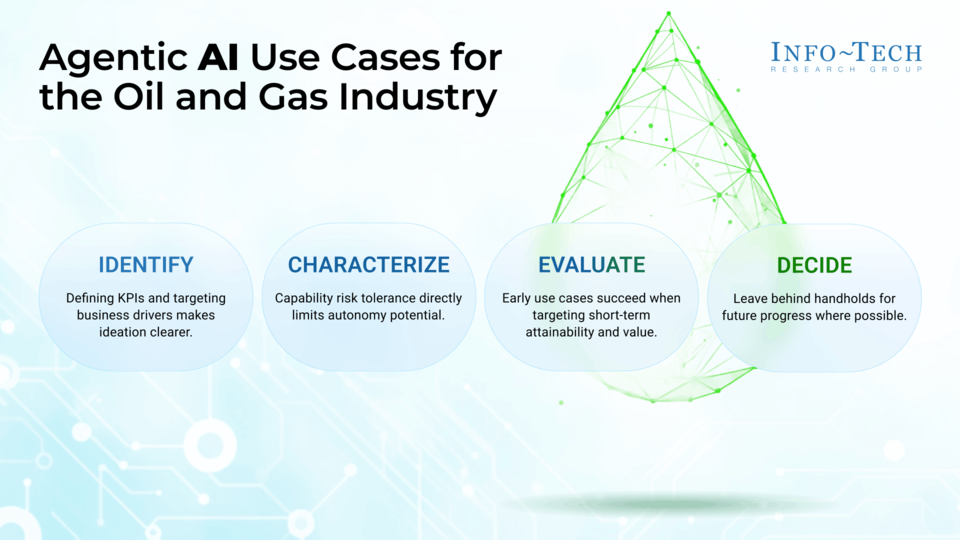
Agentic AI Use Cases for the Oil and Gas Industry
Oil and gas organizations need a defensible way to identify where agentic AI can create operational value without introducing unacceptable safety, regulatory, or financial risk.
Oil and gas organizations should prioritize agentic AI to strengthen efficiency and performance while establishing boundaries to maintain auditability and alignment with constraints.
Insight summary
Valuable autonomy must also be defensible autonomy.
Oil and gas organizations should prioritize agentic AI to strengthen production, operational efficiency, and commercial performance, while establishing boundaries to maintain auditability and alignment with safety, OT, and regulatory constraints.
Autonomy is constrained by operational complexity and domain risk.
As agents take on broader coordination and decision-making roles, increasing system and workflow complexity raises governance demands and limits where higher autonomy can be safely applied. In oil and gas organizations, these limits are most common around core OT operations.
Tune agent capabilities to match risk and readiness.
Agentic systems can be strengthened through memory, learning, and perception, but added capability increases complexity and risk. Enable these elements only where use cases are stable, and consider simplification where possible to minimize pilot and implementation complexity during early adoption.
Start with controlled use cases, then expand scope over time.
Early value in oil and gas comes from applying agents to well-defined activities such as maintenance coordination, compliance reporting, and production planning. As organizations gain confidence and control, agents can extend across adjacent workflows and systems to enable broader coordination.
Specialization reduces early complexity and improves control.
Align agents to specific roles such as monitoring, coordination, or planning, rather than building general-purpose systems. Combine them later as governance and integration maturity improves.
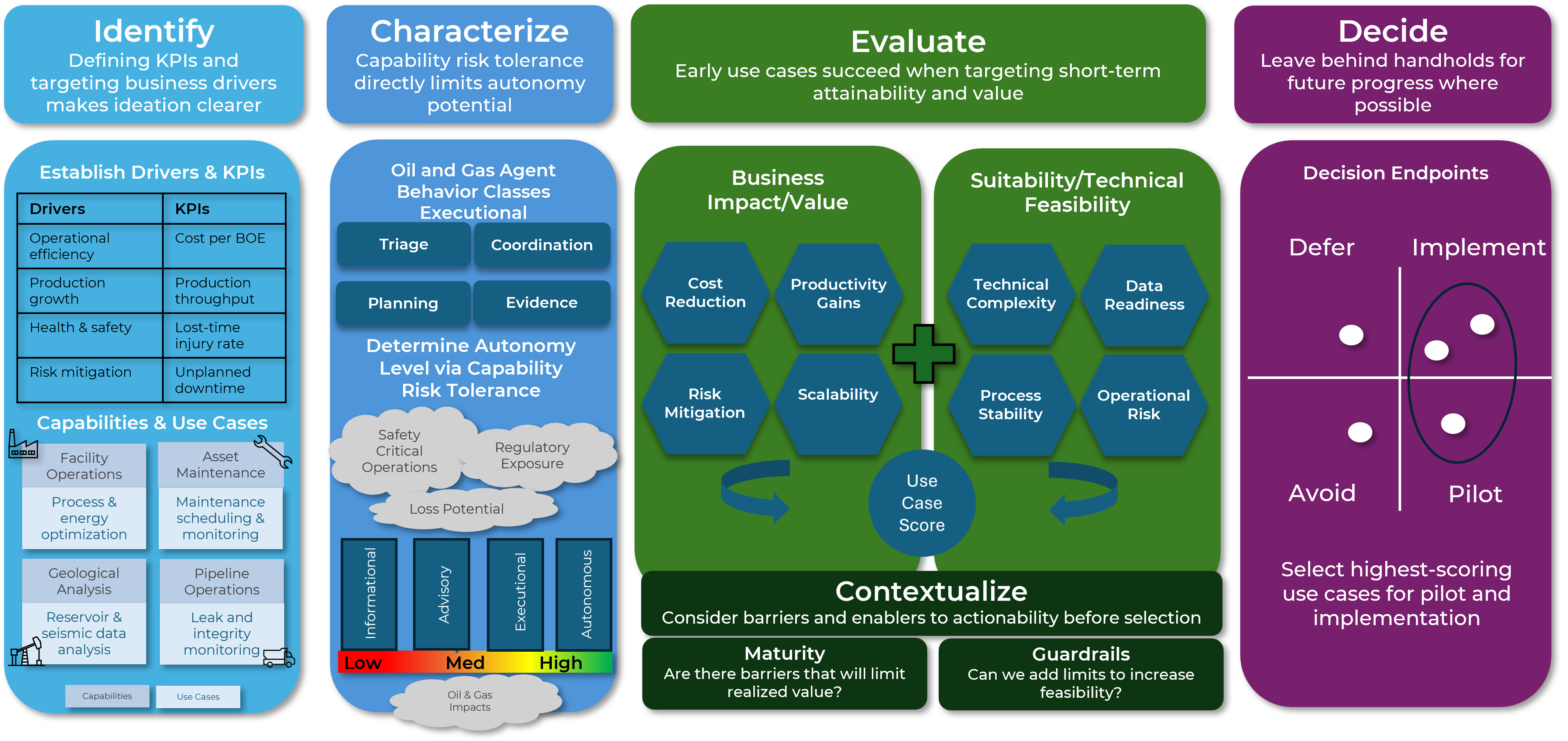
Info-Tech’s methodology for assessing agentic AI use cases in Oil and Gas
1. Identify use cases that align to your drivers and capabilities |
2. Characterize AI by purpose and scale |
3. Score and validate prioritized use cases |
|
Phase Steps |
|
|
|
Phase Outcomes |
A shared understanding of agentic AI concepts, capabilities to target based on your organization’s business architecture, and business outcomes that agentic AI use cases can target |
Agentic AI use cases evaluated and sorted based on purpose and need for autonomy, ready to be scored |
A prioritized and validated use case portfolio with consensus on the highest-value opportunities to pursue |
Research deliverable
Each step of this research is accompanied by supporting deliverables to help you accomplish your goals:
Agentic AI Use Case Tool for Oil and Gas
Provides the structure to identify and list agentic AI use cases, determine appropriate autonomy levels and behaviors, score each one across business value and feasibility, and build a prioritized portfolio.
Upon completion, organizations can confidently select the highest-impact opportunities ready to move into the Build Your Agentic AI Prototype phase.
Measure the value of this blueprint
Leverage this blueprint’s approach to ensure your AI use cases align with and support your key business drivers and speed time to value.
With Info-Tech Resources |
Without Info-Tech Resources |
||
| Project Steps | Time | Time | Rationale |
| Capability and Strategy Mapping | 0.5-1 day | 3-5 days | Creation of a reference architecture & facilitation |
| Use Case Generation | 0.5-1 day | 2-3 days | Consultant facilitation |
| Maturity Assessment | 1-2 days | 3-4 days | Assessment development & facilitation |
| Use Case Prioritization | 1 day | 2-3 days | Scoring matrix & facilitation |
| Effort | 3-5 days | 10-15 days |
Business Outcome Objective |
Key Success Metric (Examples) |
| Productivity | Expanded output/top-line revenue |
| Operational Efficiency | Reduction in delivery and administrative costs |
| Health and Safety | Reduced incident rates and workforce hazard exposure |
| Risk & Compliance | Improved risk mitigation and readiness/audit scoring |
| ESG & Sustainability | Lower emissions and resource intensity; greater reporting transparency |
Case study
INDUSTRY Segment: Upstream | SOURCE: Boston Consulting Group
Challenge
Oil and Gas operators often struggle to identify, quantify, and prioritize methane-abatement opportunities across large asset footprints. Fragmented field data and manual leak-detection-and-repair workflows make it difficult to move from baseline measurement to coordinated action at scale.
Solution
An on-premises data-agnostic platform (called Methane.AI) combined AI-enabled detection inputs, emissions estimation, forecasting, reporting, and coordination of leak detection and repair activities. The approach used multi-source field data and predictive modeling to estimate equipment-specific emissions and support geo-localized abatement planning.
Results
›8,000 potential emission sources assessed
›700 emission sources identified, measured, and digitized
~100 million m³ natural gas abated
~30% emissions-reduction impact and ~$20M expected value from the abatement program
Info-Tech offers various levels of support to best suit your needs
DIY Toolkit |
Guided Implementation |
Workshop |
Executive & Technical Counseling |
Consulting |
| "Our team has already made this critical project a priority, and we have the time and capability, but some guidance along the way would be helpful." | "Our team knows that we need to fix a process, but we need assistance to determine where to focus. Some check-ins along the way would help keep us on track." | "We need to hit the ground running and get this project kicked off immediately. Our team has the ability to take this over once we get a framework and strategy in place." | "Our team and processes are maturing; however, to expedite the journey we'll need a seasoned practitioner to coach and validate approaches, deliverables, and opportunities." | "Our team does not have the time or the knowledge to take this project on. We need assistance through the entirety of this project." |
Diagnostics and consistent frameworks are used throughout all five options |
||||
Guided Implementation
A Guided Implementation (GI) is a series of calls with an Info-Tech analyst to help implement our best practices in your organization.
A typical GI is 6 to 8 calls over the course of 2 to 4 months.
What does a typical GI on this topic look like?
Pre-Work |
Phase 1 |
Phase 2 |
Phase 3 |
| Call #1: Scope requirements, objectives, and your specific challenges. | Call #2: Anchor AI capability to business context and drivers.
Call #3: Explore agentic AI in practice. |
Call #4: Establish agentic AI capability patterns.
Call #5: Optimize the balance of autonomy and risk within use cases. |
Call #6: Score use cases for prioritization.
Call #7: Review and validate use case portfolio. |
Workshop overview
Contact your account representative for more information.
workshops@infotech.com 1-888-670-8889
Day 1 |
Day 2 |
Day 3 |
Day 4 |
Day 5 |
|
Identify |
Identify (cont.) |
Characterize |
Evaluate & Contextualize |
Decide |
|
Activities |
1.1 Anchor AI capability to business context and drivers
|
1.2 Explore agentic AI in practice
|
2.1 Establish agentic AI capability patterns
2.2 Optimize the balance of autonomy and risk within use cases
|
3.1 Score use cases
3.2 Review and validate use case portfolio
|
3.2 Review portfolio
|
Deliverables |
|
|
|
|
|
Assess and Prioritize Agentic AI Use Cases in Oil and Gas
Phase 1
Identify Use Cases That Align to Your Drivers and Capabilities
Phase 11.1 Anchor AI capability to business context and drivers 1.2 Explore agentic AI in practice | Phase 22.1 Establish agentic AI capability patterns 2.2 Optimize the balance of autonomy and risk within use cases | Phase 33.1 Score use cases for prioritization 3.2 Review and validate use case portfolio |
This phase will walk you through the following activities:
- Identifying areas of your business where agentic ai is aligned with drivers and goals
- Exploring preliminary use cases that fit with organizational needs
This phase involves the following participants:
- AI initiative lead
- CIO
- Other IT leadership
- Senior business executives and managers accountable for AI initiatives
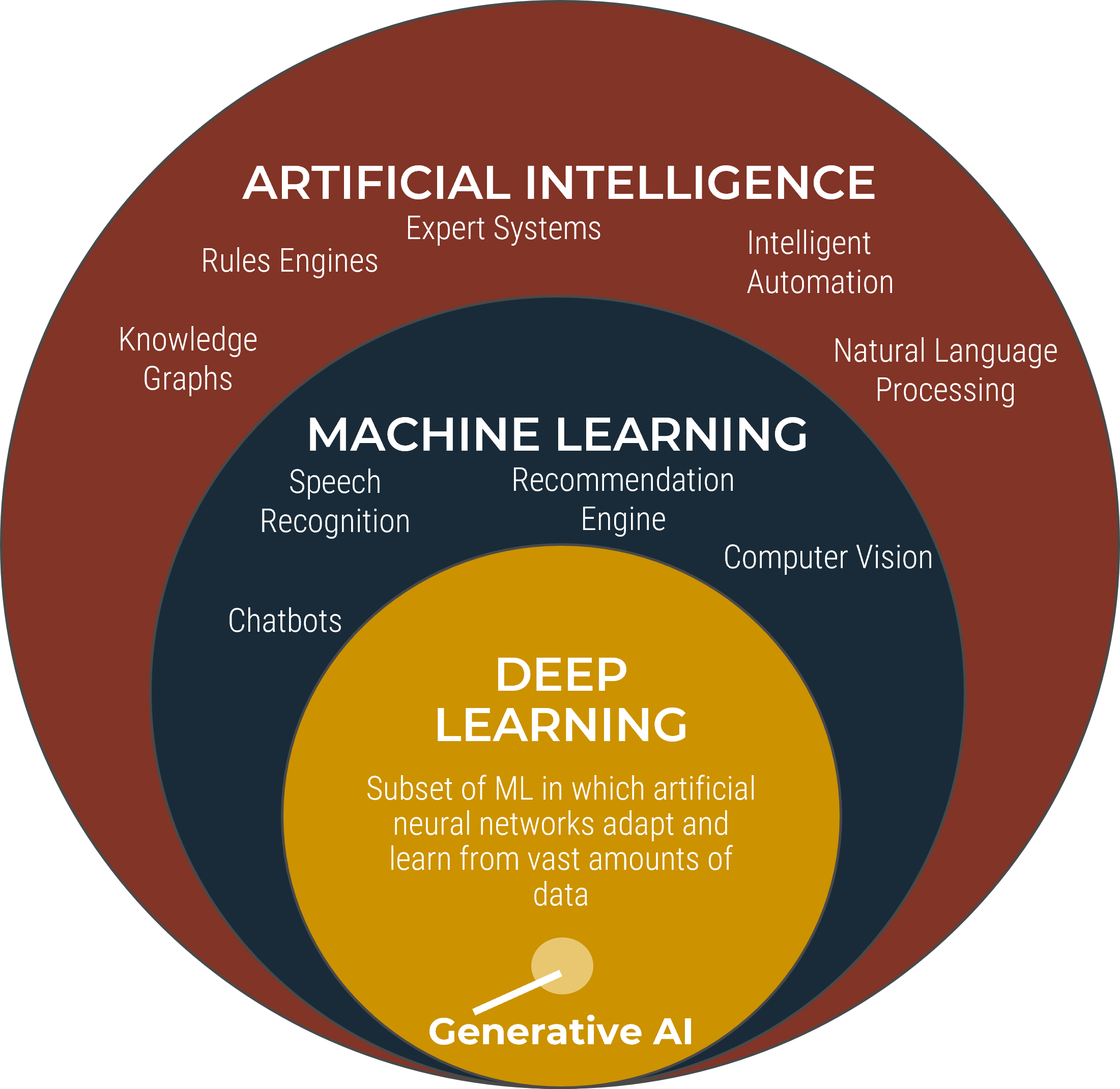
AI is an innovation in machine learning
Artificial Intelligence (AI)
A system that can make predictions, recommendations, or decisions influencing real or virtual environments.
Machine Learning (ML)
A subset of AI algorithms that parse data, learn from data, and then decide or make predictions.
Generative AI (Gen AI)
A subset of artificial intelligence systems that generate new outputs based on the data the system has been trained on using modalities such as text, audio, visual, and code.
What makes AI different
Traditional programming

Machine learning

Augmented LLMs are the foundation for autonomization
Adding memory, tools, and data access transforms LLMs from simple chatbots into the building blocks of autonomous systems.
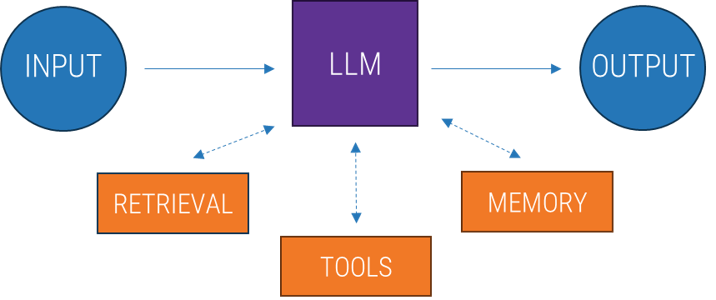
Augmented LLM
This LLM is enhanced with external capabilities but still works in a linear, input to output flow. The LLM only acts when prompted and its workflow is a single-pass interaction.
Process
- Input is passed into the LLM.
- The LLM can call retrieval, tools, and memory as needed to enrich its response.
- Output is generated and sent back.
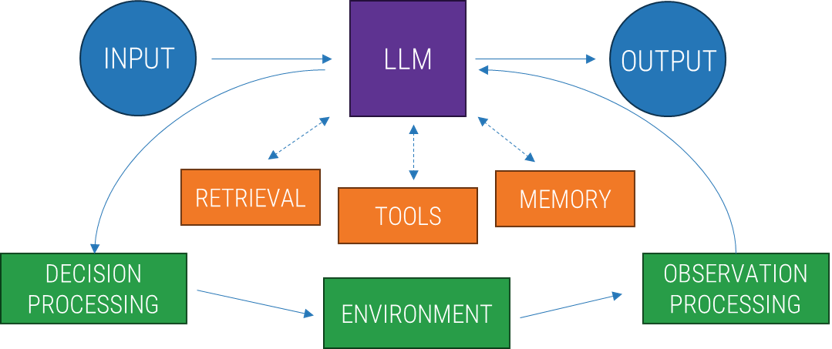
Augmented LLM
This LLM becomes part of a closed-loop system that allows autonomous decision-making and continuous action without constant human prompting.
Process
- Input still flows into the LLM.
- The LLM now also interacts with decision and observation processing modules.
- These modules enable the system to evaluate results, adapt to environmental feedback, and iterate through multiple cycles before producing final output.
Spectrum of automation and AI
From rules to agents
Concept |
Profile |
Description |
Level of Autonomy |
Coordination |
Typical Use/ Example |
Traditional Automation |
Rule-Based Operator | Executes predefined, rule-based tasks with no learning or reasoning. | None | None | RPA, workflow triggers, auto-approvals |
AI Agent |
A Specialist | A single intelligent unit that can perceive, reason, and act to produce a response. May use memory and tools but operates within defined boundaries. | Limited/Task-Bound | Minimal (solo agent) | AI assistant, chatbots, recommendation agent |
Multi-Agent System (MAS) |
Team of Specialists | A multi-agent system is a network of cooperating AI agents who each do their part when told (e.g. one checks weather, one looks at prices, one manages reservations). | Collaborative/Coordinated | Moderate | Supply chain agents, logistics optimization, multi-bot workflows |
Agentic AI |
Self-Managing Assistant | A self-directed, autonomous system that can reason, plan, and act using multiple AI Agents. It manages its own feedback loops and tool usage and is internally orchestrated. | Self-Directed/Autonomous | Dynamic self-management | Adaptive workflows, continuous optimization, self-improving enterprise AI |
Map AI to business value
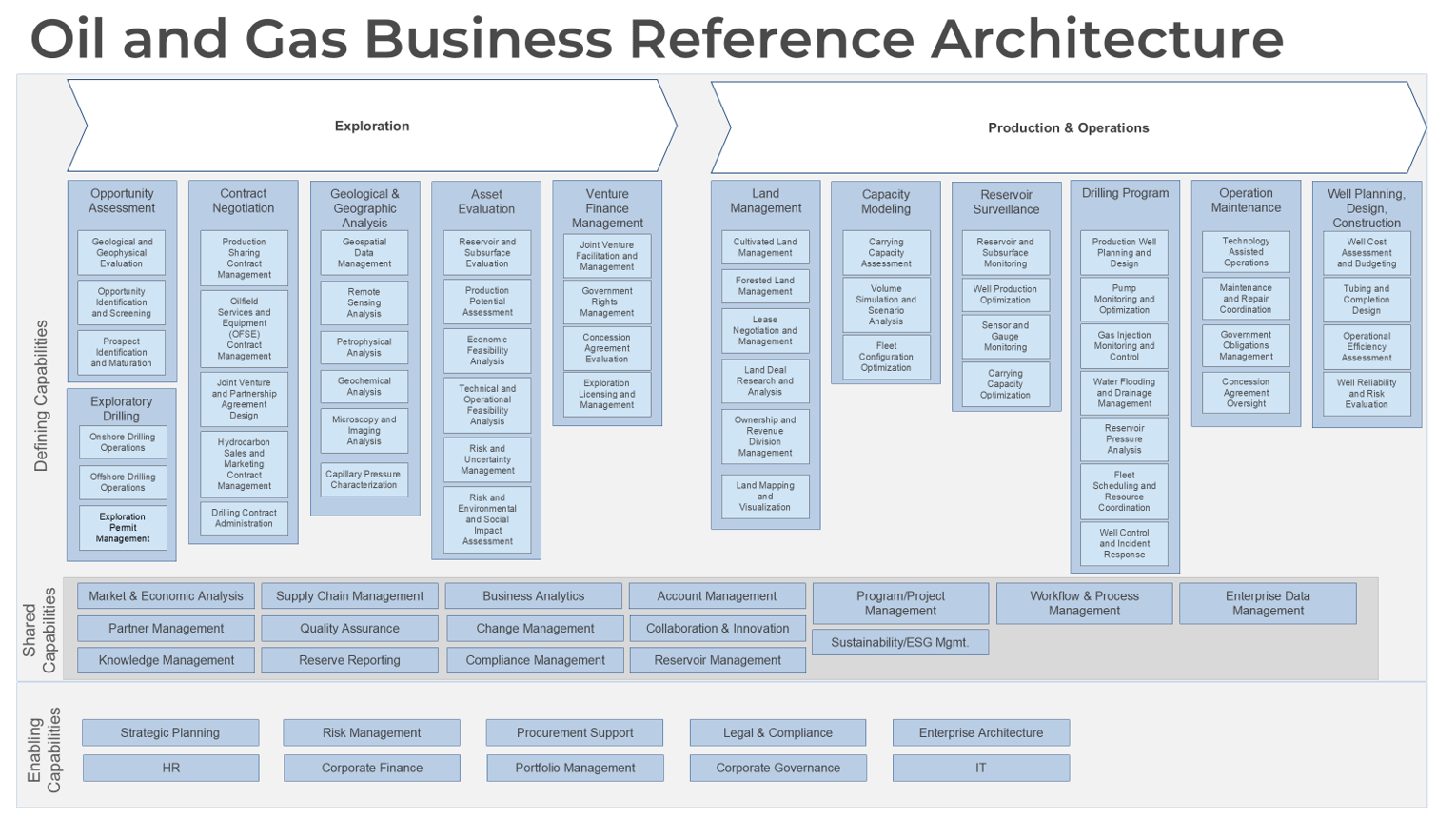
When thinking about Agentic AI, it is important to consider the business capabilities, systems, and existing AI that already support the organization. Together, these can be understood through three connected layers:
Layer 1 – The "What“ – Business Capability Map
The complete inventory of what the business does, organized into a stable, technology-agnostic hierarchy of capabilities. This is the business framework.Layer 2 – The "How“– AI Types and Agentic Capabilities
Within each business domain, specialized AI types handle specific tasks. Agentic AI orchestrates them into autonomous workflows that operate across multiple systems. The appropriate design of these workflows is shaped by risk tolerance and the level of autonomy within which AI assists, recommends, or acts given operational and regulatory boundaries. This is the intelligence framework.
Every business problem, pain point, and opportunity in this research will map to a capability, giving the team a shared way to locate, prioritize, and evaluate where agentic AI can deliver the greatest value.
Start with controlled use cases, then expand scope over time.
Early value in oil and gas comes from applying agents to well-defined activities such as maintenance coordination, compliance reporting, and production planning. As organizations gain confidence and control, agents can extend across adjacent workflows and systems to enable broader coordination.
Download the Agentic AI Capability Map Templates for Oil and Gas
Agentic AI use cases must drive value, which in oil and gas can be mapped to the primary value drivers
Sources of Value
Operations Efficiency
Optimizing cost, cycle time, and resource utilization across operations through improved planning, execution, and coordination of assets, workflows, and data.Production Growth
Increasing output, throughput, and revenue by improving asset performance, reducing constraints, and enabling more consistent and scalable operations across the value chain.Health and Safety
Reducing workforce exposure to hazardous conditions and improving incident prevention, detection, and response, for both safety and compliance purposes.Risk & Compliance
Mitigating operational, regulatory, and financial risks while ensuring adherence to safety, environmental, and operational standards to maintain continuity and avoid disruption.Environment, Social & Governance (ESG)
Improving environmental performance, transparency, and governance practices while supporting emissions reduction, reporting, and stakeholder accountability.
About Info-Tech
Info-Tech Research Group is the world’s fastest-growing information technology research and advisory company, proudly serving over 30,000 IT professionals.
We produce unbiased and highly relevant research to help CIOs and IT leaders make strategic, timely, and well-informed decisions. We partner closely with IT teams to provide everything they need, from actionable tools to analyst guidance, ensuring they deliver measurable results for their organizations.
What Is a Blueprint?
A blueprint is designed to be a roadmap, containing a methodology and the tools and templates you need to solve your IT problems.
Each blueprint can be accompanied by a Guided Implementation that provides you access to our world-class analysts to help you get through the project.
Need Extra Help?
Speak With An Analyst
Get the help you need in this 4-phase advisory process. You'll receive multiple touchpoints with our researchers, all included in your membership.
Guided Implementation 1: Pre-Work
- Call 1: Scope requirements, objectives, and your specific challenges.
Guided Implementation 2: Identify Use Cases That Align to Your Drivers and Capabilities
- Call 1: Anchor AI capability to business context and drivers.
- Call 2: Explore agentic AI in practice.
Guided Implementation 3: Characterize AI by Purpose and Scale
- Call 1: Establish agentic AI capability patterns.
- Call 2: Optimize the balance of autonomy and risk within use cases.
Guided Implementation 4: Score and Validate Prioritized Use Cases
- Call 1: Score use cases for prioritization.
- Call 2: Review and validate use case portfolio.