Enterprise Connect 2026: Agentic AI, Platform Consolidation, and the Future of Customer Experience

Source: Thomas Randall
Overview and Themes
Enterprise Connect (held 10-12 March, 2026) is a leading annual conference and exhibition for enterprise unified communications and customer experience (UC/CX) technology in North America. Given the event commands concentrated attention from buyers and practitioners, vendors in this market typically time product announcements to coincide with it. While this year’s Enterprise Connect was smaller in scope than previous years’, major announcements were still made that warrant evaluation. This note will provide a rundown of those announcements with an accompanying evaluation.
Before turning to that, though, there are three themes about the conference worth highlighting. First, buyers interviewed at the event reported it was difficult to differentiate the providers in attendance. Similar verbiage, product demos, user interfaces, and feature roadmaps pervaded the exhibition hall – from voice AI to agentic orchestration. However, while on paper these capabilities appear functionally equivalent, there is not an equivalence of execution. Meaningful, qualitative differentiation lies in how vendors are delivering these capabilities: which large language models underpin the AI layer, whether industry-specific training has been applied, how deterministic workflow logic has been structured, how accessible the solutions are for non-technical users, and so on. For CIOs navigating this environment, Info-Tech Research Group recommends de-prioritizing feature-list comparisons in favor of evaluating use cases and non-functional requirements. Buyers are better served by asking vendors to demonstrate how their platform would address specific operational scenarios rather than perform a feature checklist. This approach also disciplines the product demonstration process, limiting generalized glitz and glamor shows.
The second theme of the conference was the growing tension between what capabilities vendors are promising and what organizations can realistically implement. For vendors, this gap represents both a risk and a strategic opportunity. The risk is that organizations acquire sophisticated capabilities they cannot fully activate, producing disappointing outcomes that reflect poorly on the vendor – from customer and investor perspectives alike. The opportunity is that vendors who invest seriously in robust implementation support, geographically distributed partner networks, industry-specific expertise, and mature customer success functions are positioned to showcase value in ways that less well-resourced competitors cannot. That some providers, such as Talkdesk, chose to attend HIMMS26 rather than Enterprise Connect (the two conferences having run concurrently in Las Vegas) is itself instructive: for vendors with deep vertical commitments, proximity to industry-specific buyers may generate more qualified engagement than presence at a generalist event where differentiation is harder. Of course, the most compelling version of this opportunity is vendors using their own technology to scale AI implementation without relying on white glove services (see especially NiCE in the product announcements below).
The third theme is the most strategically consequential and cast a long shadow over the event: how specialized UC/CX providers address intensifying platform consolidation pressure. While large vendors such as Microsoft, Salesforce, and ServiceNow have always advocated unifying customers onto a single platform (namely, their own!), the promise of an “agentic era” has heightened these claims. Agentic AI (systems capable of executing multi-step tasks autonomously across enterprise workflows) raises the stakes of fragmentation in a qualitatively different way, particularly given the current immaturity of agent-to-agent (A2A) integrations. An autonomous agent’s effectiveness is a function of its ability to access consistent data, execute across systems, and operate within a coherent governance and orchestration framework. In a heterogenous environment, each boundary between systems introduces latency, loses context, and compounds coordination overhead across the agent’s decision chain. The resulting gap is the difference between whether a capability succeeds at scale or never works. Large vendors are each seeking to become the central control plane for enterprise AI agents, the owners of the AI workflow layer, and the custodians of the customer and operational data that makes those agents effective. All these large vendors are converging heavily across the UC/CX marketspace, competing for real-time interaction data that specialized CCaaS providers hold. As such, it is existentially important for specialized providers to clarify their value proposition, bringing us full circle to the first theme.
These three themes – product differentiation difficulties, ability to implement AI at scale, and platform consolidation pressure – form a compounding set of issues that will define the competitive trajectory of the UC/CX markets. Vendors must simultaneously close the gap between promise and deployment and articulate a platform strategy that remains credible as hyperscalers and platform vendors pursue their orchestration ambitions.
Major Announcements at Enterprise Connect (Alphabetical Order):
- AWS: A week before Enterprise Connect, AWS launched Amazon Connect Health, aimed at delivering patient verification, appointment management, patient insights, ambient documentation, and medical coding.
- Crescendo: Won two awards at Enterprise Connect (Best Innovation for Customer Experience and Overall Best) for its Multimodal AI product, launched in October 2025.
- Five9: Launched the evolution of Five9 Fusion with a new partner program, providing an orchestration layer that spans product integrations, independent software vendors (ISVs), and embedded technology partners.
- Genesys: Though announced a month prior to Enterprise Connect, Genesys’ release of an Agentic Virtual Agent powered by large action models (LAMs) is notable. Via its recent partnership, Genesys Cloud platform now uses the Scaled Cognition APT-1 LAM, built for deterministic execution – one of the first CCaaS providers to do so.
- GoTo: Released a new vertical SKU, GoTo Connect for Healthcare, which emphasizes Electronic Health Record integrations and tailored verticalized dashboards.
- Infobip: Set to launch AgentOS, an orchestration platform for building, deploying, and managing AI agents handling and executing customer interactions across digital channels, SMS, and voice.
- Microsoft: While notably absent from Enterprise Connect, Microsoft announced a new suite offering the week prior called Microsoft 365 E7: The Frontier Suite. Microsoft 365 E7 unifies Microsoft 365 E5, Microsoft 365 Copilot, and Agent 365 into a single solution powered by Work IQ.
- Mitel: Introduced two additions to their portfolio: Mitel WX (MWX) and Mitel Edge. MWX is Mitel’s new unified UC branding, designed to connect frontline workers, mobile employees, knowledge workers, and contact center teams. Mitel Edge enables communications workloads to run locally while remaining connected to a hybrid architecture.
- NiCE: While concurrently running NiCE Cognigy’s Nexus event in Munich, the company launched an agentic AI capability that transforms enterprise interaction data into ready-to-deploy AI agents. NiCE also won Enterprise Connect’s Best Innovation for Customer Experience for their Automated Insights solution.
- RingCentral: Announced RingCentral AIR Pro (AI Representative), which recognizes intent, authenticates customers, and executes multi-step actions autonomously. The company simultaneously launched a vertical-specific offering: AIR Pro for Healthcare.
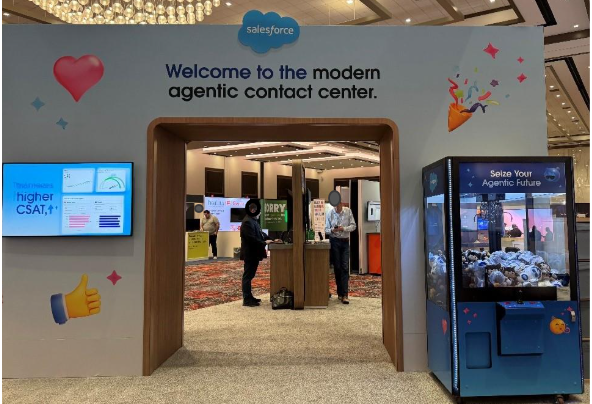
- Salesforce: Perhaps the story that had the most news outlets talking, Salesforce launched a native CCaaS solution: Agentforce Contact Center.
- Sinch: Announced two weeks prior to Enterprise Connect, Sinch launched a new set of tools that allow enterprises to deploy AI agents across communications channels. Customers remain free to use their preferred AI models.
- Talkdesk: As stated above, Talkdesk attended HIMMS26 instead of Enterprise Connect – but that did not prevent an announcement. Talkdesk launched CXA Operations Center, designed to provide AI agent observability and evaluation.
- TechSee: Announced its End-to-End Home Experience solution the week prior, which applies Visual AI across the customer lifecycle for telecoms service providers.
- UJET: Announced Agentic Experience Orchestration (AXO), an AI layer that connects and surfaces information from disparate enterprise systems into the UJET desktop application.
- Verint: Announced that Calabrio customers now have immediate access to Verint’s AI-powered bots through the Verint CX Automation Platform.
- Zoom: Used Enterprise Connect to position the company’s enterprise agentic AI 3.0 platform, announcing capabilities across the entire product suite (Workplace, Phone, and CX). Headline additions include AI Docs, AI Sheets, and AI Slides built natively into the platform, photorealistic AI avatars, real-time voice translation, deepfake detection, and a suite of enterprise AI APIs.
Our Take
Source: Thomas Randall
The most significant announcement at Enterprise Connect was Salesforce’s launch of Agentforce Contact Center. Following in Microsoft’s footprints for Dynamics 365 Contact Center, it is clear that large vendors see CCaaS as strategically valuable because this technology gets immediate access to real-time interaction data. To achieve the promise of agentic AI, these large vendors view ownership over the entire customer data lifecycle as critical. Even if Agentforce Contact Center is not market-leading, Salesforce’s value proposition is that owning the customer data layer, the AI agent orchestration layer, and the interaction layer within a single platform produces outcomes that no combination of best-of-breed vendors can replicate.
Certainly, Salesforce’s CCaaS partners were not best pleased and some of that mood was palpable across the exhibition hall. However, these vendors do not need to panic. While Salesforce believes it is merely offering customers a choice, it is not clear who that customer is. At present, Agentforce Contact Center is set up for foundational CCaaS capabilities, with other core features (like workforce management) not available until later this year. As such, Salesforce customers that have complex service workflows, require proven reliability for voice uptime, and have large agent workforces will not find Agentforce Contact Center suitable; the product is best suited for midmarket, smaller contact centers. But the costs for Agentforce Contact Center, in addition to the Salesforce platform, prices out much of that midmarket. We should wait a year to see how much investment and bundling Salesforce is willing to put into this product before Agentforce Contact Center becomes a viable recommendation.
Zoom’s announcements were also impressive. By expanding its platform across Workplace, Phone, and CX simultaneously, Zoom is making a claim that its value proposition is the platform itself rather than any individual capability. The launch of Zoom AI Services as a developer-facing API suite is particularly telling because it signals the company’s ambition to become AI infrastructure that other applications build on – not just a collaboration tool in competition with others. Microsoft’s concurrent announcement of the E7 Frontier Suite reinforces the same directional pressure. Bundling agentic AI into the core enterprise licensing structure lowers the marginal cost of AI adoption for existing Microsoft and Zoom customers, while raising the switching cost of those same customers choosing alternative orchestration layers.
The cumulative weight of these announcements shows that specialized UC/CX vendors are competing in an environment where the largest platform providers are each advancing their claim to own the orchestration layer through which AI agents will operate. How these specialized vendors are responding falls into four patterns.
First, the most direct response is ecosystem integration. Five9’s evolution of Five9 Fusion into a formal partner orchestration layer spanning product integrations, independent software vendors, and embedded technology partners is an explicit acknowledgment that the company, in a broader consolidating market, sees its value in connecting with and operating within the platforms its customers already run. Verint’s extension of its AI automation capabilities to Calabrio customers reflects the same logic: asserting platform value through reach and interoperability instead of architecture ownership.
The second pattern is vertical specialization, which represents perhaps the most defensible long-term position for specialized vendors facing platform pressure from above. Announcements from RingCentral, GoTo, and Talkdesk are all expressions of the same strategic instinct: that industry-specific capabilities are difficult for generalist platform providers to replicate at speed, even as horizontal platform consolidation advances. Even AWS’s Amazon Connect for Healthcare is notable; Amazon Connect has been a longtime strategic CCaaS partner with Salesforce, and a definitive differentiation from Agentforce Contact Center will be such verticalization.
The third pattern concerns the implementation gap. NiCE’s announcement and its award recognition at Enterprise Connect both signal that the market is treating time-to-value as a product dimension in its own right. Automating how organizations can use their data to build and deploy relevant AI agents is a strong maneuver for how to achieve scale in this market. UJET’s AXO addresses the same problem from a different angle, targeting the operational complexity agents face once a customer reaches a human representative. Taken together, these announcements suggest that a segment of the market has recognized that the gap between purchasing AI capabilities and realizing it in production is itself a competitive battleground. Vendors who solve that problem will retain their advantage.
The fourth, and final, pattern is technical architecture as competitive differentiation. Genesys is a good example. Its adoption of the Scaled Cognition APT-1 LAM argues that the quality and predictability of agentic AI executing tasks in complex contact center workflows depends on the model architecture beneath it, not just the orchestration layer above it. TechSee has a structurally similar argument in a different domain: visual AI. TechSee’s Sophie AI platform demonstrates that certain categories of real-world customer service (such as telecoms service provision and field service work) are architecturally inaccessible to text and voice AI approaches. The home environment, with physical variability, device proliferation, and installation complexity, is precisely the kind of domain where a modality advantage translates into a durable competitive position rather than a temporary feature lead.
Overall, the announcements at Enterprise Connect represent a market in active structural reorganization. Specialized vendors are each, in various ways, attempting to answer the platform consolidation question – through vertical depth, ecosystem integration, implementation tooling, or architectural differentiation. Notably, these points of differentiation are not easily captured in a procurement feature list. As argued above, the takeaway for buyers is to bring your use cases to the vendor; the differentiation will lie in these non-functional requirements.