




Salesforce Advances Intelligent Document Processing With Flow
The purpose of the addition of flow-native IDP is to reduce organizational constraints, especially for customers where MuleSoft is owned by IT and Flow is owned by low-code Salesforce administrators. Salesforce explicitly described friction when customers want document automation in Service Cloud or other systems but struggle to gain access or development capacity from MuleSoft IT teams. Embedding IDP into Flow is a way to ease adoption by moving configuration and workflow logic closer to the Salesforce admin and low-code persona. Automating the work of the low-code business persona enables great usage of the IDP process.
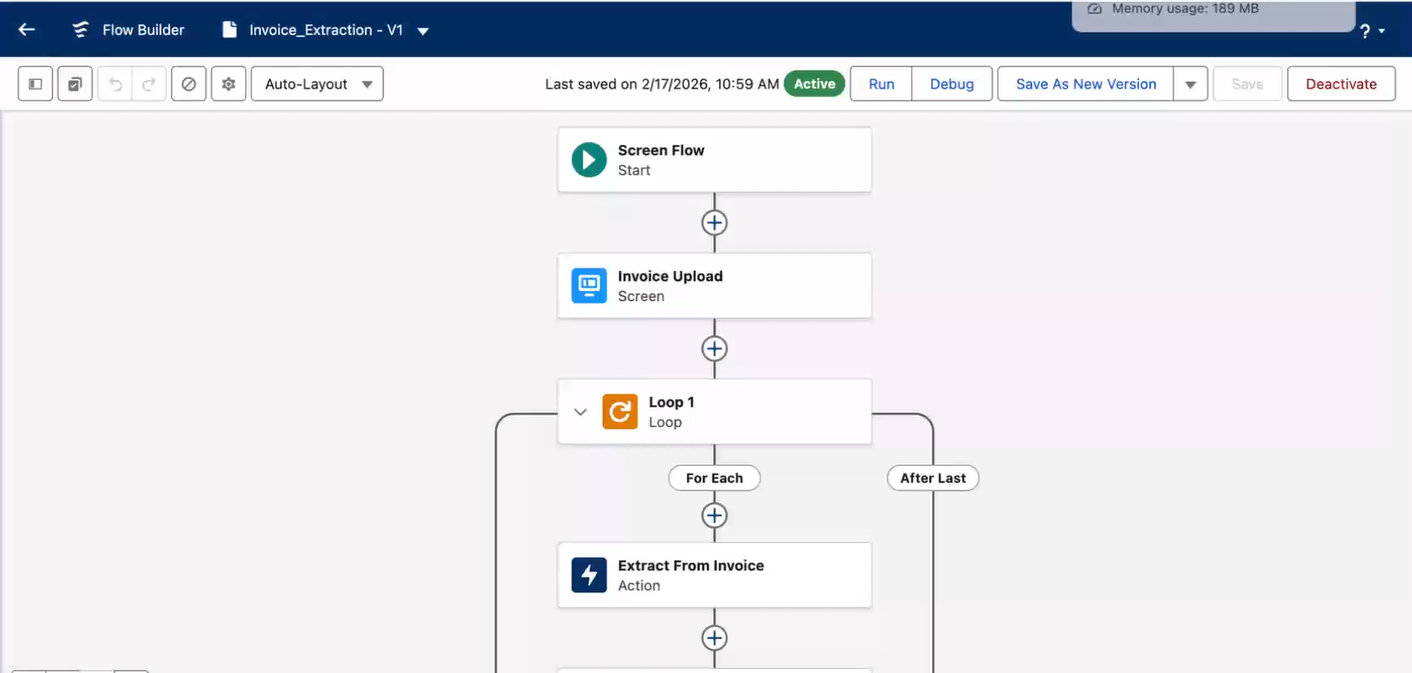
Flow Builder invoice extraction example
The Salesforce demonstration showed a typical IDP pattern implemented in Flow. It showed how Flow allows users to upload documents, loops over those documents, passes each into an extraction, and then presents extracted data for review before updating Salesforce records such as Orders. This design is intended to be configured by low code teams rather than MuleSoft specialists.
The Flow environment allows customers to use low code, visual branching logic. This includes checking for the wrong document, missing fields, and then building in escalation steps. The confidence thresholds enable users to set their parameters for quality control over the AI output and the extraction accuracy. When an extraction is flagged with a low-confidence ranking, Flow allows users to set the path for how these problematic scenarios are then routed to a human for review, flagged for follow-up, or sent into alternative paths. Combined, these options allow users to engage specific agents or other workflows and provide a safety net for inaccuracy.
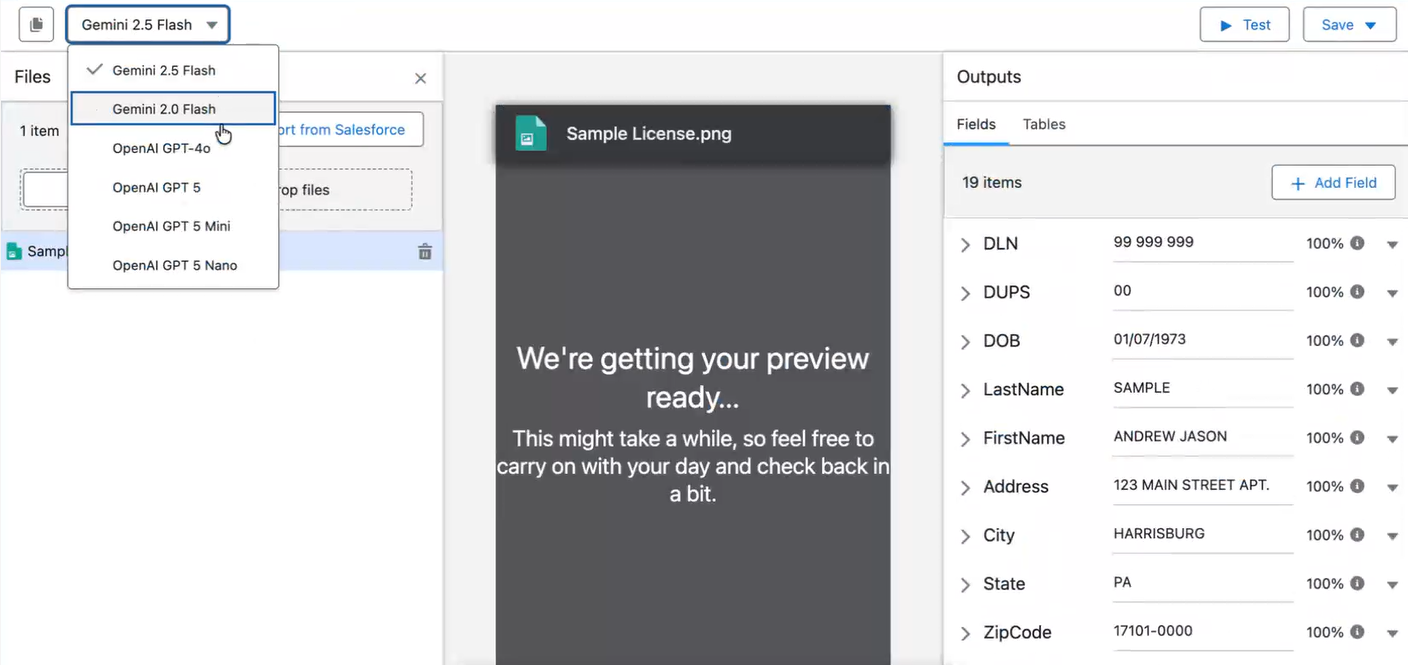
Schema editor with AI model selection and confidence scores
The schema editor supports two configuration modes. Users can define fields manually by specifying each data point to extract, or they can use an automatic mode where a foundation model identifies the document type and suggests the data to extract. Users can choose which foundation model to use, including Gemini or OpenAI GPT. For each field, the system displays both a value and a confidence score. These scores can be used inside Flow logic to decide when to auto apply values and when to trigger human review.
Salesforce states that they are planning for failure scenarios and quality control. Salesforce described common issues such as wrong documents uploaded, incomplete forms, or model misinterpretation. Flow is used as the control layer. Designers can send low confidence results to a human review screen, flag records for follow up, or route cases to agents for outreach. Examples include validating shipping addresses, correcting misattached lab results, or handling incorrect income documents in loan processes.
The roadmap addresses classification, metadata, and findability. Planned features include document classification and splitting for multidocument packets, bounding boxes that highlight the location of extracted text on the page, and configuration analytics that report success and failure rates. Underlying metadata for flows, content documents, and configurations is stored in Salesforce and will surface in the unified catalog, improving traceability and search.
Salesforce also offers flow platform services for key Industry Clouds such as financial services, health, and education. The vendor plans to support more agent-driven document interactions where users supply a document and instructions rather than fixed schemas. Bring-your-own-model options, GovCloud support, and more conversational configuration experiences are on the roadmap, although timelines and details remain subject to change.
The overall direction aligns with broader market trends in document intelligence and agentic automation, where vendors combine AI-based extraction, workflow routing, and agent decision support. Salesforce differentiates by embedding these capabilities in its CRM-centric platform and Flow environment, but independent benchmarks on extraction accuracy and operational performance across diverse document types are still limited.
Our Take
Salesforce is directly addressing a real adoption barrier in large enterprises: internal separation between CRM admins and integration teams. By offering document extraction and validation into the same low-code environment where many Salesforce processes are built, Salesforce eases adoption of IDP. We believe it also has the potential to lower the cost of deploying document automation, as well as improving the exception handling cases so that they are better tailored to the workflows of the business.
That said, buyers should treat Flow-native IDP as one component of a governed document and automation strategy. Confidence thresholds, validation rules, escalation paths, and retention requirements still need to be defined, tested, and monitored. Salesforce’s roadmap items, especially bounding boxes and configuration analytics, will help improve auditability and operational control, but organizations should pilot with real documents, including low-quality scans and mixed packets, to understand accuracy and exception volume.
For organizations already standardized on Salesforce Flow, Flow-native IDP can simplify use cases like invoice intake, lab result verification, and loan document processing. This is especially important for use cases where human review remains necessary. For others, the announcements signal that Salesforce is investing in platform-level document intelligence and aiming to make IDP a reusable service across Industry Clouds.
Want to Know More?
https://www.softwarereviews.com/products/salesforce-platform