Our systems detected an issue with your IP. If you think this is an error please submit your concerns via our contact form.
Build a Data Architecture Roadmap
Optimizing data architecture requires a plan, not just a data model.
- Data
architecture involves many moving pieces requiring coordination to provide
greatest value from data.
- Data architects are at the center of this turmoil and must be able to translate high-level business requirements into specific instructions for data consumers using complex data models.
- Data architects must account for the constantly growing data and application complexity, more demanding needs from the business, an ever-increasing number of data sources, and a growing need to integrate components to ensure that performance isn’t compromised.
Our Advice
Critical Insight
- Data architecture needs to evolve with the changing business landscape. There are four common business drivers that put the most pressure on archaic architectures. As a result, the organization’s architecture must be flexible and responsive to changing business needs.
- Data architecture is not just about models. Viewing data architecture as just technical data modeling can lead to structurally unsound data that does not serve the business.
- Data is used differently across the layers of an organization’s data architecture, and the capabilities needed to optimize use of data change with it. Architecting and managing data from source to warehousing to presentation requires different tactics for optimal use.
Impact and Result
Have a framework in place to identify the appropriate solution for the challenge at hand. Our three-phase practical approach will help you build a custom and modernized data architecture.
- Identify and prioritize the business drivers in which data architecture changes would create the largest overall benefit, and determine the corresponding data architecture tiers that need to be addressed.
- Discover the best-practice trends, measure your current state, and define the targets for your data architecture tactics.
- Build a cohesive and personalized roadmap for restructuring your data architecture. Manage your decisions and resulting changes.
Research & Tools
1. Build a Data Architecture Roadmap Deck – A step-by-step document that walks you through Info-Tech's three-phase methodology for optimizing data architecture.
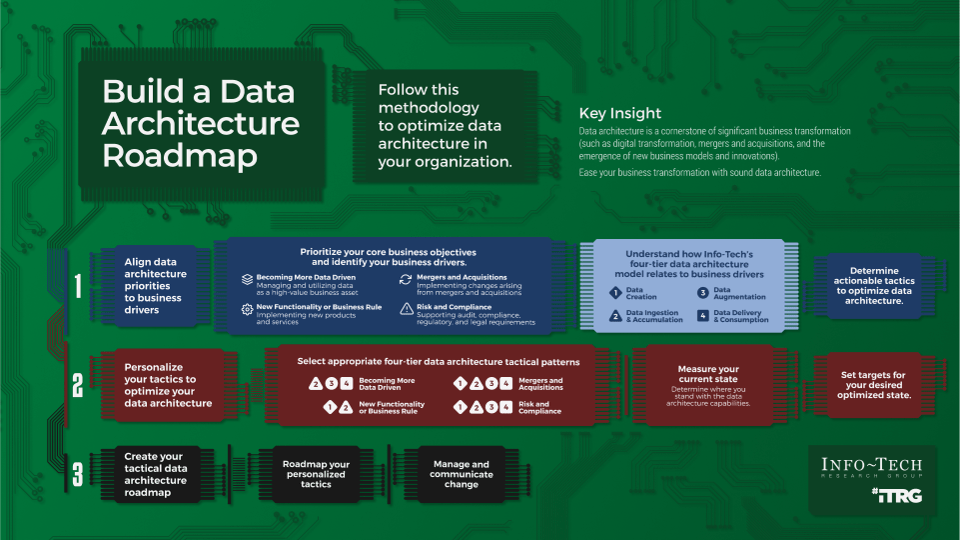
The pains of a stale and outdated data architecture are felt throughout an organization, from data workers under pressure to produce reports with tighter deadlines to executives who do not receive data in time to make effective decisions. Follow our three-phase methodology to establish a comprehensive strategy to optimize your data architecture that addresses the most pressing business drivers:
- Prioritize Your Data Architecture with Business-Driven Tactics
- Personalize Your Tactics to Optimize Your Data Architecture
- Create Your Tactical Data Architecture Roadmap
This blueprint will help you create and implement a plan to optimize your organization's data architecture by identifying the most pressing business driver that requires architectural improvements and building a roadmap of personalized tactics. Effective data architecture improvement initiatives are business-driven, action-based tactics, and this blueprint will provide you with a repeatable methodology that you can leverage to identify how and where to apply these tactics.
2. Data Architecture Driver Pattern Identification Tool – A structured tool to help you recognize your business goals and how to get there.
A data architecture that does not align with strategy can cause inefficient, inaccurate, and delayed decision making or waste resources in inefficient operations and processes. This tool can help you recognize your business goals and how to get there.
As part of Info-Tech's methodology, we've identified four business drivers as the primary motivations for modernizing a data architecture:
- Become more data-driven
- New functionality
- Mergers and acquisitions
- Risk and compliance
By answering questions about your strategy and where you currently fall short with respect to best-practice data architecture, you will uncover each business driver.
3. Data Architecture Optimization Template – A template to support your team in creating a tactical strategy for optimizing your data architecture across the four tiers of the organization’s architecture.
Use this template to build a tactical plan for optimizing your organization's data architecture environment across the four tiers of Info-Tech's data architecture model according to the drivers of the business. These tiers include:
- Data Creation
- Data Ingestion & Accumulation
- Data Augmentation
- Data delivery & Consumption
4. Data Architecture Tactical Roadmap Tool – A structured tool to help you develop a tactical plan of action to optimize the organization’s data architecture.
The full spectrum of data architecture can be quite overwhelming: considering strategic alignment, developing models, assigning roles and responsibilities, and sourcing out all necessary hardware and software.
Use this tool to:
- Narrow focus to areas related to your business needs.
- Assess the current state of your data architecture.
- Find gaps between your current and target states.
- Learn the best-practice tactics and initiatives and how to measure these going forward.
- Customize your planned initiatives based on your needs.
Create a roadmap to illustrate and communicate your strategy to stakeholders.
5. Data Architecture Trends Presentation – A template deck to provide an overview of the more significant innovations in technology that are driving today’s advanced data architectures.
Take your data architecture from modern to advanced. This trends presentation deck provides an overview of how the tools and technologies that make up data architecture are evolving to meet the needs and challenges of today's data landscape.
This presentation includes descriptions, market applications, and technological, environmental, and business value-driving forces behind the following:
- The cloud, across the four tiers of data architecture
- Real-time data architectures
- Graph databases
- Advanced data integration
6. Data Architecture Decision Template – A template to help you manage the changes that accompany major architectural decisions.
Use this template to build an effective case for data architecture decisions and document these decisions for rapid digestion of the context around major architectural decisions.
Member Testimonials
After each Info-Tech experience, we ask our members to quantify the real-time savings, monetary impact, and project improvements our research helped them achieve. See our top member experiences for this blueprint and what our clients have to say.
9.3/10
Overall Impact
$17,680
Average $ Saved
37
Average Days Saved

Info-Tech Academy
Data Architecture
Modernize your data architecture capabilities to enable agile, fit-for-purpose delivery of quality data services in the small and big data space.
This course makes up part of the Data & BI Certificate.
Please note that Academy course and certificate tracks will be updated on June 1, 2025. Please complete any current course you are enrolled in before this date or your progress will be lost.
- Number of Course Modules:
- 7
- Estimated Completion Time:
- 1.5 hours
An active membership is required to access Info-Tech Academy.
Build a Data Architecture Roadmap
Optimizing data architecture requires a plan, not just a data model.EXECUTIVE BRIEF
Analyst Perspective
A modern and business-driven data environment is integral to an insight-driven enterprise.
As business and data landscapes change, an organization's data architecture must keep pace with these changes. It must be responsive not only to ensure the organization continues to operate efficiently but to support the organization's overall strategic direction.
In the dynamic marketplace of today, organizations are constantly juggling disruptive forces and are finding the need to be more proactive. As such, organizations are realizing their data is a source of competitive advantage where the data architecture must not only support the increasing amount, sources, and rate at which organizations are capturing and collecting data but also meet and deliver on changing business needs.
Data architecture optimization should, therefore, aid in breaking down data silos and creating a more shared and all-encompassing data environment to better empower the business.

Crystal Singh
Research Director, Data and Information Practice
Info-Tech Research Group
Our understanding of the problem
This research is designed for
- Data architects or their equivalent who intend to optimize and improve the efficiency of the capture, movement, and storage of data for a variety of business drivers.
- Enterprise architects intending to improve the backbone of the holistic approach of their organization's structure.
This research will help you
- Identify the business drivers that are impacted and improved by best-practice data architecture.
- Optimize your data architecture using tactical practices to address the business' pressing issues and drive modernization.
- Align the organization's data architecture with the greater enterprise architecture.
This research will also assist
- CIOs concerned with costs, benefits, and the overall structure of their organizations data flow.
- Database administrators tasked with monitoring crucial elements of the data architecture.
This research will also help you
- Get a handle on the current situation of data within the organization.
- Understand how data architecture affects the operations of the data sources within the enterprise.
Executive Summary
Your Challenge
Your organization is experiencing data challenges:
- Large data volume, variety, and velocity, if not properly managed, may result in unreliable data and unfavorable output.
- Business transformation shapes the modern data landscape. Organizations face a growing number of challenges when it comes to adopting modern technologies.
Data architects are at the center of this turmoil and must be able to translate high-level business requirements into specific instructions for data workers using complex data models.
Common Obstacles
- Data architects must account for constantly growing data and application complexity, and more demanding business needs.
- There is an ever-increasing number of data sources and a growing need to integrate components to ensure that performance isn't compromised.
- There isn't always a clearly defined data architect role, yet the responsibilities must be filled to get maximum value from data.
Info-Tech's Approach
- Identify and prioritize the business drivers in which data architecture changes would create the largest overall benefit and determine the corresponding data architecture tiers that must be addressed to customize your solution.
- Discover the best-practice trends, measure your current state, and define the targets for your data architecture tactics.
- Build a cohesive and personalized roadmap for restructuring your data architecture. Manage your decisions and resulting changes.
Info-Tech Insight
Data architecture is a cornerstone of significant business transformation (such as digital transformation, mergers and acquisitions, and emergence of new business models and innovations). Lubricate your business transformation with sound data architecture.
Your data is the foundation of your organization's knowledge and ability to make decisions
Data should be at the foundation of your organization's evolution.
The transformational insights that executives are constantly striving to leverage can be uncovered with a data practice that makes high quality, trustworthy information readily available to the business users who need it.
Business Information
Actionable Insights
Digital Transformation
Whether you're hoping to gain a better understanding of your business or trying to become an innovator in your industry, any organization can get value from its data regardless of where you are in your journey to becoming a data-driven enterprise.
88% of respondents say that being data driven helps them stay on top of customer needs and market trends.
Source: Experian, 2022
The journey to being data-driven
The journey to becoming a data-driven organization requires a pit stop at data enablement.
The Data Economy
- Data disengaged
You have a low appetite for data and rarely use data for decision making. - Data enabled
Technology, data architecture, and people and processes are optimized and supported by data governance. - Data driven
You are differentiating and competing on data and analytics, described as a "data first" organization. You're collaborating through data. Data is an asset.
As organizations strive to become more data driven, it is imperative to better manage data for its effective use
Here comes the zettabyte era.
- Worldwide data creation is projected to increase to more than 180 zettabytes by 2025 (Statista, 2021), a challenge that is only compounded by the speed at which the data is expected to move.
- Arriving at the understanding that data can be the driving force of your organization is just the beginning. The greater obstacles to overcome are in facing the challenges of today's data landscape.
|
Challenges of the Modern Data Landscape |
||||
|---|---|---|---|---|
|
Data at rest |
Data movement |
|||
|
Greater amounts |
Different types |
Uncertain quality |
Faster rates |
Higher complexity |
Solution
Well-defined and structured data management practices are the best way to mitigate the limitations that derive from these challenges and leverage the most possible value from your data.
Refer to Info-Tech's capstone Create a Data Management Roadmap blueprint to understand data quality in the context of data disciplines and methods for improving your data management capabilities.
Data architecture is an integral aspect of data management
|
Data architecture The set of rules, policies, standards, and models that govern and define the type of data collected and how it is used, stored, managed, and integrated within the organization and its database systems. In general, the primary objective of data architecture is the standardization of data for the benefit of the organization. |
Myth Reality |
FunctionsA strong data architecture should:
|
Business valueA strong data architecture will help you:
|
Data architects must maintain a comprehensive view of the organization's rapidly proliferating data
The data architect:
- Acts as a translator between the business and data workers to communicate data and technology requirements.
- Is proactive in partnering with the business to facilitate the alignment of IT and business systems.
- Facilitates the creation of the data strategy.
- Manages the enterprise data model.
- Has a greater knowledge of operational and analytical data use cases.
- Recommends data management policies and standards and maintains data management artifacts.
- Reviews project solution architectures and identifies cross impacts across the data lifecycle.
- Is a hands-on expert in data management and warehousing technologies.
- Is not necessarily its own designated position, but a role that can be filled by a variety of IT professionals.

"Fundamentally, the role of a data architect is to understand the data in an organization at a reasonable level of abstraction."
– Andrew Johnston, Independent Consultant
Many are experiencing the pains of poor data architecture, but leading organizations are proactively addressing these issues
| Outdated and archaic systems and processes limit the ability to access data in a timely and efficient manner, ultimately diminishing the value your data should bring. |
Intuitive organizations who have recognized these shortcomings have already begun the transition to modernized and optimized systems and processes. |
|
54% of respondents say it can take a day or up to a month to add new data to their platforms due to heterogeneous data systems used for their business intelligence and analytics, and constraints from traditional applications. |
38% of organizations' top foundational drivers to become data-driven include the ability to establish an effective data architecture and technology infrastructure. |
|
80% of enterprise architects surveyed say that their company still suffers from too many manual processes. |
65% of respondents increased the funding of digital and technology initiatives, while 44% increased the number of full-time equivalents in digital and technology roles. |
Once on your path to redesigning your data architecture, neglecting the strategic elements may leave you ineffective
Focusing only on data models without the required data architecture guidance may cause harmful symptoms in your IT department, which will lead to organization-wide problems.
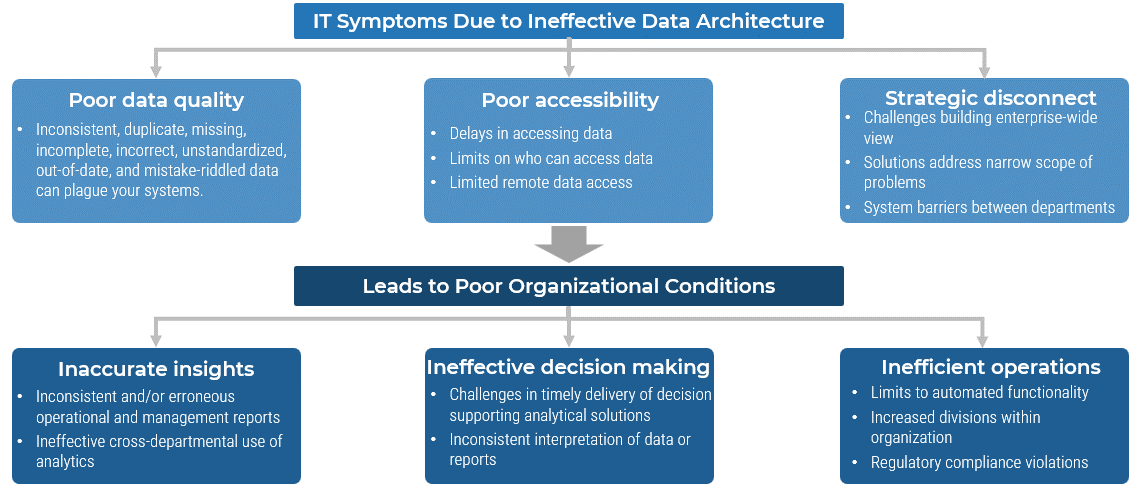
You need a solution that will prevent the pains.
Despite investments in data initiatives, organizations are carrying high levels of data debt
Data debt is "the accumulated cost that is associated with the sub-optimal governance of data assets in an enterprise, like technical debt" (Experian, 2020).
Data debt is the problem for 78% of organizations.
Think of all the time your organization spends on non-value-add activities such as cleaning and massaging data, discussing and disagreeing on the proper definition of business data terms, etc.
Data debt is the cost of fixing things instead of gathering value when your data architecture is not efficient.
|
40% of organizations say individuals within the business do not trust data insights. |
66% of organizations say a backlog of data debt is impacting new data management initiatives. |
33% of organizations are not able to get value from a new system or technology investment. |
30% of organizations are unable to become data-driven. |
Data architecture is not a standalone concept: it fits into the more holistic design of enterprise architecture
Data architecture in alignment
- Data architecture cannot be designed to simply address the focus of data specialists or even the IT department.
- It must act as a key component in the all-encompassing enterprise architecture and reflect the strategy and design of the entire business.
- Data architecture collaborates with application architecture in the delivery of effective information systems and informs technology architecture on data related infrastructure requirements/considerations.
- Please refer to the following blueprints for the full picture of enterprise architecture:

Adapted from TOGAF
Refer to Phase C of TOGAF and Bizbok for references to the components of business architecture that are used in data architecture.
Executive Brief Case Study
INDUSTRY: Financial
SOURCE: Info-Tech Consulting
Monetary authority
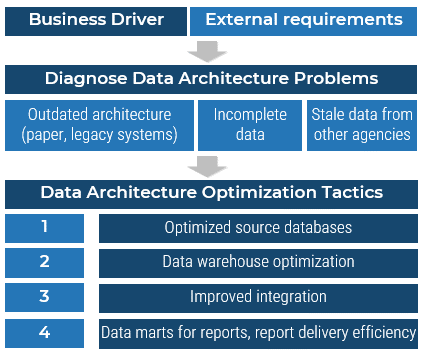
The monetary authority is responsible for monitoring the financial situation of a country that takes in revenue from foreign incorporation. Due to increased pressure from international regulatory bodies, the monetary authority became responsible for generating multiple different types of beneficial ownership reports based on corporation ownership data within 24 hours of a request.
A stale and inefficient data architecture prevented the monetary authority from fulfilling external regulatory requirements.
Normally, the process to generate and provide beneficial ownership reports took a week or more. This was due to multiple points of stale data architecture, including a dependence on outdated legacy systems and a broken process for gathering the required data from a mix of paper and electronic sources.
Results
Info-Tech helped the monetary authority identify the business need that resulted from regulatory pressures, the challenges that needed to be overcome, and actionable tactics for addressing the needs.
As you go through this blueprint, you will find additional case studies that elaborate on how Info-Tech helped this monetary authority.
Info-Tech's methodology was followed to optimize the areas of data architecture that address the business driver.
Build a Data Architecture Roadmap Project Overview
|
1. Prioritize Your Data Architecture With Business-Driven Tactics |
2. Personalize Your Tactics to Optimize Your Data Architecture |
3. Create Your Tactical Data Architecture Roadmap |
|
|---|---|---|---|
|
Best-Practice Toolkit |
1.1 Identify your business driver for optimizing data architecture 1.2 Determine actionable tactics to optimize data architecture |
2.1 Measure your data architecture capabilities 2.2 Set a target for data architecture capabilities 2.3 Identify the tactics that apply to your organization |
3.1 Personalize your data architecture roadmap 3.2 Manage your data architecture decisions and the resulting changes |
|
Guided Implementations |
Call 1 Call 2 Call 3 |
Call 4 Call 5 Call 6 |
Call 7 Call 8 |
|
Phase Outcomes |
Determine where you need to focus your efforts as a data architect (or equivalent). Optimize the holistic data architecture environment based on the drivers of the business. |
Understand the essential capabilities that your organization needs from its data architecture to develop a tactical plan for optimizing data architecture across its people, processes, and technology. |
Build a personalized roadmap and plan for optimizing data architecture in your organization. Ease the change management process while carrying out this roadmap. |
Insight summary
Overarching insight
Data architecture is a cornerstone of significant business transformation (such as digital transformation, mergers and acquisitions, and emergence of new business models and innovations). Lubricate your business transformation with sound data architecture.
Insight 1
Data architecture is not just about models. Viewing data architecture as just technical data modeling can lead to a data environment that does not aptly serve or support the business. Identify the priorities of your business and adapt your data architecture to those needs.
Insight 2
Changes to data architecture are typically driven by four common business driver patterns. Use these as a shortcut to understand how to evolve your data architecture.
Insight 3
Data is used differently across the layers of an organization's data architecture. Therefore, the capabilities needed to optimize the use of data change with it. Architecting and managing data from source to warehousing to presentation requires different tactics for optimal use.
Tactical insight
Focus on early alignment. Assessing capabilities within specific job functions can result in disagreement or debate, especially between business and IT people. Objectively facilitate any debate and only finalize capability assessments when there is full alignment. Remind everyone that data architecture should ultimately serve business needs wherever possible.
Tactical insight
Optimizing data architecture requires a tactical approach, not a passive one. The demanding task of optimization requires the ability to heavily prioritize. After you have identified why, determine how using our prebuilt roadmap to address the four common drivers.
Blueprint deliverables
Each step of this blueprint is accompanied by supporting deliverables to help you accomplish your goals:
Key deliverable:
Data Architecture Tactical Roadmap Tool
This Data Architecture Tactical Roadmap Tool will help you analyze your organization's data architecture capabilities and the gaps between the organization's current and future states.
Data Architecture Driver Pattern Identification Tool

Data Architecture Optimization Template

Data Architecture Trends Presentation

Data Architecture Decision Template
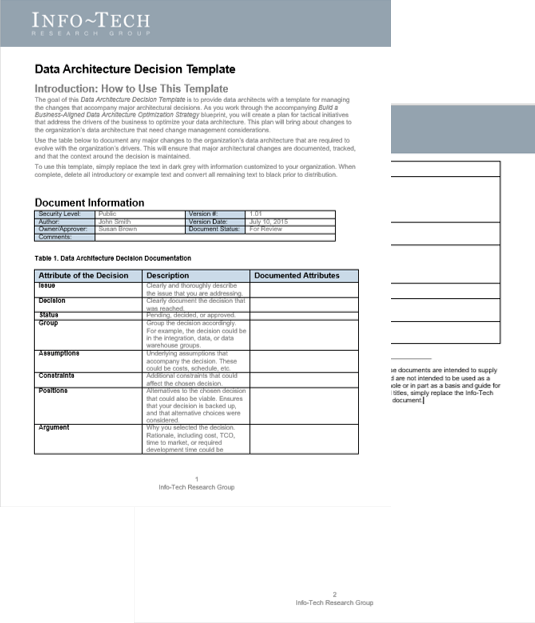
Info-Tech offers various levels of support to best suit your needs
DIY Toolkit
“Our team has already made this critical project a priority, and we have the time and capability, but some guidance along the way would be helpful.”
Guided Implementation
“Our team knows that we need to fix a process, but we need assistance to determine where to focus. Some check-ins along the way would help keep us on track.”
Workshop
“We need to hit the ground running and get this project kicked off immediately. Our team has the ability to take this over once we get a framework and strategy in place.”
Consulting
“Our team does not have the time or the knowledge to take this project on. We need assistance through the entirety of this project.”
Diagnostics and consistent frameworks used throughout all four options
Guided Implementation
What does a typical GI on this topic look like?
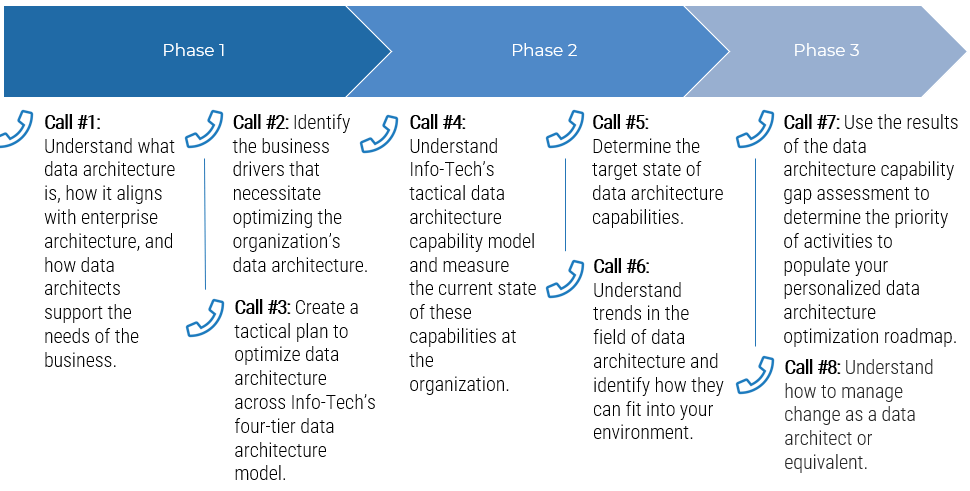
A Guided Implementation (GI) is a series of calls with an Info-Tech analyst to help implement our best practices in your organization.
A typical GI is 8 to 12 calls over the course of 4 to 6 months.
This content is exclusive to members.
Sign up to continue reading the full blueprint, or sign in if you already have an account.
Our systems detected an issue with your IP. If you think this is an error please submit your concerns via our contact form.